Every year, the Agency for Health Care Administration (AHCA) updates the Florida Medicaid program’s fee schedule, which outlines what the state will pay for healthcare services provided to patients enrolled in Florida Medicaid. This includes licensed midwives who provide a wide variety of services for their obstetric patients.
The Florida Medicaid’s 2026 Midwife Fee Schedule is a statewide fee schedule that guides what constitutes a reasonable maximum charge for billing to Florida Medicaid. The maximum payable services include:
- Prenatal care
- Labor management
- Vaginal delivery
- Postpartum care
- Newborn services
Licensed midwife billing has a great deal to do with:
- correctly selecting CPT/HCPCS codes
- using modifiers correctly (i.e., TH and TG)
- accurately documenting every clinical service provided
- properly reporting where services were performed (inpatient, outpatient, at home, etc.)
Here is an example of how choosing the right code can affect your reimbursement:
- a routine Prenatal visit billed using HCPCS code H1000 = $40.00
- same visit but billed with HCPCS code H1001 TG = $108.00
Medicaid Eligibility Requirements for Licensed Midwife Services
The FL Medicaid midwife fee schedule applies to all Medicaid patients who are being provided with obstetrical care (maternity), and that includes:
- Women who are pregnant and/or delivering and in need of prenatal and/or delivery care
- Mothers experiencing high-risk pregnancies requiring additional or enhanced monitoring
- Newborns that require either immediate postnatal care or follow-up after birth
Medicaid serves a significant number of mothers in Florida. Therefore, it is necessary for providers to accurately bill under this fee schedule to maintain compliance and strengthen revenue cycles.
Complete Licensed Midwife Fee Schedule (Effective Jan 1, 2026)
| Procedure | Modifier | Service Description | FS (Practitioner) | Facility |
| 59410 | — | Vaginal delivery (global maternity care) | $704.00 | — |
| 59410 | TH | Vaginal delivery with labor management services | $792.00 | — |
| 59430 | — | Postpartum care (global service) | $35.20 | $36.78 |
| 81025 | — | Urine pregnancy test | $5.06 | — |
| 99211 | — | Minimal E/M service (labor monitoring) | $14.58 | $4.60 |
| 99211 | TH | Labor management E/M (low complexity) | $14.58 | $4.60 |
| 99212 | — | Low-level E/M service | $21.65 | $14.79 |
| 99212 | TH | Labor management E/M (low complexity) | $21.65 | $14.79 |
| 99213 | — | Moderate complexity E/M service | $26.38 | $25.06 |
| 99213 | TH | Labor management E/M (moderate) | $26.38 | $25.06 |
| 99214 | — | Detailed E/M service | $41.10 | $39.05 |
| 99214 | TH | Labor management E/M (detailed) | $41.10 | $39.05 |
| 99215 | — | High-complexity E/M service | $79.54 | $75.13 |
| 99215 | TH | Labor management E/M (high complexity) | $79.54 | $75.13 |
| 99347 | TH | Home visit (minimal complexity) | $27.58 | — |
| 99348 | TH | Home visit (low complexity) | $47.16 | — |
| 99349 | TH | Home visit (moderate complexity) | $79.13 | — |
| 99350 | TH | Home visit (high complexity) | $115.50 | — |
| 99406 | — | Smoking cessation counseling (≤10 min) | $9.19 | $6.39 |
| 99407 | — | Smoking cessation counseling (>10 min) | $17.38 | $13.18 |
| 99460 | — | Initial newborn care | $48.35 | — |
| 99461 | — | Newborn evaluation | $56.15 | $31.82 |
| 99463 | — | Newborn care in a facility | $56.75 | — |
| H1000 | — | Routine prenatal visit | $40.00 | — |
| H1001 | — | Prenatal visit with Healthy Start screening | $88.00 | — |
| H1001 | TG | First-trimester prenatal screening visit | $108.00 | — |
| J0290 | — | Ampicillin (injection) | — | — |
| J0295 | — | Antibiotic combination therapy | — | — |
| J1364 | — | Iron infusion/injection therapy | — | — |
| J2210 | — | Oxytocin injection (labor induction/augmentation) | — | — |
| J2590 | — | Uterotonic agent | — | — |
| J2790 | — | Rho(D) immune globulin | — | — |
| J3430 | — | Vitamin K injection | — | — |
| J7050 | — | Normal saline IV infusion | — | — |
| J7070 | — | Dextrose IV solution | — | — |
| J7120 | — | Lactated Ringer’s IV solution | — | — |
| S8415 | — | Maternity support garment | $190.25 | — |
1). Delivery Services
Delivery services represent the global maternity care episode, including labor, vaginal delivery, and immediate postpartum recovery. This is the highest-paying category in Medicaid midwife medical billing in Florida.
| CPT Code | Description | Modifier | Reimbursement |
| 59410 | Vaginal delivery (global package) | — | $704.00 |
| 59410 | Vaginal delivery with labor management | TH | $792.00 |
Reimbursement Analysis
- Basic reimbursement for Florida Medicaid vaginal delivery is $704.00
- Adding modifier TH increases the reimbursement for a delivery by $88.00, approximately a 12.5% increase.
- The TH modifier indicates that active labor management was involved during the delivery or that the level of care provided escalated.
- Billing for deliveries will be the main source of revenue for midwives providing maternity services in Florida.
2). Prenatal Care Services
Routine monitoring for pregnant women (prenatal care) and scheduled visits that screen for various factors (structured prenatal screening visits) are collectively known as prenatal services. The cost of prenatal care climbs quickly once you factor in repeat visits, imaging, bloodwork, and the added care that comes with complications. These are also the basis of continuous maternity care billing.
| CPT Code | Description | Modifier | Reimbursement |
| H1000 | Routine prenatal visit | — | $40.00 |
| H1001 | Prenatal visit with Healthy Start screening | — | $88.00 |
| H1001 | First trimester screening visit | TG | $108.00 |
Reimbursement Analysis
When a healthy screening is done in the first trimester, use the TG Modifier.
Important Comparison:
- H1000 → H1001 = $48 Increase
- H1001 → H1001 TG= +$20
- Total for H1000 → H1001 TG= +$68.
Thus, prenatal coding becomes time and document-dependent. It is no longer simply about delivering clinical services.
3). Labor Management and E/M Services
The payment structure for Florida Medicaid’s E/M codes 99211-99215 is a progressive, or “step,” payment system. The difference in payments between these two codes results from higher payments per level of E/M service, which Florida Medicaid reimburses at progressively higher rates. This can be based on the number of allowable levels for each service.
| CPT Code | Description | Reimbursement |
| 99211 | Minimal E/M | $14.58 |
| 99212 | Low complexity | $21.65 |
| 99213 | Moderate complexity | $26.38 |
| 99214 | Detailed visit | $41.10 |
| 99215 | High complexity | $79.54 |
Reimbursement Analysis
- Lowest Codes (99211 – 99212): The lowest payment will be paid out for the least expensive services, which range from ($14.58–$21.65).
- Middle-Level Codes (99213 – 99214): Moderate increases in payment for middle-level services, which are ($26.38–$41.10).
- Highest Code (99215): The highest payment within its class is $79.54.
These reflect the increase in payment schedule used by Florida Medicaid in its Evaluation & Management (E/M) coding system. In other words, Medicaid pays more when the visit demands more from the provider, whether that’s extra time, harder decisions, or both.
4). Home Visit Services
The fee schedule for home visits has a stepwise increase in the reimbursement amount by complexity level, from 99347 to 99350. Also, each subsequent home visit code level has a higher value than its preceding level under Florida Medicaid.
| CPT Code | Description | Reimbursement |
| 99347 | Minimal home visit | $27.58 |
| 99348 | Low complexity | $47.16 |
| 99349 | Moderate complexity | $79.13 |
| 99350 | High complexity | $115.50 |
Reimbursement Analysis
- The difference between 99347 and 99350 is $87.92 in added reimbursement, representing the total reimbursement available for the maximum versus the minimum home visit.
- The difference between 99348 and 99350 is $68.34 in added reimbursement, or the additional money paid out when you move from a lower-complexity visit to a higher-complexity visit.
5). Preventive Services
Preventive services for maternity care focus on reducing risk factors for patients through routine, easy-to-perform screening tests and brief education or counseling. These are fundamentally different from more expensive services with variable reimbursement structures, which will have increasing payments depending on the time and/or effort required by the provider.
| CPT Code | Description | Reimbursement |
| 99406 | Smoking cessation (≤10 min) | $9.19 |
| 99407 | Smoking cessation (>10 min) | $17.38 |
| 81025 | Pregnancy test | $5.06 |
Reimbursement Analysis
- Lowest Code (81025): The pregnancy test has the lowest reimbursement, paying only $5.06. This is because the screening process is both fast and commonplace.
- Counseling Codes (99406 – 99407): Although payment for smoking cessation counseling is higher, it does not vary significantly with the time spent with the patient. However, the difference between short-term and long-term counseling remains somewhat significant, though not overly large. Smoking cessation can cost from $9.19 to $17.38.
- Highest Code (99407): At its highest level, preventive counseling can pay up to $17.38, yet this demonstrates that even the most costly preventive counseling is not intended to be a highly profitable service.
The increase in reimbursement from CPT codes 99406 to 99407 is $8.19. This indicates a limited increase in reimbursement based on the length of time spent with the patient; however, the increase is not significant.
6). Postpartum Care Services
Postpartum care addresses the physical and emotional needs of new mothers, providing for their overall health and well-being in the months immediately after childbirth. In most cases, these services will be billed as a package that includes all of the above services, or as individual office visits if they occur outside the bundle timeframe. The method of medical billing and reimbursing for postpartum care varies significantly from other medical services, which may be paid based on steps taken, supplies provided, etc.
| CPT Code | Description | Reimbursement |
| 59430 | Postpartum care | $35.20–36.78 |
| 99461 | Newborn evaluation | $56.15 |
| 99463 | Newborn facility care | $56.75 |
Reimbursement Analysis
- Lowest Code (99212 – $21.65): A simple postpartum visit with minimal complexity receives the least reimbursement, at $21.65. Most of the time, these visits are short, routine checkups with no major concerns.
- Middle-Level Codes (99213–99214): Postpartum visits are paid at increasing rates as the complexity increases. Reimbursement ranges from $26.38 to $41.10, depending on factors such as patient concerns (pain, complications) and additional evaluations, such as mental health screening.
- Flat Bundle Rate for Postpartum Care (59430): If postpartum care is billed separately (outside the global maternity package), it is reimbursed at a higher flat rate of $73.25. This reflects payment for the overall postpartum care rather than individual visits.
7). Injectable Medications (J Codes)
Injectable medications, often billed under J codes, are commonly used during labor and postpartum care for infection control, pain management, and stabilization. Unlike E/M services, these codes generally follow a supply-based reimbursement structure, which means payment depends on the medication itself (type, dosage, and units used) rather than time or complexity of care.
8). S8415 – IV Solution (Electrolyte)
The majority of IV solution codes pay $1 to $20; however, S8415 may represent a higher cost or a more complete treatment for the patient.
Reimbursement Analysis
Compared with other codes related to fluids and injections, the $190.25 reimbursement is among the highest. This likely means a larger amount of the solution is used. It may also be a more specialized electrolyte solution.
Simply, it is not a basic IV. It involves either higher volume or a more complex solution, which leads to higher reimbursement.
Compliance Guidelines for Licensed Midwife
To avoid denied claims, licensed midwives need to understand how Florida Medicaid billing works. That means knowing how to document visits, pick the right codes, and use modifiers so Medicaid approves the claim and pays them under the current year’s fee schedule.
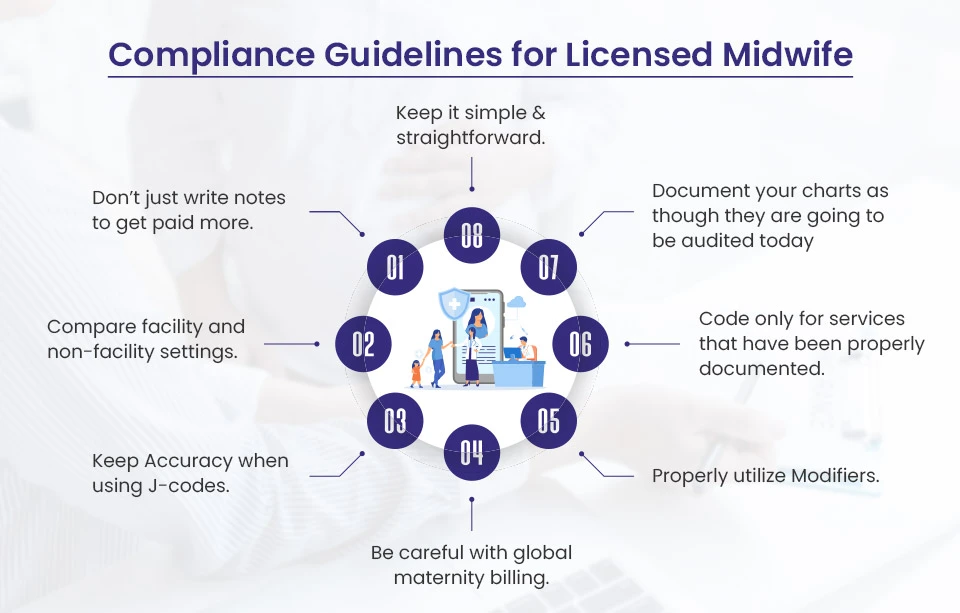
Document your charts as though they are going to be audited today.
Create chart entries as if anyone reviewing them could immediately determine why a specific medical procedure was performed. Even if the codes used are accurate, your entry will likely be rejected if the auditor cannot determine whether the treatment was medically required.
Code only for services that have been properly documented.
Do not code all services that you perform. Only those for which there is adequate documentation to demonstrate the necessity of each service. Documentation includes assessment, decision-making, and clinical rationale. If these components of your documentation do not exist, you will not receive reimbursement for these services. Consider your documentation a legal source rather than simply a report of treatment.
Properly utilize modifiers.
Modifiers such as TH and TG are not intended to generate additional revenue. Rather, Modifiers describe the reason why a service differs from the original service code. Any misuse of a modifier may result in rejection of your claim.
Be careful with global maternity billing.
As many errors occur in the global maternity package, be mindful of:
- Billing multiple visits that are included in the package.
- Incorrectly splitting services into separate bills.
Before submitting a claim for separate services, confirm whether:
Has the service already been included in the global package?
If yes, submission of another claim may result in rejection of one or more claims.
Keep accuracy when using J-codes.
J-code billing has proven to be a high-risk area. It is crucial to remember:
When using J-code billing, you are claiming for the amount administered, not just the Medication itself.
Several common errors occur when using J-codes, including:
- Using incorrect units
- Missing NDC number
- Assuming standardized rates
- Duplicate charges
Use the same level of accuracy expected when billing a pharmacy.
Compare facility and non-facility settings.
Reimbursement may vary depending on the setting in which services were delivered. Errors may occur when:
- An improper “place of service” is entered
- Facility-based payment rules are misapplied
- Managed care payment rules are ignored
These issues are often difficult to detect.
Don’t just write notes to get paid more.
Write what needs to be written to bill correctly and accurately. Do not write extensive documentation unrelated to billing.
Auditors may view excessive documentation or additional documentation that does not add to the medical record as follows:
- To make a case appear more complicated than it really was.
- Documenting the same information multiple times.
- Identifying varying degrees of patient risk through documentation.
Keep it simple & straightforward.
Claims that are uncomplicated, accurate, and consistent pose lower audit risk. Good documentation is:
- Clear
- Complete
- Straightforward
- Defensible
Overcomplicating your documentation increases audit risk.
FAQ’S
What is the Florida Medicaid Licensed Midwife Fee Schedule for 2026?
Florida Medicaid’s Licensed Midwife Fee Schedule for 2026 is the Official Reimbursement Structure effective as of January 1, 2026. The fee schedule outlines how Licensed Midwives will be reimbursed for their services, including prenatal care, delivery, postpartum care, and other related procedures under Medicaid.
How much does Florida Medicaid pay to Licensed Midwives in 2026?
According to the Florida Medicaid Licensed Midwife Reimbursement Rates for 2026:
For Florida Medicaid prenatal visit reimbursement H1001: $88 ,H1001 TG: $108 & H1000: $40
Vaginal Delivery:
- Standard: $704 (59410)
- With TH Modifier: $792 (59410 TH)
E/M Services:
- Office Visit Codes: $14 – $79 (99211–99215)
- Home Visits: Up to $115 (99350)
Reimbursement can vary based on modifiers and the location of service.
What is the difference between H1000 and H1001 in Florida Medicaid?
- H1000 = Basic Prenatal Visit ($40)
- H1001 = Prenatal Visit w/Risk Screening ($88)
- H1001 TG = First Trimester Screening ($108)
Due to the addition of Risk Screening services, the reimbursement for a prenatal visit (H1001) in Florida Medicaid exceeds that for a basic prenatal visit (H1000).
What does the TG modifier mean in Florida Medicaid midwifery Billing?
The TG modifier is added to an H1001 claim when Healthy Start Prenatal Risk Screening has been completed during the first trimester. Documentation is required to support the use of this modifier.
When applied to H1001, it increases reimbursement from $88 to $108.
What is the TH modifier in midwifery billing?
The TH modifier is used for:
- Labor management services
- When delivery occurs outside of a patient’s home or birth center
- Patient transfer to higher-level care
This modifier is important to ensure proper reimbursement for Florida Medicaid claims submitted by licensed midwives for vaginal deliveries.
What are the most common midwifery billing errors in Florida Medicaid?
Most denied midwife claims in Florida Medicaid trace back to a handful of recurring errors:
- Incorrectly submitting H1000 as opposed to using H1001 TG
- Failure to submit TH or TG Modifiers
- Selection of incorrect E/M Level
- Incorrect facility vs non-facility
Most of these errors result in denial or lower payments.
How do I bill Medicaid correctly for my midwifery services?
To adhere to the Florida Medicaid guidelines for Midwife Billing (2026):
- Use Proper CPT / HCPCS Codes
- Apply Modifiers (TH & TG) Accurately
- Document Medical Necessity
- Verify Fee Schedule vs Managed Care Rules
What is the 59410 reimbursement for midwives under FL Medicaid?
Florida Medicaid pays the following rates for 59410 to be performed by a midwife:
- $704 standard
- $792 with TH Modifier
These include labor, delivery, and the immediate postpartum period.
Why does Florida Medicaid deny midwifery claims?
Florida Medicaid denies midwifery claims most often because of:
- Missing modifiers
- Insufficient documentation
- Incorrect coding
- Exceeded authorization limits