Although CPT code 99214 is one of the most frequently used codes for outpatient E and M services in America, it’s also one of the most misused.
When does a visit really meet the definition of moderate complexity? How should you document it? What changes when the visit is done by telehealth? Those tiny questions turn into small doubts that result in undercoding, overcoding, and denials.
This guide breaks it all down so you can code CPT code 99214, understand the time and MDM requirements, apply modifiers properly, and ensure each and every claim represents the work you really do.
What is CPT Code 99214 in Medical Coding?
CPT 99214 is an evaluation and management (E/M) service code used for an established patient in an office or outpatient setting. In simple terms, this is an office visit where the physician is either managing at least two problems that have some moderate degree of complexity, or the total amount of time spent by the physician on that particular patient on that particular date was between 30 to 39 minutes.
You can select a level of service for 99214 based upon the two criterias described below:
1). Medical Decision-Making (MDM)
The patient’s condition and the physician’s management are moderately complex, which means that the physician is:
- dealing with at least two conditions,
- reviewing data,
- adjusting the treatment plan,
- or managing risks that involve a greater degree of clinical judgment.
2). Time
The physician documented that he/she spent a total of 30 to 39 minutes on that particular patient’s care on that date, including time spent reviewing records; evaluating the patient; documenting; ordering tests; and coordinating care—all on the same date.
The American Medical Association (AMA) and the American College of Surgeons (ACS) describe CPT 99214 as a key code to capture those visits that require more thinking, more data review, and more management than would be expected for a typical follow-up visit.
As you might expect, 99214 is positioned between the routine follow-up visits represented by code 99213 and the very-high-complexity visits represented by code 99215. This reflects the level of work and the associated risks involved in providing care to the patient during that encounter.
Typical Characteristics of Patients Who Receive a 99214 Evaluation and Management Visit
When we say “a visit qualifies for 99214,” we mean that the patient’s condition or the physician’s clinical work has reached a moderate level of complexity. For example:

1). Multiple Chronic Illnesses
When a patient has two or more chronic illnesses that require ongoing assessment/evaluation, adjustments to their medications, or monitoring, they will likely require more time, more data review, and more intensive management than a patient who does not have a number of chronic illnesses. So here, the use of 99214 would be suitable.
Examples include:
- Diabetes + Hypertension
- COPD + Heart Failure
- Chronic Kidney Disease (CKD) + Diabetes with Poor Control
2). New Medication Adjustments That Require Monitoring
Anytime a physician changes a patient’s medication(s), adds new prescription(s), or begins a course of therapy that necessitates monitoring, there is an increase in clinical risk.
Examples include:
- Beginning an Antidepressant or Mood Stabilizer
- Making Adjustments to an Insulin Regimen
- Changing Blood Pressure Medications
- Begins Steroid Taper
Even though the patient’s condition(s) may appear stable, the added clinical risk from medication management often promotes the visit to the usage of 99214 CPT Code.
3). New Symptoms With A Serious Case
Some patients may present with a new symptom that has no identifiable diagnosis yet but will require careful consideration to determine what diagnostic possibilities exist and how to proceed.
Examples:
- Chest Pain
- Neurological Symptoms (Numbness, Dizziness, Weakness)
- Abdominal Pain with Red-Flag Features
- Headache that Requires Imaging or Labs
In each of these cases, the physician will evaluate potential differential diagnoses; order laboratory and/or radiologic studies; consider patient risk factors (all of which align with moderate levels of MDM).
MDM vs Time: Two Ways to Get to CPT Code 99214
In 2021, the American Medical Association (AMA) simplified the process for selecting CPT code 99214 by giving providers a couple of ways to choose this code:
- MDM (the amount of medical decision making that took place during the visit),
- The total number of minutes providers spent with the patient during the visit (total time).

Although the AMA states that both history and examination can be used for clinical purposes; neither will determine the level of code selected for the visit. Therefore, the only other thing left to do is to decide:
“What happened at this visit — moderate complexity or 30-39 minutes spent taking care of this patient?”
If the answer is yes and you have documented appropriately, then 99214 is usually the best choice.
What Counts as “Total Time” for CPT Code 99214?
Time selection has also become easier to understand with the new regulations. Providers are allowed to include almost all of the time that they personally spent on behalf of each patient on the same calendar day when determining their total time. This does not only include the time spent talking with the patient but all activities related to the encounter, such as:
- Reviewing all available chart, imaging, and lab information prior to entering the exam room
- Obtaining history and performing an examination of the patient
- Talking with the patient about their diagnosis or treatment options
- Writing orders for medications and/or testing
- Coordinating the patient’s care with specialists
- After the visit, documenting what occurred during the visit
If the provider has spent a total of 30 to 39 minutes on the above tasks, then the provider can use time as the basis for their selection of CPT code 99214 regardless of the complexity of the MDM involved in the visit.
The provider can indicate in the documentation that they have included all the time spent on behalf of the patient in the visit, such as:
“I spent a total of 32 minutes today with the patient. This included a pre-visit review, the evaluation and counseling of the patient, writing orders, and the documentation of the visit.”
This provides clarity as to why the time supports the level of service.
Choosing Moderate MDM for CPT Code 99214
When providers choose to base their selection of CPT code 99214 based upon the MDM (as opposed to time), they need to determine if the MDM in the visit reflects moderate complexity.
Moderate MDM in most cases is demonstrated through a comprehensive view of the entire visit — the types of problems being managed, the type of data reviewed, and the risks being addressed. In general, when all three of these elements demonstrate more than minimal effort, the visit generally demonstrates moderate MDM and therefore would qualify for CPT code 99214.
Here is how moderate MDM usually works in daily clinical practice:
➜ Types of Problems Managed: Conditions Requiring More Than Minimal Effort (99214-Level Problems)
Most often, moderate complexity begins with the types of problems being managed. These may include:
- Monitoring two or more chronic conditions simultaneously,
- Worsening or unstable chronic condition,
- New symptoms which could possibly indicate a more serious issue and would require some form of investigation.
As a result, there is more professional judgment needed, and this increased cognitive activity often supports 99214.
➜ Types of Data Reviewed: Compiling Relevant Data (99214-Level Data)
Additionally, moderate MDM also includes reviewing data that significantly influences the providers’ decisions. Examples include:
- Reviewing trends in lab values;
- Reviewing hospital discharge summaries or specialist notes;
- Reviewing imaging studies and interpreting the results of those studies;
- Ordering multiple lab or diagnostic tests;
If the provider has to review and synthesize data from multiple sources to make a decision, that indicates moderate complexity.
➜ Risk of Management: Decisions Carrying Notable Risks (99214-Level Risk)
Finally, the risk of the management strategy should also be evaluated. Moderate risk is generally defined as:
- Initiating or changing prescription medications;
- Managing conditions that could potentially lead to harm if the dose is incorrect or follow-up is inadequate;
- Ordering tests that require follow-up;
- Escalation of care or referral to a specialist.
Because medication management is often enough to demonstrate moderate risk, many prescription changes automatically support the selection of CPT code 99214.
Common Clinical Scenarios that Justify the Usage of 99214 CPT Code
Sometimes it’s easier to understand 99214 by looking at real-world visits instead of rules on a page. Below are practical scenarios that most providers see every week. For each one, we’ll break down why it supports 99214 in terms of:
- Problems
- Data
- Risk / Management
Scenario #1: Type 2 Diabetes Mellitus + Hypertension + Stage 3 Chronic Kidney Disease Follow-Up
At 58 years old, the patient comes in for follow-up, has type 2 diabetes mellitus, hypertension and has stage 3 chronic kidney disease.
During the visit, you:
- Review the most recent laboratory values (A1c, Basic Metabolic Panel, eGFR, Lipid Profile).
- Adjust the insulin dosage.
- Prescribe or titrate an Angiotensin-Converting Enzyme Inhibitor for kidney protection.
- Review a recent nephrology note.
- Counsel the patient as to their diet, home glucose monitoring, and home blood pressure monitoring.

Why this supports 99214 (Moderate Medical Decision Making – MDM)?
Problems: The patient has three chronic diseases which could progress and therefore represents moderately complex problems.
Data: You reviewed the patient’s lab values and an outside specialist’s note, which represents moderately complex data review.
Risk: This case represents moderately complex risk because you will be managing the patient with prescribed medications (Insulin and ACE inhibitor) and the risk to the patient if these are not controlled appropriately.
Thus, the combination of problems, data and risk represent the typical 99214 case.
Scenario #2: New Chest Pain or Neurologic Symptoms Without Admitting to Hospital
The patient is a 52 year old male who presents with new chest tightness when he exerts himself, or has intermittent neurologic symptoms such as unilateral numbness, or brief weakness. However, you feel that he can safely remain as an outpatient and you want to address your concerns.
During the visit, you:
- Take a focused yet detailed history regarding the onset of the symptoms, the nature of the symptoms, the associated symptoms, and the presence of any red flag symptoms.
- Review any past ECGs or notes from the physician if available.
- Perform any testing (ECG, Troponin, Stress Test, Brain Imaging, etc.) that you determine is necessary based on the symptoms.
- Provide education to the patient on the warning signs that indicate the need for immediate medical attention and provide specific guidelines for returning to the hospital for further evaluation.
- Schedule a follow-up appointment or refer the patient to a specialist (Cardiologist or Neurologist).

Why this supports 99214?
Problems: The patient presents with a new problem of unknown etiology (Possible Cardiac or Neurologic Issue) that could potentially result in a poor outcome → Moderately Complex Problems.
Data: You will be ordering and potentially reviewing several tests → Moderate Data.
Risk: There may be serious underlying disease and you are making decisions that affect the patient’s safety and follow-up → Moderate Risk.
Regardless of whether or not the patient was admitted to the hospital, the level of thought and planning that went into determining the course of the patient’s care typically support a 99214.
Scenario #3: Depression and Anxiety – Changing Medications & Monitoring
The 35-year-old patient returns for their depression and generalized anxiety. They have had partial improvement with the current SSRI but continue to experience symptoms and report side effects (e.g. sleep disturbance).
During the visit, you:
- Review the patient’s completed PHQ-9/GAD-7 or clinical symptom scores.
- Discuss how the patient is responding to the current medication(s) and any side effects the patient is experiencing.
- Change the medication(s) dosage or switch to a different antidepressant.
- Consider prescribing an adjunctive medication (e.g. low-dose benzodiazepine for short-term use, or another non-benzodiazepine medication).
- Discuss a referral to psychotherapy, a safety plan and the time frame for follow-up appointments.

Why this supports 99214?
Problems: The patient has two ongoing psychiatric diagnoses (Depression + Anxiety) that are being treated → Moderately Complex Problems.
Data: Review of prior scores, notes or previous medication(s) → Low–Moderate Data.
Risk: Ongoing management of psychiatric medications with side effects and the risk of worsening symptoms → Moderate Risk.
Medication management for psychiatric conditions with actual changes typically supports 99214.
Telehealth & CPT Code 99214 in 2025 (Modifier 95, POS Codes, Audio-Only, etc.)
You can bill CPT Code 99214 for telemedicine in 2025 if the visit meets the same criteria as an in person visit with a 99214 – either moderate medical decision making (MDM) or 30-39 minutes of total time – and if the payer allows coverage for 99214 via telemedicine. Most Medicare and Medicaid/Commercial Payers will cover 99214 through telemedicine. However, the rules for each payer are different.
For video telemedicine, most payers will want you to:
- Use modifier 95 to indicate that the telemedicine visit was performed using real-time audio-video technology (Example: 99214-95).
Use the appropriate Place of Service (POS):
- POS 10 if the patient is located in their home
- POS 02 if the patient is located elsewhere (Clinic/Facility etc.)
For telemedicine via audio only (telephone), there are stricter rules than video telemedicine for 99214. Several payers will not consider audio only to be equivalent to video telemedicine for 99214. While some payers will not allow telephone 99214 at all, other payers may require the use of modifier 93 on specific codes that have been approved for audio only.
Therefore, the best practice is to:
- Clearly document in your records whether the telemedicine visit was audio-video or audio only.
- Adhere to the payer’s specific rules regarding the use of modifiers (95 / 93 / GT / GQ) and POS (02 vs 10).
- Consult with your coding/billing department or medical billing company and maintain an updated list of payer rules related to telemedicine CPT code 99214. This will ensure that your initial telemedicine 99214 submissions are clean and paid.
Modifiers Most Often Used When Billing CPT Code 99214
Billing CPT code 99214 can be made easier by using some key modifiers that provide clarity around the circumstances of each visit to ensure proper processing of the claim by the payer. Below is a brief summary of the commonly used modifiers with 99214 CPT Code:
1). Modifier 25 with CPT Code 99214
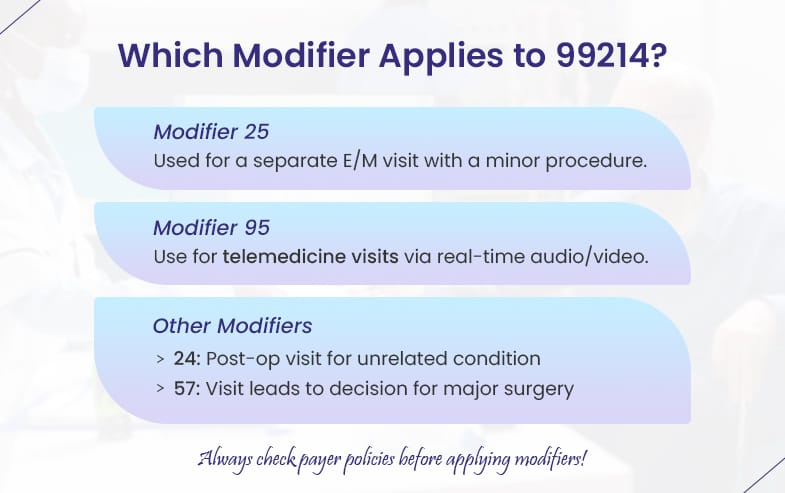
The most common modifier used in conjunction with 99214 is Modifier 25. You would use this modifier when you have performed a separately identifiable E/M visit on the same date of service as a minor procedure. In short, if you addressed a distinct issue or provided a complete 99214 level evaluation (beyond the routine pre- and post-procedure activity) of the patient, then you would bill 99214-25 along with the procedure code. The E/M work must be clearly separate from the minor procedure and medically necessary.
2). Modifier 95 with CPT Code 99214
You would use Modifier 95 when providing a 99214 visit via real time audio/video telemedicine. This modifier informs the payer that the service complied with telemedicine requirements and was provided via an approved platform. The clinical requirements remain the same – moderate MDM or 30-39 minutes – but the modifier indicates the service was provided virtually, versus face-to-face.
3). Other Modifiers
In addition, there are a few less commonly used modifiers which could be applicable in select scenarios. For instance, Modifier 24 is used when seeing a patient during a post-operative period for a condition unrelated to the surgery. Modifier 57 is used when a visit results in a decision to proceed with major surgery. While these modifiers are not typically used with 99214, and their usage is policy-specific, a review of each payer’s coverage policies would be recommended prior to application.
Most Common Issues Involving 99214 Coding and Billing (And How To Overcome Them)
Here are the most common ways that healthcare providers may have unintentionally mis-coded 99214. And how you can create some simple habits in order to keep your documentation accurate, compliant, and ready for an audit:
❌ Undercoding Due to Fear of Audits
The first of the most common mistakes related to 99214 coding is likely “fear-based” undercoding. Most providers have experienced this at least once. Providers often select the 99213 regardless of whether the visit would meet the requirements for a 99214. It’s because they fear the audit part by the insurer. However, there is an important fact to remember regarding audits. 99214 is not high risk when the visit involved moderate medical decision making, or when it took between 30-39 minutes. It is merely accurate.
Instead of using 99213 as a default, try using a simple checklist at the end of the visit. Ask yourself: Did I manage more than one problem? Did I examine meaningful data? Did I make changes to medications? Was my total time greater than 30 minutes? If you answered “yes” to any of those questions, then a 99214 should be used. As you become more comfortable with this process, your confidence will grow and you will no longer leave money due to overcautious coding.
❌ Overcoding Without Documentation
In addition to the above scenario, we also see the exact opposite occur. Often times a provider will feel that the patient had a very long and/or complex visit; therefore, the desire to use a 99214 exists, however, the supporting documentation does not support such a claim. Remember, auditors do not care how busy you were. They care only what you wrote down.
One method of preventing this from occurring is to decide what you want to base your code on prior to coding. Do you want to base the code on medical decision making (MDM), or do you want to base it on time? Once you determine which one you want to base your code on, make sure you document your choices appropriately. A one-line time entry or a clear and concise assessment and plan area of documentation is sufficient in most cases. If you document the rationale behind your decisions, the code will then logically follow.
❌ Denial of Telehealth Claims
We also need to address Telehealth since telehealth is one of the most common reasons 99214 claims are denied. Although the clinical work may be correct, Telehealth denials are often caused by a missing modifier 95, incorrect place of service, or lack of knowledge of a payer’s rules.
To avoid having your telehealth-related 99214 claims denied, create a simple payer cheat sheet. Document the payers that require a modifier 95, the ones that allow a modifier 93, and the ones that require either POS 02 or POS 10. Additionally, document whether the telehealth visit was AV (audio-vide) or AO (audio-only).
❌ Lack of Connection Between Assessment and Plan
Lastly, we have another potential error. This one may be less obvious than some of the others, but is equally as important. There are times when the actual visit is 99214 level, but the actual note appears to be written at a 99213 level because the connection between the assessment and plan is unclear. Perhaps you reviewed lab results, changed medications, or ordered follow-up testing, but the note simply states, “Continue current treatment.” Thus, the complexity of the visit is hidden.
You can easily address this by linking each problem to a specific plan and explaining why you made the decision you did. One or two sentences is all you need to complete this task. When you demonstrate your thought process through your documentation, the complexity of the visit becomes apparent, and thus 99214 is fully supported.
FAQs
What is the time requirement for 99214?
Billing for 99214, is dependent upon the amount of time spent, which is 30-39 minutes total time from reviewing the records, seeing the patient, counseling the patient, ordering tests, documenting the patient’s care and coordinating the patient’s care on the date of the encounter.
Can nurse practitioners and PAs bill 99214?
Yes. Nurse Practitioners and Physician Assistants can bill 99214, if the payer permits billing for this code, and if the documentation meets the moderate medical decision making criteria, or the NP/PA spent 30-39 minutes of total time. Any restrictions by the payer regarding the supervising/collaborating physician must also be followed.
Can 99214 be used for telehealth visits?
Yes. Most of the major payers, including Medicare, permit billing for 99214 for telemedicine visits, provided the telehealth provider has met all requirements. This typically includes the use of modifier 95, and either POS 02 or POS 10, and there must be documentation to confirm that the visit was an audio/video visit.
Can I bill 99214 and a procedure on the same day?
Yes. In some circumstances, you may bill 99214 with a procedure on the same day. If the procedure and the E&M service are separate and distinct and the documentation demonstrates a separate and distinct medical necessity for both services, you may bill them together using modifier 25.
Does a 99214 visit always require a detailed history and exam?
No. According to the 2021 and later E&M rules, billing for 99214 will depend upon either the medical decision making or total time. While the history and physical examination must be medically appropriate and demonstrate medical necessity for the reasons for the visit, they do not have to be at the level of detail of a detailed history and exam.
How often can I bill 99214 for the same patient?
There is no CPT limit on frequency. You can bill 99214 as often as medically necessary. Payers may review patterns for potential overuse, so your documentation should clearly support why each visit meets moderate complexity or time requirements.