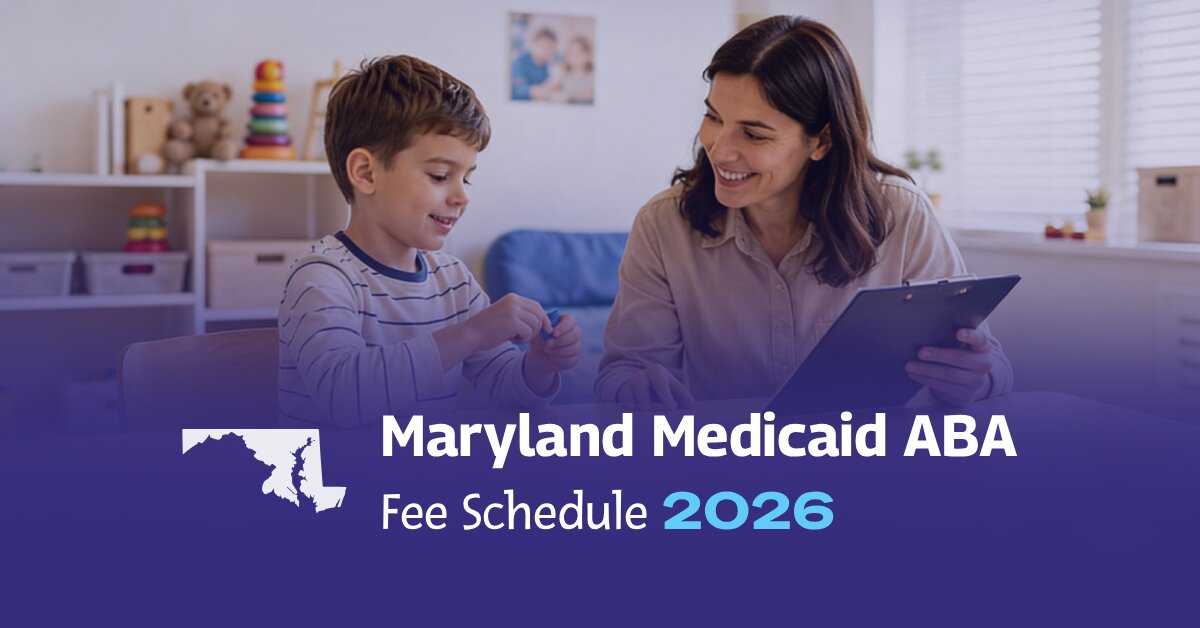
The Maryland Department of Health (MDH) has a new Applied Behavior Analysis (ABA) fee schedule. It took effect on February 1, 2026, along with new rules.
This update affects almost everyone in your practice. Clinic owners plan around it. BCBAs with large caseloads feel it. So do billing specialists who are tired of chasing denied claims.
The 2026 schedule sets daily unit limits, modifier rules, and authorization rules. You need to know all three. There is no room for guesswork.
➜ First, here is the foundation every claim rests on:
- Maryland Medicaid covers ABA only when it is medically necessary.
- The child must be under the age of 21. They must also have a confirmed Autism Spectrum Disorder (ASD) diagnosis from a qualified health care professional (QHCP).
- On top of that, the service must fall under the Early and Periodic Screening, Diagnostic, and Treatment (EPSDT) benefit.
- Maryland pays for ABA on a fee-for-service basis. The payer is its Behavioral Health Administrative Service Organization (BHASO), Carelon Behavioral Health (Carelon).
Carelon Authorization Requirement
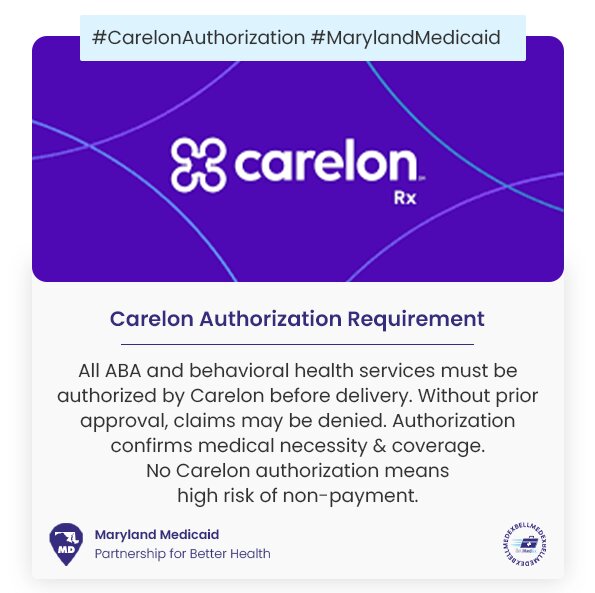
Before we get to the numbers, you need to know one major rule. It applies to all Maryland behavioral health providers.
Critical administrative information: As the BHASO, Carelon manages service authorizations for the Maryland Department of Health (MDH). So before you deliver or bill any ABA service, Carelon must review and approve it first.
What this means:
- No approval before the service usually means a denied claim.
- Approval confirms that the service is medically necessary and covered.
- To approve a service, Carelon usually wants treatment plans, assessments, and other documents.
- Each authorization lasts up to 180 days. You must reassess the client before it ends to keep services active.
No Carelon authorization means a high risk of nonpayment for the service.
Maryland Medicaid ABA Fee Schedule (Effective February 1, 2026)
Reimbursement is based on 15-minute units. Each rate depends on the provider’s credential. Each service also has a daily cap on billable units.
| CPT Code | Description | Provider | Rate | Time | Daily Max | Limitations |
| 97151 | Behavior Identification Assessment, including treatment planning | Psychologist / BCBA-D / BCBA | $38.34 | 15 min | 32 units | None |
| 97152 | Behavior Identification Supporting Assessment | BCaBA / RBT / BT | $19.17 | 15 min | 32 units | None |
| 0362T | Exposure Behavior Identification Supporting Assessment | 2 or more BCaBAs / RBTs / BTs with Psychologist / BCBA-D / BCBA on site | $52.28 | 15 min | 32 units | Psychologist / BCBA-D / BCBA must be on site, immediately available, and interruptible to provide assistance and direction |
| 97153 | Adaptive Behavior Treatment by Protocol | Psychologist / BCBA-D / BCBA: $24.41 BCaBA: $20.91 RBT / BT: $19.17 | Variable | 15 min | 32 units | None |
| 97154 | Group Adaptive Behavior Treatment by Protocol | Psychologist / BCBA-D / BCBA: $10.45 per participant BCaBA: $8.36 per participant RBT / BT: $6.96 per participant | Variable | 15 min | 16 units | Group limited to 2 to 8 participants |
| 97155 / 97155 (GT) | Adaptive Behavior Treatment by Protocol Modification / Direction | Psychologist / BCBA-D / BCBA | $38.34 | 15 min | 24 units | GT modifier signifies remote direction of a technician |
| 97156 | Family Adaptive Behavior Treatment Guidance, without the child present; may include care coordination | Psychologist / BCBA-D / BCBA: $20.91 BCaBA: $12.21 | Variable | 15 min | 16 units | None |
| 97156 (U2) | Family Adaptive Behavior Treatment Guidance, with the child present | Psychologist / BCBA-D / BCBA: $38.34 BCaBA: $20.91 | Variable | 15 min | 16 units | Use the U2 modifier |
| 97157 | Multiple-Family Group Adaptive Behavior Treatment Guidance | Psychologist / BCBA-D / BCBA | $12.91 per family | 15 min | 10 units | Group limited to 2 to 8 families |
| 97158 | Group Adaptive Behavior Treatment with Protocol Modification | Psychologist / BCBA-D / BCBA | $10.45 per participant | 15 min | 10 units | Group limited to 2 to 8 participants |
| 0373T | Exposure Adaptive Behavior Treatment with Protocol Modification | 2 or more BCaBAs / RBTs / BTs with Psychologist / BCBA-D / BCBA on site | $52.28 | 15 min | 24 units | Psychologist / BCBA-D / BCBA must be on site, immediately available, and interruptible to provide assistance and direction |
What Are the CPT Codes, Rates, and Limits in the Maryland ABA Fee Schedule?
The Maryland ABA fee schedule covers four things for each service. It sets the reimbursement rate, the billing unit, the daily limit, and any service limits.
To make it easier to follow, we group the services into billing categories. These cover assessments, direct treatment, family and caregiver education, supervision and protocol modification, group services, and high-intensity behavior services.
Each category lists the CPT codes and who can bill them. It also shows the rates, billing units, daily limits, and any special rules.
Assessment Codes
Before any therapy begins, the clinician must find the client’s starting point. This is the job of the assessment phase. It collects baseline data on how the client functions now. It also observes behavior in a live setting. The result is a formal treatment plan.
This phase holds the core codes your practice needs. They pay you for the clinical work that frames each child’s care.
➜ CPT 97151: Behavior Identification Assessment, Including Treatment Planning
Use this code for the full workup of a new client. A psychologist, BCBA-D, or BCBA evaluates the client, records behavior, interviews the family, and builds the formal behavior plan.
- Who can perform this service: Psychologist, BCBA-D, or BCBA.
- Payment rate: $38.34 per 15-minute unit.
- Daily unit limit: Up to 32 units (8 hours) per client, per day.
➜ CPT 97152: Behavior Identification Supporting Assessment
Some assessments need extra help. Use CPT 97152 for that support. It applies when a technician or other staff member helps the lead clinician. The helper might observe the client or collect data during the first assessment.
Important note: the technician or assistant cannot write the treatment plan. They only help collect data.
- Who can provide this support: BCaBA, RBT, or BT.
- Payment rate: $19.17 per 15-minute unit.
- Daily unit limit: Up to 32 units (8 hours) per client, per day.
➜ CPT 0362T: Exposure Behavior Identification Supporting Assessment
Use CPT 0362T for high-risk assessments. These are for children whose behavior could harm themselves or others. Think severe self-injury or violent aggression. The work needs at least two technicians or support staff at once. A licensed psychologist, BCBA-D, or BCBA must supervise them.
The team for this service includes:
- At least two BCaBAs, RBTs, or BTs to assist.
- A licensed psychologist, BCBA-D, or BCBA on site, ready to step in right away.
- Payment rate: $52.28 per 15-minute unit.
- Daily unit limit: Up to 32 units (8 hours) per client, per day.
- Special requirement: the supervisor must be on site and ready to step in if safety becomes a concern.
Direct Treatment Codes
Once the assessment is approved, the treatment plan goes into action. Now the work is hands-on. These codes cover your day-to-day therapy sessions. In them, therapists build new skills and reduce problem behaviors.
➜ CPT 97153: Adaptive Behavior Treatment by Protocol
This code is the standard one-on-one ABA session. The therapist follows the treatment plan set for the child.
Who can perform this, and what is the payment?
The rate depends on who delivers the service:
- Psychologist / BCBA-D / BCBA: $24.41 per 15-minute unit.
- BCaBA: $20.91 per 15-minute unit.
- RBT / BT: $19.17 per 15-minute unit.
- Daily unit limit: Up to 32 units (8 hours) per day.
➜ CPT 97154: Group Adaptive Behavior Treatment by Protocol
These are group sessions for 2 to 8 participants. Each one still works toward their own goals.
Who can perform this, and what is the payment?
Rates are paid per participant:
- Psychologist / BCBA-D / BCBA: $10.45 per participant, per 15-minute unit.
- BCaBA: $8.36 per participant, per 15-minute unit.
- RBT / BT: $6.96 per participant, per 15-minute unit.
- Daily unit limit: Up to 16 units (4 hours) per day.
Important note on groups: a group must have 2 to 8 participants. Stay in that range, or you risk denials and penalties.
Supervision and Modification Codes
These codes give supervisors three powers. They can watch active cases. They can check how well technicians follow the treatment plan. They can also adjust the plan in real time. Used well, these codes keep you compliant and improve outcomes.
➜ CPT 97155: Adaptive Behavior Treatment by Protocol Modification / Direction
Use CPT 97155 when a supervisor joins a session. In it, the supervisor can do several things. They can review how the plan is going. They can guide the technician in the moment. They can model techniques. They can also change the plan when the client needs it.
- Who can perform this service: Psychologist, BCBA-D, or BCBA.
- Payment rate: $38.34 per 15-minute unit.
- Daily unit limit: Up to 24 units (6 hours) per day.
Modifier: for live, in-person supervision, bill CPT 97155 on its own. For remote supervision, add the GT modifier (for example, 97155 GT). Remote means approved two-way audio-visual telehealth.
Family and Caregiver Education Codes
Caregivers run much of the ABA work outside of therapy sessions. So training them well is one of the biggest drivers of long-term success.
Maryland splits its family training codes by one factor: is the child in the room? When the child is present, you add the U2 modifier. That service then pays at a higher rate.
➜ CPT 97156: Family Adaptive Behavior Treatment Guidance (Without the Child Present)
Use CPT 97156 to train a parent, guardian, or caregiver without the child there. The provider teaches ABA strategies, reviews progress, and gives guidance.
Who can perform this service, and what is the payment?
- Psychologist / BCBA-D / BCBA: $20.91 per 15-minute unit.
- BCaBA: $12.21 per 15-minute unit.
- Daily unit limit: Up to 16 units (4 hours) per day.
- Modifier: you can deliver this by telehealth. It must be approved two-way, HIPAA-compliant audio-visual telehealth. In that case, add the GT modifier and use Place of Service 11, as Maryland Medicaid requires.
➜ CPT 97156 with U2 Modifier: Family Adaptive Behavior Treatment Guidance (With the Child Present)
Bill CPT 97156 with the U2 modifier when the child is present. Here you coach the parent in real time as they practice with the child. Guiding both at once is harder than guiding the parent alone. For that reason, Maryland pays this service at a higher rate.
- Psychologist / BCBA-D / BCBA: $38.34 per 15-minute unit.
- BCaBA: $20.91 per 15-minute unit.
- Daily unit limit: Up to 16 units (4 hours) per day.
Important rule: add the U2 modifier on the claim. Without it, you get paid at the lower, no-child rate.
➜ CPT 97157: Multiple-Family Group Adaptive Behavior Treatment Guidance
Use CPT 97157 to train several families at once. One provider works with several sets of parents, guardians, or caregivers together. The session covers ABA strategies, treatment goals, and behavior-management techniques.
- Who can perform this service: Psychologist, BCBA-D, or BCBA.
- Payment rate: $12.91 per family, per 15-minute unit.
- Daily unit limit: Up to 10 units (2.5 hours) per day.
Important rules:
- Each group is limited to 2 to 8 families.
- You can deliver this by approved two-way audio-visual telehealth with the GT modifier. First, though, add a completed Telehealth Readiness Checklist to the treatment plan. This applies any time you request telehealth for 97155, 97156, or 97157. Telehealth claims must also use the GT modifier with Place of Service 11.
- The service cannot be fully remote. Under Maryland rule PT 60-26, at least 25% of sessions must be face-to-face across the authorization period.
Advanced and Group Modification Codes
Sometimes a session takes an unusual turn. You might need to adapt a group’s plan on the spot. Or you might need to respond to a behavior that affects several participants at once.
Standard codes often do not fit these moments. The codes below do. They let you report complex clinical events and emergency responses in group settings.
➜ CPT 97158: Group Adaptive Behavior Treatment with Protocol Modification
Use this code when a clinician leads a group, such as a social skills or peer group. The clinician adjusts the plan or responds to needs in real time.
- Who can perform this service: Psychologist, BCBA-D, or BCBA.
- Payment rate: $10.45 per participant, per 15-minute unit.
- Daily unit limit: Up to 10 units (2.5 hours) per day.
Important rule: the group must have 2 to 8 participants.
➜ CPT 0373T: Exposure Adaptive Behavior Treatment with Protocol Modification
Use CPT 0373T for ongoing treatment of severe behaviors. These cases need at least two extra staff members for support.
- Who can perform this service: Two or more BCaBAs, RBTs, or BTs with a psychologist, BCBA-D, or BCBA on site.
- Payment rate: $52.28 per 15-minute unit.
- Daily unit limit: Up to 24 units (6 hours) per day.
Important rule: this mirrors the matching assessment code (0362T). The supervisor must be on site and ready to step in. You cannot deliver this service by telehealth.
New for 2026: Provider Payments Move to Zelis
Here is a change to watch. On June 12, 2026, Carelon moves provider payments from PaySpan to Zelis. Does your practice get ABA reimbursements through Maryland Medicaid? If so, have your billing team enroll with Zelis and update the payment details. That keeps your payments flowing without a gap.
Clean-Claim Billing Tips for the Maryland 2026 ABA Fee Schedule
A near-perfect clean-claim rate takes more than the right CPT codes.
It also takes a close watch on daily limits and modifiers. On top of that, you must work with Carelon early. Do this to protect both patient care and your revenue.
The field-tested checklist below can help your billing team lower risk and protect revenue.
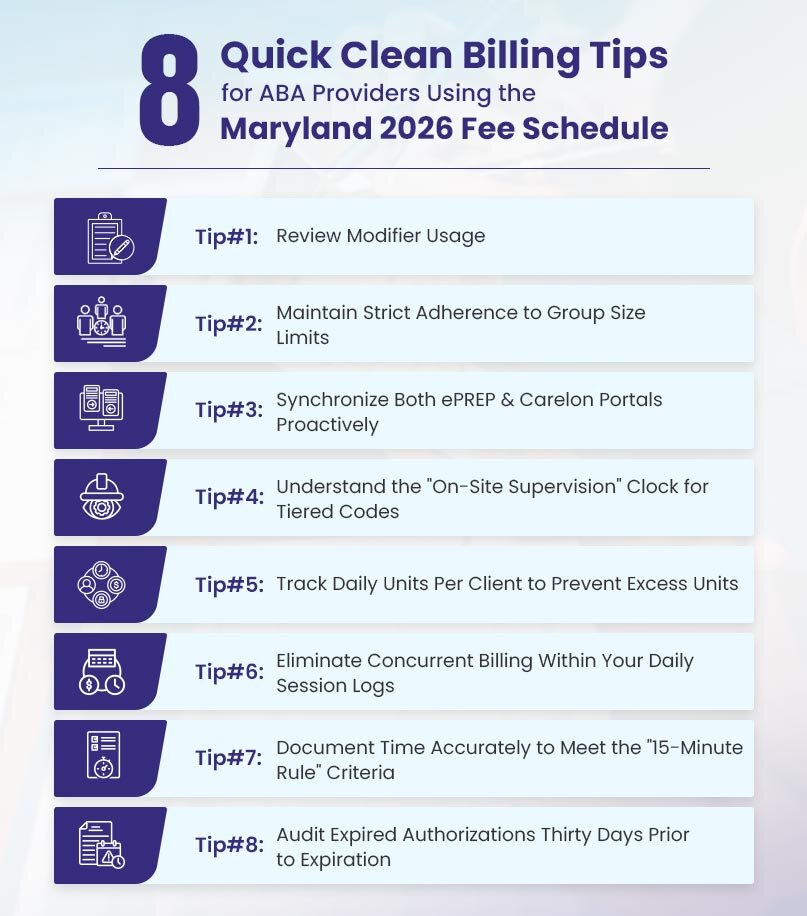
Tip 1: Review Modifier Usage
A wrong or missing modifier can cause a denial. It can also lock you into a lower payment tier by mistake.
Always add the GT modifier to telehealth services. That includes remote supervision and remote parent training.
For family training with the child in the room (97156), add the U2 modifier. Skip it, and the claim drops to the lower rate. That costs about $17.43 per 15 minutes for each BCBA.
Tip 2: Maintain Strict Adherence to Group Size Limits
Maryland Medicaid defines a group very strictly. For codes 97154, 97157, and 97158, your records must show 2 to 8 attendees or families. No more, no fewer.
Say a group of three children drops to one because two are absent. You can no longer bill it as a group. If the clinician adjusts the plan, bill it as one-on-one treatment (97153) instead.
So build a check into your routine audits. Confirm that attendance matches the group-size limit before you submit to Carelon.
Tip 3: Synchronize the ePREP and Carelon Portals Proactively
An authorization is only as strong as the credentials behind it. Two systems must agree here. The first is ePREP, the electronic Provider Revalidation and Enrollment Portal. The second is the Carelon behavioral health portal. The National Provider Identifiers (NPIs) in each must be identical.
New hires are the usual trip-up. If an RBT, BT, or BCBA NPI is not matched in both systems, the first appointment can draw an instant denial.
So make portal sync a required step in onboarding. Never book a new hire until their NPI is active and linked in both ePREP and Carelon.
Tip 4: Understand the On-Site Supervision Clock for Tiered Codes
The high-intensity codes are 0362T for assessment and 0373T for treatment. When you bill them, a senior supervisor must be on site. That means a psychologist, BCBA-D, or BCBA.
On site means ready to enter the room at any moment. The supervisor must be there to give hands-on support or clinical guidance.
So record the on-site supervisor’s name in your session notes. Confirm they were present. If the supervisor leaves the building mid-session, those units drop to the standard technician rate.
Tip 5: Track Daily Units per Client to Prevent Excess Units
Every code has a hard cap on units per day. For example, 97153 allows 32 units, and 97155 allows 24.
Sometimes you go over. A technician runs long, or two oversight sessions overlap. When that pushes you past the daily max, the extra units are rejected on their own.
So build hard stops into your EHR or practice management software. Set alerts that block logs above the daily cap for any one client.
Tip 6: Eliminate Concurrent Billing Within Your Daily Session Logs
Concurrent billing means two providers bill for the same patient at the same time. Maryland watches this closely.
Here is the limit. A supervisor cannot bill protocol modification (97155) while a technician bills direct therapy (97153) at the same time. The one exception is true team-based care: both work face-to-face with the client in the same session.
So train your staff to run overlap audits. Compare supervisor and technician schedules. Catch any overlap before claims go to Carelon.
Tip 7: Document Time Accurately to Meet the 15-Minute Rule
Maryland bills in 15-minute units. So your notes must prove the time you spent. A partial unit needs at least 8 minutes under federal rules. Maryland’s time-blocking rules also apply.
Each claim must show the total time on billable ABA services. Use exact start and stop times, such as 9:00 to 10:15 a.m. Do not just write that five units were done. Auditors can deny payment later for vague time notes alone.
Tip 8: Audit Authorizations 30 Days Before Expiration
Carelon approves and denies authorizations. Let one lapse by even a day, and you create a big headache. Carelon rarely allows late submissions or backdated approvals.
So build a rolling 30-day renewal pipeline. Have your system flag any client whose authorization expires within 30 days. That gives your team time to resubmit updated assessments (97151) and progress reports. It also renews the authorization and prevents gaps in care. Remember, each authorization lasts up to 180 days. So mark the renewal on your calendar from day one.
Conclusion
You can stay compliant and effective under the new 2026 schedule. In short, success comes down to four areas:
- Billing
- Documentation
- Authorization
- Service delivery
To succeed in each area, keep these points in mind:
- Payments follow a 15-minute model tied to each CPT code.
- The rate depends on the provider’s credential and how complex the service is.
- Every service needs prior approval from Carelon.
- Know which modifiers (GT, U2, and others) each service needs, so you capture full payment.
- Every CPT code has a daily unit cap.
Please note: rates, modifiers, and rules can change during the year. So always check the current figures before billing. The official MDH ABA Provider Manual and Carelon Behavioral Health of Maryland are your sources of truth.