The Florida Medicaid TCM fee schedule can look complicated at first glance. In reality, though, it comes down to three simple factors. Get these right, and your Targeted Case Management (TCM) claims are far more likely to be paid the first time.
Three things shape every TCM reimbursement rate:
- who receives the service — a child or an adult
- how intensive the service is
- which modifier is attached to the claim
Most Targeted Case Management services in Florida are billed in 15-minute units. Therefore, choosing the correct billing code is the difference between a clean claim and a denied one.
Florida Medicaid TCM Billing Codes and Reimbursement Rates
Here is what Florida Medicaid pays in 2026. After this quick overview, we break each code down in detail.
- Standard mental-health TCM (T1017) pays $14.82 per 15-minute unit. This reimbursement rate applies to both children and adults.
- Two specialized child-health services also use T1017 but pay less. Early Steps (modifier TL) and Medical Foster Care (modifier SE) are reimbursed at $11.42 per unit.
- Children at risk of abuse or neglect bill differently. Their service uses code T2023 and pays a flat $407.60 for one monthly unit.
- The number of billable units each day or month depends on the patient’s age and needs.
- Modifiers such as HA, HK, TL, and SE are not optional. Each one identifies the Medicaid target population being served, so the correct modifier directly protects your reimbursement.
Florida Medicaid Targeted Case Management Services Fee Schedule — 2026
| Procedure Code | Modifier | Description of Service | Maximum Fee | Maximum Units |
| T1017 | HA | Targeted Case Management for Children (Birth – 17) | $14.82 per unit | 344 per month |
| T1017 | — | Targeted Case Management for Adults (18+) | $14.82 per unit | 344 per month |
| T1017 | HK | Intensive Team TCM for Adults (18+) | $14.82 per unit | 48 per day |
| T1017 | TL | TCM for Children’s Medical Services (Early Steps) | $11.42 per unit | 32 per day |
| T1017 | SE | TCM for Medical Foster Care Contractors | $11.42 per unit | 32 per day |
| T2023 | HA | TCM for Children at Risk of Abuse and Neglect | $407.60 per unit | 1 per month |
Good to know: These figures come from the AHCA fee-for-service schedule, which sets the payment floor. Under SMMC 3.0, managed care plans (MCOs) may negotiate their own rates, so always confirm the reimbursement rate in your specific plan contract. By July 1, 2026, Florida must also publish its fee-for-service rates online in a searchable format, which makes verifying the TCM fee schedule easier than ever.
Detailed Fee Schedule for Florida Medicaid TCM Services
To make billing easier, the sections below group every Florida Medicaid TCM billing code by category. As a result, you can quickly match each service to the right code, modifier, and reimbursement rate — and stay compliant while you do it.
➜ Mental Health Targeted Case Management
| Procedure Code | Modifier | Description of Service | Maximum Fee | Unit Limit |
| T1017 | HA | TCM for Children (Birth – 17) | $14.82 | 344 / month |
| T1017 | — | TCM for Adults (18+) | $14.82 | 344 / month |
| T1017 | HK | Intensive Team TCM (Adults) | $14.82 | 48 / day |
This group of TCM services connects people who have mental health needs with the resources that support them. Those resources may include therapy, medical care, housing assistance, or other social services. However, the billing splits into three methods, and the right one depends on who the recipient is and how much support they need.
Child TCM (Birth – 17 years) — T1017 (HA)
This service supports children from birth through age 17. You bill it with procedure code T1017 and modifier HA. In short, it is child-centered case management. The case manager works closely with the child and the family so the child receives the right mental health care, school support, and follow-up.
Florida Medicaid reimburses this service at $14.82 per unit, up to a maximum of 344 units per month.
Adult TCM (18+ years) — T1017
Adult TCM serves recipients aged 18 and older. You bill it under procedure code T1017 with no modifier, and the process mirrors the child version.
Here, the case manager helps adults manage appointments, follow treatment plans, and reach the resources they need. Like the child service, Adult TCM is billed at $14.82 per unit, with the same cap of 344 units per month. In other words, the structure is identical — only the focus shifts to adults.
Intensive Team TCM (Adults) — T1017 (HK)
Finally, there is Intensive Team TCM for adults, which uses modifier HK. Like standard Adult TCM, it is built for adult recipients. However, it targets those with significant or urgent mental health needs.
Because the service is more intensive, it bills differently. The two services above rely on monthly unit caps; this one does not. Instead, it allows up to 48 units per day at $14.82 per unit.
➜ Specialized Child Health Services
| Procedure Code | Modifier | Description of Service | Maximum Fee | Unit Limit |
| T1017 | TL | CMS – Early Steps Providers | $11.42 | 32 / day |
| T1017 | SE | CMS – Medical Foster Care | $11.42 | 32 / day |
Next comes the Specialized Child Health Services category. As the name suggests, it focuses on children with unique medical or developmental needs. In other words, these children need more than mental health support — they also need extra medical coordination.
Early Steps Providers — Modifier TL
The first part of this category is Early Steps Providers, marked by modifier TL. Specifically, the program serves children who are developing slowly or who have a condition that calls for early intervention. Florida Medicaid reimburses this service at $11.42 per unit, with a daily limit of 32 units.
Medical Foster Care — Modifier SE
The second part is Medical Foster Care, which uses modifier SE. This service supports children placed in foster care whose medical needs require ongoing monitoring and coordination. Like Early Steps, it is billed at $11.42 per unit, up to 32 units per day.
Overall, Specialized Child Health Services keep medically or developmentally fragile children supported. Above all, the goal is to close gaps in care before they appear.
➜ High-Risk Abuse & Neglect Management
| Procedure Code | Modifier | Description of Service | Maximum Fee | Unit Limit |
| T2023 | HA | Children at Risk of Abuse / Neglect | $407.60 | 1 / month |
The final category is also the most sensitive: High-Risk Abuse and Neglect Management.
This is still Targeted Case Management, but it serves children who face a real risk of abuse or neglect. Because serious safety concerns exist, the first priority is protecting the child; coordination comes second.
You bill this service under procedure code T2023 with modifier HA. Unlike per-unit services, it pays a flat monthly fee of $407.60, no matter how many contacts take place. Remember, too, that T2023 may be billed only once per calendar month per child.
Compliance & Documentation Guide for Florida Medicaid TCM (2026)
The points below cover what you must do to stay compliant under the Statewide Medicaid Managed Care (SMMC 3.0) framework and AHCA documentation rules. Navigating these evolving requirements sometimes requires dedicated Florida Medical Billing support to keep your practice audit-ready.
Compliance Tips for SMMC 3.0 (2026)
Under SMMC 3.0, many managed care plans now require prior authorization after the initial assessment. Therefore, set an automatic reminder ten days before each authorization expires.
In addition, keep these compliance habits in mind:
- Never “clone” notes. Copying one note into another inside your electronic medical record is a top cause of recoupment. Instead, make sure every note reflects the patient’s current situation and the specific barriers they faced that month.
- Assess every setting, even on telehealth. Telehealth is permitted under Florida law. Even so, AHCA expects you to assess each patient’s environment. As a safeguard, schedule a quarterly face-to-face visit for every patient — even when the plan allows 100% telehealth — to show you are monitoring real-world safety.
- Keep your provider records accurate. To avoid a “Provider Not Eligible” status, update your NPI so it matches your Medicaid Provider ID in the 2026 AHCA portal.
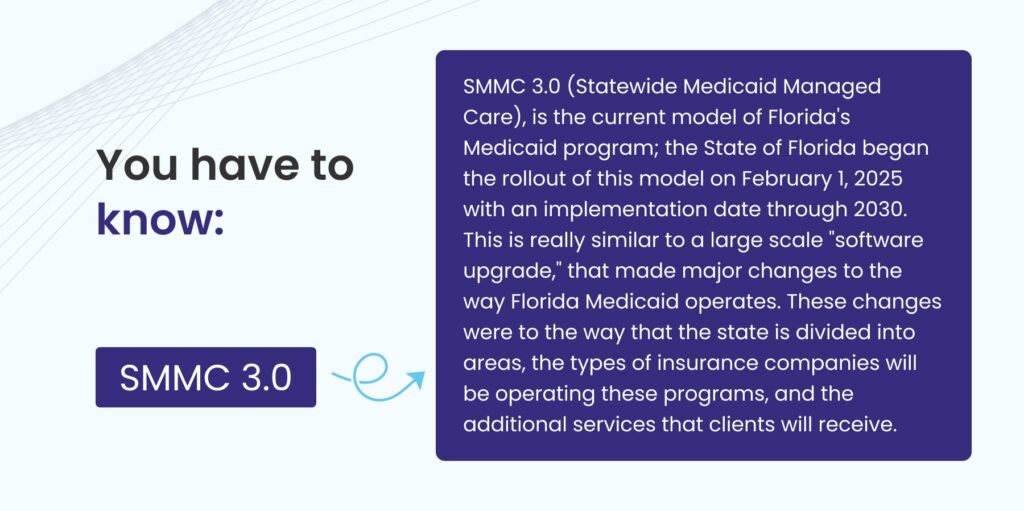
What SMMC 3.0 actually is: SMMC 3.0 (Statewide Medicaid Managed Care) is the current model behind Florida’s Medicaid program. The state began rolling it out on February 1, 2025, and the contracts run through 2030. Think of it as a large-scale software upgrade for Florida Medicaid. It reorganized the state into nine regions, awarded new contracts to the managed care plans that operate the program, and expanded the services recipients can receive.
Core Documentation Guidelines
In 2026, auditors still follow one rule above all: “if it wasn’t documented, it didn’t happen.” For that reason, every TCM entry must include the following.
- Proof of the three required milestones within each 30-day period: interactive contact, non-face-to-face coordination, and a timely face-to-face visit.
- A clear link between diagnosis and plan. Tie each patient diagnosis to the goals in the comprehensive case plan, and to the specific services named in your progress notes.
- Exact time frames. Note the actual clock time (for example, 1:05 p.m. to 1:35 p.m.) rather than simply “30 minutes.” In 2026, rounded times draw audit flags because reviewers find them suspect.
- Clinical, active language. Use verbs such as advocated, facilitated, or coordinated. Avoid passive or non-billable phrases like “spoke to,” “visited,” or “played with.”
- Whole units only. Florida Medicaid does not pay for partial 15-minute units, so document enough time to support each unit you bill.
Critical “Don’ts” for Florida Medicaid TCM Services
- Don’t bill for direct services. TCM does not cover time spent on therapy, tutoring, or transporting patients. For instance, if you drive a patient to an appointment, that travel time is not billable.
- Don’t double-bill with high-intensity services. You cannot bill TCM while another provider bills for services such as Assertive Community Treatment (ACT) or certain residential programs.
- Don’t bill group time. TCM is an individual service. As a result, you cannot bill a single “session” shared by several patients.
- Don’t sign late. Sign every note within 24 to 48 hours. In 2026, auditors check digital signatures and timestamps to confirm notes were written soon after the service.
Florida Medicaid TCM 2026 “Audit-Proof” Checklist
Before you submit, run through this quick checklist:
- Does the note clearly state where the service happened — home, office, or community?
- Does it include the modifier that matches the client’s target group?
- Does it list a follow-up task for the next contact?
- Did the case manager confirm Medicaid eligibility on the first day of the month?
Note: In 2026, AHCA is focused mainly on Outcome-Based Monitoring. To protect against recoupment, document why each service was medically necessary. For example, instead of writing “the doctor was called,” write “the doctor was contacted to confirm the patient received their prescribed medication, which helped prevent a possible emergency room visit.”
Struggling to Understand Florida’s 2026 TCM Updates?
A single missed HA or HK modifier can trigger an audit and stall your claims. On top of that, the 2026 TCM updates add medical-necessity requirements and tighten unit limits for Florida providers. Because of these changes, your documentation now has to be flawless.
BellMedEx offers Accurate TCM Billing for Florida Providers
At BellMedEx, we focus on precise Targeted Case Management billing for Florida providers. Here is how we protect your reimbursement:
- We confirm that each claim identifies the correct target group — Foster Care, Mental Health, or Early Steps — so you are paid at the right $14.82 or $11.42 rate.
- We track your monthly 344-unit cap in real time. As a result, you never deliver services you cannot bill.
- We review your treatment records to make sure each unit is fully supported and easy to defend.
- We already know the Sunshine Health, Magellan, and Molina portals, so you don’t have to.
In short, you can stop fighting the Florida Medicaid Management Information System (FLMMIS) portal. Let BellMedEx handle your TCM billing and coding from end to end.
For a free TCM billing review, contact us today.
Frequently Asked Questions
When do you apply the TL and SE modifiers?
Use the TL modifier for Children’s Medical Services (CMS) Early Steps providers. Use the SE modifier for Medical Foster Care contractors serving children who need complex pediatric care.
How can you lower your risk of a Medicaid audit?
You can reduce your audit risk in several ways:
- Use the correct billing codes and modifiers
- Keep detailed records
- Monitor your unit caps
- Avoid overlapping bills
- Record an accurate Place of Service
- Document every interaction clearly
How much does Florida Medicaid pay per 15-minute unit of T1017 in 2026?
For standard T1017 services, Florida Medicaid pays $14.82 per 15-minute unit. For specialized child-health programs, the reimbursement rate is $11.42 per unit.
What is the standard TCM reimbursement rate in 2026?
For almost all mental health services under code T1017, the standard reimbursement rate is $14.82 per 15-minute unit. Specialized services, such as Early Steps and Medical Foster Care, are the exception and pay $11.42 per unit.
Can you get paid for TCM services done over the phone?
Yes, but it depends on what you do during the call and how you document it. First, record the correct Place of Service (POS) so it reflects that the contact happened by phone. Second, make sure the work fits the definition of Targeted Case Management rather than a simple administrative check-in.
Is T1017 still a valid code in 2026?
Yes. T1017 remains a valid HCPCS code in 2026 for Targeted Case Management billed in 15-minute units, and Florida Medicaid continues to reimburse it under the 2026 TCM fee schedule.
Can two providers bill TCM for the same patient in the same month?
No. Only one provider may bill Targeted Case Management for a given patient per calendar month. Confirm that you are the assigned case manager before you submit a claim.