
What does Texas state law require when a patient’s treatment comes to an end? Once a patient leaves a healthcare setting for the last time, the medical record does not leave with them. The chart is really a “time-locked” clinical file.
First, there are rules for what must be in the clinical file. Second, after those items have been added to the file, there is another rule that starts the clock on how long it will remain available.
So, what needs to be documented in the clinical file of each patient encounter?
According to 22 TAC §163.1, physician medical records must provide a complete, contemporaneous, legible account of each patient encounter. These accounts include applicable history, examination findings, diagnosis, treatment plan, medications prescribed by the provider, properly documented corrections, and communications between healthcare providers.
Next, the clock begins ticking. According to 22 TAC §163.2, physician medical records normally must be maintained for at least seven years from the last clinical encounter. However, if the patient was under the age of 18 when they were seen by a healthcare provider for treatment. The timeline becomes more complicated than simply waiting for seven years from the date of last service.
In general, the record must be retained until the patient turns 21 or seven years have passed since the last date of service, whichever period is longer. Additionally, physicians are required to maintain access to all patient health information during the entire period of “Retention”.
However, 7 years is not a one-size-fits-all rule for every type of medical record in Texas. Some medical records, such as hospital records and certain special types of medical records, follow different requirements.
Therefore, before an old chart is deleted from an electronic health record or sent to shredders, check the relevant retention requirements.
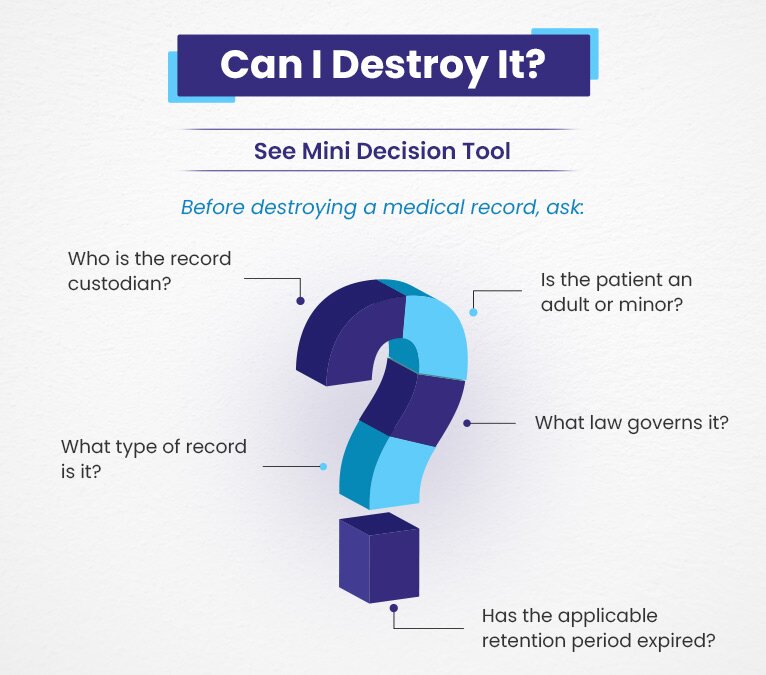
Before destroying a medical record, ask:
- Who is the record custodian?
- Is the patient an adult or minor?
- What type of record is it?
- What law governs it?
- Has the applicable retention period expired?
Why does Texas not have one single retention period for every medical record?
Healthcare organizations in Texas may fall under various state and federal regulatory guidelines. For instance;
Physicians typically adhere to the Texas Medical Board’s 7-year time frame for physician records.
- Hospital records are covered under Texas Health and Safety Code Section 241.103.
- Forensic medical examination records must be retained for 20 years.
- Patient records related to minor patients may extend based upon their age.
- Federal regulations also govern certain types of documentation.
Based on these regulatory entities, a healthcare organization should utilize record classification to determine its individualized retention time frames. Rather than relying on a universal “7-year rule.”
How does the provider type affect which retention rules apply to an organization?
An effective retention policy begins by identifying the custodian of patient records, the type of patient record, and the regulatory requirements that apply to the organization. The following is an example of how these factors can be assessed:
Provider Classification → Record Classification → Applicable Authority → Triggering Event → Retention Time Frame → Exception Review → Disposition
For example, a physician practice and a hospital that both treat the same patient clinically will likely have different policies regarding retention management due to the different statutes governing each entity.
Why is the date of last treatment important?
According to the Texas Medical Board, the last date of service represents the start of the seven-year retention time frame for physician records.
Therefore, a practice should not calculate retention from:
- Patient Registration Date
- Date Chart Created
- First Encounter
- Patient Became Inactive
- EHR Account Closed Date
The retention engine should use the last applicable treatment encounter.
Note: In an EHR, it is preferable to derive the last-treatment date from metadata associated with encounters. Instead of having staff enter it into a manual spreadsheet.
Texas Medical Record Retention Requirements
First, Texas providers should clearly know:
“What is the Medical Records Retention Timeframe for Texas?”
There are essentially two main distinctions when addressing both the length of time a document should be retained vs. the destruction date.
The time period Texas providers need to keep patients’ records is referred to as a “retention” time.
The date on which an organization can determine it will be able to destroy a document (following review of all exceptions and preservation obligations) is defined as the “destruction” date.
According to the Texas Medical Board, records generally have a retention time of seven (7) years from the last date of care.
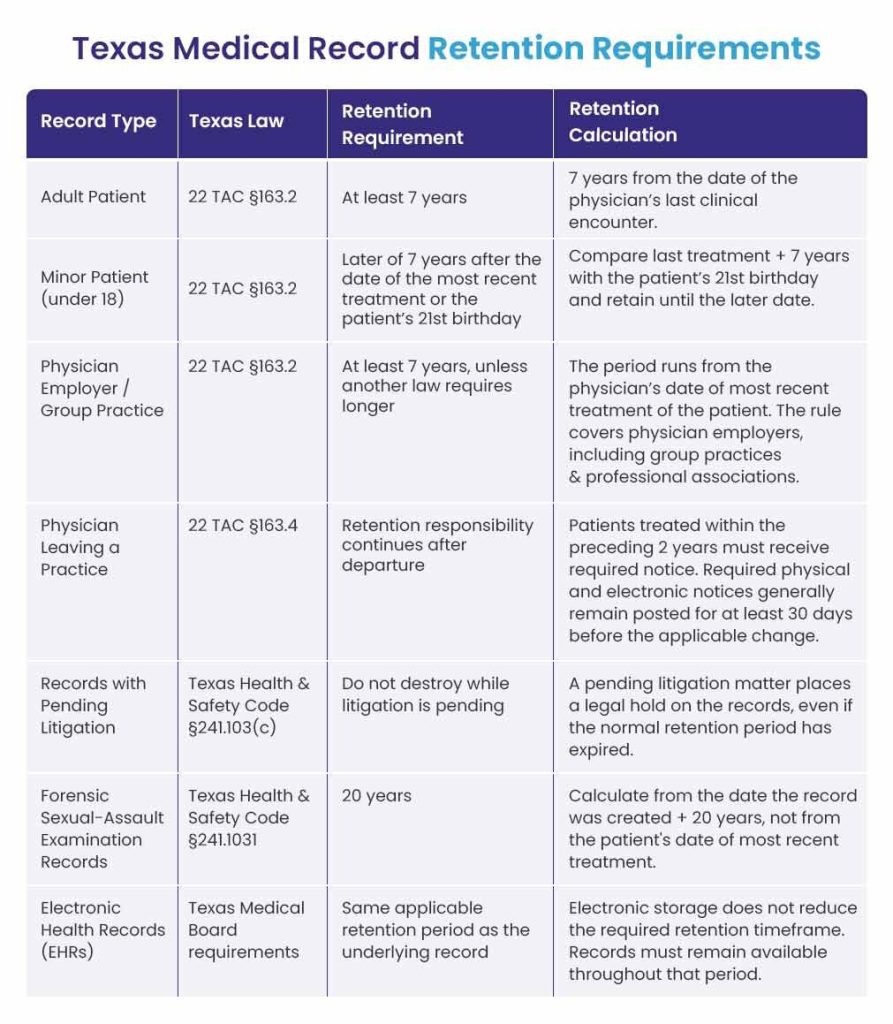
Here are Texas healthcare record retention requirements:
Find relevant RULE…..
| Record Type | Texas Law | Retention Requirement | Retention Calculation |
| Adult Patient | 22 TAC §163.2 | At least 7 years | 7 years from the date of the physician’s last clinical encounter |
| Minor Patient (under 18) | 22 TAC §163.2 | Later of 7 years after the date of the most recent treatment or the patient’s 21st birthday | Compare last treatment + 7 years with the patient’s 21st birthday and retain until the later date. |
| Physician Employer / Group Practice | 22 TAC §163.2 | At least 7 years, unless another law requires longer | The period runs from the physician’s date of most recent treatment of the patient. The rule covers physician employers, including group practices and professional associations. |
| Physician Leaving a Practice | 22 TAC §163.4 | Retention responsibility continues after departure | Patients treated within the preceding 2 years must receive required notice. Required physical and electronic notices generally remain posted for at least 30 days before the applicable change. |
| Records with Pending Litigation | Texas Health & Safety Code §241.103(c) | Do not destroy while litigation is pending | A pending litigation matter places a legal hold on the records, even if the normal retention period has expired. |
| Forensic Sexual-Assault Examination Records | Texas Health & Safety Code §241.1031 | 20 years | Calculate from the date the record was created + 20 years, not from the patient’s date of most recent treatment. |
| Electronic Health Records (EHRs) | Texas Medical Board requirements | Same applicable retention period as the underlying record | Electronic storage does not reduce the required retention timeframe. Records must remain available throughout that period. |
➜ Physician and Physician Employer Records (at least 7 Years)
How long does a Texas physician have to keep a patient’s healthcare record?
Most physician records are held for at least 7 years, but the timing of the retention begins with the patient’s last clinical encounter with that physician. Not with the creation of the chart.
As stated in 22 Tex. Admin. Code § 163.2, retention of healthcare records by a physician or his/her employer, which includes group practices, professional associations, and non-profit health care organizations, must include a minimum of 7 Years after the physician’s date of most recent treatment of a patient.
Unless another federal or State law mandates a greater length of time than 7 Years. The rule also specifies that the records must be accessible to the provider during the entire retention timeframe.
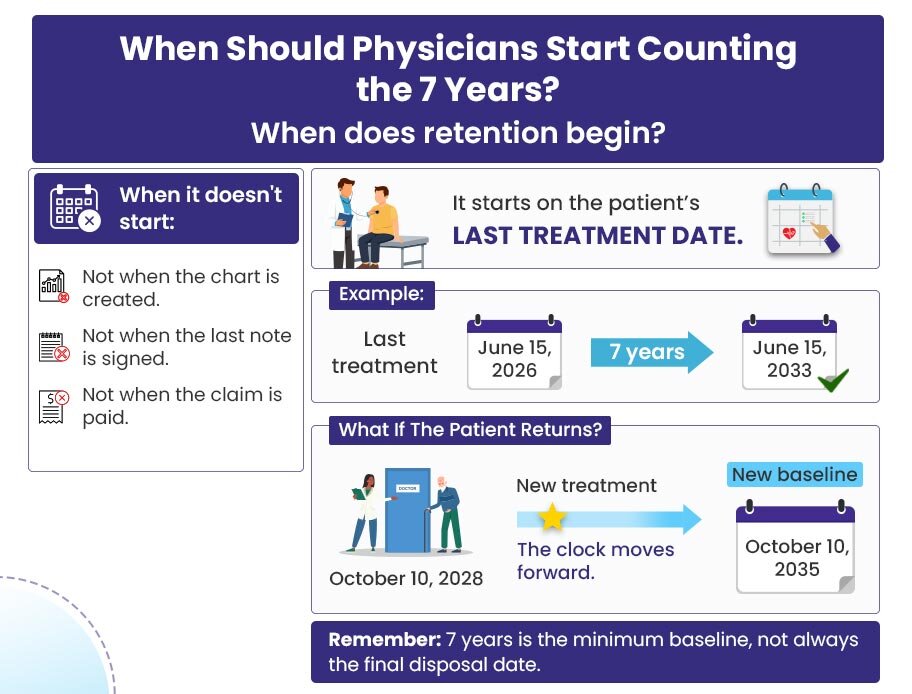
Therefore, “at least 7 Years” represents a baseline, not a universal disposal date.
Example. When does the 7-year clock start?
Dr. Jessica Morgan treated an adult patient for the last time on June 15th, 2026.
A practice should not calculate its retention from:
- The date the first appointment occurred
- The date the healthcare record was initiated
- The date the final note was completed
Or
- The date payment was made on an insurance claim.
In contrast, the correct starting point for calculating the retention is the date of last treatment by the physician.
- Date of last treatment = June 15, 2026
- Retention period = June 15, 2026-June 15, 2033
The retention period will extend until June 15, 2033, assuming no additional laws or requirements apply.
What if the patient returns later?
At this stage, the retention clock can reset.
Suppose the same patient returned to see Dr. Jessica Morgan again on October 10, 2028. That later treatment now serves as the new last-treatment date for determining how much longer Dr. Jessica Morgan has to retain the patient’s records under the normal retention process.
The retention process is calculated based upon:
October 10, 2028-October 10, 2035
Therefore, a practice should not permanently set aside a disposition date when they initially close out a chart. They need to consider future treatments to determine their retention obligations.
What happens when a physician leaves a practice?
When an MD (or physician) leaves a medical practice, it doesn’t mean the healthcare records have disappeared.
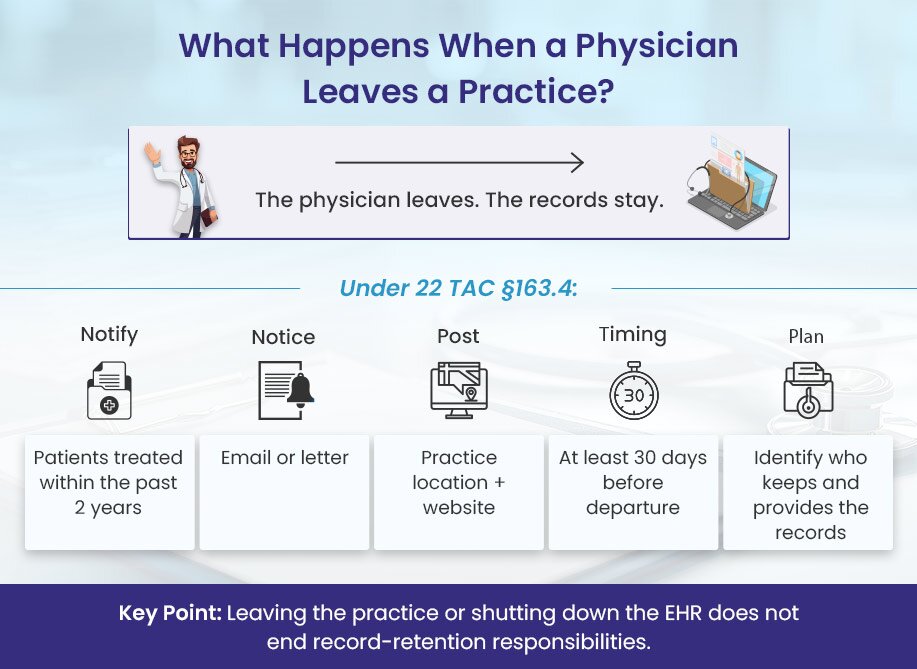
In Texas, the Medical Board has provided guidance as to how to handle such situations through Rule 22 TAC §163.4 (physician responsibilities when leaving a practice).
Upon retirement or termination of employment, or leaving a medical practice, an MD must give notice to patients. This applies to patients treated within the past two years. They must have enough time to obtain their patient health information or find another physician for ongoing treatment. This helps protect both record access and uninterrupted treatment.
Notice to the affected patients about the change and what the patient needs to do must be given in writing, either by email or letter. In addition to posting written notice about the pending change to the practice’s location, as well as listed on the practice’s website. It’s for at least thirty days prior to the actual date of said changes, excepting some specific conditions.
For example:
Dr. Patel will retire on Dec. 31, 2026.
Simply stopping use of the EHR program would not solve the problem and would not relieve the retiring MD of responsibility for the continued maintenance of those records.
Therefore, all parties involved in providing continuity of care need to establish the following:
- Identify which patients require notice (those seen in the last 24 months).
- Where will these patients’ medical records be kept?
- Who will provide copies of those medical records to these patients or facilitate arrangements for their transfer to another provider?
- How long must those healthcare records remain available?
- How will these patients know where to go to ask for their clinical records?
Specifically, in accordance with the Texas regulations, there must be notice to patients who saw the departing MD in the preceding twenty-four months. Both a physical and electronic notice must be displayed for at least 30 days prior to the actual date of that MD’s departure from the practice or another listed occurrence.
➜ Minor Patient Records Retention Requirements
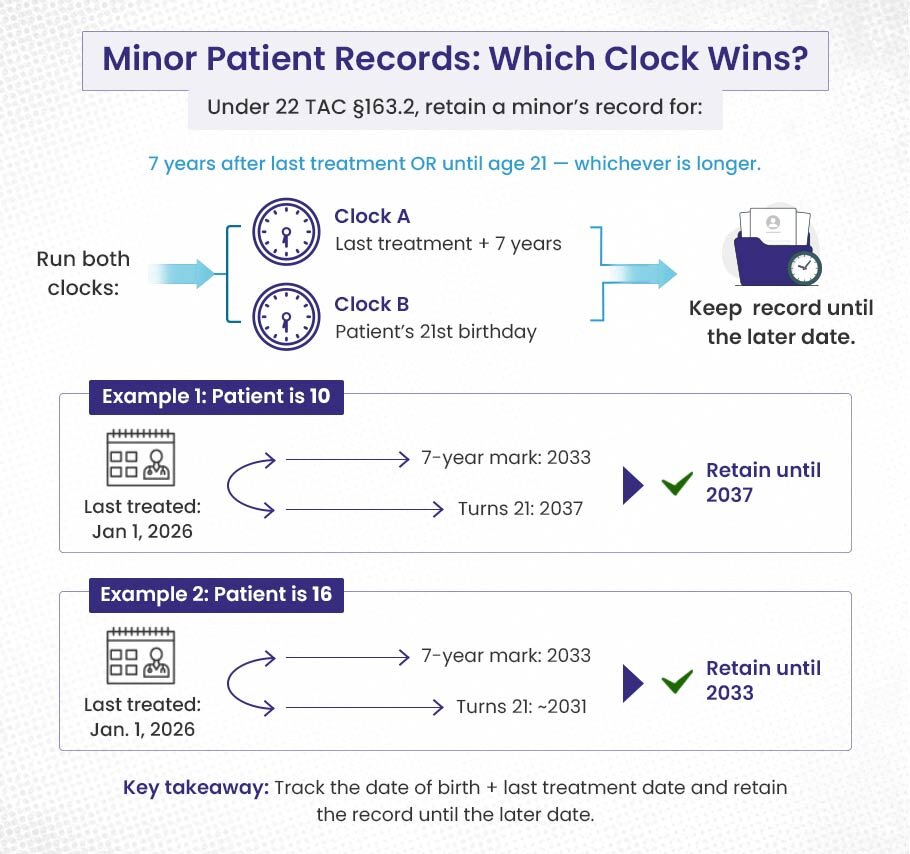
It is easy to fall into the trap of thinking “any seven-year rule” is sufficient. For minor patients (i.e., those less than 18), Texas utilizes a separate statute regarding physician record calculations according to 22 Tex. Admin. Code § 163.2
A physician record must be retained for:
7 years from the date of most recent treatment, or until the patient is 21 years old (whichever is longer)
In effect, there are two clocks running simultaneously:
- Clock A: last treatment + 7 years
- Clock B: Patient’s 21st birthday
Example 1: Minor Patient (10 years old)
Physician provides care to a ten-year-old on Jan. 1, 2026.
Check both possible dates:
- Seven years from last visit date = Jan. 1, 2033
- Patient’s 21st Birthday = 2037
A patient’s 21st birthday occurs after the end of seven years from the last visit date . In this example, the record must be retained until the patient is twenty-one years old, assuming another statute does not establish a longer retention requirement.
Example 2: Patient is 16 years old
Physician provides care to a sixteen-year-old on Jan. 1, 2026.
Determine both:
- Seven years from last visit date = Jan. 1, 2033
- Patient Turns Twenty-One = approximately 2031 (actual birthday dependent)
In this example, the seven-year period continues beyond age twenty-one. Therefore, the seven-year calculation dictates how long the record shall be retained.
Therefore, it is advisable that a practice keep track of:
date of birth + date of last visit
If a retention system only retains the last visit date, it will likely fail to include consideration for the age-based calculation for minors.
A method for remembering it:
When retaining physician records for minors, run both clocks. Retain the record until the latter clock expires.
➜ Adult Patient Records Retention Requirements
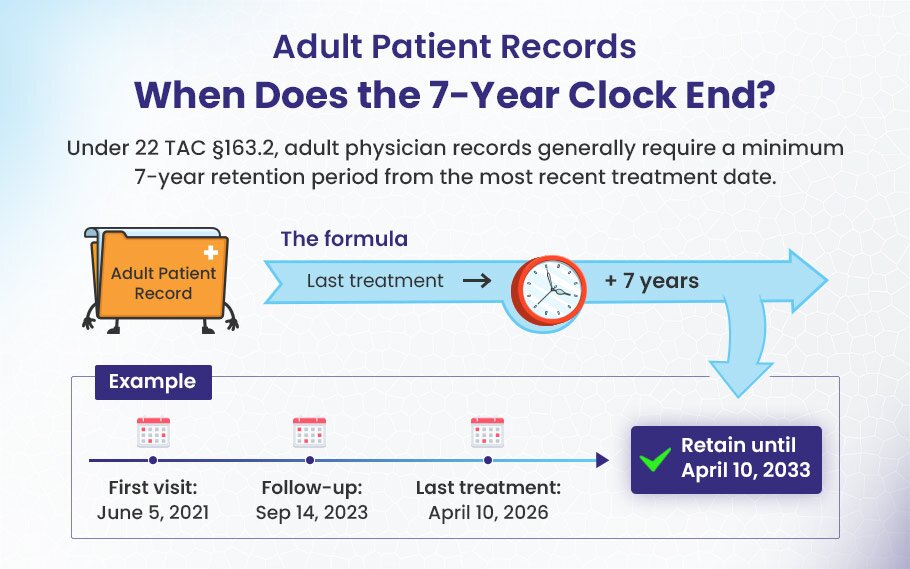
According to the Texas Medical Board, adult patients’ clinical records are typically required to be retained by physicians for no less than 7 years after the date of their most recent treatment.
Texas providers can determine the 7 year retention timeframe as follows:
Date of last treatment → add 7 years → minimum retention period
Example: An adult patient who received multiple treatments
For instance, suppose an adult patient had the following visits:
- First visit: June 5, 2021
- Follow-up: September 14, 2023
- Final treatment: April 10, 2026
Since there were multiple treatments prior to the final treatment, the first visit will not start the clock. The date that controls when the retention clock begins is the last date of care. Therefore, in this case, it would be April 10, 2026.
To find the end date of the retention clock, we simply add 7 years to that date.
April 10, 2026 + 7 years = April 10, 2033
In this case, 2033 is the date of the second occurrence of the 7 year retention clock.
So understand the differences between adults and minors
Here is what differentiates these two:
- Retaining adult patient records
Last treatment date + 7 years
- Retaining minor patients record(under 18)
Either 7 years from the date of last visit or the patient turns age 21
Unlike in an adult patient’s record, an additional “age-21” clock is necessary when retaining a patient who is a minor.
➜ What if the Record is Part of Litigation?
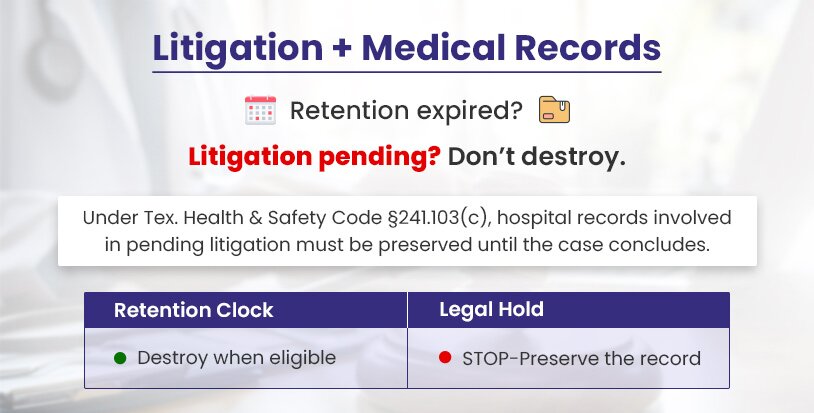
This is one of the most significant exceptions to know.
Retention clocks are used in conjunction with legal holds.
Tex. Health & Safety Code § 241.103c states that under no circumstances can a hospital dispose of or destroy healthcare records that are currently part of pending litigation unless and until such litigation is fully concluded.
Example:
The retention clock passes. But litigation is still pending.
The last visit date was on Jan. 01, 2016. The ten-year anniversary occurred on Jan. 01, 2026. Litigation related to these documents remains unresolved in 2026.
Even though ten years have elapsed. This does not mean that physicians can now destroy the document.
Litigation status has changed what previously existed.
The retention schedule may be marked
“disposal eligible.”
However, the legal-hold process should be marked
“do not destroy.”
Think about the above scenario like placing a red light above the retention time clock. Although the retention time clock has completed its cycle, the legal hold has placed a stop sign on the destruction of the document.
➜ What About Forensic Sexual-Assault Examination Records?
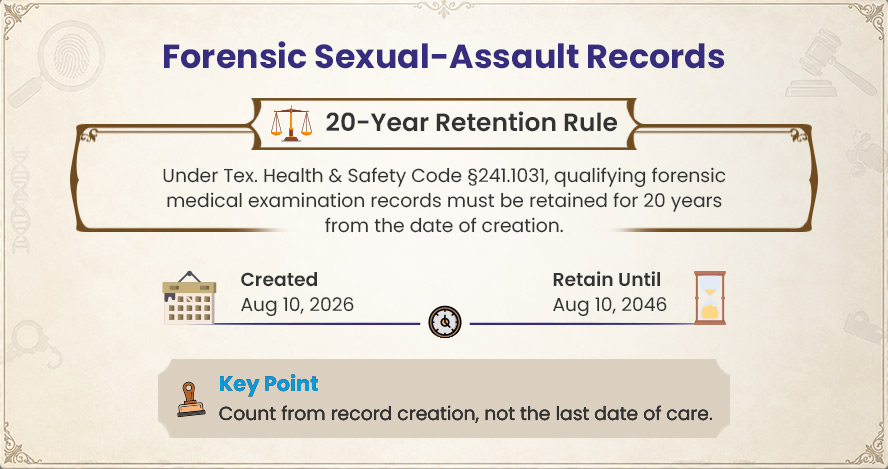
Forensic medical examination of sexual assault records must be kept longer than other records.
There are certain records that have to be kept for a much longer time than most other records. For example, under Texas Health and Safety Code §241.1031, a hospital cannot dispose of the clinical records from a forensic medical examination of a sexual assault victim until twenty years after it was made.
The method of determining when this longer retention applies is also slightly different than when the regular retention will apply. The hospital has to determine the length of time they can retain these types of records as follows:
The date the record was created + 20 years. But not the last date of care . For instance, a forensic medical examination record was generated on August 10, 2026; then the statutory retention would be triggered by:
“20th Anniversary-August. 10, 2046”
➜ Electronic Health Record Retention Requirements in Texas
Electronic Health Records (EHRs) have introduced two additional layers of regulatory compliance.
- The first includes ensuring the records are available when needed
- and maintaining the integrity of the electronic systems used to store them.
According to the Texas Medical Board, healthcare organizations must be able to provide access to patients’ EHRs throughout their designated retention timeframe.
Does Electronic Format Change the Retention Period?
Storage media can be changed, but it doesn’t reduce or remove the overall length of time that must retain clinical records.
Maintaining EHR accessibility during the retention period should be:
- readable
- searched
- protected from unauthorized access
- have enough contextual data so that authorized personnel can properly understand the content of the archival records
In addition, simply backing up the entire database onto a large disk drive does not constitute an active archival process for patients’ clinical records.
What Happens When an EHR Vendor Is Replaced?
Before retiring the current EHR system, create a written plan for retaining and migrating patient data.
Don’t forget to identify:
- active Records
- inactive records that are still retained
- records currently under litigation hold
- health records eligible for destruction
- required metadata fields
- historical attachment files
- audit trail entries
- access requirements (for example: who has access, why do they have access, etc.)
What Medical Information Should Be Included in the Retention Schedule?
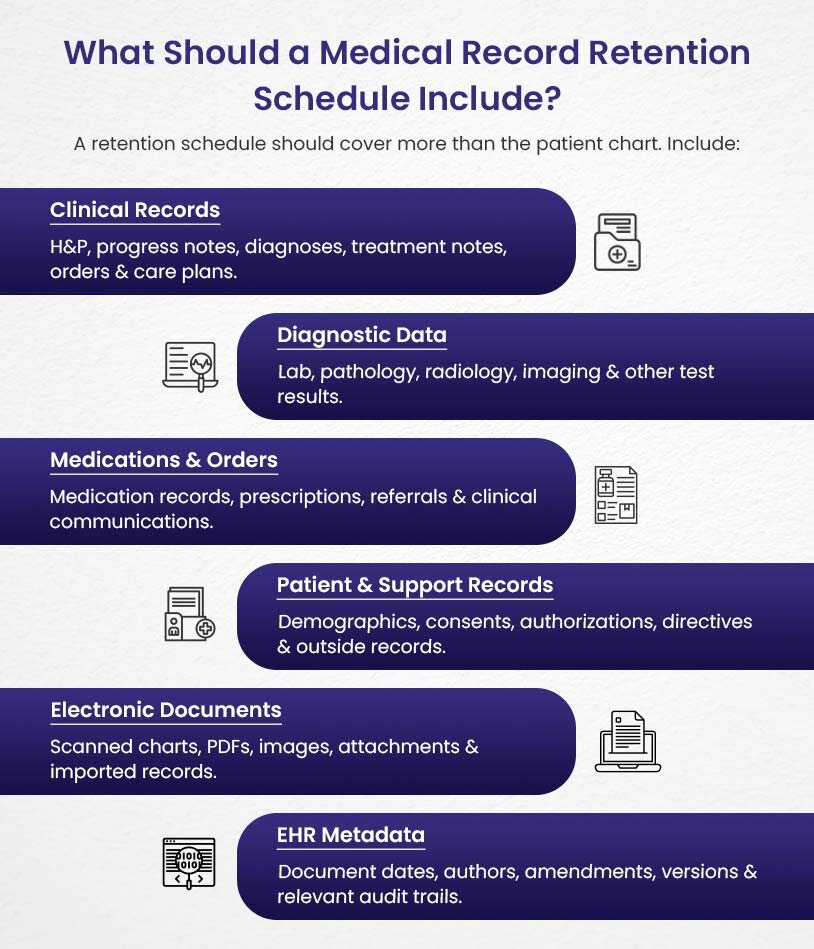
Retaining all relevant portions of a patient’s healthcare record is the main objective. A well-designed retention schedule will define the required elements that are needed to create a complete and accurate “designated record set” or “applicable legal record category.” For this reason, it is not enough to simply retain the entire patient chart. Instead, retention schedules should identify the clinical, diagnostic, and support information that make up the designated record set.
Clinical Document Retention
A retention schedule should provide detailed guidance on what clinical documents must be retained by identifying the clinical documentation created in conjunction with the patient’s episode of care. This includes:
- History & physical examination (H&P)
- Chief complaint & History of present illness (HPI)
- Review of systems (ROS) & physical examination findings
- Initial evaluation & follow-up evaluations
- Progress notes & encounter notes
- Treatment notes
- Medication management documentation
- Physician, advanced practice provider, and other authorized clinician orders
- Problem lists & active diagnoses
- Clinical decision-making documentation
- Patient instructions or education records
- Care coordination & transition-of-Care documentation
Diagnostic & Ancillary Data
Diagnostic information should be retained as identifiable record classes. Rather than simply grouped under “test results.” The schedule may include:
- Laboratory test orders or laboratory reports
- Pathology reports or sample-related documentation
- Microbiology and culture results
- Diagnostic tests results
- Electrodiagnostic & physiological test results
- Radiology imaging reports
- Imaging study metadata and other relevant data
- Cardiology test results (if applicable)
- Other diagnostic service reports integrated into the patient’s chart
Orders, Medications and Clinical Data
A complete retention inventory should also account for clinical data that may be spread throughout the electronic health record (EHR) and other connected systems:
- Medication orders and Medication Administration Records (MARS).
- Prescription records and refill documentation
- Referral orders and status records for referrals
- Consultation requests
- Procedure orders
- Diagnostic order results
- Change to care plan
- Clinical communication relating to treatment decisions
- Messages between providers and patients that are considered part of the patient’s clinical record
Patient Identification and Supporting Record Data
Additional data that support a patient’s identification and care may include:
- Patient demographic identifiers
- Emergency contact information
- Insurance coverage information stored as part of the patient’s file
- Consent and authorization forms
- Consent documentation for treatment
- Release-Of-Information (ROI) authorizations
- Advance directives and applicable hospital directives
- Referral documents
- Received patient’s healthcare records from outside physicians
- Consultant reports
- Summary of discharge & post-hospitalization instructions or follow-ups
- Transitional care records
Electronic and Scanned documents
Electronic versions of clinical records may include scanned documents, PDF files, TIFF images, photographs, imported clinical documents, other documents uploaded by patients, and attachments from external sources. Each repository containing these images should be identified in the retention program
Examples include:
- Saved paper charts using scanning equipment
- Received external clinical records imported through an application
- PDF versions of lab or consultation reports
- Scanned copies of consent forms
- Clinically created digital photographs used during assessment
- Document attachments to the electronic health record
- Patient uploaded clinical files or referral information
- External records imported through Health Level Seven (HL7) interfaces or other health-information exchange workflows
EHR Metadata and Audit Trails
Some retention programs may want to include metadata and audit information in their inventory. Examples of metadata include:
- Date & time of creation for the document
- Associated encounter date
- Clinician who authored or signed the document
- Version of document
- History of amendments made to the document
- Status regarding signatures
- Date when document was imported into the EHR system
- History of changes to the document since its original import
- Audit trail information relative to access history
What Should Be Included In a Medical Record Retention Policy For a Texas Healthcare Practice?
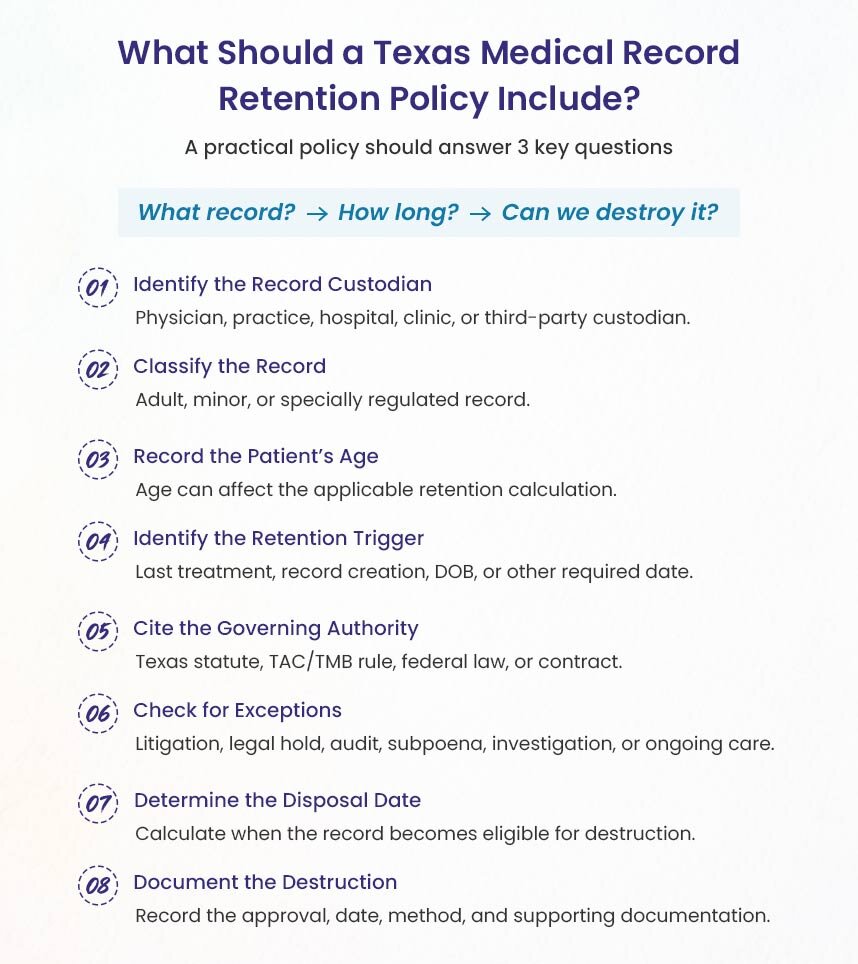
In addition to specifying how many years to retain a patient’s chart, a retention policy for a Texas healthcare provider should include several elements. The retention policy should relate to the following:
- type of patient’s healthcare record being maintained
- age of the patient, the last date of care provided to the patient
- applicable Texas requirements
- events that prevent destruction of the health record.
To create a workable retention matrix, follow these steps:
Step 1: Determine Which Entity Is Liable For Maintaining The Patient’s Medical Record
First, determine which party is liable for maintaining the patient’s clinical record. This is important. Because there are different retention requirements depending on the type of healthcare entity maintaining the healthcare record.
Document the:
- physician or medical practice that is liable for maintaining the patient’s medical record
- physician group or professional organization that is liable for maintaining the patient’s health record
- hospital or affiliated practice that is liable for maintaining the patient’s health record
- clinic or outpatient facility that is liable for maintaining the patient’s chart
- public health program liable for maintaining the patient’s health record (if applicable)
- third-party records custodian (if records have been transferred)
It is essential to document the actual record custodian, not just the Electronic Health Record (EHR) vendor. An EHR vendor stores data and becomes neither the legal owner nor custodian of the patient’s healthcare record.
Step 2: Distinguish Between Types Of Health Records According To Texas Statutes Or Regulations
Do not put all patients’ health records in one retention basket. Classify records based on the Texas statutes or regulations applicable to each category.
As an example, the matrix could distinguish between:
- Adult patients chart
- Health data for minors
- Healthcare records governed by specific Texas statutes or regulations
- Patient data required under a payer contract or agreement
- Clinical records that are the subject of ongoing litigation, government investigation, or legal hold
This would help a practice to avoid applying its standard adult-record rule to a minor’s record, or another specially regulated record.
Step 3: Identify The Correct Retention Date
The schedule should indicate when the retention timeframe begins.
For each record category, identify the relevant start date, such as:
- The date of the last clinical encounter
- The date of the last examination or service
- The date the patient chart was created when the governing requirement uses creation as the start date
- The patient’s date of birth when using an age-related calculation
- The date a contractual or regulatory obligation ceases when applicable
For a minor’s clinical data, for example, a two-date calculation is important (the last date of service and the child’s birthday).
Step 4: Include The Relevant Texas Authority
There should be a legal citation associated with each retention category.
The matrix should reference whether the requirement comes from:
- Texas Occupations Code
- Texas Administrative Code (TAC)
- Texas Medical Board rules
- Texas Health and Safety Code
- Federal laws or regulations when applicable
- A payer contract or agreement
For physician medical records, for example, the schedule will specifically address Texas Medical Board rules related to record retention (e.g., 22 TAC §163.1 & 22 TAC §163.2), as opposed to generalizing “Texas retention law.”
Step 5: Establish Exception Rules Within Schedule
Even though patient data has reached its standard disposal date, it may continue to exist due to certain exceptions. Check before destroying a record if any of the following exceptions apply:
- Pending litigation
- Legal hold
- Government investigation
- Regulatory or payer audit
- Medical malpractice complaint
- Subpoena or records request
- Patient dispute regarding access to or content of the record
- Special statutory retention provision
- Ongoing treatment for patient or unresolved episode of care
If an exception exists, update the record status within the system to “retain-exception applies” instead of “destroy eligible”.
Step 6: Determine When The Record Can Be Destroyed
The disposition date should be calculated from the correct retention trigger, not from the time that the record was loaded into EHR. One format for structuring a useful matrix is:
Record Type → Trigger Date → Mandatory Retention Period → Governing Authority → Exception → Eligible Disposition Date
This will provide a secure determination process for the category of health records.
Step 7: Confirm The Record Exists Before Disposal
Verify that retention calculation for each record is correct prior to deletion.
The workflow should be:
Identify record → Verify record type → Verify last date of service → Verify governing rule → Legal Hold → Approve Disposition → Destroy
When disposing of electronic patient health records, it is also wise to validate the original version of any documents, images, reports, etc. It contained in an ancillary file (i.e., attachment), scan, diagnostic image, etc., remain intact and preserved.
Step 8: Log Destruction Events
Texas providers are expected to keep a documentation log showing what happened to a patient’s medical record. The purpose of the log is to show what occurred with respect to a patient’s health record.
The log should contain:
- Patient or record ID number
- Type of record
- Patient’s date of birth (when used in calculating retention)
- Last date of service
- Retention trigger date
- Applicable Texas or federal law
- Mandatory retention timeframe
- Calculated destruction date
- Status regarding legal holds
- Approval process
- Actual date of destruction
- Method used to dispose of patient record
- Name & contact information for third-party vendor providing destruction services (if applicable)
- Certificate of destruction and supporting documentation (where available)
The goal here is to create an automated and accountable decision-making process for retention policies.
A Texas provider should be able to review one record and respond to three basic questions about that record:
- What triggered retention?
- What was the termination point of the retention period?
- Was it okay to delete it?
Common Texas record retention errors in medical practice
- Retaining all patient and provider types under the seven-year standard
- Incorrectly calculating record retention for minors
- Setting incorrect dates to count backward to determine destruction of documents
- Destroying records when litigation or investigations are still pending
- Failing to check on any applicable federally required payer retention standards
- Erasing electronic health records (EHR) during migration of software
- Unable to locate archived documents after deactivating EHR system
- Failing to retain a complete patient file when changing practice types
- Disposing of paper records without correct destruction procedures
- Failure to document what was destroyed and the date that it was destroyed
- No record retention policy for employees to follow
- Failure to allow patients access to their medical files upon closure of the practice
- Omitting to provide disaster recovery for electronic records
- The same retention process applied to physician practices as hospitals