
A CPT code gets the ball rolling, but it does not settle the score. Because the Texas Medicaid & Healthcare Partnership (TMHP) program doesn’t play by the “1 code, 1 rate” rule. The same Behavioral CPT code can pay differently depending on the plan, the MCO, the service type, and even the setting.
And this challenge grows when you see how many Texans rely on Medicaid and CHIP every single day.
Texas Medicaid & Children’s Health Insurance Program (CHIP) serves over 5 million low-income individuals & families. These programs provide health insurance to approximately half of Texas children & cover nearly two-thirds of people living in nursing homes.
Most Medicaid services & CHIP services are provided through managed care plans contracted with the state of Texas.
Demand for psychiatric care services is very high. According to the FY 2022 Texas Health and Human Services report, there were 303,875 people receiving Mental Health Services & 2,191,210 people receiving substance abuse services.
So… what does that mean for behavioral health providers in Texas? There will be additional documentation for each service, more claims submitted, and an increased need to match CPT billing codes for services used.
Texas Medicaid Behavioral Health CPT Codes & Fee Schedule Rates for Outpatient Services
| CPT / HCPCS Code | Service | Time / When Used | Professional Fee Schedule | UB / Special Rate | Highest Listed Rate | Quick Billing Note |
| 90791 | Psychiatric diagnostic evaluation without medical services | Initial psychiatric assessment/diagnosis | $118.15–$144.83 | $82.70–$101.38 | $144.83 | Rate varies by age, N/F classification, and UB billing |
| 90792 | Psychiatric diagnostic evaluation with medical services | Psychiatric evaluation that includes a medical component | $135.26–$163.07 | — | $163.07 | Highest listed outpatient behavioral-health rate in this schedule |
| 90832 | Individual psychotherapy | 16–37 min | $52.66–$68.48 | $36.86–$47.94 | $68.48 | Short-duration individual psychotherapy |
| 90834 | Individual psychotherapy | 38–52 min | $69.77–$90.38 | $48.84–$63.26 | $90.38 | Commonly considered the approximately 45-minute psychotherapy code |
| 90837 | Individual psychotherapy | 53+ min / approximately 60 min | See note† | $72.23–$93.72 | $133.88 | Longer individual psychotherapy session |
| 90833 | Psychotherapy with E/M | 16–37 min psychotherapy | $48.92–$63.15 | — | $63.15 | Add-on code; used with an appropriate E/M service |
| 90836 | Psychotherapy with E/M | 38–52 min psychotherapy | $62.01–$80.27 | — | $80.27 | Add-on code; does not replace the E/M code |
| 90838 | Psychotherapy with E/M | 53+ min / approximately 60 min | $82.33–$106.66 | — | $106.66 | Add-on psychotherapy code used with E/M |
| 90846 | Family psychotherapy without patient | Family session where patient is not present | $75.11–$85.60 | $52.58–$57.07 | $85.60 | Choose based on who actually participated in the session |
| 90847 | Family psychotherapy with patient | Patient participates with family | $78.32–$89.25 | $54.82–$62.48 | $89.25 | Slightly higher listed rates than 90846 |
| 90853 | Group psychotherapy | Psychotherapy delivered in a group setting | $18.44–$24.42 | $12.90–$17.09 | $24.42 | Payment varies by age; lower per-patient rate reflects group delivery |
| 90870 | Electroconvulsive therapy (ECT) | ECT treatment | $83.13–$87.57 | — | $87.57 | Age 0–20: $87.29–$87.57; age 21+: $83.13–$83.40 |
| 90899 | Unlisted psychiatric service/procedure | Psychiatric service without a specific applicable CPT code | Manually priced | Case-by-case | — | No fixed reimbursement; documentation is especially important |
| 96116 | Neurobehavioral status examination | Initial neurobehavioral/cognitive assessment | $63.08–$77.18 | $44.16–$54.03 | $77.18 | Rate varies by age and N/F setting |
| 96121 | Additional neurobehavioral status examination | Each additional hour | $52.66–$63.15 | $36.86–$44.21 | $63.15 | Add-on/time-based assessment code |
| 96171 | Health behavior intervention with family, patient not present | Each additional 15 min beyond initial service | $20.85–$23.58 | — | $23.58 | Add-on code; documentation must support time and service definition |
| H0038 | Peer support / behavioral health support | Individual or group support service | $8.55 without modifier | $1.22 with HQ | $8.55 | HQ indicates group service; applying HQ reduces the listed rate by $7.33 |
Billing for psychiatric care services in Texas requires that you select the correct CPT billing code to document your services.
However, there’s an additional issue: what will Texas Medicaid pay for those services? Reimbursement rates can be influenced by several variables, including:
- patient’s age
- provider type
- date of service
- how many units of each service were provided
- whether you’re using a modifier with each unit
- the applicable rate from the TMHP Fee Schedule
In fact, some CPT billing codes have multiple reimbursement rates based upon one of the above variables.
To simplify using the Medicaid payment rate, we have categorized common outpatient behavioral health CPT codes into categories & included their reimbursement rates along with the highest & lowest applicable rates, if they exist.
Texas Medicaid Behavioral Health CPT Codes by Service Category
First of all, see the categories and CPT codes used for them.
The reimbursement rates of these codes include professional and UB billing amounts where applicable.
| Service Category | CPT/HCPCS Codes |
| Psychiatric diagnostic services | 90791, 90792 |
| Individual psychotherapy | 90832, 90834, 90837 |
| Psychotherapy with E/M services | 90833, 90836, 90838 |
| Family psychotherapy | 90846, 90847 |
| Group psychotherapy | 90853 |
| Other psychiatric services | 90870, 90899 |
| Neuropsychological and cognitive assessment | 96116, 96121, 96171 |
| Behavioral health support | H0038 (HCPCS code) |
Prior to looking at the actual rates for each type of service, you need to understand a little about the fee-schedule types. The three most common fee-schedule types you will find are N, F, and UB.
- N: fee schedule type for non-facility Rate.
- F: fee-schedule type for facility Rate.
- UB: denotes institutional billing format as per UB-04/837I. Therefore, the rate is listed separately from the corresponding professional billing classification.
Category #1 – Psychiatric diagnostic & evaluation services (Fee Schedule)
Before beginning treatment, the provider must be able to identify or evaluate what the patient is experiencing, then develop an appropriate diagnosis and treatment plan. At this stage, psychiatric diagnostic evaluations fit into the process.
Medicaid has identified two primary CPT codes for these services: 90791 and 90792. The primary difference is that 90791 excludes medical services, while 90792 includes medical services.
➜ CPT 90791 (Psychiatric Diagnostic Evaluation Without Medical Services)
CPT 90791 refers to a mental health diagnostic evaluation without medical services. However, what will the TMHP program pay for CPT 90791? The answer will depend on how the service was classified and which age category the patient falls into.
| Classification | Age Group | Reimbursement |
| N | 0–20 | $144.83 |
| F | 0–20 | $124.90,$124.06 |
| N | 21–999 | $137.93 |
| F | 21–999 | $118.95, $118.15 |
| UB, N | 0–20 | $101.38, $101.38 |
| UB, F | 0–20 | $87.43,$86.84 |
| UB, N | 21–999 | $96.55 |
| UB, F | 21–999 | $83.27,$82.70 |
There is some variation in the fees for both services since the highest amount listed is $144.83 and the lowest amount listed is $82.70.
Why the variation?
The variation occurs because the Medicaid payment rate provides different reimbursement amounts based on provider classification, patient age classification, and UB billing.
The reimbursement for CPT 90791 can vary, so Texas providers must review the applicable fee-schedule category rather than relying on the CPT code alone.
➜ CPT 90792 (Psychiatric Diagnostic Evaluation With Medical Services)
Let’s now take a closer look at CPT 90792. This code is used when the psychiatric assessment services include healthcare services. As this service also includes a medical component, the reimbursement amounts listed for this service are greater than those listed for 90791.
| Classification | Age Group | Reimbursement |
| N | 0–20 | $162.79 / $163.07 |
| F | 0–20 | $142.02 / $142.02 |
| N | 21–999 | $155.04 / $155.30 |
| F | 21–999 | $135.79 / $135.26 |
The highest listed amount for 90792 is $163.07, while the lowest is $135.26.
Why is there a difference between the 90791 and 90792 codes?
| Comparison Point | 90791 | 90792 |
| Service | Psychiatric diagnostic evaluation | Psychiatric diagnostic evaluation with healthcare services |
| Medical services | Not included | Included |
| Primary purpose | Assess the patient’s psychiatric symptoms, history, and clinical needs | Perform the psychiatric evaluation while also providing the medical component of the service |
| Provider consideration | Used when the documented service does not include medical services | Used when the documented encounter includes the medical services required by the code |
| Medicaid rate pattern | Generally lower than 90792 in the supplied schedule | Generally higher than 90791 in the supplied schedule |
| Highest listed rate | $144.83 | $163.07 |
| Lowest listed rate | $82.70 | $135.26 |
Category #2 – Individual Psychotherapy Services (Fee Schedule)
One of the most common mental health services in Texas Medicaid is individual psychotherapy services. They use three main CPT Codes for standard individual psychotherapy:
- 90832: 30-minute psychotherapy
- 90834: 45-minute psychotherapy
- 90837: 60-minute psychotherapy
The only real difference is how long each session can be. The more time spent on psychotherapy, the greater the reimbursement.
➜ CPT 90832 (16-37 Minute Psychotherapy)
CPT 90832 is used when a provider documents a 16-37 minute psychotherapy session. The professional reimbursement rates for CPT billing Code 90832 are:
| Classification | Age Group | Reimbursement Rate |
| N | 0-20 | $62.59-$68.48 |
| F | 0-20 | $55.29-$59.78 |
| N | 21-999 | $59.61-$65.22 |
| F | 21-999 | $52.66-$56.94 |
From this table, we can easily see that 90832 has the lowest rate at $36.86 and the highest at $68.48.
If we talk about UB billing, it ranges from $36.86 to $47.94.
➜ CPT 90834 (38-52 Minute Psychotherapy)
Moving forward to 90834, this code shows a longer psychotherapy session, approximately 45 minutes.
| Classification | Age group | Reimbursement rate |
| N | 0-20 | $83.08-$90.38 |
| F | 0-20 | $73.26-$78.87 |
| N | 21-999 | $79.12-$86.07 |
| F | 21-999 | $69.77-$75.11 |
In the above table, the high healthcare reimbursement amount is $90.38.
The UB reimbursement rates for approximately 45-minute psychotherapy are from $48.84 to $63.26.
➜ CPT 90837(Minimum 53-Minute Psychotherapy)
Providers can bill CPT 90837 for approximately 60 minutes of an individual psychotherapy session. However, the payment will depend on the Medicaid payment rate that applies to the particular service, rather than a specific rate per service.
TMHP program’s fee schedule lists the following rates for this service:
| Classification | Age Group | Reimbursement Rate |
| N | 0-20 | $122.65-$133.88 |
| F | 0-20 | $10.34-$116.76 |
| N | 21-999 | $116.81-$127.50 |
UB Billing lists a range for this service as: $72.23-$93.72.
The highest listed reimbursement for CPT 90837 is $133.88.
Category #3 – Psychotherapy With Evaluation and Management Services (Fee Schedule)
CPT codes 90833, 90836, or 90838 are used in cases when both an Evaluation & Management (E/M) service and a psychotherapy service have been performed on the same date as well as within the same office visit.
The E/M service handles one part of the encounter, while the add-on psychotherapy code accounts for the psychotherapy time.
Therefore, these three codes cannot replace any of your usual psychotherapy CPT Codes.
➜ CPT 90833 (16-37 minutes of psychotherapy)
Use CPT 90833 when there has been 16-37 minutes of psychotherapy provided with an E/M service. The Medicaid billing rates for this code are listed below:
| Classification | Age group | Reimbursement Rate |
| N | 0-20 | $57.54-$63.15 |
| F | 0-20 | $51.36-$55.85 |
| N | 21-999 | $54.80-$60.14 |
| F | 21-999 | $48.92-$53.19 |
Maximum charge = $63.15
➜ CPT 90836 (38-52 minutes of psychotherapy)
When the amount of time spent in psychotherapy increases by almost an additional 15 minutes above that covered under CPT 90833, then you would use CPT 90836.
The Medicaid Fee Schedule lists the amounts charged as follows:
| Classification | Age group | Reimbursement Rate |
| N | 0-20 | $72.97-$80.27 |
| F | 0-20 | $65.12-$71.01 |
| N | 21-999 | $69.50-$76.45 |
| F | 21-999 | $62.01-$67.63 |
Maximum charge = $80.27
➜ CPT 90838 (Minimum 53 or 60 Minutes of Psychotherapy)
When an encounter includes a minimum of 53 minutes of psychotherapy along with an appropriate E/M service, CPT 90838 is an add-on psychotherapy code.
The supplied Medicaid Texas billing rates show the rates, which are following:
| Classification | Age group | Reimbursement Rate |
| N | 0-20 | $96.55-$106.66 |
| F | 0-20 | $86.45-$94.87 |
| N | 21-999 | $91.95-$101.58 |
| F | 21-999 | $82.33-$90.35 |
The highest Texas provider payment rate for 90838 is listed as $106.66.
Category #4 – Family Psychotherapy Services (Fee Schedule)
Family therapy comes with two CPT codes you’ll see over and over again. They look similar on medical notes, but they’re not interchangeable:
- 90846-family therapy without the patient
- 90847-family therapy with the patient
A minor detail can totally change the code usage and reimbursement.
➜ CPT 90846 (Family Therapy Without the Patient)
90846 is used when you’re meeting with the family alone. They may be addressing communication issues, parenting strategies, or other factors that affect medical attention.
TMHP program lists the following professional rates:
| Classification | Age group | Reimbursement Rate |
| N | 0-20 | $79.15-$85.60 |
| F | 0-20 | $78.87-$85.32 |
| N | 21-999 | $75.38-$81.53 |
| F | 21-999 | $75.11-$81.26 |
UB billing lies between $52.58 and $57.07, with the highest rate at $85.60.
➜ CPT 90847 (Family Therapy With the Patient)
90847 is used when the patient is part of the session. The patient may be working through conflict, improving communication, or addressing shared goals. The listed rates are:
| Classification | Age group | Reimbursement Rate |
| N | 0-20 | $82.52-$89.25 |
| F | 0-20 | $82.24-$88.97 |
| N | 21-999 | $78.59-$85.00 |
| F | 21-999 | $78.32-$84.74 |
UB reimbursement ranges from $54.82 to $62.48, with the highest rate at $89.25.
90846 vs. 90847
What’s the main difference between these two?
It’s quite simple:
- 90846 = patient not in the room
- 90847 = patient in the room
The pay is a little higher for 90847. But the code should always match who actually participated.
Billing based on reimbursement instead of documentation is a fast track to trouble.
Category #5 – Group Therapy CPT Codes (Fee Schedule)
Group therapy includes only one CPT billing code.
➜ CPT 90853 (Group Therapy)
There are differences in the rhythm of group and individual therapy (multiple clients, similar objectives) as well as how they are paid. The Texas Medical Assistance Program has established these rates for group therapy:
- Children (0 – 20): $19.37-$24.42
- Adults (21-999): $18.44-$23.26
UB reimbursement will be:
- Children (0 – 20): $13.56-$17.09
- Adults (21-999): $12.90-$16.28
The highest fee is $24.42, while the lowest is $12.90. This represents an obvious decrease from what you can earn per session with individual therapy.
Category #6 – Other Psychiatric Services (Fee Schedule)
➜ CPT 90870 [electroconvulsive therapy (ECT)]
ECT does not resemble the typical outpatient visit. Instead, it’s a special medical tool reserved for those times when the clinical need necessitates. Because of this uniqueness in service delivery, billing for CPT 90870 can be thought of as being similar to an “express lane”. This means straightforward, with little or no complexity.
According to the TMHP program:
- Age 0–20: $87.29-$87.57
- Age 21–999: $83.13-$83.40
The highest listed reimbursement is $87.57.
➜ CPT 90899 (Unlisted Psychiatric Service or Procedure)
90899 represents a “junk drawer” area of psychiatric coding. It is where you place items that do not have an existing CPT code. When there is a psychiatric service delivered, but it cannot be coded according to standard CPT criteria, then this is the place to send the service billed.
TMHP program marked 90899 as follows:
“manually priced”
There is no fixed Medicaid reimbursement amount established. There is also no upper or lower range for the payable amount. This code on the pricing sheet is “priced based on case-by-case,” and you will not know the actual cost of the service until after the payer reviews your documentation.
But any ambiguity in your documentation could cause billing snags, claim pushbacks, or getting under‑reimbursed for services billed using CPT 90899. Your documentation will be responsible for providing clarity on all aspects of the provided service.
Category #7 – Neuropsychological & cognitive assessments (Fee Schedule)
The neuropsychological and cognitive assessments are more similar to conducting diagnostic tests, such as assessing cognitive function, memory, reasoning, and behavioral patterns. These types of evaluations are detailed, time-based, and extremely definition-specific.
➜ CPT 96116
This code most commonly provides neurobehavioral status examinations. Essentially the initial screening to determine how well the brain functions. This examination serves as the initial diagnostic test to help identify what may be contributing to the patient’s condition.
Reimbursement Rates:
| Classification | Age group | Reimbursement Rate |
| N | 0-20 | $76.90-$77.18 |
| F | 0-20 | $66.24-$66.52 |
| N | 21-999 | $73.24-$73.51 |
| F | 21-999 | $63.08 -$63.35 |
- UB payment rate range: $44.16 – $54.03
- Maximum reimbursement amount: $77.18
➜ CPT 96121
CPT code 96121 is generally used to report each additional hour of neurobehavioral status examination. This includes continuing the diagnostic process by further investigating cognitive patterns.
Reimbursement Rates:
| Classification | Age group | Reimbursement Rate |
| N | 0-20 | $62.87-$63.15 |
| F | 0-20 | $55.29-$55.57 |
| N | 21-999 | $60.14-$59.88 |
| F | 21-999 | $52.66-$52.93 |
- UB Medicaid payment range: $36.86 – $44.21
- Maximum reimbursement amount: $63.15
➜ CPT 96171
CPT 96171 is an add-on code for health behavior intervention with a family, without the patient present (each additional 15 minutes beyond the initial 30 minutes).
| Classification | Age group | Reimbursement Rate |
| N | 0-20 | $23.58 |
| F | 0-20 | $21.89 – $22.17 |
| N | 21-999 | $22.45 |
| F | 21-999 | $20.85 – $21.12 |
- Maximum reimbursement amount: $23.58
- Minimum reimbursement amount: $20.85
A small FYI for Billing Assessment Codes
Assessment codes are very rigidly defined and follow a formulaic approach. They’re like dispensing medicine with strict dosage; otherwise, everything collapses.
- Time plays a big role.
- The CPT definitions carry real weight.
- Documentation must exactly meet the description outlined in the CPT definitions.
Any deviation from these standards will require some form of corrective action down the road.
Note :
Texas Medicaid’s Outpatient Behavioral Health Program uses CPT billing Codes to assign Clinical Psychotherapy and Evaluation Services. However, Medicaid has incorporated HCPCS (Healthcare Common Procedure Coding System) codes for non-clinical or skills-based services. HCPCS code H0038 covers self-help and peer support services, serving as a complement to clinician-led CPT codes in Texas Medicaid billing.
Category #8 – Behavioral Health Support Services
➜ HCPCS H0038
H0038 typically relates to skill development or psychosocial rehabilitation. H0038 supports the patient’s integration of their new learning processes through the provision of scaffolding support during the therapy process.
Medicaid lists the reimbursement amounts as follows:
- Without Modifier: $8.55
- With HQ Modifier: $1.22
When applying the HQ modifier to H0038, however, the reimbursement drops significantly: $7.33.
That $1.22 is currently the lowest reimbursement in the entire HCPCS schedule.
The HQ modifier signifies that the session happened in a group setting. Therefore, justifies the large decrease in reimbursement levels. It’s the difference between one-on-one coaching sessions(without HQ modifier) and group workshops(with HQ modifier). Both represent similar concepts, yet deliver differing levels of service intensity.
Therefore, you should never submit a claim automatically for H0038 without verifying whether or not an HQ modifier is applicable due to the significant variation in reimbursement levels depending on whether the service was individual or in a group.
FYI: Who Qualifies for Medicaid in Texas?
When we discuss Texas Medicaid behavioral health CPT billing codes, knowing who is actually eligible for the program is important. Texas has some of the most restrictive Medicaid rules in the United States. So as a result, there is a very small group of individuals who have access to outpatient mental health services.
The eligibility details are as follows:
- Babies (0 – 1 year) qualify up to 198% FPL (federal poverty level).
- Toddlers (1-5 years) qualify up to 144% FPL.
- Children and teens (6 – 18 years) qualify up to 133% FPL.
- Pregnant women qualify up to 198% FPL.
- Adult caregivers only qualify up to 12% FPL.
- In addition, children may be able to receive either Medicaid or CHIP at the higher amount of 201% FPL.
Which CPT Code Pays the Most for Texas Outpatient Mental Health?
➜ CPT 90792 (Psychiatric Diagnostic Evaluation with Medical Services)
The “Star Quarterback” of all outpatient mental health codes is 90792. It carries the team to victory and earns the most money.
Medicaid’s maximum allowable payment is $163.07 for non-facility services involving patients 0-20 years old.
So why does 90792 earn so much?
Because 90792 is not simply “talk therapy”.
It is an integrated assessment that combines elements of both a full medical examination and thorough psychiatric assessment services. This includes reviewing medications and prescribing when appropriate, incorporating medical decision-making, assessing both psychiatric and physical factors simultaneously, etc.
Which CPT Code Has the Lowest Reimbursement Rate for Texas Outpatient Mental Health?
➜ CPT 90853 (Group Psychotherapy Code)
You can view 90853 as a “shared ride”. In which one psychotherapist will provide psychotherapy services to multiple patients at the same time. When it comes to payment for those services, the insurance company will pay per participant. In other words, instead of paying the entire fee for an individual session with each patient, they are paying based on how many participants are in the group.
The lowest reimbursement amount listed under the professional fee schedule is $12.90 for UB billing (age 21-999). The maximum reimbursement amount is $24.42.
So, while 90853 might appear to be a low-cost code. This reduced reimbursement is due to how the service is delivered through a group format. But not because of the quality or value of the treatment being provided.
What should providers check before submitting CPT codes on Texas Medicaid claims?
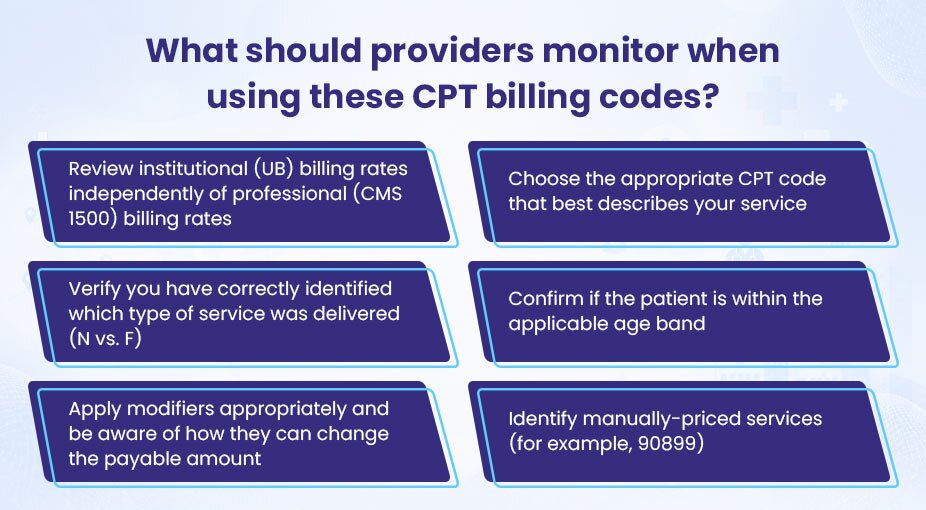
1). Choose the appropriate CPT code that best describes your service
When selecting CPT billing codes, you need to ensure they match what services were provided. There are no exceptions or “workarounds” to the selected codes. The definition of each CPT code has its own specific requirements and time-based criteria, and payers will typically conduct audits to confirm the service being billed corresponds to the documented clinical services.
2). Verify you have correctly identified which type of service was delivered (N vs. F)
For many Cognitive Behavioral Therapy(CBT) and community-based service codes, payers use indicators such as N (non-facility) and F (facility). Depending on where the service is provided, this impacts the billing rate paid to you by the payer. Therefore, prior to assigning any fee schedule amount, you must verify which indicator applies.
3). Confirm if the patient is within the applicable age band
Psychiatric care services are frequently segmented into separate fee schedules by age bands. Commonly used age bands include 0-20 years and 21+. Age bands are defined by clinical intensity and regulatory requirements.
If an incorrect age band is chosen, it may result in rate calculation errors and claim payment refusal for non-age eligibility.
4). Review institutional (UB) billing rates independently of professional (CMS 1500) billing rates
UB 04 (institutional) billing uses revenue codes. Institutional billing often uses different reimbursement methodologies than professional billing (i.e., CMS 1500), including per diem models, case rate models, or payer-specific contracts. Additionally, institutional billing rates may vary significantly from professional billing CPT rates. Therefore, Texas providers should verify their billing arrangements prior to submitting bills to avoid both under-billing and over-billing.
5). Apply modifiers appropriately and be aware of how they can change the payable amount
Modifiers, such as HQ (group setting), have a significant role in the amount paid for services. For example, H0038 vs. H0038HQ tells how a modifier changes the payment made due to payer policies regarding group versus individual skills training. Errors in modifier reporting can draw payer scrutiny and result in reimbursement being reclaimed.
6). Identify manually-priced services (for example, 90899)
Manually-priced services, for example, 90899, require the payer to determine the reimbursement amount based on:
- contract terms between provider and payer
- documentation substantiating the services delivered
- whether the services meet patient-specific need
- comparative data for similar services