A golden rule of Florida Medicaid is that you cannot afford to make even the tiniest of errors in billing. Mess up the billing rules through wrong CPT coding, inappropriate modifiers, or ignoring the frequency limit, and you end up losing your hard-earned money.
If you’re not careful, you won’t get paid. It’s that simple.
So, how do you guarantee a steady cash flow?
You strictly follow the AHCA guidelines for occupational therapy services, specifically the official 2026 fee schedule outlined under Rule 59G-4.002. These statewide rates for 2026 serve as a rigid payment structure for all Fee-For-Service (FFS) claims.
Simply put, if your billing practices don’t align with the AHCA’s exact coding guidelines, your practice’s revenue collection will take a direct hit. One wrong move and you end up going back and forth with insurance companies, reworking claims, and wasting precious hours on tedious appeals. Medical billing services in Florida can also help practices manage these billing tasks.
That’s why today we’re covering the 2026 Florida Medicaid Occupational Therapy Services Fee Schedule to ensure that you stay compliant with the Sunshine State’s latest regulations and nip the evil of denials in the bud.
We’ll break down the exact OT services rates, modifiers, penalties, new legislation, and the capital-draining audit traps.
Florida Medicaid Occupational Therapy Fee Schedule 2026
The table below lists the official 2026 Florida Medicaid rates, required modifiers, and daily, weekly, and annual unit caps for occupational therapy.
Want to ensure errorless billing and timely reimbursements? Update your billing software with these exact numbers to eliminate claim rejections and protect your practice’s revenue.
| CPT Code | Modifier 1 | Modifier 2 | Description of Service | 2026 Maximum Fee | Maximum Allowable Units |
| 97165 | — | — | Occupational Therapy Evaluation, Low Complexity | $58.11 | 1 per state fiscal year |
| 97166 | — | — | Occupational Therapy Evaluation, Moderate Complexity | $58.11 | 1 per state fiscal year |
| 97167 | — | — | Occupational Therapy Evaluation, High Complexity | $58.11 | 1 per state fiscal year |
| 97168 | — | — | Occupational Therapy Re-Evaluation | $58.11 | 1 per 5 months |
| 97530 | GO | — | OT Treatment Visit Provided by an Occupational Therapist | $20.33 | 4 per day, 14 per week |
| 97530 | HM | — | OT Treatment Visit Provided by an Occupational Therapy Assistant | $16.28 | 4 per day, 14 per week |
| 97535 | — | — | OT Treatment Visit – Self-care/home management training | $20.33 | 4 per day, 14 per week |
| 97110 | GO | — | OT Treatment Visit – Therapeutic procedure | $20.33 | 4 per day, 14 per week |
| 97755 | — | — | OT Treatment Visit – Assistive Technology | $20.33 | 4 per day, 14 per week |
| 97542 | GO | — | Wheelchair Management and Training by an Occupational Therapist | $36.38 | 4 visits per state fiscal year |
| 29799 | HA | GO | Application of Casting or Strapping | $22.27 | 2 per day |
Good to Know: While AHCA’s official Occupational Therapy Fee Schedule PDF lists dashes (—) for codes like 97535 and 97755, electronic billing software and clearinghouses may still require the GO modifier on submitted claims to designate an OT plan of care.
Occupational Therapy Evaluation Codes (97165 – 97168)
An effective treatment plan starts with the first evaluation. Be it low, moderate, or high complexity, Florida Medicaid pays a flat rate of $58.11 for an initial evaluation.
Although the maximum fee is the same for all the complexity levels (97165, 97166, 97167) and re-evaluations (97168), you must code the evaluation accurately based on the patient’s condition. The American Medical Association (AMA) has strict criteria for choosing the evaluation code.
Remember that therapists are allowed one initial evaluation per patient, per state fiscal year. However, if you need to re-assess the patient later, you must bill it as a re-evaluation using CPT code 97168.
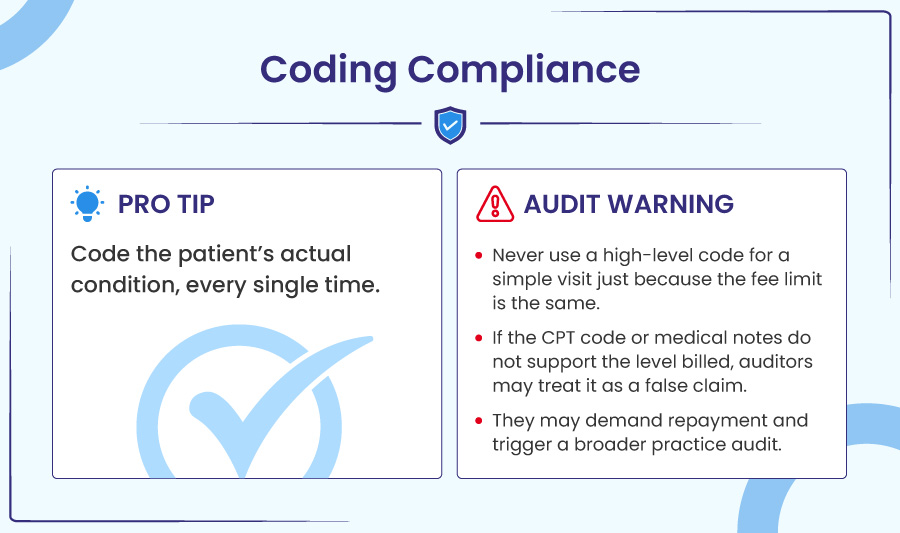
➜ Pro Tip: Code the patient’s actual condition, every single time.
⚠️ Audit Warning
To stay compliant with AMA’s guidelines, never use a high-level code for a simple visit just because the fee limit is the same. Insurance companies run constant audits. If you submit the wrong CPT code or the medical notes don’t prove that the patient actually needed that high-level code, auditors will find it and treat it as a false claim. They will demand their money back. Moreover, by doing so, you risk triggering a full practice audit.
Understanding the Three Levels of Complexity – 97165, 97166, 97167
97165: Low Complexity
According to the AHCA guidelines, use CPT code 97165 in case of a simple evaluation. It typically takes 30 minutes of face-to-face time. Only a licensed occupational therapist (OT/OTR) may perform and bill CPT Code 97165.
To qualify for low complexity, the patient’s assessment must check all boxes below:
✓ Brief History — A basic review of the patient’s medical records focusing only on the current problem.
✓ 1 to 3 Deficits — The patient struggles with 1 to 3 specific skills such as physical reaching, cognitive focus, or basic grooming.
✓ Zero Complications — The patient has no other medical conditions affecting their performance.
✓ No Extra Help — The patient can finish the evaluation tasks without needing physical or verbal assistance from the therapist.
✓ Extra Info: Prior Authorization Requirement — CPT code 97165 doesn’t require prior authorization under standard Fee-For-Service guidelines, though health plans may vary.
97166: Moderate Complexity
CPT code 97166 is used for a moderate evaluation that typically requires 45 minutes of face-to-face time with the patient or family. To properly support CPT 97166 in an audit, your documentation must establish all of the following:
✓ Thorough History — A thorough review of the patient’s past medical and therapy records, including physical, cognitive, or psychosocial history related to their current performance.
✓ 3 to 5 Performance Deficits — The patient exhibits 3 to 5 distinct performance deficits across physical, cognitive, or psychosocial domains.
✓ Secondary Conditions (Comorbidities) — The patient may present with underlying conditions that directly impact their ability to perform daily tasks.
✓ Moderate Assistance — The therapist must provide minimal to moderate task modifications or hands-on and verbal cues to complete the assessment.
✓ Extra Info: Prior Authorization Requirement — No prior authorization required for Children’s Medical Services (CMS) network plan members and members aged 3 and under. For all other members, authorization is required only for non-participating providers.
97167: High Complexity
Therapists bill the 97167 CPT code on claims to indicate an extensive evaluation typically requiring 60 minutes of face-to-face time with the patient or family. To ensure compliance with Florida Medicaid guidelines and defend against an AHCA audit, your documentation must establish all of the following:
✓ Extensive History — A comprehensive review of the patient’s past medical, physical, cognitive, and psychosocial records related to current functional issues.
✓ 5 or More Deficits — The patient exhibits 5 or more performance deficits across physical, cognitive, or psychosocial skills that limit their activity and/or restrict participation.
✓ Comorbidities Present — The patient has secondary health conditions that directly affect their occupational performance and treatment options.
✓ Significant Assistance — The therapist must provide major task modifications or a combination of substantial physical and verbal help for the patient to complete evaluation.
✓ Extra Info: Prior Authorization Requirement — No authorization required for Children’s Medical Services (CMS) network plan members and members aged 3 and under. For all other members, authorization is required for non-participating providers only.
CPT 97168: OT Re-Evaluation
As described in the American Occupational Therapy Association’s (AOTA) CPT code manual, 97168 must be appended to the claim when the provider reassesses an established patient’s progress or modifies their treatment goals. CPT 97168 reimburses at the same flat rate of $58.11 and typically requires 30 minutes of face-to-face time.
While standard Fee-For-Service (FFS) Florida Medicaid requires re-evaluations at least once every 5 months for prior authorization (PA) renewals, Managed Medical Assistance (MMA) plans like Sunshine Health or Simply frequently operate on shorter, 90-day authorization cycles.
OT clinics must align the re-evaluation date with the specific plan’s PA window. Waiting 5 months for a plan that requires 90-day renewals will cause the authorization to lapse, leaving therapists providing unpaid care for two months. It can seriously dent their finances.
To defend CPT 97168 in an audit, your medical reports must include the following:
✓ Documented Status Change — Proof of a change in the patient’s functional status or medical condition based on a revised plan of care.
✓ Updated Occupational Profile — Written updates reflecting how new barriers or environment changes impact their current goals.
✓ Revised Plan of Care — A formal revision of the treatment plan, intervention strategies, and updated clinical goals.
✓ Unit Limit — 97168 is an untimed code. You bill it as a single unit for the entire re-evaluation, instead of breaking it down into 15-minute blocks.
✓ Extra Info: Prior Authorization Requirement — 97168 CPT code doesn’t require prior authorization for members aged 3 and under. For members aged 4 or older at the date of service, authorization is required only for non-participating providers.
⚠️ Compliance Warning
It’s important to note that Florida Medicaid will not reimburse for CPT 97168 occupational therapy re-evaluation just because a new month has started.
To bill this code, providers must document a specific clinical reason such as a sudden change in performance deficits, a revised plan of care, or an upcoming Prior Authorization renewal window. For instance, 5 months for standard FFS Medicaid, or typically 90 days for MMA plans.
How to Choose Between CPT 97165, 97166, and 97167?
Choosing between CPT 97165, 97166, and 97167- Low, Moderate, and High Complexity, respectively isn’t easy. A lapse in judgment about the wrong complexity tier leads to audits of OT billing. Although these five-digit CPT codes have identical structural components, the differences lie in performance deficits, comorbidities, and clinical decision-making.
Note: We’ve also added a fourth CPT code, 97168, Occupational Therapy Re-evaluation, to complete the comparison section. It indicates a follow-up assessment or re-evaluation after significant changes have occurred during a plan of care.
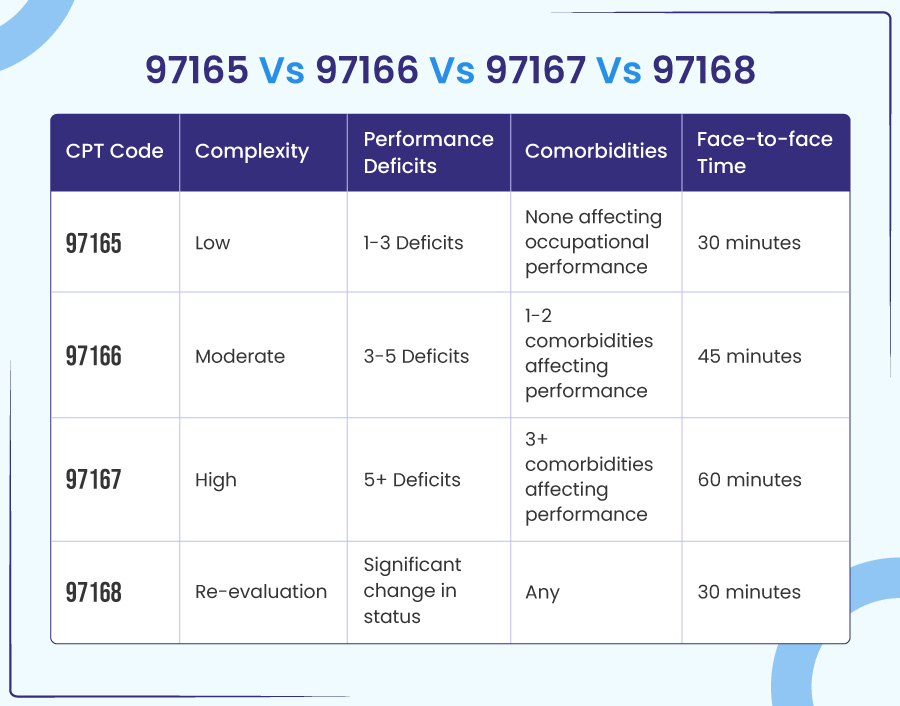
| CPT Code | Complexity | Performance Deficits | Comorbidities | Face-to-face Time |
| 97165 | Low | 1-3 Deficits | None affecting occupational performance | 30 minutes |
| 97166 | Moderate | 3-5 Deficits | 1-2 comorbidities affecting performance | 45 minutes |
| 97167 | High | 5+ Deficits | 3+ comorbidities affecting performance | 60 minutes |
| 97168 | Re-evaluation | Significant change in status | Any | 30 minutes |
GO vs. HM Modifiers with CPT 97530: Different Pay for Occupational Therapists and Assistants
OT clinics across the US lose huge revenue every day just by mixing up who actually performed the work, the licensed Occupational Therapist or their Assistant. Florida Medicaid has a different pay rate for both.
97530 with GO Modifier: OT Treatment Visit Provided by an Occupational Therapist
When a fully licensed Occupational Therapist performs a standard therapeutic activity session, they use CPT code 97530 and attach the GO modifier.
The GO modifier indicates that the service was performed under an outpatient occupational therapy plan of care by the primary therapist. Florida Medicaid’s 2026 payment rate for therapists performing therapeutic activity is $20.33.
97530 with HM Modifier: Treatment Visit Provided by an Occupational Therapy Assistant
When an OT Assistant performs that same therapeutic activity, the payment drops from $20.33 to $16.28. Clinics must append the HM modifier to show FL Medicaid that the assistant performed the job.
Florida Medicaid cuts reimbursement by 20% for two main reasons.
- Assistants require less formal education/licensure and hence earn lower pay rates than licensed Occupational Therapists.
- While federal CMS (Medicare) rules mandate only a 15% pay reduction for assistant-level care, Florida Medicaid enforces a much harsher 20% pay cut. Clinic owners and managers must base their billing and financial forecasting on the state-level reduction, not the standard federal/Medicare rate.
Compliance Warning
If the assistant does the work but, instead of appending the HM modifier, you put the licensed therapist’s GO modifier on the bill to get higher pay, that is fraudulent activity. If an AHCA or Medicaid audit uncovers a discrepancy, your clinic will face a financial recoupment and potential fines.
Ensure that your electronic health record (EHR) system is configured to auto-apply the HM modifier when an OT Assistant provides treatment. However, the modifier alone will not save you in an audit. You must document undeniable proof of supervision in the clinical file.
If an auditor sees the HM modifier on the claim but cannot find the primary, licensed Occupational Therapist’s co-signature and explicitly documented active supervision in the daily progress notes, they will declare the visit invalid and recoup 100% of the payment. An Assistant’s note is never complete until the Supervising Therapist signs it.
Florida Medicaid Occupational Therapy Unit and Frequency Limits
FL Medicaid uses strict scrubbing software to enforce limits on the number of services you can provide. If you exceed these limits, your claim goes straight into the denial pile. Why? Because they use fully automated systems to flag such claims.
Unit Limits for Standard OT Treatment Visits
As mentioned above in the table, for all standard treatment visits signified by CPT codes 97110, 97530, 97535, 97755, Florida Medicaid restricts you to:
- Maximum 4 units per day.
- Maximum 14 units per week.
For Example: If a patient requires intensive therapy and you see them four days a week, billing four units per day equals 16 units in total. Based on the limits set, the system will process the first 14 units and automatically deny the final 2, resulting in $40.66 in lost revenue for that week.
Always follow Medicaid’s unit limits so your hard work doesn’t go to waste.
Service-Specific Frequency and Billing Limits
Specialized procedures like Wheelchair Management come with their own frequency limits.
CPT Code 97542: Wheelchair Management and Training
Although 97542 is reimbursed at a higher rate of $36.38 per unit, it is capped at 4 visits per state fiscal year. This CPT code covers specialized assessment, fitting, and mobility training.
So, in your documentation, you must clearly explain the exact wheelchair skills taught to the patient, like safe propulsion, pressure relief, or navigating various terrains.
Your clinical notes must also state measurable functional goals to show Medicaid why the fitting required a licensed OT’s services instead of caregiver assistance.
CPT Code 29799: Application of Casting or Strapping
Reimbursed at $22.27, but limited to 2 per day, 29799 is an unlisted code. When billing for it, the sequence of modifiers is critical. You must use the exact modifier order, i.e., HA in the first slot and then GO in the second.
- HA modifier signifies a Child/Adolescent Program.
- GO modifier signifies services delivered under an outpatient occupational therapy plan of care.
If you reverse the sequence or miss either one, the software will deny your claim automatically. Moreover, in your notes, you must specify the type of casting or strapping applied to prove that the service was actually provided to the patient.
Compliance Warning
Only use 29799 when the casting or strapping procedure is so unique that a specific code doesn’t describe what you actually performed. And when you do use it, be prepared to send complete documentation to prove it.
8-Minute Rule vs. 15-Minute Units in Occupational Therapy
Occupational Therapy CPT codes like 97530 for therapeutic activities, or 97110 for therapeutic exercise are timed treatment codes. Medicaid doesn’t reimburse a flat rate for these simply because the provider showed up. The provider is paid based on the exact amount of time they spend with the patient to deliver direct, one-on-one care.
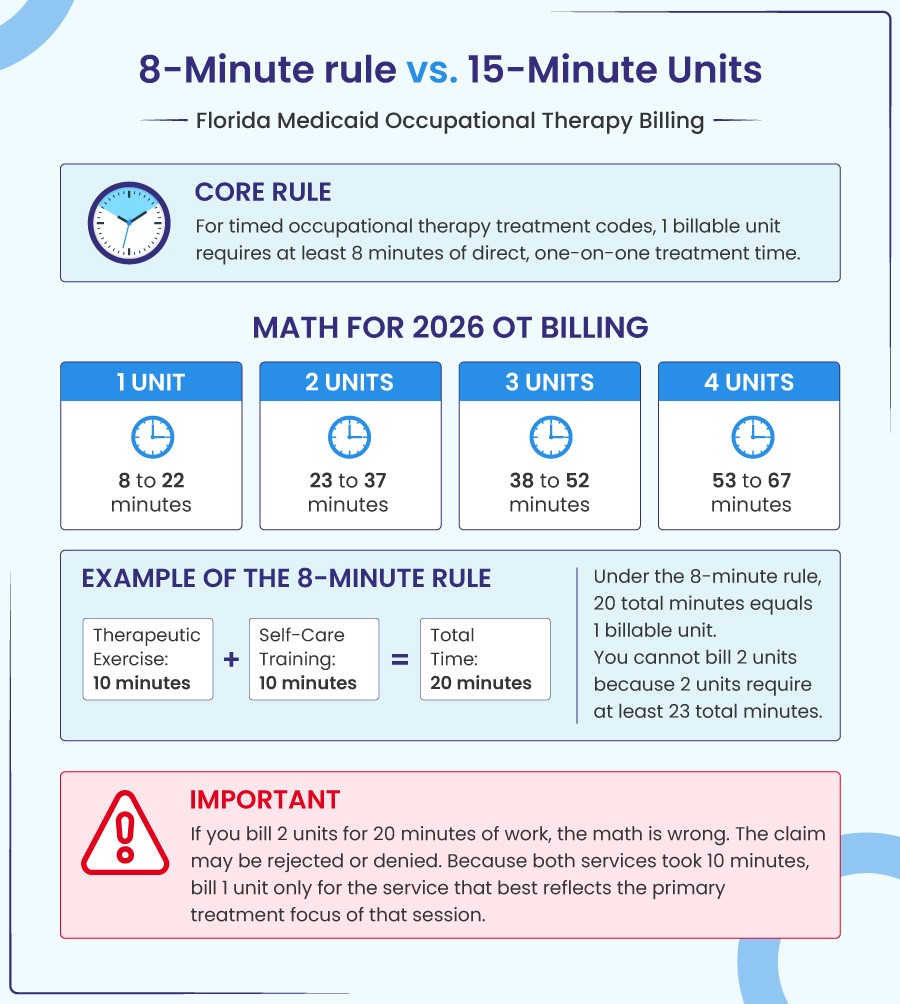
Florida Medicaid enforces the standard 8-Minute Rule established by CMS for Occupational Therapy. To bill a single 15-minute unit for a time-based code, you must provide at least 8 minutes of direct, one-on-one service.
Math for 2026 OT billing:
- 1 Unit: 8 minutes to 22 minutes
- 2 Units: 23 minutes to 37 minutes
- 3 Units: 38 minutes to 52 minutes
- 4 Units: 53 minutes to 67 minutes
Example of the 8-minute Rule:
Suppose you provided 10 minutes of therapeutic exercise and 10 minutes of self-care training, which makes 20 minutes in total. Under CMS guidelines, 20 minutes equals 1 billable unit. You cannot bill 1 unit for exercise and 1 unit for self-care training. That would equal 2 units, and 2 units require a total of 23 minutes.
If you bill 2 units for 20 minutes of work, the math is wrong. Florida Medicaid’s automated system will catch the error, reject the bill, and you won’t get paid. Because both services took exactly 10 minutes, you must choose 1 unit for whichever service provided the primary clinical outcome for that session.
Florida Medicaid OT Fee Schedule and Reimbursement Issues to Avoid in 2026
As a leading revenue cycle management company specializing in Medicaid billing, we’ve noticed the same mistakes made by OT clinics and therapists in the Peninsula State every single quarter.
If you want to keep the money you earn in 2026 and stay compliant with state and federal bodies, train your staff to overcome these three critical weaknesses.
Documentation Mistakes That Can Affect OT Reimbursement
Your daily treatment note is your main defense in an audit. Many overwhelmed therapists copy and paste the exact same note from Friday into Monday’s file to save time.
Imagine reading a book where every single page has the exact same words. You would discontinue reading it and throw it away in disgust because it tells you nothing new.
Here’s What Happens and What to do?
When a Medicaid auditor reads your patient’s file, they want to read a story of the patient’s condition and them getting better over time. If your note from Friday looks exactly the same on Monday, the payor and auditor will assume you did nothing new.
They will assume the patient is not improving. If the patient is not improving, Medicaid will simply stop paying for the therapy. So, to ensure you’re on the right track and get paid accordingly, you must write down exactly what changed each day. Did they reach higher? Did they button their shirt faster? Explain the condition or improvement with proof.
MMA Authorization Limits vs. Florida Medicaid Fee Schedule Limits
Do not confuse Standard Fee-For-Service (FFS) Medicaid rules with Managed Medical Assistance (MMA) plan rules.
Initial Evaluations (97165–97167): In-network providers do not need a Prior Authorization (PA) to perform an initial evaluation for Sunshine Health members.
Ongoing Treatment: Once the evaluation is complete, ongoing therapy sessions require strict Prior Authorization (PA) through third-party vendors.
While standard FFS Medicaid allows up to 14 units a week, an MMA plan strictly limits you to what is on your PA approval letter. If your PA only approves 8 units per week, billing a 9th unit will result in an instant denial. Always verify approved PA unit limits before providing treatment.
Billing Maintenance Therapy Instead of Active Treatment
Standard therapy requires clear evidence that a patient is improving and actually needs a therapist’s medical skills. Once a patient reaches their maximum recovery and no longer needs your specialized assistance with their exercises, you must stop billing for active treatment.
Continuing to bill standard recovery codes, such as CPT 97110 and 97530, just to maintain a patient’s current baseline is a massive violation. It will trigger audits, and your clinic may have to repay the money.
Conclusion
The Florida Medicaid Occupational Therapy Fee Schedule 2026 provides a clear roadmap to full reimbursement. However, to stay compliant, you must strictly follow the AHCA guidelines for Occupational Therapy services.
If you want correct and timely reimbursement, update your billing software to reflect the $58.11 evaluation rate for CPT codes 97165, 97166, 97167, and OT re-evaluation 97168. Also update the payment rates for CPT 97110 and 97530 to $20.33.
Lastly, your system must auto-apply the GO modifier for licensed therapists and the HM modifier for assistant care to prevent claim denials.