A claim can carry its own payment problem into Medicare’s system. In Occupational Therapy billing, three minor-looking details often create that problem before the clinical notes are considered:
- the 2026 KX spending point
- the required use of GO
- the method used to turn treatment minutes into claimable units.
Across the United States, many OT providers collect less than the services should produce. The cause is often surprisingly small. A two-character claim marker may be absent from one service line, or the treatment duration may be divided into units in the wrong manner.
Yearly revisions redraw both the coding framework and the payment values attached to Occupational Therapy services. At the same time, therapy assistants are being given a narrower working boundary, while Medicare reviewers increasingly trace every billed service back to the words written in the patient record.
This guide places the main 2026 billing material in one location. It includes the Occupational Therapy CPT code set, updated payment amounts, the modifiers that prevent a claim from being stopped for technical reasons, and the documentation habits that are more likely to remain defensible during a Medicare examination.
Five Latest Occupational Therapy Billing Details in 2026
Medicare does not receive an OT claim as a neutral document. In 2026, several rules begin controlling its course from the moment the claim is prepared, which makes them essential knowledge for both therapists and billing teams.
1). The 2026 KX Spending Point Is $2,480
Medicare counts Occupational Therapy separately from Physical Therapy and Speech-Language Pathology when measuring this amount.
When the combined OT charges for one patient reach $2,480 within the calendar year, KX must be placed on every OT claim that follows.
When KX is missing after the patient has crossed that amount, Medicare’s system stops payment automatically.
2). GO Modifier Must Accompany Each Medicare OT Service Line
GO is not a modifier that may be placed once and assumed to cover the entire claim.
Every service line furnished under an Occupational Therapy plan of care must carry the GO marker.
When GO is left out, Medicare treats the claim as incorrectly filed rather than as a medical-necessity denial. The biller cannot repair the matter through the usual appeal route. The claim must be corrected and transmitted again.
3). Timed OT Services Follow the Eight-Minute Counting Method
Most time-based Occupational Therapy procedures are reported in fifteen-minute units.
However, the first unit becomes reportable after at least eight minutes of direct, individual contact with the patient.
- Eight minutes support one unit.
- Twenty-three total minutes support two units.
- Thirty-eight total minutes support three units.
An incorrect placement of only a few minutes may cause the reported quantity to fall below or rise above what the treatment record can support. It may also invite claim examination that could have been prevented.
4). A 2.5 Percent Work RVU Efficiency Reduction Applies to Untimed Services
CMS placed a 2.5 percent work RVU efficiency adjustment on services that are not measured through treatment time. CPT codes 97165 through 97168 are included in this group.
Because of this adjustment, the payment amount connected with each affected code is approximately 2.5 percent lower in 2026.
This reduction comes from a general CMS pricing policy rather than from a decision made on one individual claim. For that reason, the usual claim appeal process does not undo it.
CMS intends to calculate the adjustment again every three years.
5). Three New Remote Therapeutic Monitoring Codes Became Active on January 1, 2026
Occupational Therapy practices may miss payment connected with monitoring work when the new Remote Therapeutic Monitoring codes are ignored or paired with the wrong documentation.
The new codes are:
- CPT 98979
- CPT 98985
- CPT 98984
These additions give occupational therapists a reporting path for shorter remote-monitoring periods that were previously more difficult to place within the available coding structure.
Occupational Therapy CPT Codes and the Payment Values Linked to Them
The figures below should be read as national reference amounts rather than fixed payments. They come from the CMS Physician Fee Schedule and represent average non-facility values across the country.
The sum that finally reaches the provider is shaped by two separate pricing layers. The first is the geographic adjustment attached to the service area. The second is the payment arrangement written into the provider’s contract with the payer. Private insurers may place a noticeably different value on a code than Medicare does.
For that reason, the national figure should not be the final number used when forecasting payment. Before a claim is released, compare it with the rate assigned to the provider’s own Medicare Administrative Contractor locality.
➜ Evaluation and Re-evaluation Occupational Therapy Codes
These four codes carry the billing value of the first assessment and any later reassessment. They are not counted through fifteen-minute units.
Only one unit is reported for each patient encounter. The chosen complexity level must match the clinical picture preserved in the note, not simply the code a practice uses most often.
| CPT Code | Service in Brief | Typical Face-to-Face Time | 2026 Non-Facility Price | Main Reporting Condition |
|---|---|---|---|---|
| 97165 | Initial OT evaluation with low complexity | 30 minutes | $100.54 | The record must identify 1 to 3 performance deficits |
| 97166 | Initial OT evaluation with moderate complexity | 45 minutes | $100.54 | The record must identify 3 to 5 performance deficits |
| 97167 | Initial OT evaluation with high complexity | 60 minutes | $100.54 | The record must identify 5 or more performance deficits |
| 97168 | OT re-evaluation under an existing plan of care | 30 minutes | $68.47 | Use only when the record shows a meaningful functional, medical, or environmental change |
An important feature appears across the three initial evaluation codes. Moving from low complexity to high complexity does not raise the listed payment amount.
Because the price remains the same, some practices repeatedly select 97165 even when the patient presentation fits 97167. That choice does not automatically create a billing violation. The deeper weakness is that the clinical note may shrink a complicated case into a simpler account.
When the code understates the encounter, the written record may fail to carry the full number of deficits, the amount of task alteration, or the reasoning behind the therapist’s decisions. A reviewer following the code back through the chart may then wonder whether important limitations were never identified or were left outside the treatment plan.
The evidentiary burden is not equal across 97165 and 97167. Code 97167 calls for at least five performance deficits and a clear statement describing how extensively the tasks had to be modified.
When the note contains those elements, the code should mirror them. A complex evaluation should not be repeatedly pressed into a lower category merely because that coding habit feels safer or more familiar.
➜ Therapeutic Procedures Codes Used In Occupational Therapy Billing (Reported in 15-Minute Units)
Evaluation codes describe the assessment stage. The codes below carry much of the treatment activity that follows.
Each one is time-based and must be converted into billable units through the eight-minute method. Medicare claims also require the correct discipline marker on each applicable service line.
| CPT Code | Service | 2026 Non-Facility Price per 15-Minute Unit | Practical Description |
|---|---|---|---|
| 97110 | Therapeutic Exercise | $29.06 | Exercises selected to develop strength, movement capacity, endurance, or breathing control |
| 97112 | Neuromuscular Re-education | $32.73 | Individual treatment intended to rebuild balance, coordination, movement control, and neuromuscular function |
| 97113 | Aquatic Therapy with Therapeutic Exercise | $37.07 | Exercise performed in water to improve strength, movement, and participation in daily activity |
| 97116 | Gait Training Therapy | $29.06 | Training in walking, stair use, and safe handling of mobility equipment to increase independence |
| 97129 | Cognitive Function Intervention, First 15 Minutes | $22.38 | Treatment and compensatory methods for thinking, memory, reasoning, and problem-solving |
| 97130 | Cognitive Function Intervention, Each Additional 15 Minutes | $21.04 | Add-on code used with 97129 for further work on planning, organising, sequencing, and completing tasks effectively |
| 97140 | Manual Therapy Techniques | $27.72 | Hands-on techniques such as mobilisation, manipulation, and directed pressure for joint or soft-tissue limitations |
| 97150 | Group Therapy | $18.04 | Direct therapeutic procedures delivered to several patients within a supervised rehabilitation setting |
| 97530 | Therapeutic Activities | $35.07 | Purposeful activities used to strengthen the patient’s ability to perform changing and functional tasks |
| 97533 | Sensory Integrative Techniques | $60.79 | Structured sensory input used to improve sensory processing, including treatment for children with autism or brain injury |
| 97535 | Self-Care and Home Management Training | $32.40 | Skilled instruction and adaptation for personal care, household activity, and recovery-related routines |
| 97537 | Community and Work Reintegration | $32.06 | Treatment that prepares the patient to resume employment, community access, or both |
| 97542 | Wheelchair Management | $31.06 | Evaluation of wheelchair needs and training in positioning, propulsion, turning, and safe manoeuvring |
The 2026 payment movement is not equal across all code families. CMS left timed procedures outside the 2.5 percent work RVU efficiency reduction placed on untimed services. As a result, CPT 97530 remains near $35.07 per unit.
In practical terms, treatment-code values held their ground more successfully than evaluation-code values during this payment year.
A Closer Look at CPT 97112
Occupational therapists commonly use 97112 when treatment is directed toward balance, motor coordination, postural control, or proprioceptive function.
Assistant participation changes the payment calculation. When a PTA or COTA supplies more than 10 percent of the total timed minutes attached to the service, the CQ or CO modifier must be added. Once that modifier enters the claim, Medicare applies a 15 percent payment reduction.
Assistant time should therefore be traced carefully across the full timed session. A small shift in who delivered the minutes can alter the amount that Medicare allows.
Why CPT 97535 Needs Stronger Clinical Detail
Payers often give CPT 97535 a closer reading because the service can appear similar to ordinary instruction or routine maintenance.
The note must therefore show more than a list of directions given to the patient. It should reveal the therapist’s clinical judgement, the way the activity was altered, the risks being controlled, and the reason professional skill was necessary.
A convincing record explains what the therapist noticed, what was changed in response, and how safety was managed during the task.
The central question is simple: could an untrained caregiver have delivered the same service in the same way? When the answer is no, the note should make the reason visible.
➜ Modality Codes Used In Occupational Therapy Billing (Supervised & Constant Attendance)
The modality family divides into two billing arrangements. In one, the clinic watches over the patient while the equipment carries most of the treatment. In the other, professional input must be woven into every minute placed on the claim. Knowing which arrangement belongs to each code prevents equipment time from being mistaken for clinician time.
| CPT Code | What the Code Represents | Time Arrangement | 2026 Payment |
|---|---|---|---|
| 97010 | Heat or cold placed on one body region to ease symptoms linked with injury or illness | Clinic oversight, no timed units | Changes by setting |
| 97014 | Electrical stimulation delivered without bedside clinician participation for the full treatment period | Clinic oversight | Changes by setting |
| 97018 | Paraffin treatment used to encourage circulation and soften stiffness or discomfort | Clinic oversight | $6.01, or setting-dependent |
| 97022 | Whirlpool treatment used for blood flow, movement freedom, functional use, or selected wound needs | Clinic oversight | $15.70, or setting-dependent |
| 97032 | Electrical stimulation with clinical input present in every reported minute | 15-minute units | About $14.70 per unit |
| 97033 | Iontophoresis, in which a gentle electrical current carries medication through the skin | 15-minute units | About $19.04 per unit |
| 97035 | Therapeutic ultrasound used to quiet pain and assist tissue repair in tendon, muscle, or ligament conditions | 15-minute units | About $14.36 per unit |
Codes 97010 through 97022 sit in the oversight branch. The patient may receive the modality while the therapist handles another nearby duty, provided the clinic can observe the patient and respond quickly when help is needed.
Codes 97032 through 97035 follow a tighter billing logic. The machine cannot carry the charge by itself. Each claimed minute must also contain clinical work, such as choosing settings, changing intensity, repositioning the patient, checking tissue response, or reshaping the technique when the patient reacts differently than expected.
A device producing heat, current, or sound is only one part of the service. For constant-attendance codes, the payable interval is created by the machine and the therapist working together.
➜ Occupational Therapy Caregiver Teaching Codes (Without Patient Present)
Family instruction often disappears from the claim because it is treated as conversation rather than as a separate skilled encounter. Codes 97550 through 97552 provide a billing route when a relative or caregiver receives face-to-face teaching without the patient in the room.
| CPT Code | Work Represented by the Code | 2026 Payment |
|---|---|---|
| 97550 | Individual caregiver teaching for the opening 30 minutes | $52.77, or payer-dependent |
| 97551 | Each further 15 minutes of individual caregiver teaching | $26.05, paired with 97550 |
| 97552 | Caregiver teaching delivered to several people together | $22.04, or payer-dependent |
The note needs three anchors. It should identify the patient’s absence, the caregiver’s need for therapist-shaped instruction, and the care-plan goal that gave the meeting its purpose.
“Caregiver educated” leaves nearly the whole encounter unwritten. A useful entry should name the caregiver’s difficulty, describe how the lesson was rebuilt around that difficulty, record the caregiver’s attempt, note any errors that were corrected, and identify the home activity connected with the teaching.
The skilled element lies in more than passing information from one person to another. It appears when the therapist studies how the caregiver performs the task, adjusts the explanation, corrects unsafe movement, and decides whether the caregiver can carry the method into daily life without creating new risk.
➜ Physical Measurement, Assistive Technology, and Device Use Codes Used In Occupational Therapy
The next code group belongs to work involving measured performance, technology selection, or the practical handling of an orthosis or prosthesis.
| CPT Code | Work Represented by the Code | 2026 Payment |
|---|---|---|
| 97750 | Physical performance testing followed by a written account of the measured outcomes | $33.73, or payer-dependent |
| 97755 | Study of whether assistive technology fits the patient’s functional needs | $37.74, or payer-dependent |
| 97760 | First-stage orthotic management and training | $46.09, or payer-dependent |
| 97761 | First-stage prosthetic training | $40.42, or payer-dependent |
| 97763 | Later orthotic or prosthetic management and training | $50.10, or payer-dependent |
These codes are untimed, but that does not make them simple. Their billing weight comes from the questions asked, the measurements taken, the problems uncovered, and the conclusions placed in writing afterward.
A routine fitting is too narrow. Merely placing a brace, splint, or prosthetic device on the body does not create the fuller service represented by these codes.
The encounter should explore how the device behaves during movement, where control breaks down, whether safety is weakened, which daily tasks remain difficult, and what adjustment or training method could improve practical use.
The written entry should preserve the route from problem to decision. It should state what failed, what was measured, what was changed, and why that choice matched the patient’s actual circumstances.
Routine fitting puts equipment on the body. Skilled device management works out whether that equipment can become useful beyond the clinic.
➜ Developmental, Cognitive, Emotional, and Health-Behavior Codes Used In Occupational Therapy
This family appears often in pediatric Occupational Therapy and mental health practice. It may also be relevant whenever development, thinking, emotion, or behavior narrows a person’s ability to recover or manage ordinary life.
| CPT Code | Work Represented by the Code | 2026 Payment |
|---|---|---|
| 96112 | Developmental test administration, clinical reading of the outcome, and formal reporting for the first hour | $125.25, or payer-dependent |
| 96113 | Each further 30 minutes of developmental testing and result analysis | $56.11, paired with 96112 |
| 96125 | Standardized measurement of cognitive performance, reported by the hour | $102.87, or payer-dependent |
| 96127 | Brief standardized emotional or behavioral measure with scoring and written outcome | $5.01, or payer-dependent |
| 96156 | Initial health-behavior assessment or reassessment | $107.55, or payer-dependent |
| 96158 | Face-to-face health-behavior work for the opening 30 minutes | $73.82, or payer-dependent |
| 96159 | Further health-behavior work aimed at psychological, social, or behavioral obstacles to recovery | $25.38, paired with 96158 |
Most codes in this group need a recognized instrument named in the chart. Informal observation may add context, but it rarely supplies enough structure by itself.
“Testing completed” is an empty shell. The entry should name the instrument, set down the score or measured outcome, and state the clinical meaning drawn from it.
The score must also travel somewhere. It should alter a goal, justify a particular intervention, expose a hidden difficulty, narrow a safety concern, or change the working plan.
A strong entry therefore answers four questions: what tool was used, what result appeared, what that result means, and which clinical decision came from it.
The New 2026 Remote Therapeutic Monitoring (RTM) Codes for Occupational Therapy
RTM payment turns on two clocks. One counts the days on which the patient uses the monitoring device. The other counts the professional minutes spent managing the case during the month.
Before 2026, both clocks had empty stretches. Device use below 16 days often fell outside the older supply codes, while monthly management below 20 minutes did not reach 98980. CMS filled those two spaces on January 1, 2026, by adding 98984, 98985, and 98979.
For OT practices, these additions may convert short but valid RTM work from an unpriced activity into a payable claim line.
| CPT Code | Activity Named by the Code | 2026 National Rate | Limiting Rule |
|---|---|---|---|
| 98984 | Respiratory RTM device use recorded on 2 through 15 days | $52.11 | Reserved for respiratory conditions |
| 98985 | Musculoskeletal RTM device use recorded on 2 through 15 days within a 30-day span | $51.44 | Cannot share the same period with 98977 |
| 98979 | Monthly RTM management reaching at least 10 minutes of physician or qualified healthcare professional work | $26.39 | The month must include one live interaction with the patient or caregiver |
The new trio does not create a different kind of RTM. Instead, it gives shorter activity a place of its own.
Codes 98984 and 98985 catch device use that reaches at least two days but stops before day 16. Code 98979 catches monthly management that reaches 10 minutes but does not climb to the 20 minutes needed for 98980.
| CPT Code | Activity Named by the Code | 2026 Rate | Limiting Rule |
|---|---|---|---|
| 98975 | Opening equipment setup and patient instruction for an RTM episode | $21.71 | Used once during the episode |
| 98976 | Respiratory RTM device supply covering 16 through 30 days | $52.11 | Respiratory use only |
| 98977 | Musculoskeletal RTM device supply covering 16 through 30 days | $51.44 | Cannot share the same period with 98985 |
| 98980 | First 20 minutes of RTM management within one calendar month | $54.11 | One live interaction is required |
| 98981 | Each further 20 minutes of RTM management during that month | $41.42 | May appear only after 98980 |
What Changed for Short Device Use
Under the earlier arrangement, respiratory and musculoskeletal supply codes generally began at 16 monitored days inside a 30-day period.
That left a patient with 10 qualifying days in a coding void. The device had been used, data had been gathered, and the practice may have carried out related work, yet the day count did not fit 98976 or 98977.
The 2026 additions divide the month more precisely:
| Monitored Days | Respiratory Code | Musculoskeletal Code |
|---|---|---|
| 2 to 15 days | 98984 | 98985 |
| 16 to 30 days | 98976 | 98977 |
The body system still decides which branch applies. Respiratory monitoring belongs with 98984 or 98976. Musculoskeletal monitoring belongs with 98985 or 98977.
The shorter and longer code from the same branch are not meant to occupy the same 30-day stretch.
What Changed for Monthly Management Minutes
The management side previously began at 20 minutes through code 98980.
That left 10 to 19 minutes without a matching entry. A clinician could review transmitted information, speak with the patient, and revise the working approach, yet still finish the month below the old starting point.
Code 98979 now receives that lower band.
| Monthly RTM Management Time | Applicable Code |
|---|---|
| 10 to 19 minutes | 98979 |
| First 20 minutes | 98980 |
| Each further 20 minutes | 98981 |
Code 98979 is therefore not a smaller version of 98980 used by preference. It belongs only where the qualifying work reaches 10 minutes but remains under 20 minutes.
The monthly total must also contain at least one live conversation or comparable synchronous contact with the patient or caregiver. Device readings, stored messages, or data review alone do not complete that requirement.
How These Codes Attach to Occupational Therapy
CMS places these RTM codes in the category of sometimes therapy services.
When an occupational therapist furnishes the service under an OT plan of care, the claim line takes the GO modifier.
The assistant rule does not spread across the entire RTM family. It reaches only selected codes.
RTM Codes Subject to the De Minimis Assistant Rule
- 98975
- 98979
- 98980
- 98981
For these entries, OTA participation must be measured against the de minimis standard. When the assistant’s share crosses the applicable limit, the assistant-related modifier and payment reduction come into play.
RTM Codes Outside the Assistant-Modifier Calculation
- 98976
- 98977
- 98984
- 98985
These four entries describe the device-supply portion rather than monthly management time. The assistant modifier does not attach to them, even when an OTA helps with equipment setup or other practical steps connected with the device.
The cleanest way to separate the two groups is to ask what the code is pricing. Codes tied to setup or professional management may bring assistant time into the calculation. Codes tied only to the monitored device period do not.
2026 Occupational Therapy Modifier Field Guide
A modifier is a two-character claim signal placed beside a CPT code. It tells the payer what sits behind that service line, such as the therapy discipline, an assistant’s share of the work, a crossed Medicare spending limit, or the reason two procedures should not be merged.
Leaving out a required marker may stop the claim before ordinary payment review begins. Choosing the wrong marker may allow the claim to move farther, only for the payer to refuse payment later.
The sections below sort the main OT modifiers by the job each one performs.
Discipline Markers: Identifying the Therapy Path
| Modifier | Meaning Carried by the Modifier | Where It Belongs |
|---|---|---|
| GO | The service was furnished by an occupational therapist or under an outpatient OT plan of care | Attach to every Medicare OT service line |
| GP | The service belongs to a Physical Therapy plan of care | Use only for PT billing, never as an OT substitute |
| GN | The service belongs to an outpatient Speech-Language Pathology plan of care | Use only for speech-language services |
For Medicare OT billing, GO is not an optional label added once to the claim header. It must travel with each individual OT line.
When GO is absent, Medicare may stop the claim at intake rather than issue a formal denial. No denial decision means no appeal route exists. The biller must correct the file and send it through again.
That detour may leave expected payment sitting outside the normal payment stream for several weeks.
Assistant Markers: Showing Who Supplied the Timed Work
| Modifier | Meaning Carried by the Modifier | Where It Belongs |
|---|---|---|
| CO | An Occupational Therapy Assistant furnished all or part of the OT service | Use when the OTA’s independent share rises above 10 percent of a timed unit |
| CQ | A Physical Therapist Assistant furnished all or part of an outpatient PT service | Use only on PT lines involving a PTA |
The de minimis calculation turns on the assistant’s independent minutes.
When an OTA supplies no more than one-tenth of a single CPT unit, CO is generally not added. Once the OTA portion moves beyond that one-tenth boundary, the line takes the CO modifier.
A CO line is paid at 85 percent of the usual Medicare Part B amount. The reduction is attached line by line, so a modest cut on one service can become a large revenue drain across repeated claims.
The last payable unit has a special timing safeguard. When the supervising occupational therapist personally supplies at least eight minutes of that final unit, CO does not attach to that unit.
Minute ownership therefore matters. Practices should record not only the total duration, but also which practitioner supplied each portion.
CO never stands alone on a Medicare OT line. It must sit beside GO.
Correct arrangement: 97110 GO CO
Threshold and Patient-Liability Markers
| Modifier | Meaning Carried by the Modifier | Where It Belongs |
|---|---|---|
| KX | The yearly Medicare therapy amount has been crossed, and the continuing skilled need is supported | Add after the patient’s cumulative OT charges pass $2,480 in the calendar year |
| GA | A valid Advance Beneficiary Notice of Noncoverage has been issued and kept on file | Add when Medicare payment is not expected and the patient has accepted personal payment responsibility |
KX and GA send opposite messages.
KX tells Medicare that the annual amount has been exceeded, yet further skilled Occupational Therapy remains clinically justified. The chart must carry enough substance to defend that statement.
Adding KX without a record capable of carrying it may later produce repayment demands.
GA belongs to a different billing situation. It indicates that the patient received an ABN before the service and agreed to become financially responsible when Medicare does not pay.
KX says continued Medicare-covered therapy remains justified.
GA says Medicare coverage is not expected and the patient has accepted the cost.
The two should not be placed on the same claim.
Modifiers Used to Keep Separate Procedures Apart
| Modifier | Meaning Carried by the Modifier | Best-Fit Situation |
|---|---|---|
| 59 | Distinct procedural service | Use when an NCCI edit joins two codes even though the services had separate clinical identities |
| XE | Separate encounter | Use when the same patient receives the services in different, self-contained visits on the same date |
| XP | Separate practitioner | Use when another qualified professional furnished the separately payable service |
| XS | Separate structure | Use when the procedures were performed on different anatomical structures or organs |
| XU | Unusual non-overlapping service | Use when the services occurred in the same encounter but did not share the same purpose, work, or body region |
NCCI edits are designed to prevent payment for code pairings that usually belong inside one combined service. A modifier may separate the pair only when the actual encounter does not fit that usual pattern.
Modifier 59 is the broad option. It should not be used merely because two codes were performed on the same day. The chart must give each procedure its own clinical reason, its own work content, and enough separation to justify independent payment.
Consider manual therapy under 97140 and an OT re-evaluation under 97168 on the same date. NCCI may join the two.
Modifier 59 may be placed on the re-evaluation only when that re-evaluation arose from its own clinical need and was not simply a brief continuation of the treatment visit.
The note should make visible why a new evaluative look was necessary, what changed, and what decision followed from that new information.
When one of the X modifiers gives a more exact description, use it instead of the wider 59 marker:
- XS for different body structures
- XP for different practitioners
- XE for different encounters
- XU for unusual services whose work does not overlap
Choose the narrowest modifier that the clinical entry can genuinely carry.
The Eight-Minute Method in Occupational Therapy Billing
Timed OT billing works from a minute ledger, not from the scheduled length of the appointment. Medicare counts only the interval during which the therapist is actively treating the patient in an individual setting.
Minutes used for writing notes, moving the patient between locations, preparing the room, or waiting for treatment to begin do not enter the billable total.
The following ranges show how many units the treatment clock can produce:
| Countable Treatment Minutes | Units Available for Billing |
|---|---|
| 8 to 22 minutes | 1 unit |
| 23 to 37 minutes | 2 units |
| 38 to 52 minutes | 3 units |
| 53 to 67 minutes | 4 units |
| 68 to 82 minutes | 5 units |
| 83 to 97 minutes | 6 units |
Each therapy discipline keeps its own minute pool. When the same patient receives OT and PT on one date, the OT clock and PT clock must be counted in separate columns. Minutes from one discipline cannot be poured into the other to create another unit.
Example: Forty Minutes Spread Across Two OT Codes
Suppose the patient receives:
- 97530, therapeutic activities, for 25 minutes
- 97140, manual therapy, for 15 minutes
Together, the two timed services contain 40 payable minutes. Under the eight-minute chart, 40 minutes produce three units.
The remaining question is where the third unit belongs.
The Residual-Minute Method
Begin by removing one complete 15-minute block from each service.
For 97530, the first 15-minute block leaves 10 unused minutes.
For 97140, the full 15 minutes leave no unused minutes.
Two units are now assigned, but the 40-minute total permits three. The extra unit travels to the code holding the larger remainder. Because 97530 has 10 residual minutes and 97140 has zero, the claim should contain:
- 97530: 2 units
- 97140: 1 unit
This method prevents the final unit from being placed by guesswork or by whichever code has the higher payment value.
Give the Billing Clock a Visible Trail
Writing only “15 minutes” leaves the sequence of care difficult to reconstruct. A stronger entry gives each procedure its own beginning, ending, and minute count.
For example:
97530: 10:00 a.m. to 10:25 a.m., 25 minutes
97140: 10:25 a.m. to 10:40 a.m., 15 minutes
This format lets a reviewer retrace the unit count without having to infer how the session was divided. It also shows that the same minutes were not assigned to two procedures.
How Medicare Builds the Dollar Value of an Occupational Therapy Code
Medicare does not attach a payment figure to a CPT code without first passing it through an RVU formula.
Each code receives a Relative Value Unit made from three separate value layers.
Work RVU
The work RVU places a numerical weight on the clinician’s professional labor. It takes account of the time involved, the skill demanded, the clinical decisions made, and the mental or physical intensity carried by the service.
Practice Expense RVU
The practice expense RVU represents the operating burden behind the encounter. It includes items such as employee wages, rent, equipment, clinical supplies, and the other resources consumed while care is furnished.
Malpractice RVU
The malpractice RVU accounts for the professional-liability cost connected with delivering the service.
CMS joins these three values into one total RVU. That total is then paired with the annual conversion factor, which changes the RVU number into a dollar amount.
For 2026, the conversion factor supplied for clinicians outside a qualifying Alternative Payment Model is $33.4009. Most OT practices fall inside this group.
Qualifying APM participants receive the slightly higher figure of $33.5675, although relatively few occupational therapists meet the current legal conditions for that category.
Why OT Payment Can Look Disproportionately Small
The RVU comparison reveals why many therapists regard the payment structure as uneven.
For neuromuscular re-education under 97112, the total value is approximately 0.99 RVUs. Using a conversion factor near $33.40 produces a payment of roughly $33 for one 15-minute unit.
An established-patient office visit reported by a primary care physician under 99213 carries approximately 2.75 RVUs. At the same conversion factor, the resulting payment is close to $91.
The second amount is almost three times the first, even though both services require the clinician to read changing patient responses, choose what should happen next, and carry responsibility for the outcome.
Knowing how this imbalance is produced does not enlarge the current payment. It does, however, uncover the numerical structure behind the difference and explains why therapy advocacy groups continue pressing for a new valuation of therapy RVUs.
2026 Occupational Therapy Billing & Coding Threshold
For 2026, Medicare gives Occupational Therapy its own $2,480 KX limit. OT spending is counted separately from Physical Therapy and Speech-Language Pathology.
Think of the threshold as one yearly account for each patient. Starting on January 1, every Medicare-allowed OT amount enters that account. After the total passes $2,480, KX must appear on every later OT claim line until December 31.
A diagnosis change does not erase the earlier amount or begin a new total.
For example, a patient may receive hand therapy in March and pass the limit during that episode. If the same person returns for shoulder therapy in September, the earlier hand-therapy amount remains part of the yearly OT count. KX is still required because Medicare places all OT services for that patient inside one calendar-year total.
The $3,000 Review Level
A second financial point appears at $3,000.
Reaching this amount does not automatically stop payment. It means later claims may be selected for targeted medical review. CMS may ask the practice to provide the chart material that explains why therapy continued.
This request often arrives as an Additional Documentation Request, commonly called an ADR.
An ADR includes a response deadline. The requested material must reach the Medicare contractor before that date. Missing the reply period may cause the related claims to be denied without further review.
Start Tracking From the First Visit
Begin the running total with the patient’s first OT visit of the year. Do not wait until the amount is already close to $2,480.
A new Medicare patient should also be asked whether Occupational Therapy was received from another provider earlier in the same year. Counting only the services supplied by your own practice may give a false picture of the patient’s remaining amount.
When the patient cannot give a reliable answer, request the available usage details from the relevant Medicare contractor.
Your billing system should create two advance warnings:
- One shortly before $2,480
- Another shortly before $3,000
Memory, handwritten totals, and separate spreadsheets make the process unreliable. A dependable practice-management system keeps the annual figure in one place and brings approaching limits into view before the claim is sent.
Documentation Rules for Medicare Audits
A Medicare review does not stop at the CPT number. The reviewer moves from the claim line into the chart and looks for the work represented by that code.
The written account should therefore make the encounter understandable without guesswork.
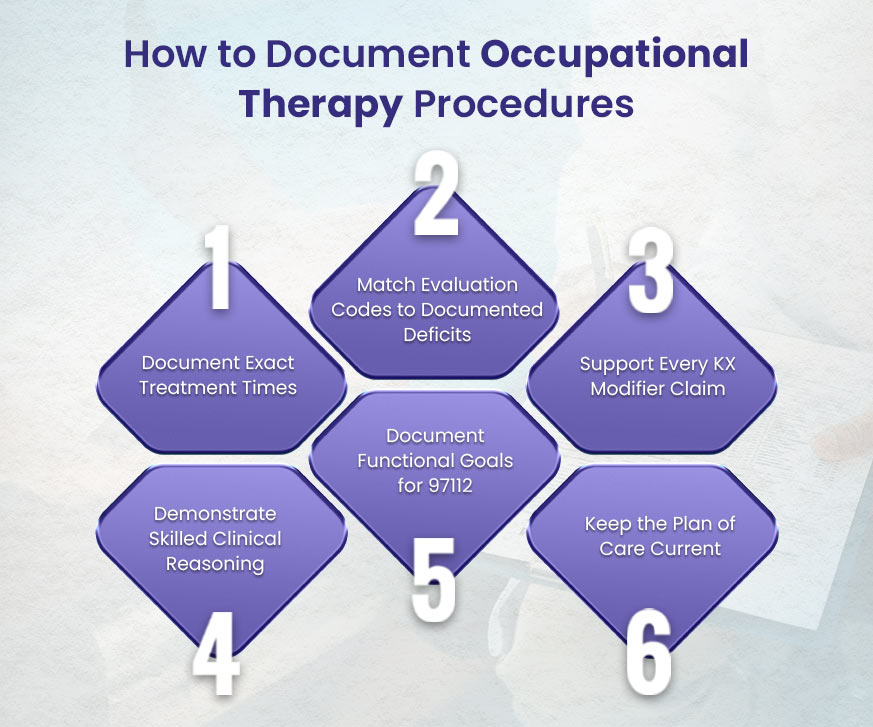
1). Record Exact Start and End Times
For every timed procedure, write the exact opening and closing times.
Avoid an entry such as:
97535, 15 minutes
Use a clock-based entry instead:
97535: 9:00 a.m. to 9:15 a.m.
This gives the billed interval a clear boundary. It also helps establish that the same minutes were not counted twice or mixed with transport, waiting, note writing, or other non-treatment activity.
2). List the Required Deficits
The selected evaluation level should be visible inside the evaluation note itself.
For the codes listed here:
- 97165 requires 1 to 2 deficits
- 97166 requires 3 to 4 deficits
- 97167 requires 5 or more deficits, together with the degree of task modification
Do not scatter unclear references across several pages and expect the payer to assemble them. Name the deficits directly and place them close enough to the complexity choice that the connection is easy to follow.
3). Support the KX Modifier
KX tells Medicare that skilled OT remains justified after the yearly spending limit has been crossed. The chart must contain the explanation behind that claim marker.
A KX-supported entry should make the following points clear:
- Why does the patient still require the knowledge and judgement of an occupational therapist?
- What decline, danger, or lost ability may follow if therapy ends?
- What function is improving, being preserved, or being prevented from worsening?
- Why could a caregiver or ordinary helper not provide the same work with equal safety and effect?
A KX modifier used without this written foundation may later lead to a repayment request.
Document Skilled Work for 97535
For self-care training under 97535, a sentence such as “patient practised dressing” records the activity but leaves the therapist’s contribution nearly invisible.
A stronger note identifies the difficulty observed, the movement pattern or environment that was reworked, the safety issue that had to be controlled, and the reason that particular change was selected.
For example, the entry may describe where dressing broke down, how the method was rebuilt around the patient’s limitation, and which danger the therapist prevented during the task.
The payable element lies in the professional decisions threaded through the activity, not simply in the fact that dressing took place.
4). Document the Main Problem for 97112
For 97112, do not leave the chart as a bare list of exercises.
Name the exact neuromuscular problem being addressed, such as:
- Impaired balance
- Reduced motor coordination
- Poor postural control
- Diminished proprioceptive awareness
Then connect that problem to an ordinary-life demand. The entry should state how the selected activity is meant to improve standing, reaching, transfers, walking, dressing, meal preparation, or another practical function.
A movement list records what the patient did. A well-built 97112 entry records why that movement was chosen and which motor-control difficulty it was intended to change.
5). Update the Plan of Care Every 90 Days
The plan of care should be reviewed at least every 90 days, and earlier when the patient’s condition changes in a meaningful way.
Detailed daily notes cannot make up for an expired plan. Even carefully written session entries may fail during payment review when the governing plan was not renewed within the required period.
The plan-renewal date should therefore sit inside the same alert system that watches the KX amount and the $3,000 review level.
Common Occupational Therapy Claim Problems and Fixes
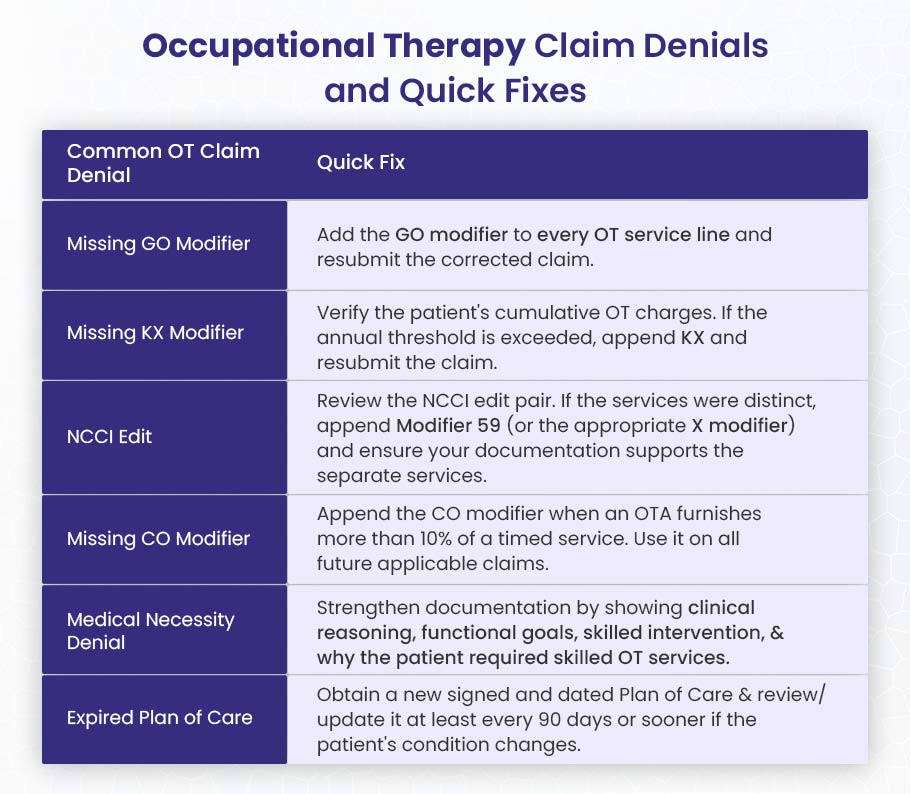
❌ Missing GO Modifier
Why the claim stopped
One or more Medicare OT service lines reached the system without GO.
How to fix it
- Place GO beside every applicable OT entry and send the corrected claim again.
This is usually a front-end rejection rather than an appealable denial. The practical route is correction followed by resubmission.
❌ Missing KX Modifier
Why payment stopped
The patient’s year-to-date OT amount had already passed $2,480, but the later claim lines did not carry KX.
How to fix it
- Rebuild the patient’s cumulative Medicare-allowed OT total.
- When the amount is above the threshold, attach KX to the affected lines and submit them again. When your own calculation appears lower, compare it with Medicare’s information because the patient may have received OT elsewhere earlier in the year.
❌ Missing Modifier 59 or X Modifier
Why the codes were combined
Two CPT entries were billed on the same date even though the NCCI system usually treats one as part of the other.
How to fix it
Examine the exact edit pair and decide whether the two procedures truly had separate clinical purposes.
When they did, place 59 or the most precise X modifier on the secondary code. The chart should describe the reason for separation rather than simply state that the procedures were different.
Use:
- XE when the services occurred in separate encounters
- XP when different practitioners supplied them
- XS when different anatomical structures were involved
- XU when the work did not overlap in an unusual but valid way
❌ Missing CO Modifier
Why the line became vulnerable
An OTA supplied more than 10 percent of a timed unit, but CO was not attached.
How to fix it
- Use CO correctly on later claims and keep a minute-by-minute division of work between the OT and OTA.
- Earlier claims paid at the full amount may later produce a repayment demand. The practice should find exposed lines before a payer review uncovers them.
- For Medicare OT billing, CO remains beside GO. It does not replace GO.
❌ Medical Necessity Not Supported
Why the payer refused the service
The note named an exercise or task but did not reveal the professional judgement inside it.
How to fix it
Read the entry from the payer’s position and ask:
- What difficulty did the therapist detect?
- Which decision came from that difficulty?
- What was reworked because of professional judgement?
- Which practical goal did the activity serve?
- Why could the patient or caregiver not complete it safely without skilled help?
These details should be written before the claim leaves the practice. Adding them only after payment is refused may appear retrospective and may not repair the original weakness.
❌ Expired Plan of Care
Why the claim lost support
The plan of care was not renewed within the required interval.
How to fix it
- Obtain a newly signed and dated plan when appropriate. For later cases, place an alert well before day 90 so renewal occurs before the claim sequence is interrupted.
- The safest arrangement is to keep the plan date, KX total, $3,000 review level, and ADR deadline inside one shared billing view rather than scattering them across unrelated systems.