The urologist checks the size of the stone when a patient says there is a stone in the bladder.
Next, they start crushing and taking out the stone from the body. This process is known as Cystourethroscopy with Litholapaxy. The doctor uses a cytoscope, which goes through the urethra. This helps to break stones using lasers or ultrasound and wash away the pieces.
However, things get tough when there comes the time to link the medical codes to the paperwork and charge for this Cystourethroscopy process.
The stone can be small or large, and the procedure can be simple or complex. You need a clear view of the entire situation to charge the payer for what you really did.
Two CPT codes are used to bill for removing stones, depending on their size.
Urology billers use CPT Code 52317 for removing small stones that are 2.5 cm or smaller. For stones bigger than 2.5 cm, they use CPT Code 52318.
It’s important to know how to use these codes to bill the procedures right. This blog will explain CPT code 52317 and how to document and bill it for quicker reimbursement from insurance payers.
Understanding CPT Code 52317 and How It’s Used
Before submitting a claim that requests reimbursement for the “Cystourethroscopy with Litholapaxy” process, urologists and urology medical billing service providers need to know the basics of CPT Code 52317.
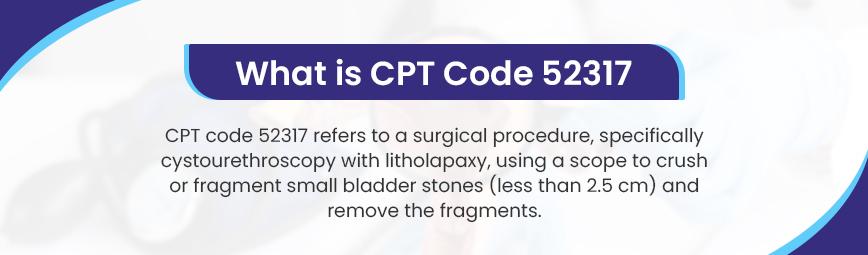
CPT code 52317 refers to a surgery called litholapaxy. This procedure uses a scope to crush or break apart a small bladder stone (less than 2.5 cm) and then removes the fragments.
Urologists use a cystoscope and special tools to break apart and take out stones. The procedure can be simple or complex based on how big the stone is.
Scenarios for Using CPT Code 52317 in Urology Clinics
Scenario 1: Easy Cystolitholapaxy for One Small Stone
A patient visits a urology clinic, experiencing intense pain during urination. The X-ray report shows one bladder stone that is about 1.5 cm wide.
The doctor does a cystoscopy, uses a laser to break the stone, and then takes out the stone pieces with a suction device called an Ellik aspirator.
The biller will use CPT Code 52317 for billing. This is because the stone was 1.5 cm and the procedure was simple.
Scenario 2: Using Laser Lithotripsy to Remove Small Bladder Stones
The patient has a few small bladder stones, each smaller than 2.5 cm. All the stones were broken up and taken out in the same surgery.
When dealing with many small bladder stones in one cystoscopy session, choose your CPT code based on the complexity of the procedure and the payer’s policies, not just the number of stones removed.
Write down all the important data, including:
- count of stones,
- total stone load,
- method of fragmentation,
- duration of surgery,
- and any technical issues faced during the process.
If this procedure is clearly a simple cystolitholapaxy, like when there are small stones, CPT Code 52317 would probably be used. It would also apply if there are no unusual factors making the case more complex, such as a larger number of stones or a longer surgery time.
Otherwise, you can use CPT 52318 (instead of CPT 52317) if there were special factors involved, like a longer surgery time or a lot of difficulty in removing fragments, and so on.
So, before you make your final coding choice, always look at the payer’s rules and add enough details about the procedure to explain why you picked that specific code.
Using CPT Code 52317
As a urologist, getting paid on time relies heavily on using the CPT code. Therefore, use CPT code 52317 only when it’s the right situation. Otherwise, your medical claim will be denied by the payer.
Use CPT Code 52317 when:
- A cystourethroscopy is done to break up the bladder stone and take it out.
- The process was easy since the stone was tiny, often smaller than 2.5 cm across.
- A laser ultrasound or a mechanical lithotripter can break the stone into pieces, and then it can be taken out in the same procedure.
- The stone is in the bladder. It can also be found as calcifications in the urethra or prostatic urethra.
Simply put, if a small bladder stone is broken and taken out using a cystoscope, you should use CPT 52317 to report it.
When Should You Avoid Using CPT 52317:
- Do not use CPT 52317 if the stone is 2.5 cm or bigger. CPT 52318 fits better here because it is for bigger or more complicated bladder stones.
- Do not use 52317 if the stone is taken out through an open surgery, like a cystotomy. In those situations, you should report a different code, like 51050, instead.
- Routine cystoscopic exams, standard catheter placements, and bladder irrigation are usually included in cystolitholapaxy billing codes. So, they shouldn’t be submitted separately.
- There can be times when a different service is needed for medical treatment, and it should be clearly noted. Look at your NCCI edits and the payers’ bundling rules to see if you can submit a specific service on its own. If you submit a service on its own, please include documents that show why the service was separate and needed for medical reasons.
- CPT 52317 is used only for bladder stones that are treated with cystourethroscopy. Stones that form in the ureters or kidneys will be assigned different codes. For example, use CPT Code 52353 if you perform cystourethroscopy with ureteroscopy and lithotripsy. Make sure your operative report clearly shows where the stone was found and what tools and scope were used. This helps apply the right anatomic code.
Documentation Requirements for CPT Code 52317
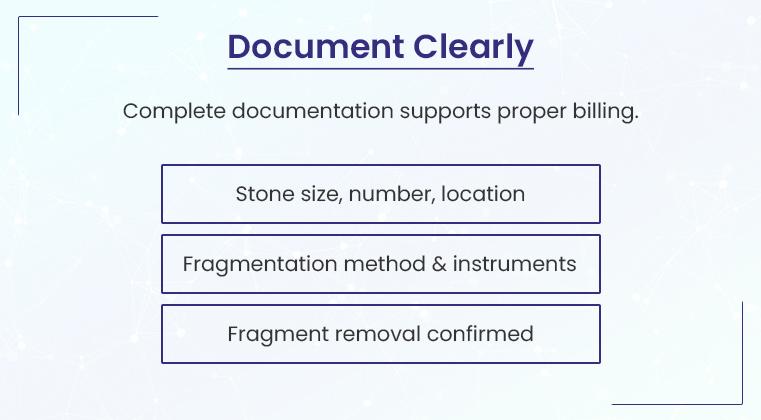
Simple and clear documentation is essential for getting a medical claim approved by an insurance company. When you bill CPT Code 52317, make sure to write down every detail correctly.
- Document clearly the “Cystourethroscopy, with litholapaxy (crushing or breaking down of stones in the bladder and taking out the pieces)”.
- Clearly state that the stone size was under 2.5 and was located in the bladder.
- Write down the method used to break the stone, like laser, electrohydraulic, or ultrasonic lithotripsy.
- Also, remember to write down the inspection details of the bladder, urethra, and ureter openings.
- If several procedures are done (like in the kidney or ureter), write down different locations, tools, and, if needed, different scopes to help with extra, separate codes using modifiers.
- If a different procedure is done in the same session that isn’t included in the usual litholapaxy package, modifier -XU (Unusual Non-overlapping Service) can be used if the paperwork shows it is a separate service.
Usage of Modifiers for 52317 CPT Code
You should only use a modifier in your claim for a medical bill service if you have documentation supporting that you provided an additional or separate service to what is described by the 52317 CPT code. Check the NCCI edits and the payer’s rules regarding the use of modifiers prior to submitting a claim.
Modifier 59: Separate Services
Use Modifier 59 sparingly; there are typically other more precise modifiers (XS, XE, XP, or XU) that would best represent an additional service provided to the patient. If possible, choose a specific modifier rather than Modifier 59 to describe an additional service.
Modifier 22: More Time or Effort Used to Complete Additional Services
Use Modifier 22 when the operative report clearly indicates that the additional services were significantly longer or more difficult to complete.
The urologist must document the reason(s) for the increased time/effort required to complete the procedure within the operative report. The procedure may require additional time to perform because of anatomical variations, multiple attempts to break the stone, etc., as examples.
Estimated Medicare Payment Rates For CPT 52317 In 2026
Physician Fee Schedule rates for CPT 52317 are determined based on local area and type of location that services were provided in (office, ambulatory surgical center, hospital outpatient).
Here are estimated Medicare Reimbursement (physician fee schedule) for the 52317 CPT Code.
| Item | Estimate / Guidance | Key Drivers & Context |
| National Average (Non-Facility) | ≈ $850–$900 | Repayment for the procedure is greater as it will be done in a private physician’s office with all expenses (staff, supplies, etc.) covered by the physician. |
| National Average (Facility) | ≈ $300–$1,000 | Non-facility rates are generally less than those for facilities (hospitals or ambulatory surgery centers), because Medicare reimburses the facility for its own operating costs. |
| Primary Driver (Work RVU) | Substantial | The work RVU for CPT code 52317 reflects both the amount of time spent and the degree of skill and intellectual effort required to perform the procedure. |
| Secondary Driver (PE RVU) | Variable | The Practice Expense (PE) RVUs vary depending on the location of the service (facility versus non-facility). |
Remember: Use the CMS PFS lookup for the most up-to-date information regarding allowed amounts, RVU components and locality adjustment factors for your zip code and place of service.
Commercial Payer Rates for 52317 CPT Code
Commercial payer rates vary on how they negotiate their rate structure, however a common approach is to find that commercial allowed amounts are generally from 1.1 × – 1.6 × Medicare when comparing in-network physician professional services. However, this may have greater variability when looking at facility based charges or out-of-network physician claims.
A Medicare base line with an application of your contract multiplier will provide a rough estimate, but ultimately the language within the contract (i.e., fee schedule, contract multiplier, capitation) dictates what the final allowed amount is for a 52317 claim.
The table below shares estimated rates that commercial payers have defined for 52317:
| Payer Type | Typical Allowed Range (Multiplier) | Estimated Dollar Amount | Regional & Strategic Notes |
| Large National Commercial (In-Network) | 1.2x – 1.6x Medicare | $1,000 – $1,600 | Standard for national plans like UnitedHealthcare or Cigna. Rates vary by employer group contract. |
| Regional Blue / Anthem / Aetna | 1.1x – 1.5x Medicare | $900 – $1,400 | Strongest in high-cost markets (e.g., Northeast, West Coast) where negotiated schedules often hit the higher end. |
| Out-of-Network / Self-Pay | 2.0x – 4.0x Medicare | $1,800 – $3,600+ | High variability; billed charges are often high, but actual “allowed” amounts are restricted by state “No Surprises” laws. |
A Note on “Bundling of Services”
Before filing the claim for the procedure, the urologist must look over the list of services included in the code.
For instance, routine catheter placement, cystoscopic examination of the bladder and urethra, and bladder irrigation are services that are included in CPT 52317.
Therefore, when submitting the claim, the urologist cannot charge for each of these services separately. The payer will deny each one as duplicate charges.
It would be helpful for the urologist to review both the NCCI guidelines and their individual payer’s policies for bundling and charging separately for related services.
Reviewing all of the included services prior to submission of a claim can assist in making certain the claim includes only services that meet criteria. Therefore, there is no delay in payment for revisions to the claim.