When a patient enter hospice care, the goal of treatment changes. Instead of pursuing a cure, hospice now focuses on such things as comfort, quality of life and peace.
Billing for hospice care is also handled somewhat differently than billing for a regular hospital stay. On the UB-04 claim form, the revenue codes tell the insurance company what kind of room and what kind of service the patient received.
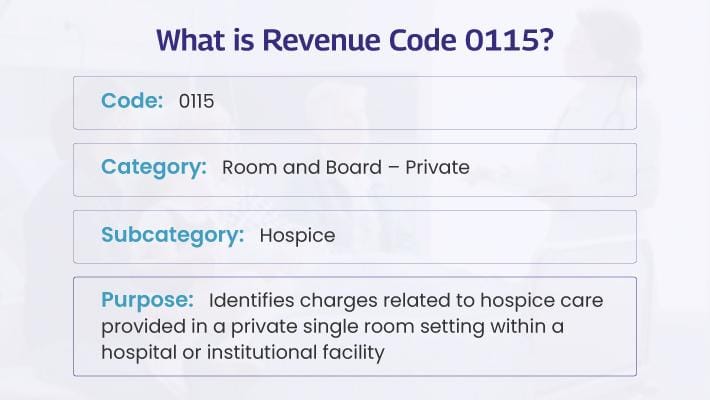
This is where Revenue Code 0115 comes in. It shows that the patient was in a private room for hospice inpatient care, and you are billing for the daily room and board provided with that stay.
Later sections will explain when to use 0115 revenue code and when the other hospice billing codes such as the 065X series would be more appropriate.
What is Revenue Code 0115 in Medical Billing?
Revenue Code 0115 is one component of the 011X group for private room and board. Within that group, 0115 indicates to the payer that the patient was in a private room for hospice inpatient care. For comparison, 0113 is the code for pediatric private rooms.
RC 0115 is entered in form locator 42 of the UB-04 institutional claim form. This indicates that you are billing the facility’s standard room and board for a hospice inpatient day.
What RC 0115 usually covers:
- The private room and bed
- Meals and dietary services
- Routine nursing care associated with room and board
- Linens, housekeeping and basic comfort items
Important note: Emotional and spiritual support is included in the hospice benefit. They are covered under the hospice plan of care and not as separate line items under the hospital’s 0115 revenue code.
What RC 0115 does not include:
- Lab tests, imaging, therapies and procedures. Those are separable services with their own revenue codes if billable.
- Medications. Drugs related to the terminal illness are included in the hospice benefit and provided by the hospice provider and are not included on the facility’s 0115 line.
- Physician professional fees. These go on a professional claim (CMS-1500) and not the UB-04.
When to use 0115?
Use 0115 revenue code when:
- The patient is receiving hospice inpatient care in a private room.
- You are billing routine room and board for that hospice day.
- The day is part of the hospice benefit and not a hospital stay due to acute care. If the patient is in the hospital for acute care instead, select the revenue code for the hospital unit corresponding to the one in which the patient is being treated, such as medical or surgical.
💡 ➜ Hospice inpatient care is a form of care provided to patients suffering from terminal illness in need of round-the-clock medical care and symptom management which cannot be provided in the home or some other place. It is designed to promote comfort and quality of life rather than curative treatment. It pivots on pain management, emotional and spiritual support and assistance of the patient and his family. This form of care is generally provided in a hospice, hospital or special inpatient unit dedicated to hospice care.
Why Does Hospice Private Room Billing Matter?
Hospice billing can be confusing because it does not work the same way as regular hospital billing.
In a hospital stay, you usually bill each service separately, such as nursing, meals, and tests.
On the other hand…
In hospice care, insurance companies (called payers) often pay a daily rate that already includes most services. These payers can be Medicare, Medicaid, or private insurance companies like Blue Cross, Aetna, or UnitedHealthcare.
When you use Revenue Code 0115, you are telling the insurance company:
“This patient is receiving hospice care in a private room, and we are billing for that day’s room and board.”
Special rules for Medicare hospice claims
For patients on Medicare hospice, billing works differently.
In this case, the hospice agency (not the hospital or nursing home) sends the claim directly to Medicare.
Medicare requires hospices to use a different group of revenue codes called the 065X series. These codes show what level of hospice care the patient is receiving.
For example:
0656 means General Inpatient Hospice Care, used when the patient needs 24-hour nursing for pain or symptom management.
The hospital or nursing facility that provides the private room does not bill Medicare directly. Instead, it bills the hospice agency for room and board based on a contract between the two. The hospice agency then includes that cost when it bills Medicare.
To sum up:
- The hospice agency bills Medicare with 0656, not 0115.
- The facility bills the hospice agency, not Medicare.
- Always confirm who is paying for the patient’s hospice care, because Medicare, Medicaid, and private insurers each have their own billing rules.
What about private or commercial insurance
Some private insurance plans follow the same rules as Medicare. They may want inpatient hospice care billed under 0656 as one daily, all-inclusive charge.
Other insurance companies still allow facilities to bill using 0115 for hospice room and board. This is why it is important to check the insurance policy or your provider agreement before submitting a claim. When we say “payer policy,” we mean the specific billing rules for that insurance company.
Stop Leaking Hospice Revenue
Are you struggling with wrong code choices, missing hospice elections, and late interim bills. We are here to fix the basics fast so more of your hospice days get paid. Book a quick review.
Using Revenue Code 0115 in Hospice Care vs. General Inpatient Care
Even though both types of care happen inside a facility, the reason for the stay makes a big difference.
General inpatient care means the patient is being treated to get better, such as for pneumonia or after surgery. Hospice inpatient care, on the other hand, means the patient is being kept comfortable near the end of life, focusing on pain control and dignity rather than cure.
Because the goals are different, the billing codes and payment rates are also different.
Example 1: Hospice stay in a private room
A 72-year-old patient with advanced lung cancer is admitted to your hospital’s hospice wing for pain relief. If the patient’s insurance plan allows it, bill 0115 for each day in the private hospice room. Pain medications and comfort supplies are usually part of the hospice benefit and are not billed separately.
Always verify what the patient’s insurance company requires before billing.
Example 2: Transition from hospital care to hospice care
Day 1: The patient is in a semi-private medical room for pneumonia. Bill 0120 for that day.
Days 2 to 5: The family chooses hospice care, and the patient moves to a private hospice room. Depending on the insurance company:
- Use 0115 for each hospice day if the payer allows it.
- Use 0656 if the hospice agency is billing Medicare for inpatient hospice care.
The key idea is that your billing must always match both the type of care the patient is receiving and which payer is responsible for that day.
Reimbursement Rates for Revenue Code 0115 in Medical Billing
How much you get paid for RC 0115 depends heavily on payer type:
Medicare Reimbursement Rates
Medicare pays hospice by a daily rate that already bundles most services. The rate depends on the hospice level of care, not on 0115.
National FY 2025 base rates before local wage adjustment are approximately:
- Routine Home Care days 1 to 60: $224.62 per day
- Routine Home Care days 61 and beyond: $176.92 per day
- General Inpatient Care (GIP) 0656: $1,170.04 per day
- Inpatient Respite Care 0655: $518.78 per day
- Continuous Home Care 0652: $1,618.59 per 24 hours
Note: Your actual payment is wage indexed to your area.
Medicaid Reimbursement Rates
- Medicaid is state based, although many states base their hospice rates upon the above Medicare hospice rates. States publish their own manuals and fee schedules.
- Always check the state hospice billing guidelines for any exceptions, such as additional documentation if a private room is required. Some states also reference room and board revenue codes like 0115 in specified facility settings.
Commercial Insurance Reimbursement Rates
Private plans pay via contract. Some company plans follow Medicare’s lead and want the inpatient hospice day billed as an all-inclusive hospice level of care line, most likely correlating to 0656, and do not want a separate 0115 room and board line on the claim.
For example, Blue Cross Blue Shield of Nebraska advises that room and board should not be broken out line item wise under 0115. Therefore, always check with the payer’s schedule policy or your contract.
Other plans do allow for a per day room and board line such as 0115. If they do, then the amount allowed is as stated in your contract. There is no “standard” commercial reimbursement rate for the 0115 revenue code.
How Do You Know Whether To Send 0115 Or 0656 On Your Hospice Claim?
0115 means private hospice room on a facility claim when the payer allows it. Medicare hospice claims use 065X instead, usually 0656.
So when should hospice billing facilities use revenue code 0115, and when should they bill 0656 instead?
First determine the answers to two questions:
- Has the patient elected the Medicare hospice benefit
- Who is the claim going to
➡️ If the answer is Medicare hospice:
- The hospice agency sends the reimbursement claim to Medicare.
- The hospice uses the 065X hospice codes, usually 0656 for General Inpatient Care.
- The hospital or nursing facility does not bill 0115 to Medicare.
- The facility usually bills the hospice agency under their contract. You would see 0115 on that facility invoice, but not on the Medicare claim.
➡️ If the claim is going to Medicaid or a commercial plan:
- Follow the plan’s rules and your contract.
- Some plans mimic Medicare and want an all inclusive hospice line like 0656.
- Other plans want or allow a room and board line with 0115 for a private hospice room.
- Check the policy or contract to see what they want.
➡️ If the patient’s stay is not hospice level of care:
- Use normal room and board codes for general inpatient care, for instance 0111 for a standard private room or 0120 for a semi private medical room.
- Do not use RC 0115 unless the patient is in hospice inpatient care in a private room and the insurance payer wants that code.
➡️ Quick examples:
➝ Medicare hospice day in hospital hospice unit. Hospice bills Medicare with 0656. The hospital invoices the hospice with revenue code 0115. So 0115 revenue code may appear on the hospice invoice submitted by the hospital to the hospice agency, but not on the Medicare claim submitted by the hospice agency to Medicare.
➝ Commercial plan that allows facility billing for hospice room and board. Hospital bills the plan with 0115 per the contract.
➝ Patient treated for pneumonia, not hospice. Use the general inpatient room code such as 0120 if it is a semi private medical room.
How To Use Revenue Code 0115 Correctly?
Let’s start with a key point that saves a lot of confusion. Generally, Medicare hospice claims do not use revenue code 0115. When a patient has elected the Medicare hospice benefit, the hospice agency bills Medicare using the 065X code group, which defines the level of hospice care being given. Thus, for a day in the hospice as an inpatient, it would be 0656 General Inpatient Care.
However, hospitals, nursing homes, and inpatient hospice units providing the bed may use 0115 when billing the hospice agency for room and board. Also, some Medicaid and/or private insurance plans will allow or require the use of 0115 on their claim. Thus, 0115 is not an improper code but it must be used only when the payor (the insurer or hospice) is expecting this code.
Step 1). Confirm hospice eligibility
Before you fill out the UB-04, you need to confirm whether the patient is truly eligible for hospice. The payor will want evidence that the patient is actually under official hospice election. This means:
- The patient or family of the patient has executed a form confirming hospice election.
- A physician certification confirms the patient’s life expectancy is six months or less.
This documentation should be in the patient’s chart. Otherwise, the payor can deny the claim.
Step 2). Select appropriate code for the payor
Once there is verification of eligibility, the physician has to determine which code would be applicable here.
- When filing Medicare hospice claims, the hospice uses 0656 on the UB-04, not 0115.
- With Medicaid or private insurance, check the billing policy or provider contract. Some companies follow Medicare’s rule and want 0656. Others want a separate room and board line for inpatient days with 0115 on it.
If in doubt, it’s safest to check with the payer before billing.
Step 3). Fill out the UB-04 correctly
When the payer allows for 0115 here is what to enter:
- FL 42 (Revenue Code): Put 0115 in order to show hospice inpatient room and board.
- FL 46 (Units): Number of covered hospice days.
- FL 45 (Service Date): Enter either each date for daily billing or one span for a multi-day stay.
- FL 6 (Statement Covers Period): The dates here should match the units and service dates.
If you are billing Medicare hospice instead, substitute 0656 for 0115 in the revenue code field.
Step 4). Add the correct diagnoses
The diagnosis codes show why the patient qualifies for hospice care.
- Principal diagnosis (FL 67): The terminal illness such as metastatic cancer, or ALS, or end-stage heart disease.
- Other diagnoses (FL 67A-Q): The conditions which complicate the care, such as COPD, or diabetes, or dementia.
Accurate diagnoses justify the necessity for inpatient hospice care.
Step 5). Add HCPCS codes if required
Not every payer wants a HCPCS code, but some do.
- Medicare does not generally want a HCPCS code with 0115.
- Some Medicaid or private insurers want you to add Q5006 which means “Hospice care provided in an inpatient hospice facility.”
Therefore, always review the payer billing manual to be sure.
Step 6). Show why inpatient hospice was necessary
The documentation must clearly show why the patient could not stay at home on routine hospice care. For example:
- Severe pain which could not be controlled with home medications.
- Nausea and vomiting which required IV medication.
- Complicated wounds which needed nursing care 24 hours a day.
This explanation proves that the inpatient stay was medically necessary.
Step 7). Use the correct claim type
On the UB-04, the Type of Bill (TOB) indicates where you are in the billing cycle. Hospice bills start with 08 followed by a digit which shows whether the hospice is freestanding (1) or hospital-based (2), and another digit indicating what time it is regarding the claim.
- or 0821: Admission claim
- or 0822: First interim claim
- or 0823: Continuing interim claim
- or 0824: Final claim after discharge or death
These codes help the payer process your claim in the right order.
Step 8). Send interim claims for long stays
Don’t wait until the patient is discharged to bill everything. If a patient stays in inpatient hospice for several weeks or longer, submit interim claims on a regular basis, generally monthly. This brings in necessary payments thus avoiding large lags later on in getting money in.
Schedule a FREE 15-minute Hospice Billing Checkup
Give us a short call. Our medical billing service providers will spot the top three issues that are costing you money and show you how we fix them.