Knowing how to bill couples therapy is about getting reimbursed for relational work while being compliant with payers. This guide helps Marriage and Family Therapists (MFT or LMFT) create an easy-to-follow way to bill based on what the payer expects.
We will help you find the best CPT codes for family psychotherapy, which are primarily CPT 90847 when the identified patient is in session and CPT 90846 when they are not. Additionally, we will explain how to write documentation that is compliant for insurance reimbursement and avoid claim denials, as well as medical necessity using the patient’s ICD-10 diagnosis.
This guide will provide you with additional information regarding telehealth visits including Place of Service (POS) 02 or 10, Modifier 95, and tips on verifying benefits and prior authorization. Lastly, this guide answers frequently asked questions regarding couples therapy billing and will assist you in coding, documenting and submitting clean claims with confidence.
How To Code Couples Therapy?
In insurance terms, couples therapy is billed as family psychotherapy. One person must be selected as the identified patient, that is the person who has the diagnosis which meets the medical necessity and under whom the claim is submitted. The other person is the patient’s partner/spouse who is present to assist in the treatment.

Couples Therapy CPT Codes
CPT Codes are set by the American Medical Association. Health Plans require them, because CPT is the common language which indicates to the insurer exactly what service you have delivered, so that the claim can be processed and paid the same way for all insureds.
Here are the CPT codes used for coding couples therapy:
1). CPT Code 90847 (Family Psychotherapy with the patient present)
Use this one when the identified patient is present and the work moves ahead with this person’s treatment plan. CPT describes a typical 50 minute session. Under the time rules of CPT, one unit can be billed once you pass over the midpoint of at least 26 minutes.
Example:
Alex has major depressive disorder and is the identified patient. You meet with Alex and their spouse to work on communication patterns which ease Alex’s withdrawal and support treatment case management goals. Bill 90847 under Alex.
2). CPT Code 90846 (Family Psychotherapy without the patient present)
Use this couples therapy CPT code when you meet with the partner or another family member with the identified patient not in the session, while the focus is yet on the continuing care of the identified patient.
Example:
Jordan is the identified patient with the anxiety disorder. You meet only with Jordan’s partner to coach them on reducing reassurance behaviors which increase Jordan’s anxiety. Bill 90846 under Jordan.
Note: Don’t bill for ongoing couples work using the individual psychotherapy codes.
Do not bill for ongoing couples sessions using individual psychotherapy codes like 90837. These codes are for a one to one psychotherapy service where the focus of the clinical service is on the individual’s treatment—not the treatment of the relationship.
Then what about 90847? Isn’t there an individual there?
Yes, the identified patient is there, but the service itself is family psychotherapy directed at how the relationship effects the symptoms and goals of the patient. This is why you use 90847—not an individual code.
When an individual code can still be right?
If the visit is truly individual psychotherapy and you briefly invite in the partner just to help support the individual’s goals, the individual code can be appropriate for this visit.
❌ Example of incorrect use
Every week you work with Taylor and their spouse on conflict patterns that worsen Taylor’s symptoms of PTSD. Billing 90837 every week would be a bad idea should an audit happen. Use 90847 for these conjoint sessions.
✔️ Example of correct individual visit
You see Sam alone for CBT geared toward the issues of panic disorder. For 10 minutes you invite in Sam’s wife to learn of Sam’s breathing plan. The session is still individual psychotherapy. Billing 90837 on this visit can be appropriate as the primary service was one to one care.
Couples Therapy CPT Code 90847 vs 90846

Ask two questions: who is attending and what is the clinical aim?
- Choose 90847 if the identified patient is in the session and the work contributes to that patient’s diagnosis and goals.
- Choose 90846 if the identified patient is not in the session and you’re working with the patient’s partner or family members for the support of the identified patient’s plan.
Couples Therapy Billing Without the Headaches
Let our medical billing company handle 90847 and 90846. We manage benefits checks, documentation tips, and appeals for family psychotherapy. Claim your free reimbursement review.
Telehealth Medical Billing for Couples Sessions
Most payers will reimburse for 90846 and 90847 via telehealth, but rules seem to vary, so check each one via:
- The payer’s provider portal under Policies or Telehealth. Examples are Aetna, BCBS plans, Cigna, UnitedHealthcare.
- Provider manuals or medical policy libraries on the payer’s website.
- Clearinghouse portals that host payer spaces, such as Availity, if your payer uses them.
- State Medicaid websites and bulletins.
- For Medicare, see CMS telehealth policy pages and local Medicare Administrative Contractor (MAC) bulletins.
Commercial plans mostly use Place of Service 02 for telehealth outside of the patient’s home and Place of Service 10 for telehealth inside the patient’s home. Most will also require modifier 95 for real time audio and video.
Medicare seems to like to know the same place of service you would have used if in person, plus modifier 95 to signal telehealth. Some Medicare Advantage plans follow commercial rules.
Couples Therapy Billing Process: From Intake to Payment
This walkthrough follows how most payers handle family psychotherapy claims, so you can move smoothly from the first visit to getting paid.
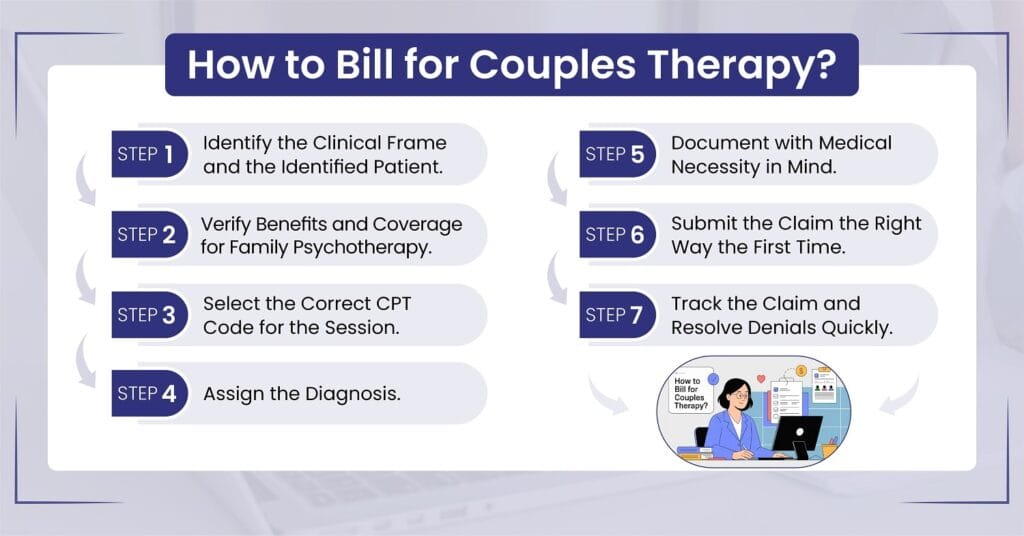
Step #1: Identify the clinical frame and the identified patient
Complete your intake and assessment, determine who has the covered mental health diagnosis, and confirm medical necessity for family psychotherapy. That person is the “identified patient.” Although both partners are present during the session, all billing and documentation are related to the identified patient’s treatment plan.
Tip: Insurance will generally not cover services unless there is a diagnosable condition or medical necessity. Relationship enrichment or generic communication coaching are examples of services that would not be considered medically necessary.
Step #2: Verify benefits and coverage for family psychotherapy
Using either the payer’s online portal or by phone to verify the following:
- Coverage for 90847 and 90846
- Session limits or pre-authorizations
- Any applicable telehealth rules or modifiers
- Copays, coinsurance, and deductibles
Verify that all applicable plans have been verified, including determining which plan is primary under Coordination of Benefits, to ensure that you are billing in the proper order.
Step #3: Determine the appropriate CPT code for each session
➜ When the identified patient participates in a family session, the appropriate code is 90847.
➜ When the identified patient does not participate in the session but you meet with the identified patient’s partner or family to assist in advancing the identified patient’s treatment, the appropriate code is 90846.
➜ When you transition to providing only individual psychotherapy to the identified patient, you would utilize the individual psychotherapy codes (90832, 90834, 90837) depending on the length of the session.
Time Note for Family Psychotherapy: CPT defines family psychotherapy as a typical 50-minute service. You can bill one unit of 90847 or 90846 when you exceed the mid-point of the session (at least 26 minutes). You cannot bill multiple units of 90847 or 90846 per day.
Examples:
- You provide a 52-minute session to Chris and their partner focused on Chris’s PTSD plan. Use code 90847.
- You provide a 45-minute session to Chris’s partner to educate them on how to provide trauma-informed support to Chris. Use code 90846.
- You provide a 60-minute CBT session to Chris. Use code 90837.
Step #4: Assign the diagnosis
Only report the identified patient’s diagnosis on the claim. Most covered mental health diagnoses are located in the ICD-10 F Chapter (mental and behavioral disorders). There is no specific “F-code” for Couples Therapy. Do not use a Z-code alone if you want payment for treatment of a mental disorder. Payers will sometimes permit certain Z-codes to be reported as secondary, but never as the sole diagnosis for psychotherapy.
Step #5: Document with medical necessity in mind
Ensure that the documentation supports the medical necessity of the service, specifically the identified patient’s need for treatment.
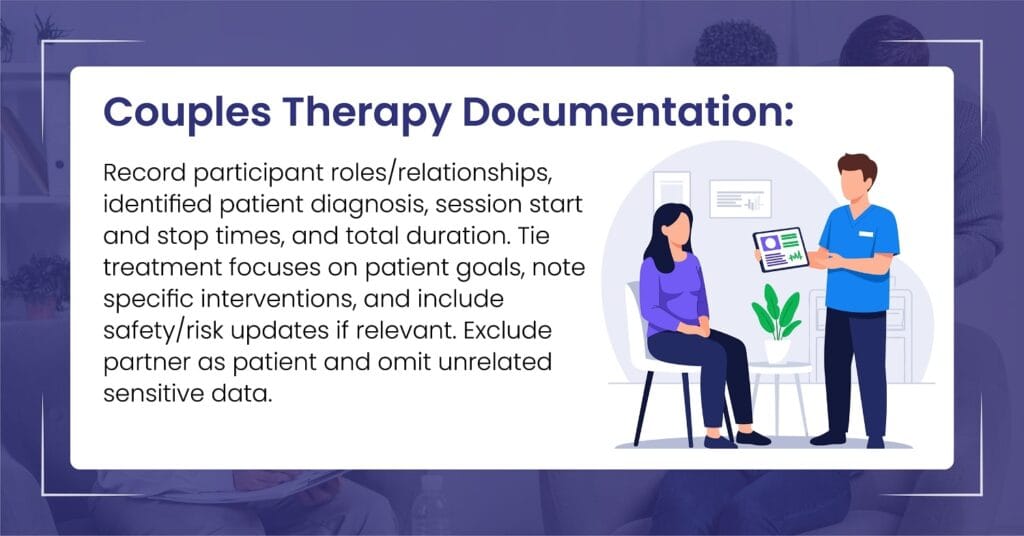
Include in your documentation:
- The attendees and their respective roles
- Start and stop times to validate the length of the session
- Specific interventions and how they relate to the identified patient’s objectives and symptoms
- Your response to treatment and plan for future sessions
Example Template:
- Attendees: Identified patient Morgan and partner. Length of session: 3:00 to 3:52.
- Focus: To reduce depressive withdrawal that exacerbates couple conflict.
- Interventions: Provided Morgan with a behavioral activation plan and educated partner on how to prompt and praise engagement.
- Response to Treatment: Morgan completed two activities this week, Partner prompted four times.
- Future Plan: Continue BA target behaviors and develop an evening check-in script for partner.
Documentation Tip: HIPAA requires that you limit the disclosure of information regarding the psychotherapy session to only the necessary information to facilitate reimbursement and/or to respond to an audit. Psychotherapy notes should be kept separate from the rest of the documentation as they are not submitted for reimbursement purposes.
Step #6: Properly bill the claim the first time
- Utilize the identified patient’s demographic information in the patient field.
- Add the selected family psychotherapy code (90847 or 90846) and diagnosis.
- Identify the proper Place of Service and any required Telemedicine Modifiers.
- If secondary insurance is involved, submit the secondary claim with the primary plan’s Explanation of Benefit (EOB) attached so that secondary can process payment accordingly.
Step #7: Monitor the claim status and address denials timely
Review the denial reason, review your documentation to verify medical necessity and compliance with coding requirements and address the denial in a timely manner.
Common causes for denials include:
- Incorrect Place of Service
- Missing or Incorrect Modifier (e.g., 95)
- Plan language excluding “couples counseling,” however you provided family psychotherapy for a covered diagnosis. Include clarification in your appeal for this issue.
Example Appeal: “One family psychotherapy session, CPT 90847, for treatment of F33.1. The service targeted the patient’s depressive symptoms through partner-assisted behavioral activation. This is not marital counseling for enrichment. Documentation attached.”
FAQs
Does insurance cover couples therapy?
Usually, yes, if one partner has a diagnosable condition and the session is medically necessary. You would bill family therapy by code 90846 or 90847. Coverage varies by plan and some exclude services deemed marriage counseling. Be certain to check benefits first.
How does couples counseling work with insurance?
Insurance accepts it as family therapy. Pick an identified patient who has the diagnosis. Check benefits, pick the appropriate code for each visit, document the diagnosis and medical necessity and bill under the identified patient.
Can I bill couples therapy to both insurances or each separately?
No. One session is one service. You cannot split the hour and bill each partner’s plan. If the identified patient has two plans, bill the primary plan first, then send the secondary with the primary plan’s explanation of benefits.
Will insurance cover couples therapy if the client is also in individual therapy?
Usually yes, when both are medically necessary and are correctly coded. Some payers limit same day combinations or same provider same day. If both happen the same day, write up separate notes with distinct goals and check the payer’s same day policy before you schedule.
How do I code seeing one member of the couple or family alone once?
Code for seeing that member and the reason why.
If the individual therapy is performed with the identified patient, use an individual psychotherapy code (such as 90832, 90834 or 90837, depending on the time).
If the meeting was held without the identified patient to benefit that patient’s treatment, use 90846.
What if there are identifiable diagnosed conditions for both partners?
Pick one identified patient for each claim. Pick out the patient whose identified condition is treated that day and the one whose plan you will bill. If the identified patient’s treatment object changes in the long run, you can switch identified patients after a new assessment and plan. If the authorization given initially is tied to the first patient, check to see whether or not you need a new authorization.
Can the identified patient change from session to session?
Try to be consistent in this matter. There are short term exceptions, otherwise it looks like error or gaming if frequently switched. If changing identified patients for a period of actual treatment, document reason for it, update plan, and check benefits for the new patient of record.
Do I take one copay or two?
One copay only, for the billed patient and service. You are not billing two patients for the same hour.
Can I bill two family psychotherapy session on the same day?
Generally not. The various plans will pay for one 90846 or 90847 per date of service per patient. Two back to back on that day or a morning and afternoon session will be most usually denied unless there is an unusual emergency which can be clearly documented, and the payer allows it.
Can I use 90846 for meeting parents without the child?
Yes. 90846 is family psychotherapy minus the identified patient. It is commonly used for parent only sessions when the identified patient is a minor.
What if the plan states “couples or marriage counseling is excluded”?
That wording will usually be aimed at enrichment counseling. If you have provided family psychotherapy in treating a covered diagnosis for the identified patient, explain this in your claims documentation and/or appeal. Point to the diagnosis, goals, and how the session targeted the patient’s symptoms and functioning.
How should I handle records if my EHR creates separate charts for each partner?
Keep the billing chart under the identified patient. If you maintain linked records, get written consent for information sharing between records for treatment and billing, and keep psychotherapy notes separate if you use them.
What documentation helps if I have to appeal?
Include:
- The CPT code used
- The identified patient’s diagnosis
- A brief medical necessity statement tied to symptoms and functioning
- Who attended and why that was therapeutic
- Start and stop times
- A short paragraph explaining why this is family psychotherapy, not enrichment
Couples Therapy Billing Experts You Can Count On
BellMedEx Medical Billing Services Company has mastered relational billing compliance and payer language so you don’t have to. Schedule your free couples therapy billing audit.