In January 2026, CMS started paying for two new CPT codes for remote patient monitoring (RPM), CPT 99445 and CPT 99470. With the implementation of these new CPT codes, healthcare providers now have more flexibility in how they deliver RPM services to their patients. As stated by CMS, the implementation of these two CPT codes represents a significant shift in how technology based care is paid for, and indicates a long-term expansion to contemporary healthcare delivery models.
New CPT Codes for RPM (beginning January 1, 2026)
- (CPT 99445) ➜ Supply of device with automatic recording or transmission of data for 2-15 days in a 30 day period (~$47)
- (CPT 99470) ➜ Clinical staff, physician, or qualified professional time with at least one interactive communication for 10-19 minutes in a calendar month (~$26)
Existing CPT Codes for RPM (will continue to be available)
- Initial device setup and patient education per patient ~$22
- Supply of device with daily recording or transmission for 16-30 days in a 30 day period ~$47
- First 20 minutes of RPM treatment management per month (~$52)
- Each additional 20 minutes of treatment management per 20 minute increment (~$41)
- CMS has not finalized prices for the 2026 Physician Fee Schedule for all CPT codes. Prices shown are approximate & national estimates for each code.
CPT 99445: An Explanation of the New Code and How It Can Help Healthcare Providers
The RPM reimbursement policy that has been in effect for over five years has a 16-day data transmission requirement. If patients sent data for only 14 or fewer days in a month, providers were not reimbursed for RPM services. To correct this issue, the American Medical Association’s CPT Editorial Panel developed CPT 99445. CMS approved CPT 99445 in the 2016 Physician Fee Schedule. CPT 99445 allows providers to receive reimbursement for meaningful monitoring regardless of the frequency of data transmission.
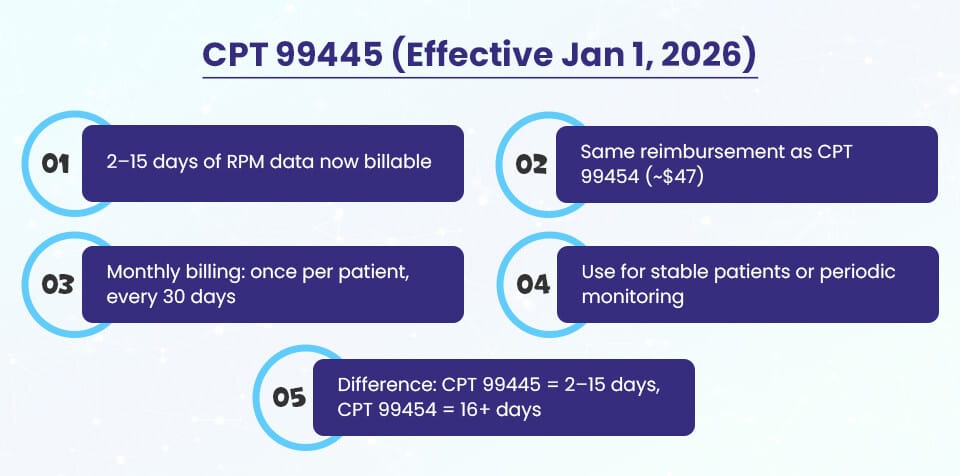
Code Official Status: CPT 99445 – Effective 01/01/2026
CPT 99445 has been added to the CMS Physician Fee Schedule for 2026.
CPT 99445 was developed to address the current gap in RPM reimbursement policy which did not permit billing of patients who sent less than 16 days of physiological data (which was previously unbillable) and those patients who sent at least 16 days of physiological data using CPT 99454.
CPT 99445 is designed to consider 2-15 days of data transmission as meaningful monitoring allowing providers to bill for this type of monitoring.
Supply & Transmission of Physiological Data Description: (2-15 Days)
CPT 99445 is for the monthly supply of an FDA cleared device and the collection and transmission of physiological data.
The primary difference between CPT 99445 and CPT 99454 is the number of days of data required to qualify for billing; CPT 99445 requires only 2-15 days of data within a 30-day period while CPT 99454 requires at least 16 days of data within a 30-day period.
CPT 99445 is for use when less frequent monitoring is acceptable; e.g. patients with stable chronic conditions, or patients on therapies that may require periodic monitoring.
Billing: Once Every 30 Days Per Patient
CPT 99445 may be billed once every 30 days per patient just like CPT 99454.
CPT 99445 may not be billed multiple times in the same month for the same patient.
Providers will need to determine if they should submit CPT 99445 or CPT 99454 based on the level of patient engagement (2-15 days vs 16+ days).
Approximate Reimbursement Amount: ~$47 (same as CPT 99454)
CMS set the reimbursement amount for CPT 99445 to be about $47, the same as CPT 99454.
CMS set the reimbursement amount for CPT 99445 the same as CPT 99454 to avoid financially penalizing healthcare providers for providing RPM services to patients who send fewer than 16 days of data in a month.
Setting the reimbursement amount for CPT 99445 the same as CPT 99454 establishes a stable financial basis for RPM programs and eliminates the financial risk associated with billing CPT 99454 “all or nothing.”
Who May Bill CPT 99445: Eligible Providers
Any provider with an active NPI (National Provider Identifier) is eligible to bill CPT 99445.
Eligible providers include:
- Physicians
- Advanced Practice Registered Nurses (APRN)
- Physician Assistants (PA)
- Clinical Staff working under General Supervision
Eligible providers are allowed to delegate most of the RPM work to clinical staff, resulting in reduced time for physicians to devote to RPM-related tasks.
Why CPT 99445 is Important to Healthcare Providers
CPT 99445 is important because it addresses a significant flaw in the present RPM reimbursement policy.
The present RPM reimbursement policy states that patients must send physiological data for at least 16 days in a month for providers to be reimbursed for RPM services. This results in a situation where providers are either fully reimbursed for their services, or they are not reimbursed at all for their services.
Additionally, this policy restricts the availability of RPM services for patients who could benefit from RPM but are unable to send data on a daily basis.
CPT 99445 remedies both of these problems by allowing providers to bill for RPM services when patients send data between 2 and 15 days in a 30-day period. As a result, providers will now be able to bill for services that are clinically relevant, even though they are not necessarily daily.
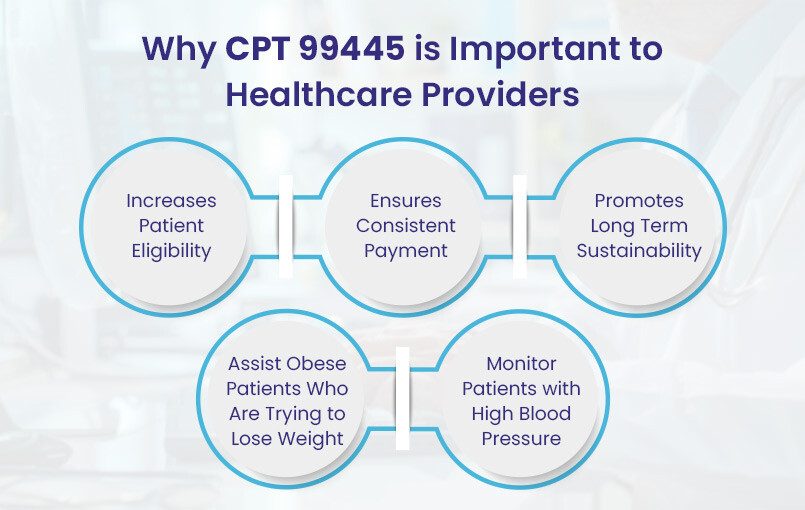
1). Increases Patient Eligibility
CPT 99445 expands the eligibility for RPM services to go beyond patients who transmit data for 16+ days in a month and opens the door for RPM to be applied to patients who could benefit from less-frequent monitoring.
- Reduces exclusion of clinically relevant patients
- Reduces exclusion of patients who cannot pragmatically monitor daily
- Increases opportunities for providers to apply rpm to a greater number of patients
2). Ensures Consistent Payment
Eliminates the risk of full loss of payment since providers will be able to bill CPT 99445 at the same rate as CPT 99454 when patients send fewer than 16 days of data in a month.
- Stabilizes revenue flow
- Avoids sudden financial losses because of minimal noncompliance issues
- Promotes clinical decision making
- Allows providers to decide the frequency of monitoring depending on the needs of their patients
Example:
- A patient with controlled hypertension may only need to have his blood pressure taken 2-3 times a week.
- A patient taking weight-loss medication may only need to have his weight checked once a week.
- CPT 99445 gives physicians the ability to make clinical decisions without the threat of not being able to bill for such decisions
3). Promotes Long Term Sustainability
CPT 99445 promotes the sustainability of rpm programs by ensuring rpm programs will remain economically viable when including patients who send data less frequently
Promotes practices maintaining a steady flow of revenue while providing patient-centered care that is based on real world behavior
According to a case study performed by Prevounce Health, adding CPT 99445 to their RPM program resulted in an increase of 13% ($65,000) of annual revenue for a 522-patient program.
Example:
CPT 99445 is intended to be applied to patients who do not need to monitor themselves on a daily basis, yet still would benefit from regular check-ins. Unlike CPT 99454, which requires patients to send physiological data for 16 days in a month, CPT 99445 allows providers to bill for patients who send data between 2 and 15 days in a 30-day period.
4). Assist Obese Patients Who Are Trying to Lose Weight
- Obese patients trying to lose weight typically see slow and steady weight loss and improvement in their overall health status.
- Tracking data on a daily basis can feel overwhelming and may lower the patient’s chances of engaging in RPM.
- CPT 99445 enables providers to schedule weekly or bi-weekly weigh-in sessions for obese patients managing their weight.
5). Monitor Patients with High Blood Pressure
- Patients with high blood pressure who have achieved stability in their blood pressure levels through the alteration of their medications may not need to track their blood pressure on a daily basis.
- Tracking blood pressure 2-3 times a week is typically sufficient to verify that their blood pressure remains within a safe range.
- CPT 99445 enables providers to enroll hypertensive patients in RPM programs and not have to monitor them on a daily basis.
Best Practices for Billing CPT 99445
Check Your Equipment Regularly
Just as you check your smartphone for signal strength and battery life, you should regularly check your RPM equipment to ensure it continues to function properly. If your device ceases to send data, you may not reach the 2-day minimum. Viewing your dashboard daily usually reveals whether there is a problem with the equipment and communicating with the patient is often a simple process to resolve the issue.
Track Patient Activity
The primary distinction between CPT 99445 and CPT 99454 is the amount of time the patient spends interacting with RPM.
- CPT 99445 = 2-15 days of data transmission in a month
- CPT 99454 = 16+ days of data transmission in a month
Therefore, the emphasis is on how often patients are submitting readings. Track what they are doing during the course of the month and then bill the correct code so you will not pass up any opportunities for reimbursement.
Document Everything Clearly
CMS wants proof that the monitoring occurred. Thus, document should show:
- How many days of data were received
- The name of the device (and that it is FDA cleared)
- Any comments regarding staff or provider communication
Good documentation is not just good compliance practice – it can also protect you from the headaches of audits.