
GEHA (Government Employees Health Association) allows healthcare providers a defined period to send an initial claim. In most cases, a new claim must reach GEHA within 365 days. The count generally begins on the day the patient received care.
The rule does not end with the first submission.
Separate deadlines may affect secondary claims, billing corrections, and appeals. Secondary billing applies when GEHA pays after another insurer. A revised submission is used to fix an error in a claim already sent. An appeal asks GEHA to review a denial. Each situation can follow a different timeframe. For instance, if another health plan is primary and GEHA is secondary, the first plan processes the bill first. The provider then sends GEHA the remaining eligible balance along with the first insurer’s EOB.
Note: GEHA plans are administered in partnership with UnitedHealthcare, and the allowed filing period can vary slightly by plan type, including Standard, High, HDHP, and Elevate. Network status may also affect the cutoff. Before disputing a denial, verify the exact requirement in your provider contract or the current GEHA/UnitedHealthcare provider manual.
GEHA’s Timely Filing Deadline for New Claims
Most participating, or in-network, healthcare providers have 365 days (12 months) to send a new claim to GEHA after care is delivered. This deadline is similar to the range used by many large commercial and federal employee health plans, often 90 to 365 days. Out-of-network providers may receive less time under some plan types, so check your network status before relying on the full year.
When the GEHA Filing Period Begins
Finishing the paperwork does not trigger the countdown. The key event is when care occurred, although the exact starting point changes with the claim category:
- Outpatient or office visits: count from the day treatment occurred.
- Inpatient or facility stays: the period usually begins on discharge, not admission. Example: if a patient is admitted on June 2 and discharged on June 6, June 6 is usually the starting point for the inpatient facility filing period.
- A series of related treatments: some payers measure from the final day in the treatment series instead of each individual visit. Check the plan guidance when billing this type of care.
Professional Claims
For professional claims (CMS-1500 / 837P), the filing period generally runs from the day treatment was provided. For example, care provided on March 1, 2026 would usually need to be billed to GEHA by about the end of February 2027 to remain within the allowed timeframe.
Facility Claims
Hospitals, surgery centers, and other institutional providers filing UB-04 / 837I claims generally measure inpatient deadlines from discharge. Outpatient facility billing usually uses the care date. Since an inpatient stay can last several days or weeks, this difference may move the cutoff compared with a professional claim tied to the same episode of care. A simple case is a hospital stay in which the physician bills a professional service using the treatment day, while the hospital measures its inpatient facility deadline from discharge.
GEHA Filing Timeframes by Claim Type
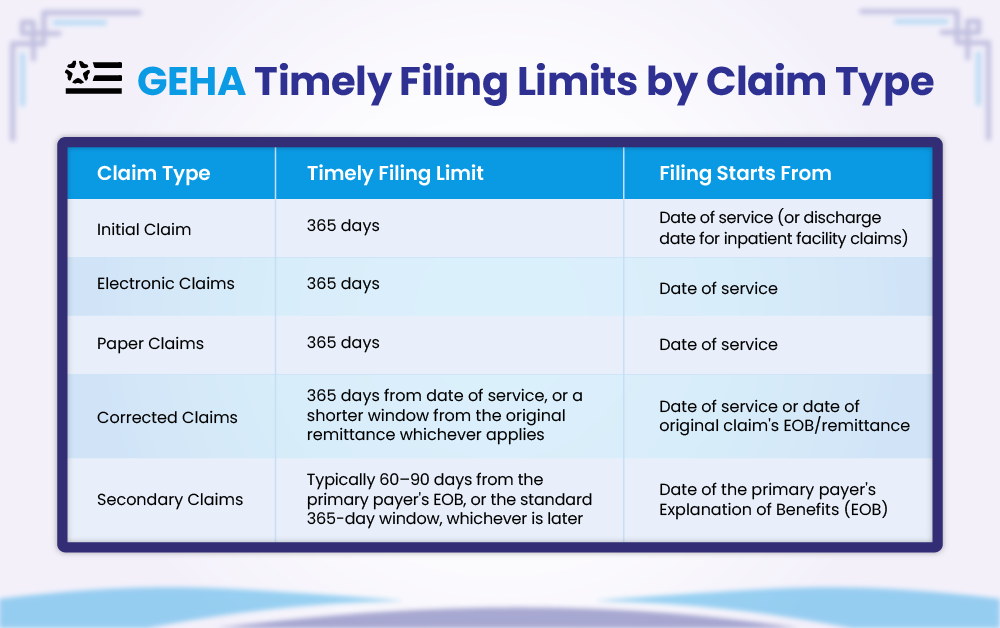
| Claim Type | Filing Limit | Starting Point |
| Initial Claims | 365 days | Day care was provided, or discharge for inpatient facility billing |
| Electronic Claims | 365 days | Treatment date |
| Paper Claims | 365 days | Day care occurred |
| Corrected Claims | 365 days after care was provided, or a shorter period linked to the original remittance when required by the plan | Day of treatment or the first remittance / EOB |
| Secondary Claims | Typically 60 to 90 days after the first insurer’s EOB, or the broader one-year allowance, whichever is later | Date shown on the primary insurer’s EOB |
Timely Filing Deadline When GEHA Is The Secondary Insurance Payer
When GEHA pays second, the submission period works differently from a standard first filing. A follow-up claim is typically allowed within 60 to 90 days. Rather than counting from when care occurred, the period commonly begins when the primary insurer sends its Explanation of Benefits (EOB). Suppose the first insurer issues its EOB on April 10. The secondary filing period is generally measured from that EOB event rather than from the earlier visit.
Documents Needed When GEHA Pays Second
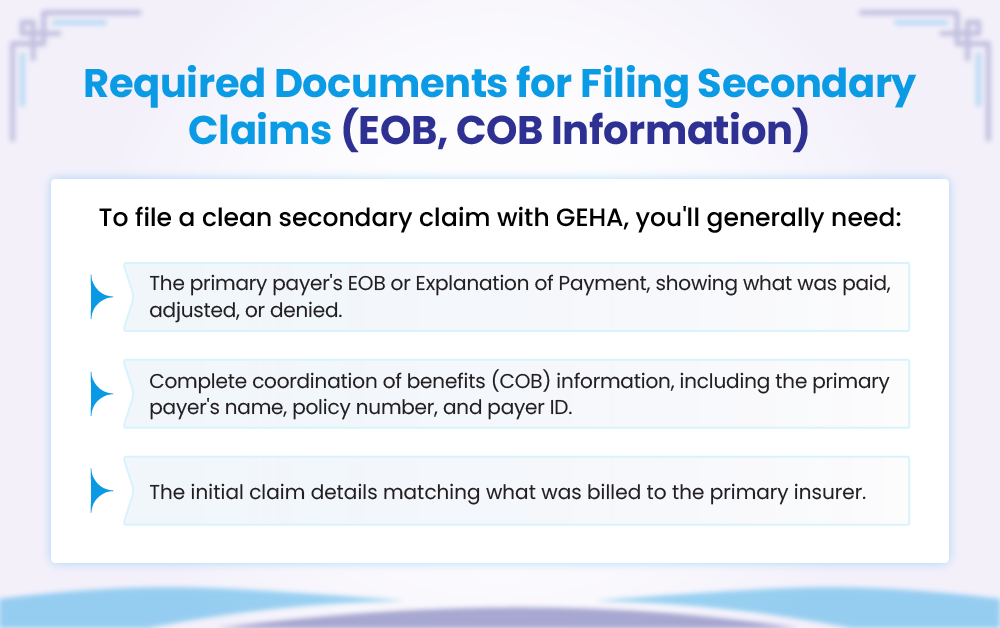
A complete follow-up submission to GEHA will generally require:
- The EOB or Explanation of Payment from the primary insurer, showing amounts paid, adjusted, or denied
- Complete coordination of benefits (COB) details, including that insurer’s name, policy number, and payer ID
- The original billing details matching what was sent to the primary plan
Common Reasons GEHA Rejects Secondary Billing
A claim sent after the primary plan may be denied for reasons such as:
- Sending the follow-up claim without the other insurer’s EOB
- Missing or outdated COB details in the GEHA record
- Submitting after the GEHA secondary cutoff, even when the date care was provided still falls within the broader limit
- Coding differences between the original payer submission and the follow-up sent to GEHA
Rules for Correcting a Submitted Claim to GEHA
A corrected claim replaces a submission that GEHA already received. It is used when the original version contains a wrong code, incorrect modifier, missing NPI, or some billing mistake. In general, this revision follows the same 365-day allowance as the first filing. Depending on the plan, the countdown may use the day of treatment or the initial remittance. This is not a brand-new claim because it remains linked to the earlier claim number and formally replaces that record.
For example, if the first bill used the wrong modifier, the healthcare provider fixes that modifier and sends a replacement linked to the prior claim reference instead of creating an unrelated new claim.
GEHA TFL Period for Claim Corrections
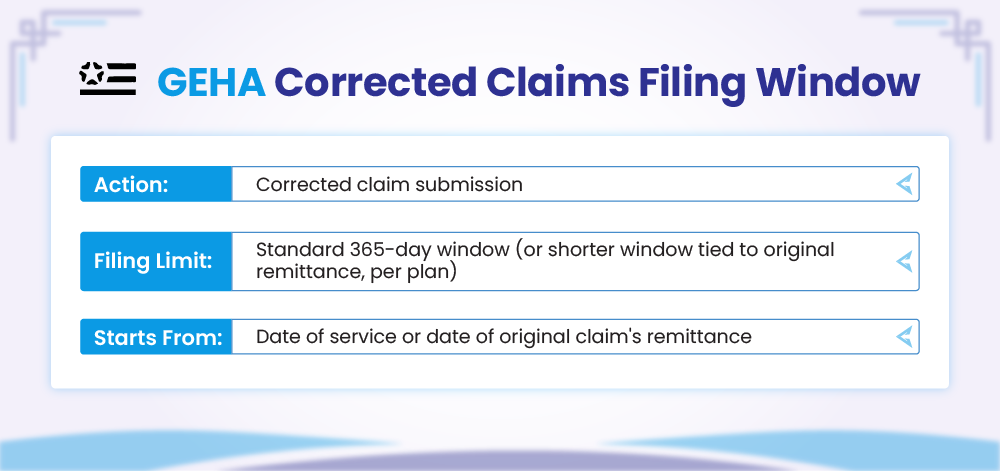
| Action | Filing Limit | Starting Point |
| Claim correction | Usual one-year allowance, unless the plan applies a shorter period linked to the original remittance | Day care occurred or original remittance date |
Requirements for a Claim Correction
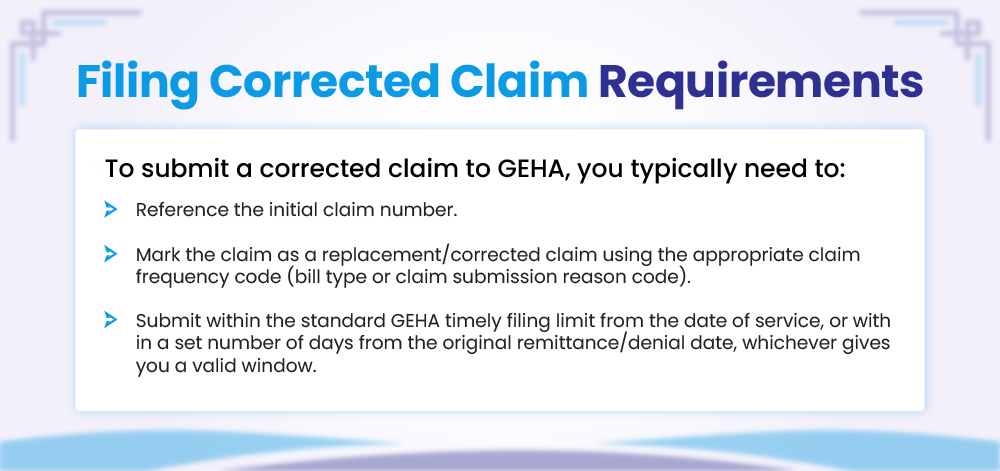
When sending a revised claim to GEHA, you typically need to:
- Reference the claim number assigned to the original submission
- Identify the filing as a replacement or correction with the proper claim frequency code, bill type, or submission reason code
- Send it within GEHA’s usual one-year allowance beginning with the care date, or within any shorter period tied to the original remittance or denial, depending on the plan
Corrected Claims vs. Resubmissions
A correction and a resubmission are not the same action. A correction changes an error and replaces the earlier record. A resubmission sends the existing claim again, often because it was lost, rejected before adjudication, or never received, with no billing detail changed. Payers handle these actions differently, and using the wrong submission type can delay processing. If the CPT code was wrong, the claim needs a correction. If every billing detail was right but the payer never received the file, sending the same information again is a resubmission.
Common mistakes:
- Sending a claim correction as a new filing instead of identifying it as a replacement
- Failing to reference the prior claim number
- Letting the correction period expire while waiting for internal review or provider sign-off
- Changing the wrong field and triggering another denial
GEHA Timely Filing Deadline for Claim Appeals
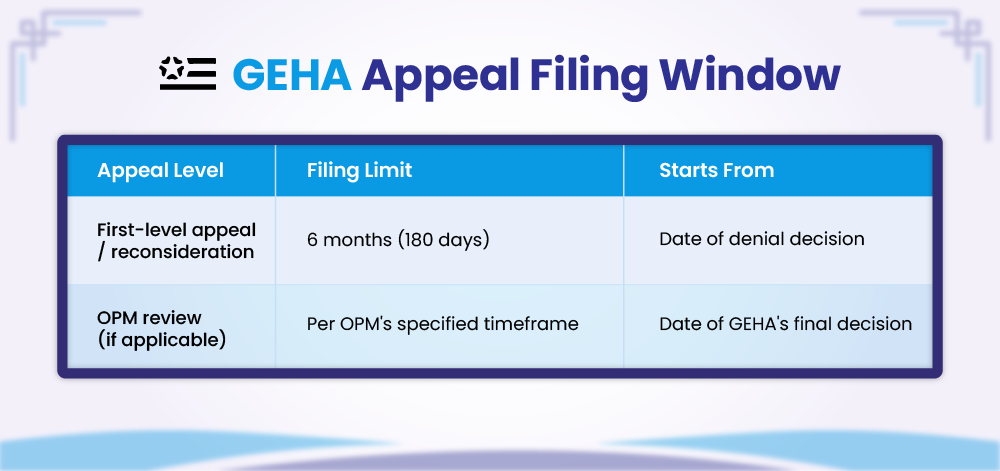
After a denial, GEHA members and providers generally have six months, or about 180 days, from the denial decision to request a first-level appeal or reconsideration. Many commercial payers allow only 60 to 90 days, so confirm the GEHA period instead of assuming the shorter timeframe applies. For instance, if GEHA denies a claim months after the visit, the appeal period is generally tied to the denial decision rather than the day treatment occurred.
Appeal Timeframe
| Appeal Level | Filing Limit | Starting Point |
| First-level appeal / reconsideration | ~6 months (180 days) | Denial decision date |
| OPM review (if applicable) | Timeframe specified by OPM | Date of GEHA’s final determination |
Understanding Reconsideration vs. Formal Appeal
Reconsideration is usually the first review step. It asks GEHA to look at the earlier decision again, often with added documentation or clearer support.
A formal appeal may follow when reconsideration does not settle the issue. GEHA evaluates the submitted information and may seek input from a healthcare professional before making a determination. If the dispute continues, the matter can be taken to the Office of Personnel Management (OPM) for a federal plan review.
Documents Needed for an Appeal
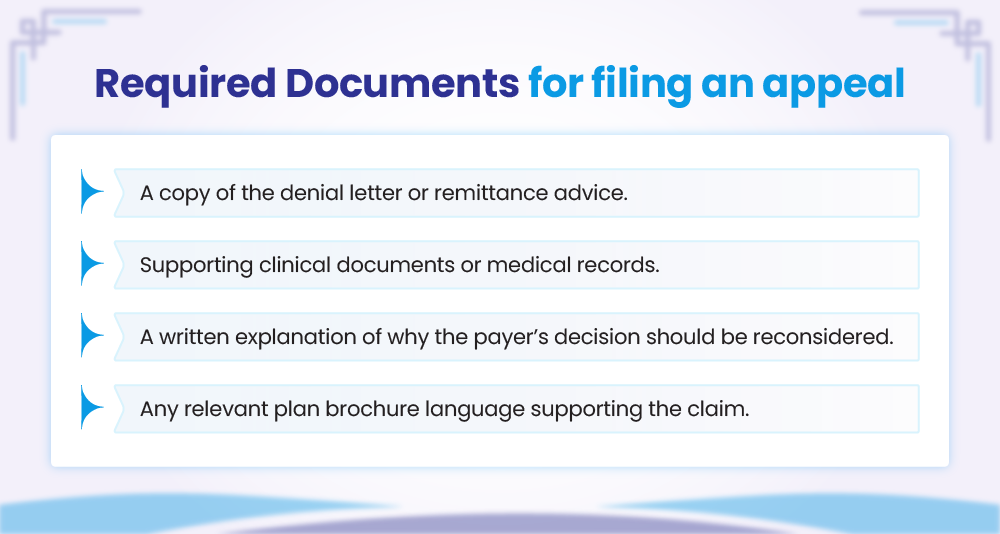
- A copy of the denial letter or remittance advice
- Relevant clinical documentation or medical records
- A written explanation of why the payer’s determination should be reconsidered
- Any plan brochure language that supports the claim
What Happens After an Appeal Is Filed
Once GEHA receives the appeal, it evaluates the claim and supporting material and then provides a determination. If GEHA upholds the denial and the dispute involves a Federal Employees Health Benefits (FEHB) plan, an OPM review may be requested. OPM typically responds within 60 days. If the matter remains unresolved, the final recourse is a lawsuit against OPM in federal court, generally by December 31 of the third year after the year in which the disputed service was received. In practical terms, if reconsideration still leaves an FEHB claim denied, an OPM review may become the next review step.
Tips for Avoiding a GEHA Filing Denial
A claim that reaches GEHA too late may leave the practice unable to collect payment for care it already provided. Preventing a CO-29 is usually much simpler than trying to overturn one later. In plain words, CO-29 means the payer believes the claim arrived after the allowed filing period. A few habits can keep that from happening:
- Send claims electronically when available. Electronic submission gets the claim into the payer system quickly and leaves a dated record showing when it was sent.
- Check the patient’s insurance before the visit. This gives the billing team the correct payer, member, and coverage information before a claim is prepared.
- Give every claim a filing due date. Record that date in the practice management system and set reminders early enough for the billing team to act before the deadline arrives. For example, if a claim must reach GEHA by December 1, the team could set an internal reminder for November 1 so there is still time to correct or resend it if needed.
- Save evidence of every submission. Clearinghouse reports, certified mail records, and fax confirmations can show when a claim left the practice if GEHA later says it arrived late.
- Circle back to sent claims while corrections can still be made in time. If a claim is rejected by GEHA or sitting unresolved, finding that problem early gives the medical billing team a chance to resend or correct it before the filing period expires.
Conclusion
GEHA generally gives providers 365 days to send an initial claim in 2026. That same timing does not necessarily apply when GEHA is billed after another insurer, when previously submitted billing information needs correction, or when a denial is being appealed. Each situation can begin its countdown from a different event.
The safest approach is to know which event starts the allowed filing period, record the resulting due date, and keep evidence showing when the claim was submitted. Doing this helps the practice collect payment for completed care instead of losing it simply because a filing date was missed.