
The Buckeye timely filing limit is 365 days for most plans. So for office visits, outpatient care, and other professional claims, the clock starts on the date of service. For inpatient hospital claims, however, it starts on the discharge date instead.
Here is a simple example. A patient is admitted on January 1 and discharged on January 10. In that case, the filing period begins on January 10, not on the admission date. For a routine office visit, it begins on the day of the visit. Either way, Buckeye must receive the claim within that window.
One thing is important to know up front, though. For Buckeye Medicaid, the 365-day window covers initial, corrected, and voided claims alike. In other words, a corrected claim does not get a separate, shorter deadline. Ambetter from Buckeye, the Marketplace plan, works differently. In-network providers get only 180 days from the date of service there, and out-of-network providers get 90 days. Disputes and appeals also run on their own clock across every plan. The sections below walk through each one.
Buckeye Timely Filing Limit at a Glance (2026 Updated)
Use this table as a quick reference. After that, read the matching section for the details and exceptions.
| Claim action | Buckeye Medicaid / MyCare | Ambetter from Buckeye | Wellcare Medicare |
| Original claim | 365 days from the date of service or discharge | 180 days (in-network), 90 days (out-of-network) | 365 days from the date of service |
| Corrected or voided claim | 365 days from the date of service or discharge, the same window as the original | 180 days (in-network), 90 days (out-of-network) from the EOP | Confirm in the Wellcare provider manual |
| Secondary (COB) claim | No separate limit. The 365-day window applies. | 90 days from the primary payer’s EOP | Confirm in the Wellcare provider manual |
| Claim dispute or appeal | 12 months from the date of service or 60 days from the EOP, whichever is later | 180 days (in-network), 90 days (out-of-network) from the EOP | 65 days from the EOP for payment appeals |
These are the windows Buckeye has published at the time of writing. Rules can change, so always confirm the current figure in Buckeye’s provider manual or contact BellMedEx at (888) 987-6250 before you rely on it for a specific claim.
Buckeye Timely Filing Limit for Secondary Claims (COB)
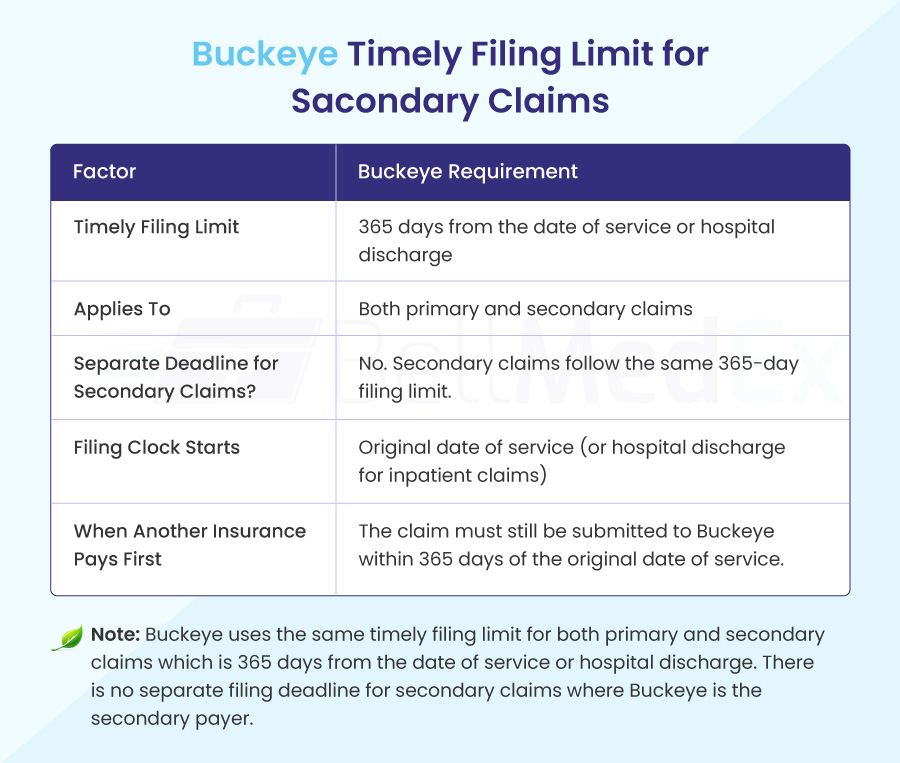
For Buckeye Medicaid, secondary claims follow the same 365-day window as any other claim. The 2026 Medicaid Provider Manual sets one filing rule for all clean claims, and it does not carve out a shorter deadline for coordination of benefits. So the clock still runs from the date of service or discharge, not from the primary payer’s EOP.
That rule sounds generous, but it creates a trap. Your window is shrinking while the primary payer takes its time, because the primary payer’s delay eats into the same 365 days.
For example: a patient is seen on March 1, and the primary insurer does not issue its EOB until December. You have now burned nine months of your Medicaid window on a claim you could not yet bill. So file the secondary claim with Buckeye as soon as the primary EOB arrives.
Ambetter from Buckeye is stricter here. For Ambetter COB claims, the deadline is 90 days from the primary payer‘s EOP, for in-network and out-of-network providers alike. That is a much tighter window than the Medicaid rule, so do not apply the Medicaid deadline to an Ambetter claim.
A few more points on secondary claims:
- Use EDI when you can. Electronic filing lets you skip paper secondary claims in most cases. In addition, it gives you proof that the claim was received.
- Get the COB details right. Claims get denied when the other insurance details are missing or wrong. So verify and update coordination of benefits information whenever a patient has extra coverage.
- Do not wait on a slow primary payer. Under Medicaid, waiting on the primary payer does not buy you extra time. So chase the primary EOB rather than assume the clock has paused.
| Factor | Buckeye Medicaid | Ambetter from Buckeye |
| Secondary (COB) filing limit | 365 days, the same as any other claim | 90 days from the primary payer’s EOP |
| Clock starts | Date of service or discharge | Date of the primary payer’s EOP |
| Separate COB deadline? | No. The manual sets one filing rule for all clean claims. | Yes. COB has its own shorter window. |
| Common denial cause | Missing or incorrect other-insurance information | Missing or incorrect other-insurance information |
Buckeye Timely Filing Limit for Corrected Claims
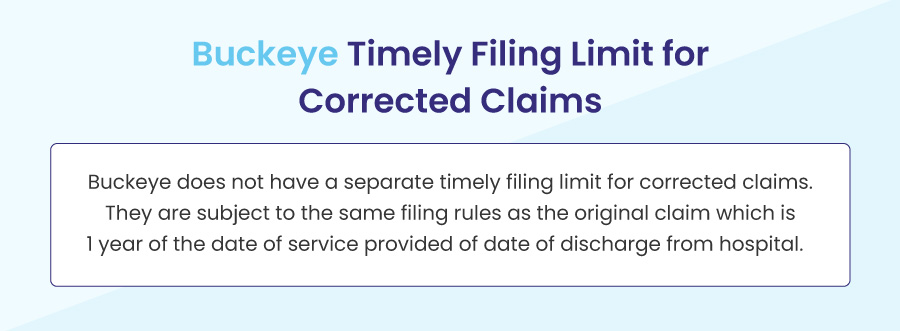
The timely filing limit for Buckeye corrected claims is the same as the limit for the original claim. First, a quick definition. A corrected claim is one you resubmit to fix an error on the original, such as a wrong diagnosis code, a missing modifier, or the wrong number of units.
For Buckeye Medicaid, you have 365 days from the date of service or discharge to file a corrected claim. The 2026 Medicaid Provider Manual is explicit on this. It states that providers must submit clean claims, whether initial, corrected, or voided, within 365 days, and it lists first-time claims and corrected billing claims under the same 365-day rule. So Buckeye does not set a separate or shorter deadline for corrections on the Medicaid side.
Even so, correcting a claim does not restart the clock. The 365 days still run from the original date of service, not from the date of your correction. So a claim you fix in month eleven leaves you almost no room if the correction itself is wrong. Send corrections as soon as you spot the error.
Here is what you need to know when you submit a corrected claim:
- Use the right channel. Route new and corrected Medicaid billing claims through ODM’s FI/OMES system. If you do not have access to it, you can submit the correction through the Buckeye Secure Provider Portal by opening the original claim and selecting Correct Claim.
- Mark it clearly. Whether you file electronically or on paper, mark the claim as a corrected claim or a resubmission. On paper, include the original claim number, the EOP, and a short note on what changed. On EDI, use the right claim frequency code (7 for a replacement, 8 for a void).
- Know when to use it. Common reasons include fixing a billing error, correcting other insurance details, or following up on a claim that processed incorrectly.
- Include the required details. If the corrected claim is missing the original claim number or the EOP, Buckeye may deny it as a duplicate or reject it for processing.
Ambetter from Buckeye is the exception. There, a corrected claim is handled as a post-service resubmission with its own window, which runs 180 days from the EOP for in-network providers and 90 days for out-of-network providers.
Keep in mind that a corrected claim is new billing. A dispute or appeal is different, because there you ask Buckeye to change its decision. The two follow different rules and deadlines, which the next section covers.
Buckeye Timely Filing Limit for Disputes and Appeals
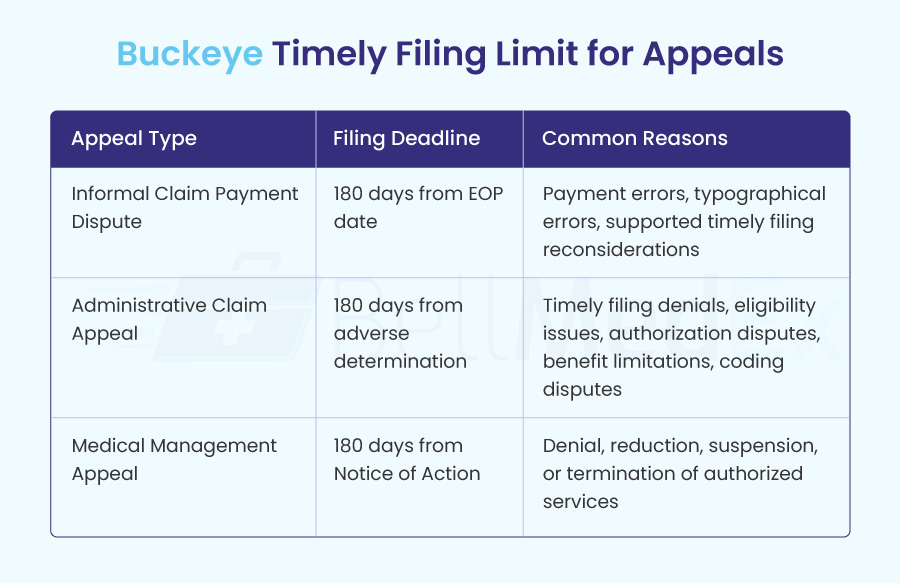
Disputes and appeals run on their own clocks, separate from claim submission. For Buckeye Medicaid, the deadline is 12 months from the date of service or hospital discharge, or 60 days from the date of the EOP, whichever is later. So a late EOP can actually extend your dispute window past the one-year mark.
Buckeye sorts Medicaid disputes into three types, and you indicate the right one on the cover form so it routes correctly:
- Post-service provider appeal. The service was denied or reduced because it did not meet a clinical criterion, policy, or guideline, and an authorization denial is on file. Submit supporting medical records with it.
- Administrative appeal. The service was denied because prior authorization was not obtained in time. Explain the circumstances and justify why Buckeye should make an exception.
- Claim dispute. You disagree with a payment determination after the claim was adjudicated, and the issue is not medical necessity or authorization. Timely filing denials, coding denials, and payment amount disputes all belong here.
| Plan | Dispute or appeal deadline | Notes |
| Buckeye Medicaid | 12 months from the date of service or discharge, or 60 days from the EOP, whichever is later | The claim must already have been submitted and paid or denied. A claim you never filed cannot be disputed. |
| Ambetter from Buckeye | 180 days from the EOP (in-network), 90 days (out-of-network) | Reconsiderations, disputes, and appeals share this window |
| Wellcare Medicare (payment appeals) | 65 days from the EOP | A signed Waiver of Liability must be included, or the appeal is dismissed |
For Medicaid disputes, the fastest route is the Secure Provider Portal. Open the claim, select Dispute Claim, and choose whether the dispute involves medical necessity or level of care. You can also file by phone or by mail.
Once Buckeye has your dispute, it sends written notice of the outcome no later than 30 business days after receipt. After that resolution, it reprocesses and pays or upholds the claim within 30 calendar days of the written notice. If the denial was based on medical necessity, you can request an external medical review once Buckeye’s own dispute process is exhausted.
Buckeye Medicaid Timely Filing Limit
For Buckeye Medicaid, you must submit the original claim within 365 days of the date of service or discharge. This follows Ohio Administrative Code rule 5160-1-19, and it matches the federal Medicaid standard (42 CFR § 447.45), which allows up to 12 months for claim submission.
| Claim action | Deadline |
| Original claim submission | 365 days from the date of service or discharge |
| Corrected billing claim | 365 days from the date of service or discharge |
| Voided claim | 365 days from the date of service or discharge |
| Secondary (COB) claim | No separate limit. The 365-day window applies. |
| Claim dispute or appeal | 12 months from the date of service or discharge, or 60 days from the EOP, whichever is later |
Key point: Buckeye applies one filing rule to Medicaid claims. Initial, corrected, and voided claims all share the same 365-day window. However, that window never restarts, so a correction filed late in the year still counts against the original date of service.
Buckeye Medicare Timely Filing Limit (2026 Changes)
The Buckeye Medicare timely filing limit is still 365 days from the date of service. The plans themselves changed for 2026, though, so check the plan and member ID before you bill. Buckeye now offers its Medicare Advantage and dual plans under the Wellcare by Buckeye Health Plan brand.
The old MyCare Ohio Medicare-Medicaid Plan has ended. As a result, those members moved to a new dual plan called Wellcare Buckeye MyCare Ohio Dual Align (HMO D-SNP) on January 1, 2026. For dates of service on or after that date, bill the new plan with the member’s updated ID. Otherwise, claims billed under an old MyCare ID may be rejected.
Here are the timely filing rules for the Medicare products:
| Plan / action | Timely filing | Key rule |
| Wellcare by Buckeye Medicare Advantage / D-SNP | 365 days from the date of service | Use the current 2026 plan and member ID |
| Former MyCare (dates of service before 2026) | 365 days from the date of service | Bill under the plan in effect on the date of service |
| Corrected claims / adjustments | 180 days from the EOP date | Mark clearly as corrected and include the original claim number |
| Non-par provider payment appeal | 65 days from the EOP | Include a signed Waiver of Liability |
A few general reminders for 2026 Medicare claims:
- Verify the plan and ID. Use each member’s updated 2026 member ID. Also confirm the plan type (HMO-POS, HMO-POS D-SNP, or the MyCare HMO D-SNP) before you bill.
- Use the Wellcare manual. Billing and appeal guidance for the Medicare plans now lives in the Wellcare provider manual on Buckeye’s provider resources page.
You may also see mentions of specific 2026 Medicare processing changes, such as new pre-payment edits or a short-term EDI issue. Notices like these are time-limited. So verify them against a current Buckeye provider bulletin before you rely on them.
Is the Buckeye Timely Filing Limit Different by State?
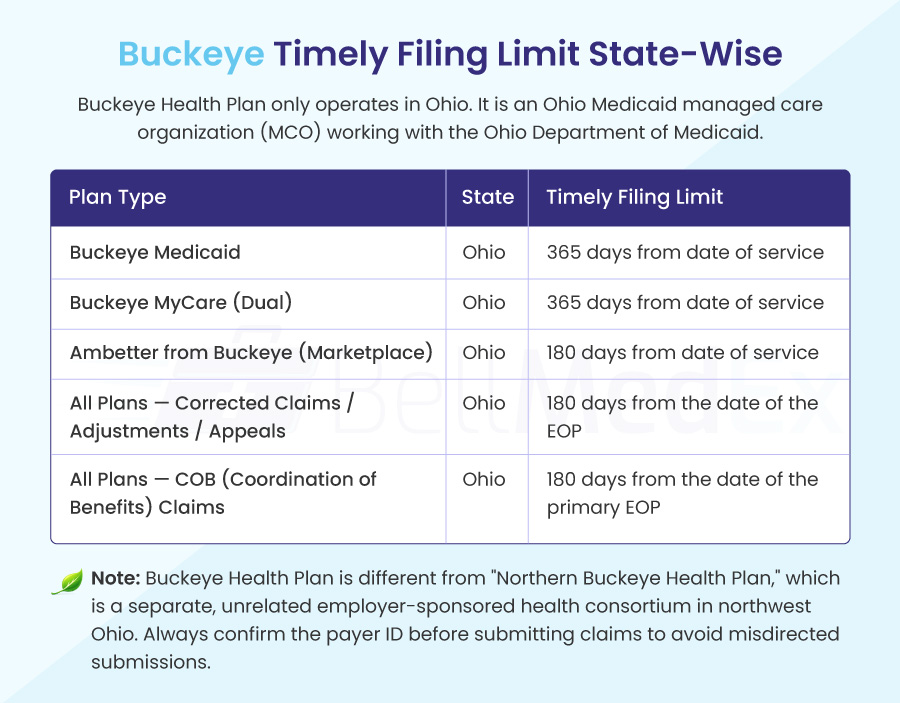
Many providers search for the Buckeye timely filing limit by state. Some look it up as the timely filing limit of Buckeye, and others as the timely filing limit for Buckeye in a particular state. Either way, the answer is the same. Buckeye Health Plan, also known as Buckeye Community Health Plan, operates only in Ohio. It is an Ohio managed care organization under contract with the Ohio Department of Medicaid, and it also offers Ambetter Marketplace and Wellcare Medicare plans in the state.
Because Buckeye is an Ohio-only payer, its filing rules do not change from state to state. Instead, the same Ohio guidelines apply across all 88 counties, no matter the plan type.
| Plan | State | Original claim timely filing limit |
| Buckeye Medicaid | Ohio | 365 days from the date of service |
| Wellcare by Buckeye MyCare / D-SNP (dual) | Ohio | 365 days from the date of service |
| Wellcare by Buckeye Medicare Advantage | Ohio | 365 days from the date of service |
| Ambetter from Buckeye (Marketplace) | Ohio | 180 days from the date of service |
As a reminder, the other deadlines still apply. Corrected claims and adjustments are due 180 days from the EOP. COB claims are due 180 days from the primary EOP. Medicaid disputes are due 12 months from the date of service or 60 days from the EOP, whichever is later.
Note: Buckeye Health Plan is not the same as Northern Buckeye Health Plan. The latter is a separate, unrelated employer health group in northwest Ohio. Always confirm the payer ID before you submit, or your claim may go to the wrong payer.
Common Billing Errors That Affect Timely Filing
Small billing mistakes can get a claim rejected or returned. After that, you must correct and resubmit while the clock keeps running. So the best way to protect your window is to get the claim right the first time. The most common errors include:
- Using outdated CPT or HCPCS codes for the date of service
- Missing the required 4th or 5th digit on ICD-10 codes
- Entering a wrong provider number, NPI, or Tax ID
- Leaving out or mistyping the member’s Medicaid ID
- Listing wrong or unverified other-insurance (COB) details
- Sending handwritten, photocopied, or faxed claims when only original, typed claims are accepted
- Printing with poor alignment, which pushes data outside the form fields
A late rejection can leave you little time to refile. For that reason, accuracy on the first submission is critical to meeting the timely filing window.
How to Submit Provider Claims to Buckeye
How you submit a claim matters. Your submission method is also your proof that you filed on time. So if the payer ever questions timely filing, that proof settles the matter. Here are the main ways to file provider claims within the window.
Electronic Claims (EDI)
Buckeye recommends electronic claims in the EDI 837 Professional or 837 Institutional format. The big benefit is the confirmation you get back (a 999/277CA report). It shows when the claim was sent and accepted. As a result, it serves as proof of timely filing if a dispute ever comes up.
For Ambetter and Medicare (Wellcare by Buckeye) claims, you can file through a clearinghouse with payer ID 68069. Medicaid works a little differently. Ohio’s Next Generation program routes electronic Medicaid claims through the state’s central EDI system first, and only then do they reach Buckeye. For that reason, Medicaid trading-partner setup goes through the Ohio Department of Medicaid, not through a Buckeye clearinghouse ID. To be safe, confirm the payer ID and routing with your clearinghouse for each plan.
Also, every claim must include your NPI and Tax ID. If either one is missing, the claim will be rejected. A rejected claim does not count as a timely submission until you fix the error and resubmit it successfully.
Paper Claims
Some claims must go on paper. Professional claims use the CMS-1500 form (formerly HCFA-1500), while facility claims use the CMS-1450/UB-04 form (formerly UB-92). In addition, a few services must always be mailed on paper with the required federal consent forms attached. These include sterilization, hysterectomy, and abortion claims.
Where you mail a paper claim depends on the plan and the service:
- Medicaid medical claims: Buckeye Health Plan, P.O. Box 6200, Farmington, MO 63640-3800
- Behavioral health claims: Buckeye Health Plan, P.O. Box 6150, Farmington, MO 63640-3800
- Ambetter (Marketplace) claims: Ambetter from Buckeye, P.O. Box 5010, Farmington, MO 63640-5010
- Dental and vision claims: Separate vendors handle these benefits (for example, Envolve Dental handles dental). Their claim addresses change from time to time, so confirm the current address in Buckeye’s provider manual before you mail anything.
Paper claims do not come with an automatic receipt the way EDI claims do. Therefore, keep proof that you mailed the claim, such as a certified mail receipt or a tracking record. You will need it if timely filing is ever questioned.
FAQs
Does the 365-day clock restart if my claim is rejected?
No, it does not. A rejected claim never resets the clock. You still have to correct and resubmit within the original window. That is why a rejection late in the year is risky.
What if the patient has other insurance?
Bill the primary insurer first. After that, submit the secondary claim to Buckeye within 180 days of the primary payer’s EOP. Do not rely on the original 365 days in that case.
How do I prove I filed on time?
Keep your EDI acceptance report (the 999/277CA) for electronic claims. For paper claims, keep a certified mail or tracking receipt. In a timely filing dispute, that record is what settles things in your favor.
How long do I have to appeal a timely filing denial (Medicaid)?
You can file a claim dispute up to 12 months from the date of service or 60 days from the EOP, whichever is later. Along with it, attach proof of your original, timely submission.
Conclusion
The Buckeye timely filing limit of 365 days is more generous than most payers offer, and under Medicaid it stretches further than many billers realize, because corrected and voided claims share that same window. Even so, the limit is strict, and claims are denied once the deadline passes. The one thing the 365 days never do is restart. That window runs from the date of service, no matter how many times you correct the claim.
In practice, most filing problems do not come from the 365-day rule itself. Instead, they happen when a rejected claim is not fixed in time, when provider details like the Tax ID are wrong, or when a resubmission is not marked correctly. So file electronically when you can, fix errors fast, mark corrections clearly, and keep records of every submission. If you stay organized, the deadlines are easy to manage.