
Ambetter’s timely filing limit in 2026 stays the same as 2025. In-network providers must file claims within 180 days from the date of service in most states. However, Tennessee and New York are exceptions: in these states, providers have only 90 days from the date of service.
Out-of-network providers usually have up to 365 days from the date of service, but this can vary by state and by payer agreement.
Late-filing exceptions are granted only for special situations such as natural disasters, retroactive eligibility, or system outages — not for routine billing mistakes.
In this guide, we explain Ambetter’s timely filing limits in detail — for initial claims, corrected claims and disputed payments, and secondary (COB) claims.
Ambetter Timely Filing Limit for Initial Claims
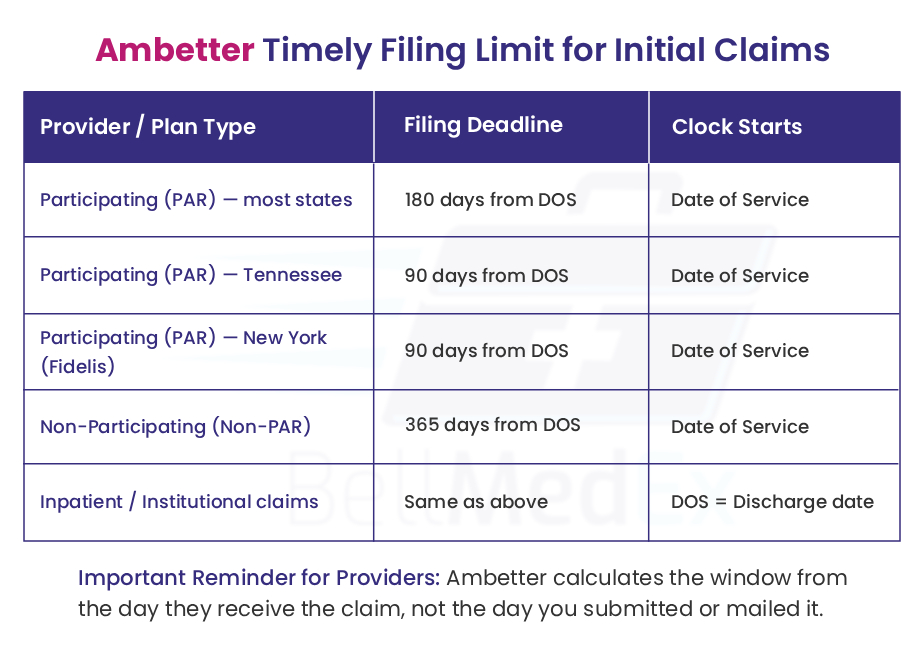
The most common timely filing limit Ambetter applies to claim submissions is 180 days from the date of service (DOS). However, the filing window for initial claims varies by state and by providers’ contracts with the payer. For example, the timely filing limit for new claims in Tennessee is 90 days from the date of service. Furthermore, the filing window may vary by provider type. In some states, the claim submission deadline is 365 days for non-participating providers.
| Provider / Plan Type | Filing Deadline | Clock Starts |
| Participating (PAR) — most states | 180 days from DOS | Date of Service |
| Participating (PAR) — Tennessee | 90 days from DOS | Date of Service |
| Participating (PAR) — New York (Fidelis) | 90 days from DOS | Date of Service |
| Non-Participating (Non-PAR) | 365 days from DOS | Date of Service |
| Inpatient / Institutional claims | Same as above | DOS = Discharge date |
To avoid timely-filing denials, always verify your exact window in the state-specific Ambetter provider manual for your practice.
Important Reminder for Providers: Ambetter calculates the window from the day it receives the claim, not the day you submit or mail it.
Ambetter Timely Filing Limit by Claim Type
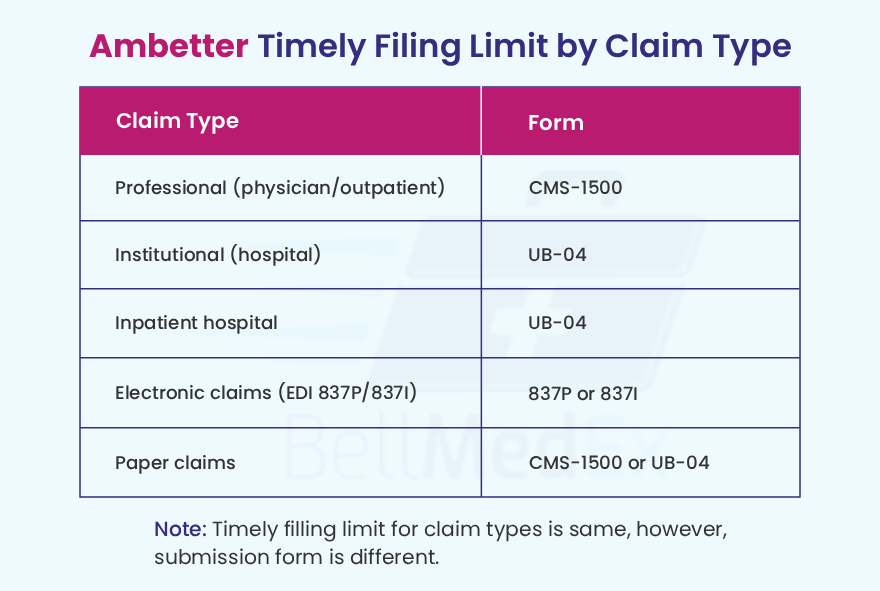
Ambetter applies the same submission window to all claim types; the window depends on the state where the services were provided, not on the claim type itself. However, different claim types must be submitted on different forms.
| Claim Type | Form |
| Professional (physician/outpatient) | CMS-1500 |
| Institutional (hospital) | UB-04 |
| Inpatient hospital | UB-04 |
| Electronic claims (EDI 837P/837I) | 837P or 837I |
| Paper claims | CMS-1500 or UB-04 |
Ambetter Timely Filing Limit for Corrected Claims
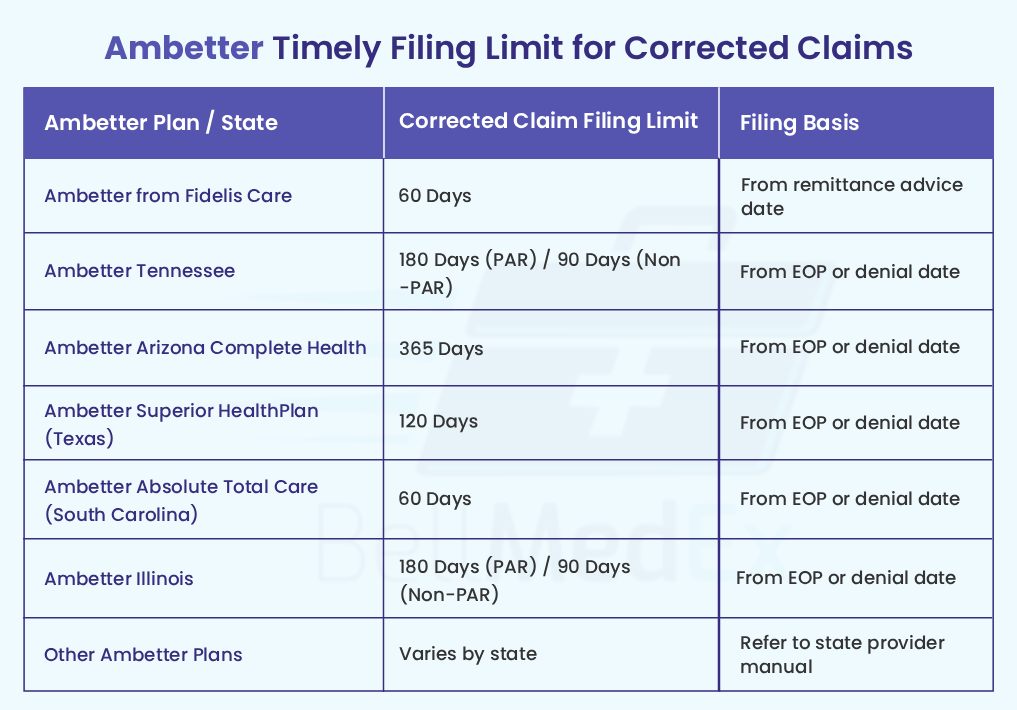
In some states, Ambetter’s timely filing limit for corrected claims is 180 days from the EOP/EOB. The time frame varies by state, provider, and plan type. For example, this 180-day window applies to participating providers. For out-of-network providers, the window is reduced to 90 days.
Providers must submit disputed claims within the plan’s reconsideration timeframe. Ambetter treats corrected claims/resubmissions as a separate post-service resolution process with its own filing timeframe, not the original or initial filing window.
The limits in this table are general guidelines. Before resubmitting a corrected claim, check your contract or read the provider manual. The window for submitting disputed claims also depends on your agreement with Ambetter.
| Ambetter Plan / State | Corrected Claim Filing Limit | Filing Basis |
| Ambetter from Fidelis Care | 60 Days | From remittance advice date |
| Ambetter Tennessee | 180 Days (PAR) / 90 Days (Non-PAR) | From EOP or denial date |
| Ambetter Arizona Complete Health | 365 Days | From EOP or denial date |
| Ambetter Superior HealthPlan (Texas) | 120 Days | From EOP or denial date |
| Ambetter Absolute Total Care (South Carolina) | 60 Days | From EOP or denial date |
| Ambetter Illinois | 180 Days (PAR) / 90 Days (Non-PAR) | From EOP or denial date |
| Other Ambetter Plans | Varies by state | Refer to state provider manual |
Ambetter Timely Filing Limit for Secondary Claims (COB)
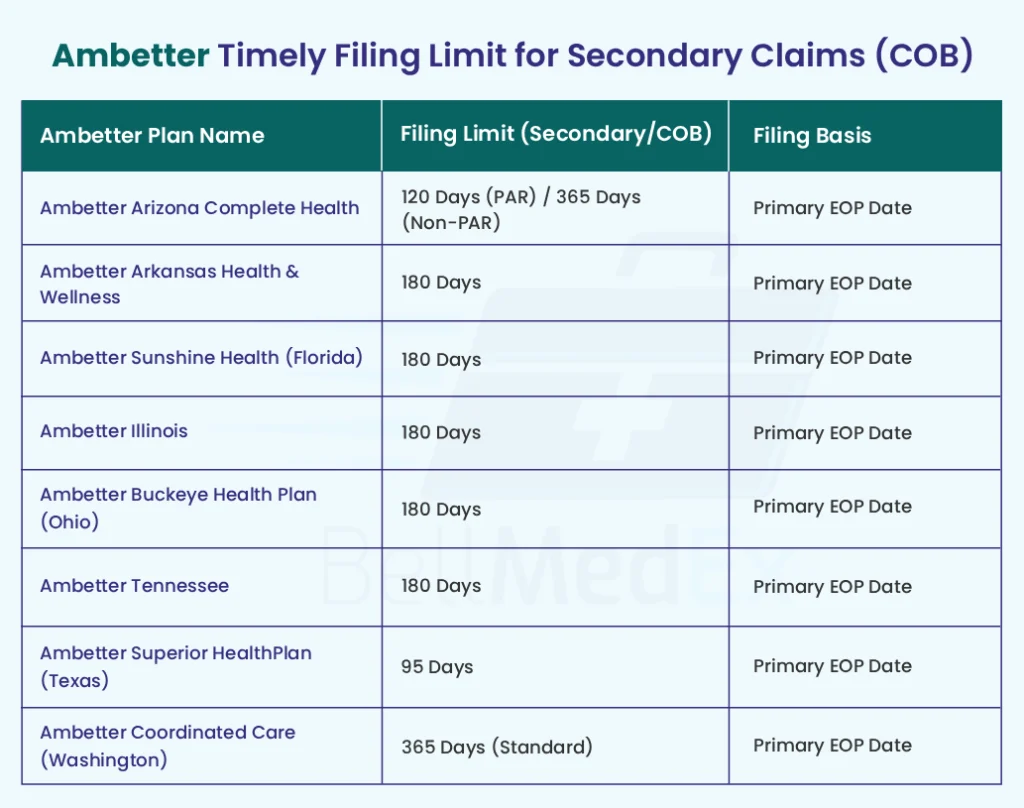
When Ambetter is the secondary payer, the claim filing clock does not start from the date of service. It starts on the date the primary payer’s Explanation of Payment (EOP), or EOB, is issued. However, the deadline for submitting secondary claims varies by plan. Providers must submit secondary claims with proof of the primary payer’s EOB.
In addition, the same filing requirements apply to paper and electronic claims — there is no separate window for secondary claims, whether you submit them manually or electronically.
| Ambetter Plan Name | Filing Limit (Secondary/COB) | Filing Basis |
| Ambetter Arizona Complete Health | 120 Days (PAR) / 365 Days (Non-PAR) | Primary EOP Date |
| Ambetter Arkansas Health & Wellness | 180 Days | Primary EOP Date |
| Ambetter Sunshine Health (Florida) | 180 Days | Primary EOP Date |
| Ambetter Illinois | 180 Days | Primary EOP Date |
| Ambetter Buckeye Health Plan (Ohio) | 180 Days | Primary EOP Date |
| Ambetter Tennessee | 180 Days | Primary EOP Date |
| Ambetter Superior HealthPlan (Texas) | 95 Days | Primary EOP Date |
| Ambetter Coordinated Care (Washington) | 365 Days (Standard) | Primary EOP Date |
Ambetter Timely Filing Limit by State
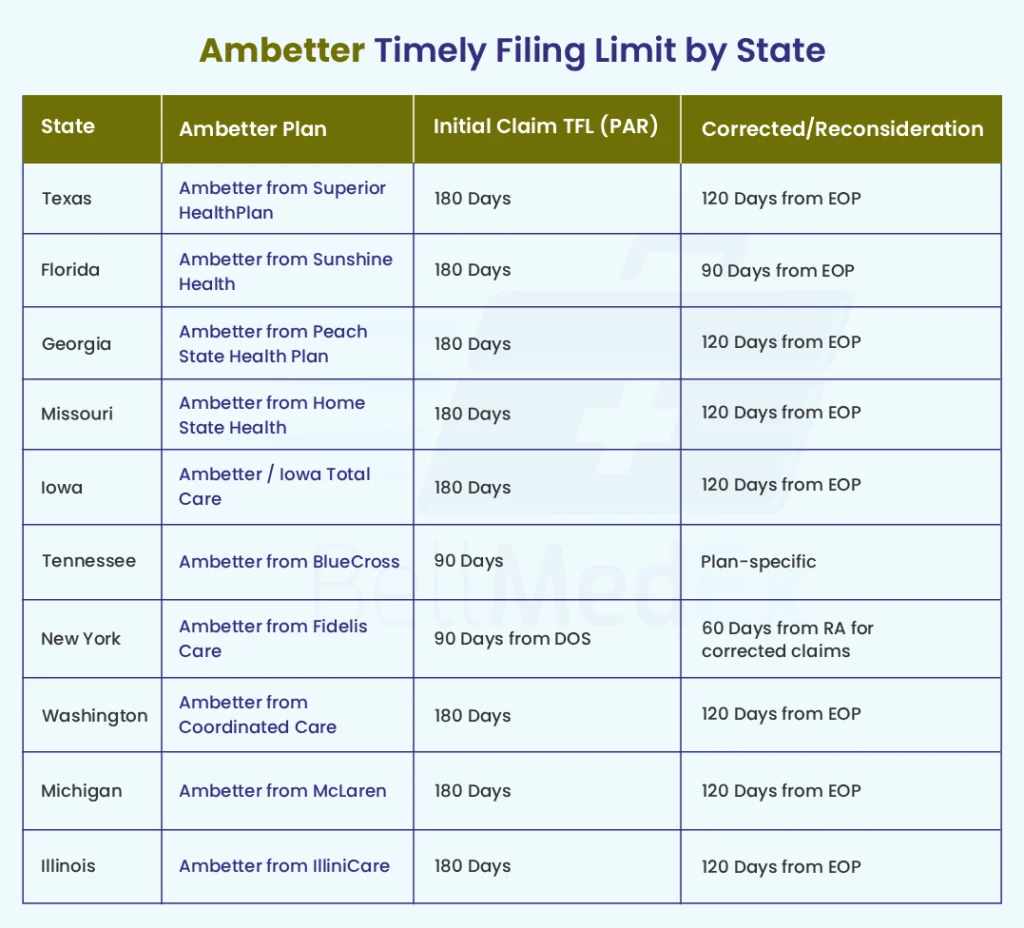
Though the general claim submission timeline for initial claims is 180 days, Ambetter applies different timeframes for different plans and claim types across states. Below, we summarize the timely filing windows for several states. You can visit Ambetter’s official website to confirm the exact limit for each state. You can also consult your provider manual, since the filing window varies depending on the payer agreement.
| State | Ambetter Plan | Initial Claim TFL (PAR) | Corrected/Reconsideration |
| Texas | Ambetter from Superior HealthPlan | 180 Days | 120 Days from EOP |
| Florida | Ambetter from Sunshine Health | 180 Days | 90 Days from EOP |
| Georgia | Ambetter from Peach State Health Plan | 180 Days | 120 Days from EOP |
| Missouri | Ambetter from Home State Health | 180 Days | 120 Days from EOP |
| Iowa | Ambetter / Iowa Total Care | 180 Days | 120 Days from EOP |
| Tennessee | Ambetter from BlueCross | 90 Days | Plan-specific |
| New York | Ambetter from Fidelis Care | 90 Days from DOS | 60 Days from RA for corrected claims |
| Washington | Ambetter from Coordinated Care | 180 Days | 120 Days from EOP |
| Michigan | Ambetter from McLaren | 180 Days | 120 Days from EOP |
| Illinois | Ambetter from IlliniCare | 180 Days | 120 Days from EOP |
Note: These filing limits are based on the information available at publication. Before submitting, confirm the current filing window directly with the insurer. As a best practice, we recommend submitting claims within 24 to 48 hours of the service date or hospital discharge. Likewise, if a claim is rejected or denied and needs to be corrected, resubmit it as soon as possible.
Ambetter Timely Filing Limit for Out-of-Network Providers
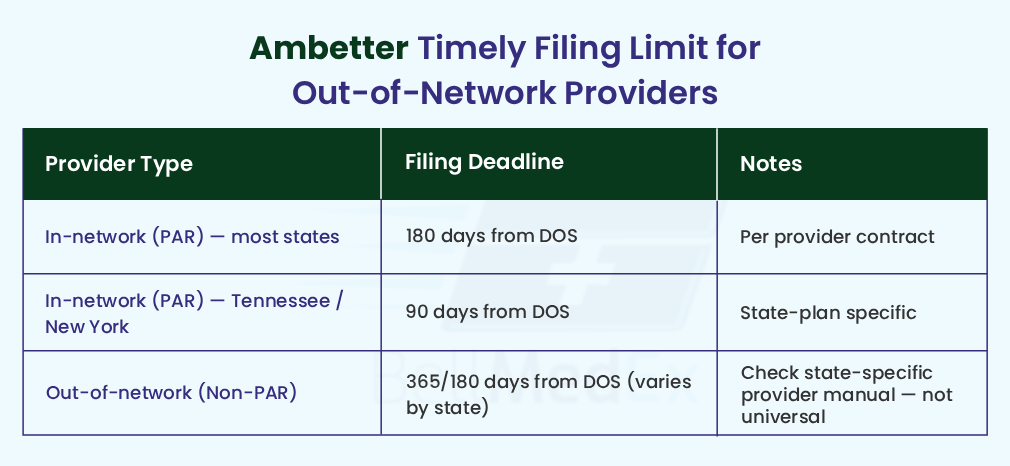
Ambetter offers a longer filing window for non-participating (out-of-network) providers than for in-network (PAR) providers.
In-network providers must submit claims within 180 days (or 90 days in Tennessee and New York). However, out-of-network providers usually have up to 365 days from DOS for claim submission. The 365-day out-of-network deadline is not universal across all Ambetter plans or states; it varies by state and specific plan, so you should always verify with your state’s Ambetter provider manual before filing.
| Provider Type | Filing Deadline | Notes |
| In-network (PAR) — most states | 180 days from DOS | Per provider contract |
| In-network (PAR) — Tennessee / New York | 90 days from DOS | State-plan specific |
| Out-of-network (Non-PAR) | 365/180 days from DOS (varies by state) | Check state-specific provider manual — not universal |
Ambetter Medicare Timely Filing Limit
Ambetter treats Medicare differently from other payers, in the following ways:
- Ambetter is an ACA Marketplace (commercial) product
- It is not a Medicare Advantage plan
- Ambetter does not administer Medicare Advantage coverage
- If the patient has both Ambetter and Medicare, coordinate benefits using standard COB rules
- For Medicare primary claims where Ambetter is secondary, use the primary Medicare EOP as the clock start for secondary filing
How to Calculate Ambetter Filing Deadlines
Knowing the exact timely filing window for Ambetter claims is important, but it is just as essential to know how to calculate the deadline yourself.
Ambetter Filing Window: 180 Days
Example: Service date = February 5, 2026
What is the last day for claim submission?
Step 1: Start with DOS: February 5, 2026
Step 2: Add 180 calendar days
February has 28 days in 2026, so 23 days remain in February
Step 3: 180 − 23 = 157 days left (March onward)
Step 4: March: 31 days → 157 − 31 = 126 left
Step 5: April: 30 days → 126 − 30 = 96 left
Step 6: May: 31 days → 96 − 31 = 65 left
Step 7: June: 30 days → 65 − 30 = 35 left
Step 8: July: 35 − 31 = 4 days into August
Deadline for claim submission = August 4, 2026
For claims with a 365-day filing limit, simply forward the date by 1 year. For example, for services provided on May 30, 2026, the filing limit is May 30, 2027.
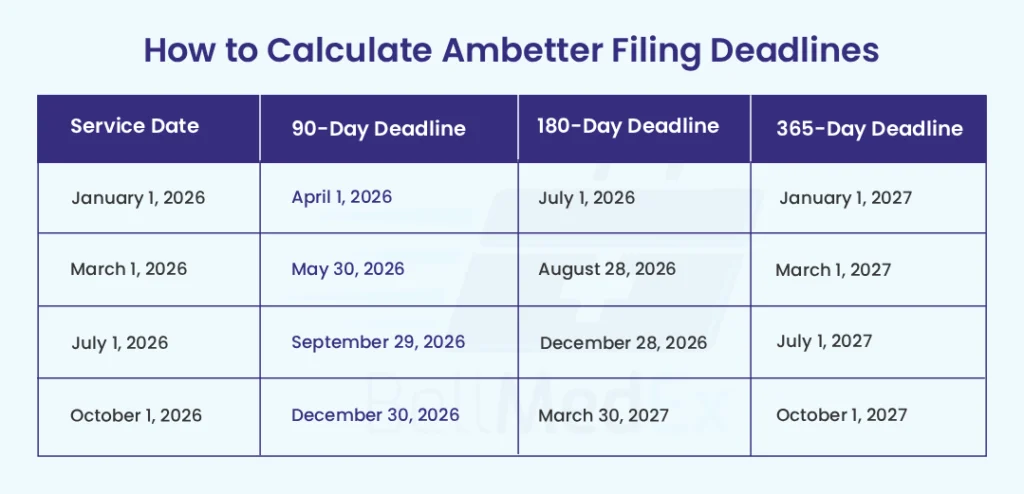
Here is a quick reference table for calculating filing limit days.
| Service Date | 90-Day Deadline | 180-Day Deadline | 365-Day Deadline |
| January 1, 2026 | April 1, 2026 | June 30, 2026 | January 1, 2027 |
| March 1, 2026 | May 30, 2026 | August 28, 2026 | March 1, 2027 |
| July 1, 2026 | September 29, 2026 | December 28, 2026 | July 1, 2027 |
| October 1, 2026 | December 30, 2026 | March 30, 2027 | October 1, 2027 |
Note: Ambetter does not publish an official one-day extension for weekends or holidays. Do not rely on grace days. File early.
What Happens If You File a Claim Late
If a claim reaches Ambetter after the filing window closes, it is denied with denial code CO-29, “The time limit for filing has expired.” Because CO-29 carries the Contractual Obligation (CO) group code, the unpaid amount becomes the provider’s responsibility under the contract and generally cannot be billed to the patient. For institutional (UB-04) claims, payers may instead return the related remark code N39011 to indicate the same problem.
Once a claim is denied for timely filing, the revenue is difficult to recover. Payers treat filing deadlines as a strict administrative requirement, so a corrected claim alone will not fix the problem. You can only recover payment if you can prove the claim was actually filed on time or that a recognized exception (such as retroactive eligibility, a natural disaster, or a documented system outage) applies.
How to Prove Timely Filing (POTF)
If Ambetter denies a claim for timely filing but you submitted it on time, you can appeal with proof of timely filing (POTF). The key is to show the date the payer received the claim — not just the date you generated or mailed it. Strong forms of proof include EDI acceptance reports and 277CA acknowledgment files (which confirm the payer received the claim), clearinghouse acceptance timestamps, payer-portal submission confirmations, and certified-mail tracking for paper claims.
For secondary or COB claims, also keep the primary payer’s EOB showing its adjudication date, since that date starts the secondary filing clock. As a best practice, submit electronically whenever possible and reconcile your clearinghouse acceptance and rejection reports every day. That way, a rejected claim can be corrected and resubmitted while it is still inside the filing window, rather than discovered after the deadline has already passed.
Frequently Asked Questions
Does the filing clock start on the date of service or the date I submit?
For initial claims, the clock starts on the date of service (the discharge date for inpatient claims). For secondary claims, it starts on the date the primary payer’s EOP or EOB is issued.
Is the deadline based on when I send the claim or when Ambetter receives it?
Ambetter counts the date it receives the claim, not the date you send it. Build in time for mailing or clearinghouse processing, and file early to stay safely inside the window.
Can a timely-filing denial be appealed?
Sometimes. If you can show proof of timely filing or a recognized exception — such as retroactive eligibility or a documented system outage — you can request reconsideration within the plan’s appeal window. Routine billing errors are usually not accepted as grounds.
Is the limit counted in calendar days or business days?
Filing windows are counted in calendar days. Ambetter does not add grace days for weekends or holidays, so treat the stated number of days as a hard deadline.