Established in 1988 upon President Ronald Reagan’s proclamation, we observe National Foster Care Awareness Month every May to raise awareness about children and youth in foster homes across the Nation.
For 31 days each year, all communities focus on the needs of young people growing up in substitute care. The medical community sees it as an opportunity to ensure safe, stable homes and continuous care for children transitioning into adulthood.
It is a time to pay tribute to foster parents, kinship caregivers, and child welfare professionals who were ready to take on the responsibility even at 2 AM. Lastly, the month reminds people that children constantly need happy homes and loving families.
The Growing Foster Care Gap in Florida
Data collected by the Annie E. Casey Foundation tells us that the United States has more than 360,000 children in foster care. About 55% of children enter care due to neglect, which is beyond their control. Kids under age 6 make up 39% of these cases, which is the largest age group.
Florida saw a 23% decline in licensed foster homes from 2023 to 2025. For instance, by 2023, there were 8,712 foster homes in the state, a number that decreased to 6,699 in 2025.
According to Daniel, a child-serving agency in Jacksonville, the number of kids coming into foster care is going up, and the number of foster homes available is going down. Community advocates hope to reverse the current trend to ensure every child has a safe and supportive environment.
The Florida Medical Foster Care Program Calls for Action
With 15,346 children in out-of-home placements in the Sunshine State, medical care coordinators call for appropriate foster placements. Why? Because creating safe and supportive placements for medically fragile children requires a massive coordinated effort. This heavy lifting is supported through the Florida Medical Foster Care program.
This program is a highly specialized joint effort between the Florida Department of Health Children’s Medical Services, the Department of Children and Families, and the Agency for Health Care Administration.
This program is directed towards neglected youth whose parents cannot care for them in their own homes. It also serves children with complex medical conditions, allowing them to receive necessary care in a specialized foster home rather than a hospital.
For case managers and foster parents doing this life-saving work, compassion is the driving force. However, compassion alone doesn’t sustain a complex healthcare system. Funding this level of in-home pediatric care is based on strict financial guidelines outlined by the Florida Medicaid Medical Foster Care Services Fee Schedule 2026.
Turning Compassion into Compliant Billing Under Rule 59G-4.002
Being a foster parent is a full-time responsibility. It requires patience, lots of hugs, celebrating birthdays, cheering home runs, and a lot of heart. That same level of dedication is required behind the scenes when submitting the claims.
Medical foster care billing is highly strict and requires absolute precision to ensure these safe homes actually receive the reimbursement they deserve. For this purpose, billers and case managers must follow the AHCA guidelines for Foster Care services and the 2026 Medical Foster Care services fee schedule outlined under Rule 59G-4.002.
For the calendar year 2026, the Florida Medicaid Medical Foster Care Services Fee Schedule outlines the maximum daily per diem fees paid for in-home care provided to medically fragile children.
Good to Know: This schedule covers the daily specialized supervision and care provided by certified medical foster parents. Healthcare providers, billers, and clinical coordinators must know that these rates are non-negotiable state ceilings for fee-for-service claims. They form the baseline for Statewide Medicaid Managed Care (SMMC) health plans such as Sunshine Health, Simply Healthcare, and Humana.
2026 Florida Medicaid Foster Care Reimbursement Rates and Tiers
The table below includes required modifiers, code descriptions, the official statewide reimbursement rates, and billing limits established by AHCA.
The total daily payment depends entirely on the modifier attached to this code, which reflects the child’s clinically assessed level of medical complexity.
| Procedure Code | Modifier | Description of Service | 2026 Reimbursement Rate | Billing Unit & Allowable Cap |
| S5145 | HA | Level I Medical Foster Care Service | $48.47 per day | 1 unit per day (Per Diem) |
| S5145 | TF | Level II Medical Foster Care Service | $60.59 per day | 1 unit per day (Per Diem) |
| S5145 | TG | Level III Medical Foster Care Service | $84.81 per day | 1 unit per day (Per Diem) |
| T1017 | SE | Targeted Case Management (CMS Medical Foster Care) | $11.42 per unit | 15-minute unit (Max 32 units/day) |
Three Tiers Explained Along With Targeted Case Management
Level I Medical Foster Care (S5145 + HA)
2026 pay rate: $48.47 per day
HCPCS code S5145, combined with modifier HA, applies to children with basic medical needs, daily clinical supervision, and routine oral medication management using basic medical equipment.
The use of the HA modifier highlights child/adolescent specialty care within the program framework.
Level II Medical Foster Care (S5145 + TF)
2026 pay rate: $60.59 per day
Code S5145 with TF is designated for children who require moderate medical support. This includes children dependent on gastrostomy tubes, specialized daily respiratory therapy, or complex neurological monitoring.
Level III Medical Foster Care (S5145 + TG)
2026 pay rate: $84.81 per day
This combination is used only for the medically fragile youth dependent on intensive, round-the-clock technical care or specialized life-support equipment. The TG modifier indicates a complex level of care requiring constant clinical intervention.
Important Note: These services are billed strictly as daily per diems. You cannot bill partial days, hourly rates, or multiple units of code S5145 for a single day.
Targeted Case Management (TCM)
Code + Modifier: T1017 + SE
2026 pay rate: $11.42 per 15-minute unit.
Foster parents are typically paid for daily physical care. However, clinical case managers use code T1017 to bill for coordinating that care. This includes the time spent scheduling specialized therapies, organizing medical records, and communicating with doctors, schools, or state agencies.
Simply put, HCPCS code T1017, along with modifier SE, covers comprehensive planning and thorough paperwork to simplify medical aid for the child and to keep them safe.
Daily Limit: Maximum of 32 units per day, i,e., 8 full hours of direct or indirect service coordination.
Modifier Rule: Modifier SE stands for State and/or Federally Funded Programs or Services. To ensure complete accuracy, append this modifier directly to procedure code T1017. Modifier SE separates Medical Foster Care case management from general child mental health case management, which uses modifier HA, and Early Steps case management, which uses modifier TL.
The Mistake of Mixing Up Separate Fee Schedules
One of the biggest financial mistakes clinics and billing teams make is searching for clinical care coordination codes on the Medical Foster Care Fee Schedule.
Example of why this mistake happens:
Bring to your mind a cafeteria menu. One menu lists the price for lunch, and a completely different menu lists the price for breakfast. If you try to order breakfast using the lunch menu or demand lunch items in breakfast, the cashier will get confused and refuse the order.
In Florida Medicaid, the Medical Foster Care Fee Schedule is like the lunch menu for the foster parent’s daily home care. The care coordinator’s work lives on a totally different menu called the Child Health Targeted Case Management Services Fee Schedule. Looking for care coordination on the foster care fee schedule will result in lost time and rejected claims every single time.
Care coordinators working with Children’s Medical Services (CMS) foster care contractors must use code T1017 with modifier SE under the Child Health Targeted Case Management Fee Schedule. This service pays $11.42 per 15-minute unit, up to a maximum of 32 units daily.
Medical Foster Care 2026 Compliance Hurdles and Audit Risks
Florida Medicaid and its contracted Managed Medical Assistance (MMA) plans have implemented automated, high-level auditing filters in 2026. So, to ensure revenue integrity, billing departments must eliminate three primary operational weaknesses.
These are:
Level Assignment Mismatches
Imagine buying size 10 shoes when your foot is a size 8. It simply won’t fit your feet.
Likewise, if a child is assigned to Level I care by the Children’s Multidisciplinary Assessment Team (CMAT), but your billing department submits a claim using modifier TG (Level III) to collect $84.81, instead of modifier HA (Level I) reimbursed at $48.47, the claim will fail automated cross-checks.
Strict Compliance Check: Before submitting the claim, make sure you verify the modifier on the S5145 claim and that it matches the exact tier designated in the child’s active CMAT assessment file.
Copied Clinical Documentation
Imagine a student copying and showing the same homework assignment every day. All he does is change the date at the top. The teacher will catch it immediately, and the student may face severe consequences.
Auditors do the same. They actively flag copied progress notes in which daily entries for foster care oversight or case management are identical copies of previous days.
Strict Compliance Check: Every progress note must show specific, individualized details about the child’s health status, medication changes, or medical appointments for that exact date of service. Generic copy-pasted clinical information will lead to recoupment demands during audits.
Inpatient Hospital Overlaps
A hospital admission creates a potential billing overlap, but it does not automatically make S5145 nonbillable for every day of the hospital stay.
Under Florida Medicaid’s Medical Foster Care rules, a child’s hospital admission does not automatically stop S5145 reimbursement. Florida Medicaid allows up to 15 leave days during any 90-day period for hospitalization or therapeutic visits.
For hospitalization leave days, the MFC provider should document that they continued providing services while the child was hospitalized. The clinical file must include supporting documentation, such as a physician’s statement confirming the provider’s presence during the stay in the hospital.
Strict Compliance Check: Don’t stop billing S5145 just because the child is hospitalized. Start by confirming whether the hospitalization qualifies for the Medicaid leave-day provision and whether the required documentation supports billing the affected dates.
Also, check whether the MFC service unnecessarily duplicates another provider’s service. Once the available leave days are exhausted or the applicable coverage requirements are no longer met, S5145 should not be billed for the child’s continued absence from the MFC home.
FL Medicaid Documentation Rules That Can Put MFC Payments at Risk
➜ Keep the MFC Plan of Care Current
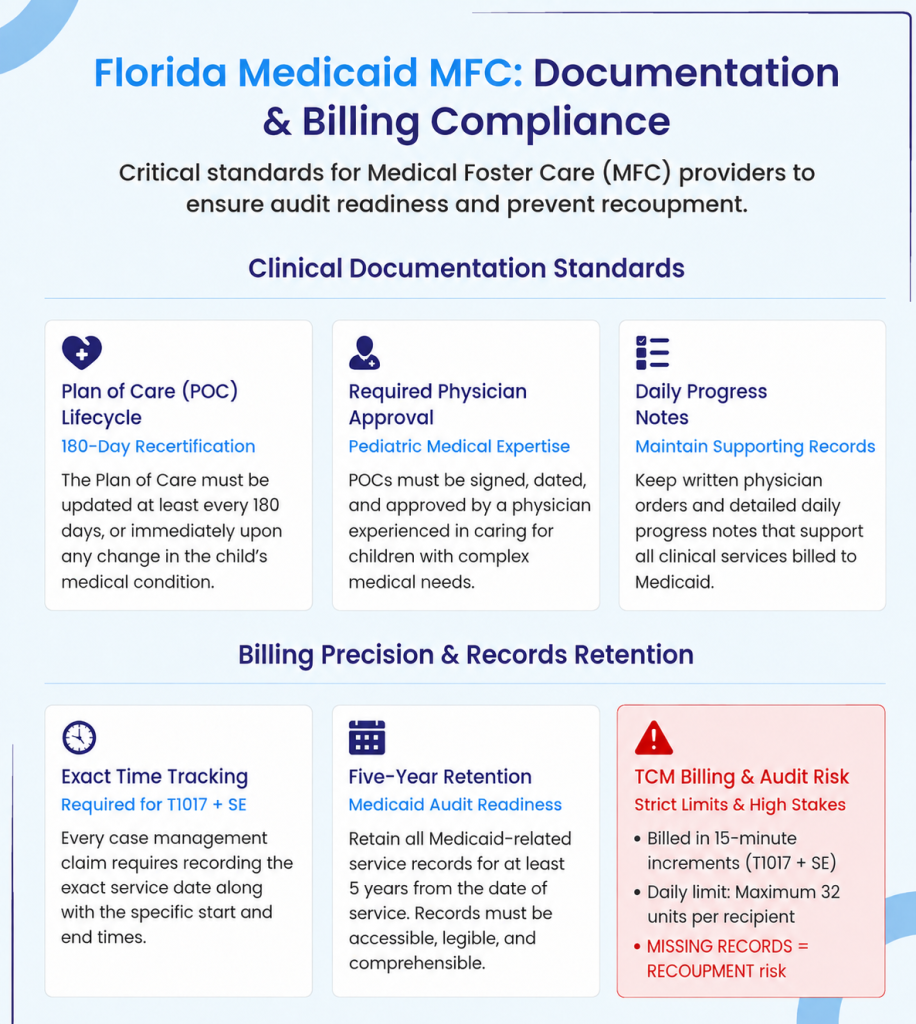
Florida Medicaid requires the recipient’s MFC file to contain a Plan of Care (POC) updated every 180 days or upon a change in the child’s condition. The POC must be signed, dated, and approved by a physician experienced in caring for children with complex medical needs.
Providers must also maintain the written MFC Staff physician’s order and daily progress notes supporting the services provided.
➜ Record the Actual Time when Billing T1017 + SE
T1017 with modifier SE is used for Child Health Targeted Case Management (TCM) provided by Medical Foster Care contractors. It is separate from the S5145 foster care per diem. Florida Medicaid reimburses T1017 + SE in 15-minute units, up to 32 units per recipient per day.
Essential documentation must include:
- Exact date of service.
- Exact start and end times.
- Service location.
- Specific activity performed.
- Number of 15-minute units billed.
- Detailed notes linking the case manager’s work to the child’s Plan of Care (POC).
➜ Maintain Medicaid Records for Five Years
FL Medicaid providers must keep records of billed services for at least five years from the date of service. These records must be readable, accessible, and available for review by authorized state or federal agencies.
If the provider cannot produce the documentation needed to support a payment during an audit, that payment may be at risk of denial or recoupment.
Actionable Steps for Billing Managers
Here are some key action steps that billing managers in Florida must take to ensure smooth claim creation, processing, and compliance with state regulations.
1). Verify Provider Enrollment
Medical foster care parents billing as atypical providers don’t require a National Provider Identifier (NPI). However, they must have an active Florida Medicaid ID. For paper CMS-1500 claims, enter the Medicaid ID in Box 33B with qualifier 1D and leave Box 33A blank when required for atypical provider billing.
2). Audit Claim Modifiers
Pay close attention to modifiers HA, TF, and TG, with pay rates of $48.47, $60.59, and $84.81, respectively, to ensure they align with CMAT authorizations on the date of service.
3). Keep TCM Billing Separate
Bill care coordinator services, using code T1017 and modifier SE at $11.42 per 15-minute unit, under the Child Health Targeted Case Management Fee Schedule. Also, separate these care logs for these sessions from daily per diem records.
4). Monitor Plan-Specific Guidelines
Confirm claim submission rules with individual managed care payors like Sunshine Health or Simply to ensure timely filing limits and correct claim references on resubmissions.
5). Verify CMAT Approvals, Not Plan Authorizations
For managed care plans such as Humana and Sunshine Health, MFC per diem services do not require prior authorization. However, the child’s current MFC level must be supported by a CMAT evaluation, since the CMAT determines whether the child is Level I, II, or III and the applicable S5145 modifier and reimbursement depend on that level.
Before billing, verify that the health plan has the child’s current MFC information and that the claim reflects the CMAT-assigned level.