Every year, Florida’s Medicaid program, run by the Agency for Health Care Administration (AHCA), publishes a Physician Pediatric Surgery Fee Schedule.
The fee schedule is like a restaurant menu, except instead of food prices, it lists the maximum amount Florida Medicaid will pay a doctor for each type of surgery or procedure performed on a child. In the 2026 edition, we will discuss more than 400 different procedure codes and their specific cost or reimbursement fee.
This Florida Medicaid fee schedule applies only to two specific types of physician specialists:
- Pediatric Surgeons (listed as Specialty Code 059)
- Urologists (listed as Specialty Code 063)
If a general surgeon or family doctor performs the same procedure, they use a different fee schedule. Let’s say procedure 44950 (appendectomy) is on this schedule ➜ If a Pediatric Surgeon (059) performs it, they bill using this pediatric surgery fee (e.g., $645.76). If a Urologist (063) performs it, they can use the same schedule. But, if a General Surgeon performs it, they get paid the standard rate from a different schedule instead of this special pediatric one.
This fee schedule applies to children enrolled in Florida Medicaid. To qualify, patients must be under 21 and eligible for the state’s public health insurance program.
Florida Medicaid covers millions of children across the state, including:
- Premature newborns who need emergency surgery
- School-age children with hernias
- Teenagers needing specialized urological or oncological procedures
The tables below show different CPT codes with their specific FL Medicaid fee and rules explaining specific documentation, authorization, and billing requirements for that procedure in Florida.
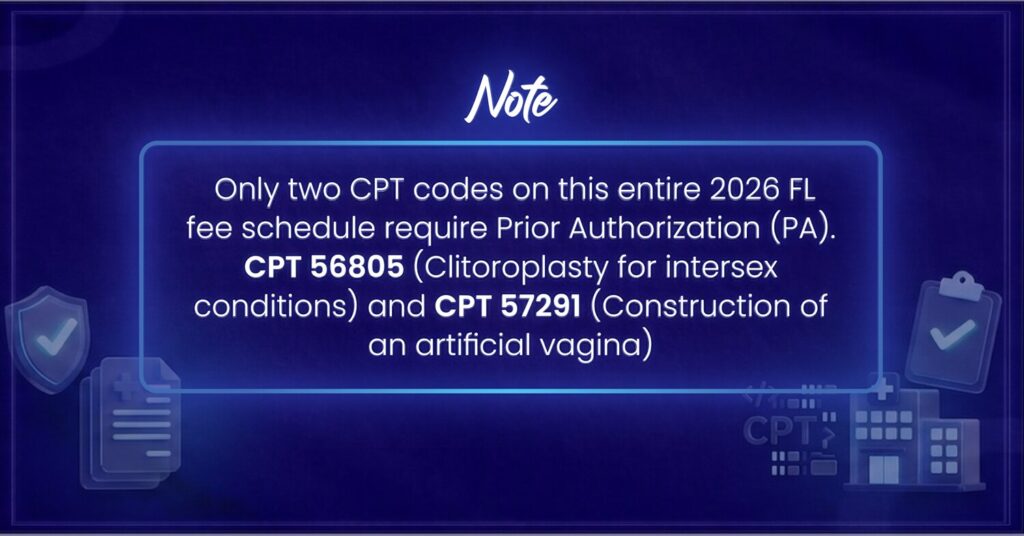
Note: On the Florida official state list, only two CPT codes on this entire 2026 FL fee schedule require Prior Authorization (PA). CPT 56805 (Clitoroplasty for intersex conditions) and CPT 57291 (Construction of an artificial vagina). However, many individual plans (like Sunshine Health) also require a PA for related procedures like 57292, 57295, 57296, and 57335. Every plan has its own rules, so it’s better to double-check with the payor before scheduling any reconstructive surgery to make sure you’re covered.
Skin Incision, Drainage & Debridement
Florida Medicaid pays a set fee for each type based on complexity. All services apply only to Pediatric Surgeons (059) and Urologists (063).
The size of the wound and how deep it goes determines which CPT code is used and how much Florida Medicaid pays.
| CPT Code | FL Medicaid 2026 Fee | Florida Medicaid Rules & Conditions |
| 10060 | $118.06 | Simple incision and drainage of a skin abscess. Must document abscess size, location, and that patient is under 21. No PA required. |
| 10061 | $208.22 | Complex or multiple abscess drainage. Florida Medicaid requires medical records showing infection severity. |
| 10080 | $185.43 | Incision and drainage of a pilonidal cyst, simple. Confirm patient is under 21. Common in adolescent males. |
| 10081 | $280.35 | Complicated pilonidal cyst drainage. FL Medicaid expects records showing why simple drainage was insufficient. |
| 10180 | $253.13 | Complex drainage of post-operative wound infection. Must include culture and sensitivity results. Not billable with routine wound care codes on same date. |
| 11042 | $120.10 | Debridement of skin and subcutaneous tissue, first 20 sq cm. Wound dimensions must be measured and recorded. |
| 11043 | $234.42 | Debridement involving muscle or fascia, first 20 sq cm. Physician must attest deep tissue involvement was medically necessary. |
| 11045 | $42.87 | Add-on: each additional 20 sq cm of skin debridement. Cannot be billed alone — requires CPT 11042 on same claim line. |
| 11046 | $74.17 | Add-on: each additional 20 sq cm of muscle/fascia debridement. Used with CPT 11043 only. Cannot be billed standalone. |
Benign Skin Lesion & Skin Tag Removal
Skin tags and benign (non-cancerous) lesions are common in children. While not dangerous, they may bleed, get infected, grow too large, or cause pain and may need surgical removal. Florida Medicaid covers removal when medical necessity is documented. Purely cosmetic removal is not covered.
| CPT Code | FL Medicaid 2026 Fee | Florida Medicaid Rules & Conditions |
| 11200 | $89.48 | Removal of up to 15 skin tags. Document number removed and medical reason (irritation, bleeding). |
| 11201 | $19.05 | Each additional 10 skin tags beyond 15. Add-on to 11200. Total count must be documented. Both codes must appear on same claim line. |
| 11400 | $126.91 | Excision of benign lesion, trunk/arms/legs, up to 0.5 cm. Record exact lesion size. |
| 11401 | $152.76 | Benign lesion excision, trunk/arms/legs, 0.6–1.0 cm. Size at time of service must match documentation. Florida Medicaid audits lesion size accuracy. |
| 11402 | $169.77 | 1.1–2.0 cm benign lesion, trunk/arms/legs. Pathology submission required to confirm the benign nature before final reimbursement is processed. |
| 11403 | $195.63 | 2.1–3.0 cm excision, trunk/arms/legs. Documentation of necessity required. Operative notes may be requested for lesions above 2 cm. |
| 11404 | $221.83 | 3.1–4.0 cm benign lesion, trunk/arms/legs. Clinical photographs may be required for audit. Document cosmetic vs. medical necessity clearly. |
| 11406 | $317.43 | Over 4.0 cm benign lesion, trunk/arms/legs. Physician attestation of medical necessity required for large excisions. |
| 11420 | $125.89 | Benign lesion, scalp/neck/hands/feet/genitalia, up to 0.5 cm. These anatomical areas have higher technical difficulty recognized by Florida Medicaid. |
| 11421 | $161.27 | 0.6–1.0 cm, scalp/neck/hands/feet/genitalia. Measurements must be at time of excision. |
| 11422 | $179.30 | 1.1–2.0 cm, sensitive anatomical areas. Must include exact anatomical site in medical records. |
| 11423 | $206.52 | 2.1–3.0 cm, sensitive areas. Florida Medicaid encourages histopathologic examination for lesions this size to confirm benign diagnosis. |
| 11424 | $237.14 | 3.1–4.0 cm, scalp/neck/hands/feet/genitalia. Florida Medicaid may require pre-authorization for recurrent or multiple site procedures. |
| 11426 | $336.15 | Over 4.0 cm, sensitive areas. Full operative report required. Florida Medicaid scrutinizes large pediatric excisions for appropriate medical indication. |
| 11440 | $139.15 | Benign lesion, face/ears/eyelids/nose/lips, up to 0.5 cm. Medical necessity required. cosmetic facial excisions are not covered by Florida Medicaid. |
| 11441 | $172.16 | 0.6–1.0 cm facial lesion. Must document cosmetic vs. functional impairment. Purely cosmetic excisions are not covered. |
| 11442 | $192.23 | 1.1–2.0 cm, face/ears/eyelids/lips. Pathology required. If lesion caused functional impairment (e.g., blocked vision), document in records. |
| 11443 | $228.29 | 2.1–3.0 cm, facial area. Operative report with diagram or photo is ideal for Florida Medicaid claims above 2 cm on the face. |
| 11444 | $285.45 | 3.1–4.0 cm, face/ears/lips. If reconstruction is needed, bill separately. Florida Medicaid covers functional reconstruction. |
| 11446 | $393.65 | Over 4.0 cm, facial area. Full documentation including pre- and post-operative notes required. |
Malignant Skin Lesion Removal
Malignant lesion removal requires wider surgical margins to ensure all cancer cells are removed. Its reimbursement rates are higher than for benign lesion removal.
Florida Medicaid requires a pathology report confirming the malignancy before final payment is processed.
FL Medicaid covers medically necessary facial reconstruction after cancer surgery in children. Oncology consultation notes, imaging, and pathology confirming clear margins are all expected documentation for malignant lesion claims.
| CPT Code | 2026 Fee | Florida Medicaid Rules & Conditions |
| 11600 | $197.33 | Malignant lesion, trunk/arms/legs, up to 0.5 cm. Pathology confirming malignancy required before final payment. |
| 11623 | $306.55 | 2.1–3.0 cm malignant, trunk/arms/legs. Document wide surgical margins in operative report. Oncology consultation documentation may be required. |
| 11624 | $344.65 | 3.1–4.0 cm malignant excision, trunk/arms/legs. FL Medicaid may require tumor board review documentation for pediatric malignancy of this size. |
| 11626 | $415.42 | Over 4.0 cm malignant excision. Requires full oncologic workup and operative report with margin measurements. |
| 11640 | $206.18 | Malignant lesion, face/ears/eyelids/nose/lips, up to 0.5 cm. Pathology must confirm diagnosis. Coordinated care with oncology is expected. |
| 11641 | $243.60 | 0.6–1.0 cm malignant facial lesion. Must include margin notation in operative report. Document tumor type (basal cell, melanoma, SCC) in diagnosis code. |
| 11642 | $277.29 | 1.1–2.0 cm malignant, face. Reconstruction likely needed; bill separately. Florida Medicaid covers reconstruction after malignant excision in children. |
| 11643 | $326.28 | 2.1–3.0 cm malignant excision, face. Full surgical and pathology documentation required. |
| 11644 | $401.81 | 3.1–4.0 cm malignant facial lesion. Complex reconstruction usually required. |
| 11646 | $522.25 | Over 4.0 cm malignant facial excision. Full operative documentation, pathology margins, and oncology coordination notes required. |
Nail Procedures & Wound Repair (Layered Closure)
Codes 11750 to 11772 are for nail removals and cyst surgeries. For a permanent nail fix (11750), Medicaid wants to see proof of long-term infections. They also need to know that simpler treatments didn’t work. Basically, you have to show that surgery was the only option left.
Intermediate wound repair means closing a wound in multiple layers.
The fee is based on the wound length in centimeters and the location on the body. Florida Medicaid audits wound repair claims carefully.
Estimating or rounding the wound size is not acceptable and can result in claim denial or downgrade.
| CPT Code | 2026 Fee | Florida Medicaid Rules & Conditions |
| 11750 | $226.59 | Permanent nail removal (excision of nail matrix). Must document medical necessity i.e. chronic ingrown nail with recurring infections. |
| 11765 | $170.12 | Wedge excision of nail fold for chronic ingrown toenail. Prior conservative treatment attempts (soaking, antibiotics) must be documented in chart. |
| 11770 | $284.77 | Excision of pilonidal cyst, simple. Florida Medicaid covers when abscess drainage has failed or cyst is recurrent. |
| 11771 | $582.81 | Extensive pilonidal cyst excision, multiple tracts. Must document complexity and why simple excision was not adequate. |
| 11772 | $709.38 | Complicated pilonidal excision. Reserved for deep or extensive tissue involvement. Full operative and post-op wound care protocol required. |
| 12031 | $244.29 | Layered closure, scalp/trunk/arms/legs, up to 2.5 cm. More than one tissue layer must be closed. Simple adhesive closures do not qualify for this code. |
| 12032 | $311.99 | Layered closure, scalp/trunk/extremities, 2.6–7.5 cm. Document exact wound length in centimeters. |
| 12034 | $319.48 | 7.6–12.5 cm layered closure, trunk/extremities. Full wound description with technique and suture type required. |
| 12035 | $397.73 | 12.6–20.0 cm layered closure. Longer lacerations in children require detailed records documenting the injury mechanism. |
| 12036 | $433.45 | 20.1–30.0 cm layered closure. Largest wound in intermediate repair. Document injury type (traumatic, surgical) and closure materials used. |
| 12041 | $248.03 | Layered closure, neck/hands/feet/genitalia, up to 2.5 cm. Sensitive anatomical sites justify higher skill-level recognition by Florida Medicaid. |
| 12052 | $300.42 | Layered closure, face/ears/eyelids/nose/lips/mouth, 2.5 cm or less. Facial repairs require precision. Document cosmetic vs. functional outcome. |
| 12053 | $354.86 | 2.6–5.0 cm facial layered closure. Accurate measurement documentation required. Before/after records may be requested for facial repairs. |
| 12056 | $559.00 | 7.6–12.5 cm facial layered closure. Operative notes must include wound description, layers closed, and suture type. |
| 12057 | $564.10 | 12.6–20.0 cm layered facial closure. Rare in children; requires detailed medical justification. |
Complex Wound Repair
Complex wound repairs are for the most challenging injuries, e.g., contaminated wounds, irregular lacerations, tissue loss, or wounds in difficult anatomical locations.
Add-on CPT codes (13102, 13122, 13133, 13153) are used when the total wound length exceeds a certain size.
Florida Medicaid is very specific. The doctor must document exactly what made the wound complex. Stating ‘complex wounds’ alone is not enough.
| CPT Code | 2026 Fee | Florida Medicaid Rules & Conditions |
| 13100 | $341.93 | Complex repair, trunk, 1.1–2.5 cm. Contaminated wounds, tissue defects, or irregular lacerations. Document complexity factors elevating repair beyond simple closure. |
| 13101 | $406.23 | Complex repair, trunk, 2.6–7.5 cm. Document contamination level, tissue loss, or anatomical complexity. FL Medicaid may audit for age-appropriate medical necessity. |
| 13102 | $124.52 | Add-on code: each additional 5 cm of complex trunk repair. Must be billed with 13101. Cannot be billed alone. |
| 13120 | $358.26 | Complex repair, scalp/arms/legs, 1.1–2.5 cm. Must document reason for complex closure (e.g., tissue loss, contamination, irregular edges). |
| 13121 | $437.20 | 2.6–7.5 cm complex repair, scalp/arms/legs. Operative report must describe complexity factors. |
| 13122 | $136.43 | Add-on code: each additional 5 cm of scalp/arm/leg complex repair. Used alongside 13121. Document total wound dimensions. |
| 13131 | $393.99 | Complex repair, forehead/cheeks/chin/mouth/neck, 1.1–2.5 cm. Write facial nerve proximity or vascular involvement in operative report. |
| 13132 | $486.19 | 2.6–7.5 cm complex repair, facial/neck areas. Document layers involved, complexity factors, and closure technique. |
| 13133 | $180.66 | Add-on: each additional 5 cm of complex facial/neck repair. Use with 13132. Each additional segment documented separately. Must match claim and records. |
| 13151 | $430.39 | Complex repair, eyelids/nose/ears/lips, 1.1–2.5 cm. Document any functional impairment addressed. |
| 13152 | $488.57 | 2.6–7.5 cm complex repair, eyelids/nose/ears/lips. Full operative report is essential. |
| 13153 | $196.31 | Add-on code: each additional 5 cm of complex eyelid/nose/ear/lip repair. Must use it with CPT 13152. Never bill add-ons without the primary code. |
| 13160 | $818.93 | Secondary closure of large or infected wound, or delayed primary closure. Must document why primary closure was not possible or was delayed at initial surgery. |
Skin Grafts, Burns & Lesion Destruction
Skin grafts are used when a wound is too large to close on its own. The doctor takes skin from one part of the patient’s body (called an autograft) and applies it to cover the wound.
Florida Medicaid covers grafts when the wound cannot heal on its own and the procedure is medically necessary.
Burn care codes cover dressing changes, debridement of burned tissue, and escharotomy (cutting through burned skin to restore blood flow in circumferential burns). The fee increases with burn size (%BSA) and complexity.
| CPT Code | 2026 Fee | Florida Medicaid Rules & Conditions |
| 15100 | $877.11 | Split-thickness skin autograft, trunk/arms/legs, first 100 sq cm. Document harvest and recipient site. |
| 15101 | $191.55 | Add-on code: each additional 100 sq cm of split-thickness autograft, trunk/arms/legs. Used with 15100. Document total graft surface area in operative notes. |
| 15120 | $867.25 | Split-thickness autograft, face/hands/feet, first 100 sq cm. Document functional importance of site. |
| 15121 | $212.98 | Add-on code: each additional 100 sq cm, face/hands/feet autograft. Must accompany 15120. Operative diagram or photo documentation recommended. |
| 15277 | $299.74 | Skin substitute graft, trunk/arms/legs, first 25 sq cm. Must document why autograft is not feasible. |
| 15278 | $74.51 | Add-on code: each additional 25 sq cm of skin substitute, trunk/arms/legs. Document product name and lot number used for Florida Medicaid audit trail. |
| 15940 | $706.32 | Excision of sacral pressure ulcer with bone removal. Covered for children with spina bifida or paralysis. |
| 16020 | $83.36 | Dressing change/debridement of burn, outpatient, small (<5% BSA). Each visit separately documented with wound status and BSA percentage. |
| 16025 | $150.04 | Burn dressing/debridement, medium (face or 5–10% BSA). Face burns in children are high-priority. Note BSA affected and burn depth at each visit. |
| 16030 | $187.13 | Large burn dressing/debridement (>10% BSA). Hospital-based authorization may be required. Document every dressing change with wound measurements. |
| 16035 | $199.72 | Escharotomy: incision through burned skin to restore circulation. Used for circumferential burns. |
| 16036 | $80.97 | Add-on escharotomy for additional incision sites. Used with 16035. Each escharotomy incision site must be listed separately in the operative note. |
| 17000 | $83.36 | Destruction of premalignant skin lesion, first lesion. Diagnosis code confirming premalignant condition required. Document number of lesions and treatment method. |
| 17003 | $6.80 | Each additional premalignant lesion (lesions 2–14). Add-on to 17000. Total count must match chart documentation. Florida Medicaid pays per lesion. |
| 17110 | $114.32 | Destruction of benign skin lesions (e.g., warts), up to 14 lesions. Common for viral warts. Document each lesion site and treatment method. |
| 17111 | $135.41 | Destruction of 15 or more benign lesions. Higher fee for greater number. Each lesion site must be individually documented. |
Breast, Chest Wall & Soft Tissue Tumor Surgery
Breast surgery in children is mainly for gynecomastia (enlarged breasts in boys) and breast masses in teenage girls (like juvenile fibroadenoma).
Florida Medicaid covers surgical repair only when CT scan results and breathing tests show the chest deformity is causing real heart or lung problems. However, cosmetic chest surgery is not covered.
| CPT Code | 2026 Fee | Florida Medicaid Rules & Conditions |
| 19101 | $351.46 | Open breast biopsy. Rare in children; common for gynecomastia or breast mass. Diagnosis code and imaging pre-authorization required in most cases. |
| 19120 | $501.50 | Excision of breast lesion or mass. Most common for juvenile fibroadenoma in teenage girls. Imaging or biopsy confirming mass requiring removal required. |
| 19300 | $533.48 | Mastectomy for gynecomastia. Covered when gynecomastia causes significant pain, functional impairment, or psychological distress in boys under 21. Cosmetic surgery cases excluded. |
| 20205 | $298.72 | Open muscle biopsy. Used to diagnose muscular dystrophy or inflammatory muscle disease. |
| 20680 | $639.29 | Deep hardware removal (implanted metal plates or rods). Covered when hardware causes pain, infection, or mechanical problems. |
| 21011 | $357.92 | Soft tissue tumor, face/scalp, <2 cm, subcutaneous. Document exact size and location. Pathology report required for all excisions. |
| 21012 | $340.91 | Soft tissue tumor, face/scalp, ≥2 cm, subcutaneous. Pre-operative imaging may be requested. Document tumor characteristics and surgical margins. |
| 21013 | $531.10 | Deep soft tissue tumor, face/scalp, <2 cm. Deeper resection carries higher risk. Detailed operative report with depth of excision required. |
| 21014 | $526.68 | Deep soft tissue tumor, face/scalp, ≥2 cm. Full operative report and pathology required. Multidisciplinary discussion may be required. |
| 21015 | $719.25 | Radical resection, face/scalp, <2 cm. Wide margins taken. Oncology involvement documentation and pathology confirming clear margins expected. |
| 21016 | $1046.55 | Radical resection, face/scalp, ≥2 cm. Requires full oncologic documentation, imaging, pathology, and post-operative plan. Multi-specialty coordination required. |
| 21501 | $473.26 | Incision and drainage of deep neck/thorax abscess. Must document abscess depth. Imaging-confirmed deep abscess is typical clinical scenario. |
| 21550 | $270.48 | Biopsy of soft tissue, neck/thorax. For diagnosis of neck masses. Covered when imaging or exam supports suspicious lesion. |
| 21555 | $430.73 | Excision of subcutaneous soft tissue tumor, neck/thorax, <2 cm. Pathology required. Covered for both benign and malignant diagnoses. |
| 21556 | $541.99 | Soft tissue tumor excision, neck/thorax, ≥2 cm. Operative report must include tumor dimensions and histological type. |
| 21602 | $1631.35 | Excision of chest wall tumor including rib(s). Complex surgery. Imaging, pathology, and thoracic surgery involvement required. |
| 21740 | $1228.23 | Open repair of pectus excavatum. Covered only when documented cardiac or respiratory impairment is present. CT scan results required. |
| 21742 | $1221.84 | Minimally invasive pectus excavatum repair (Nuss procedure). Same coverage criteria as 21740. |
| 21743 | $1385.05 | Minimally invasive pectus carinatum repair. Covered when documented functional or significant structural deformity is present. |
Spine/Back Tumors, Foreign Bodies & Nasal Surgery
Soft tissue tumors of the back, flank, and extremities can be benign (lipomas) or malignant (sarcomas). The fee schedule is based on tumor size and depth (subcutaneous vs. intramuscular).
Florida Medicaid requires CT or MRI imaging before surgery to determine whether the cyst connects to brain structures. This imaging guides the surgical approach.
| CPT Code | 2026 Fee | Florida Medicaid Rules & Conditions |
| 22900 | $568.86 | Soft tissue tumor, back/flank, <5 cm, intramuscular. Write size and location (intramuscular vs. subcutaneous) in notes. |
| 22901 | $669.57 | Back/flank soft tissue tumor, ≥5 cm. Pre-operative MRI or CT may be requested. Doctor should write full operative report. |
| 22902 | $444.68 | Subcutaneous back tumor excision, <3 cm. Document depth if tumor extends into muscle, use codes 22900/22901 instead. |
| 22903 | $439.92 | Subcutaneous back tumor, ≥3 cm. Must document size and depth. Florida Medicaid auditors check claim code with pathology report. |
| 22904 | $1060.84 | Radical resection, back/flank tumor, <5 cm. |
| 22905 | $1339.49 | Radical resection, back/flank, ≥5 cm. Highest back category fee. Full oncologic documentation, imaging, and operative report required. |
| 24200 | $210.60 | Foreign body removal, upper arm/elbow, simple. Document type of foreign body and imaging confirmation of location. |
| 25075 | $495.72 | Soft tissue tumor excision, forearm/wrist, <3 cm. Document size and relationship to vessels/nerves. |
| 28190 | $267.76 | Simple foreign body removal, foot. Imaging confirming location required. Document object type and removal method. |
| 28192 | $490.95 | Complicated foreign body removal, foot. Deeper dissection or proximity to tendons. Document anatomy involved and write why simple extraction was insufficient. |
| 28193 | $552.87 | Complex foot foreign body removal. Typically requires operating room. FL Medicaid will require OT notes and anatomical documentation. |
| 30124 | $294.64 | Excision of nasal dermoid cyst. CT or MRI required before surgery to rule out intracranial extension. Note imaging findings and surgical approach. |
Airway & Tracheobronchial Surgery
Children with breathing problems may need procedures on the trachea (windpipe) or bronchi (airways to the lungs). Children who need long-term ventilator support or have severe airway obstruction need Tracheostomy (creating a hole in the neck for breathing).
Florida Medicaid covers tracheostomy and related care when medical necessity is documented properly.
Bronchoscopy involves using a tiny camera on a flexible tube to look inside a child’s airways. Doctors can see the airway to find the cause of breathing problems, remove swallowed foreign objects, or widen a narrowed airway.
Florida Medicaid covers both diagnostic bronchoscopy (looking only) and therapeutic bronchoscopy (treating the problem).
| CPT Code | 2026 Fee | Florida Medicaid Rules & Conditions |
| 31502 | $35.04 | Tracheotomy tube change, infant under 2 years. Routine care for infants with tracheostomies. Document tube size and condition at time of change. |
| 31587 | $1016.27 | Laryngoplasty with cricoid split. For subglottic stenosis in infants. PA recommended. Document airway measurements pre- and post-operatively. |
| 31600 | $399.77 | Planned tracheostomy, patient over 2 years. Document medical necessity (e.g., prolonged ventilator dependency, airway obstruction). |
| 31601 | $261.98 | Tracheostomy in a child under 2. All documentation requirements same as 31600. Infant tracheostomies require NICU/PICU level documentation. |
| 31622 | $326.62 | Diagnostic flexible bronchoscopy. Covered for evaluation of airway problems (stridor, recurrent pneumonia). Document all findings and airway measurements. |
| 31630 | $203.46 | Bronchoscopy with balloon dilation of bronchial stenosis. Document stenosis severity before and after. Covered when airway narrowing affects breathing significantly. |
| 31631 | $231.70 | Bronchoscopy with airway stent placement. For severe fixed narrowing. Document failed dilation attempts or severe stenosis. |
| 31635 | $359.62 | Bronchoscopy with foreign body removal from airway. Very common pediatric emergency. Document type and location of foreign body and retrieval method. |
| 31645 | $331.04 | Bronchoscopy with bronchoalveolar lavage (BAL). For infections or lung diseases diagnosis. Covered with appropriate diagnosis code (e.g., immunocompromised patient). |
| 31820 | $453.19 | Surgical closure of a tracheostomy opening. Performed when child no longer needs tracheostomy. Document that underlying condition resolved and child breathes independently. |
Open Thoracic (Chest) Surgery
Open chest surgeries are performed for serious pediatric lung conditions that cannot be treated with medicine.
Florida Medicaid requires extensive pre-operative documentation for all thoracic surgeries e.g., CT scan confirming the problem, pulmonary function tests, lung specialist consultation notes, and a clear explanation of why surgery was best. Fees for thoracic surgery are among the highest on this schedule, reflecting the complexity and risk involved.
| CPT Code | 2026 Fee | Florida Medicaid Rules & Conditions |
| 32100 | $832.88 | Thoracotomy with chest cavity exploration. Covered for diagnostic or emergency purposes. Operative report must describe all findings and reason for exploration. |
| 32110 | $1490.55 | Thoracotomy to control major chest bleeding. Emergency procedure in pediatric trauma. Document injury mechanism, hemodynamic status, and surgical findings. |
| 32141 | $1551.45 | Thoracotomy to remove lung bullae causing pneumothorax. Covered after two pneumothorax episodes or one life-threatening event is documented. |
| 32200 | $1155.08 | Open drainage of lung abscess (pneumonostomy). Requires documentation of failed antibiotic therapy and CT imaging confirming abscess. |
| 32215 | $818.25 | Pleural scarification to prevent repeated pneumothorax. Covered after recurrent pneumothorax and failed conservative management are documented. |
| 32220 | $1621.54 | Total lung decortication (removal of fibrous peel from lung surface). CT must show significant lung entrapment and impaired lung function. |
| 32320 | $1629.70 | Decortication with parietal pleurectomy. Extensive procedure for complex empyema. Imaging and culture data required. Full operative report mandatory. |
| 32440 | $1593.30 | Total pneumonectomy (complete lung removal). Rare in children. Requires extensive pre-operative documentation and pulmonology clearance. |
| 32480 | $1507.22 | Lobectomy (removal of one lung lobe). For CPAM, tumors, or chronic infections. Payer will require Imaging, pathology, and pulmonology consultation. |
| 32482 | $1613.37 | Bilobectomy (removal of two lung lobes). Document extent of disease and justification for bilobectomy vs. lobectomy. |
| 32484 | $1461.63 | Segmentectomy (removal of a small lung segment). Lung-sparing approach. Document segment removed and rationale for preserving remaining lung. |
| 32551 | $177.94 | Chest tube insertion (tube thoracostomy). Document indication (air vs. fluid), tube size, and insertion site. |
| 32560 | $258.23 | Pleurodesis via chest tube. Used to seal recurrent pneumothorax or pleural effusions. Document recurrent episodes and type of agent instilled. |
| 32562 | $87.44 | Fluid removal via drainage catheter (add-on). Used with chest tube management. Document total fluid removed. |
VATS (Video-Assisted Thoracic Surgery)
VATS stands for Video-Assisted Thoracic Surgery, a minimally invasive chest surgery using small cuts and a tiny camera. Instead of opening the whole chest, surgeons make 2–3 small holes and operate while watching on a screen. Children recover faster and have less pain with VATS compared to open chest surgery.
Florida Medicaid covers VATS procedures for the same conditions treated with open thoracic surgery.
If a procedure is started with VATS but converted to open surgery, then the open surgery codes should be used instead.
| CPT Code | 2026 Fee | Florida Medicaid Rules & Conditions |
| 32601 | $314.37 | Diagnostic thoracoscopy (scope into chest to look inside). Covered when non-invasive tests are inconclusive. |
| 32607 | $325.94 | Thoracoscopy with biopsy of lung or mediastinum. Covered for unexplained masses. |
| 32608 | $401.13 | Thoracoscopic wedge biopsy of the lung. Covered when CT-guided biopsy failed or was not appropriate. Document prior failed biopsy attempts. |
| 32650 | $681.48 | VATS pleurodesis for recurrent pneumothorax. Document number of prior episodes and failed non-surgical treatment. |
| 32651 | $1115.27 | VATS removal of blood clot or foreign body from pleural space. Document CT findings and approach used for removal. |
| 32652 | $1688.90 | VATS total pneumonectomy. Rare in children. Same documentation requirements as open pneumonectomy (32440). |
| 32653 | $1075.13 | VATS removal of fibrin or foreign material from pleural space. Document empyema stage (I, II, III) and fibrin characteristics. |
| 32655 | $977.14 | VATS excision of lung bullae. For spontaneous pneumothorax in adolescents. Same PA criteria as open surgery. |
| 32658 | $728.43 | VATS removal of clot/fibrin from pleural or pericardial space. Document nature of material removed and post-operative drainage output. |
| 32662 | $908.07 | VATS lobectomy. For CPAM, tumor, or chronic infection. Document CT findings, pathology, and why VATS was selected over open surgery. |
| 32663 | $1424.20 | Major VATS lobectomy. Pre-operative pulmonology consultation and imaging documentation required. |
| 32665 | $1238.44 | VATS esophagomyotomy for achalasia. Swallowing studies confirming achalasia required. Esophageal manometry results needed for prior authorization. |
| 32666 | $909.43 | VATS partial lung resection. Document which segment removed and pre-operative CT with lesion measurement. |
| 32667 | $167.73 | Add-on code: each additional VATS lung resection segment. Use it with CPT 32666. Cannot be billed alone. |
Cardiac, Pericardial & Vascular Access
Central venous catheters (CVCs) are long IV lines placed in large veins near the heart. They are used for children with cancer who need chemotherapy, premature babies who need nutrition, or patients requiring long-term antibiotics.
Florida Medicaid distinguishes between tunneled lines (under the skin, permanent) and non-tunneled (temporary, surface-level).
| CPT Code | 2026 Fee | Florida Medicaid Rules & Conditions |
| 33017 | $242.66 | Pericardiocentesis, infant under 8 lbs or child under 2 years. Echocardiogram confirmation of pericardial effusion required. |
| 33018 | $276.51 | Pericardiocentesis with imaging guidance, age 2 and older. Document imaging used, amount of fluid removed, and fluid analysis results. |
| 33019 | $224.56 | Add-on code for additional components of pericardiocentesis. Used with 33017 or 33018. Cannot be billed alone. |
| 33025 | $816.89 | Surgical pericardial window for drainage. Covered when pericardiocentesis has failed or fluid recurs rapidly. |
| 33820 | $997.89 | Surgical repair of aortic coarctation. Covered for confirmed hemodynamically significant coarctation. |
| 36420 | $52.40 | Cutdown venipuncture (cut to access a vein), infant under 1 year. Covered when standard IV access fails. Document number of failed attempts. |
| 36425 | $40.15 | Cutdown venipuncture, child age 1 and older. Same documentation as CPT 36420. Covered as alternative when standard approaches unsuccessful. |
| 36555 | $265.04 | Non-tunneled CVC placement, child under 5 years. Covered for IV access needed longer than 3–5 days. Document indication and insertion site. |
| 36556 | $240.88 | Non-tunneled CVC, child 5 years and older. Document catheter type, size, and tip position confirmed by X-ray. |
| 36557 | $806.00 | Tunneled CVC without port, child under 5 (e.g., Broviac line). Covered for long-term IV therapy. Document expected duration and diagnosis. |
| 36558 | $819.27 | Tunneled CVC without port, child 5 and older (e.g., Hickman). Covered for chemotherapy, TPN, or prolonged antibiotics. |
| 36560 | $1443.94 | Tunneled CVC with port (port-a-cath), child under 5. PA typically required. Document diagnosis and expected frequency of access. |
| 36561 | $1252.39 | Port-a-cath placement, child 5 and older. Covered for chemotherapy, immunotherapy, or long-term IV access. Oncology referral documentation supporting need required. |
| 36593 | $31.64 | Declotting of implanted IV device using thrombolytic agent. Document failed attempts to flush device before using clot-dissolving drug. |
| 36800 | $168.07 | Insertion of AV cannula for dialysis access. Covered for children with renal failure. Nephrology documentation supporting dialysis required. |
Spleen Surgery & Lymph Node Procedures
The spleen filters blood and fights infections. Diseases like hereditary spherocytosis, sickle cell disease, and ITP can require splenectomy (spleen removal).
Florida Medicaid covers splenectomy with documentation from a hematologist confirming the diagnosis. After splenectomy, pneumococcal, meningococcal, and Hib vaccines must be given and documented.
| CPT Code | 2026 Fee | Florida Medicaid Rules & Conditions |
| 38100 | $1157.12 | Open total splenectomy. Covered for hereditary spherocytosis, sickle cell, ITP, or traumatic rupture. |
| 38101 | $1168.35 | Open partial splenectomy. Spleen-saving approach. Document why partial removal was chosen over total splenectomy. |
| 38115 | $1275.18 | Surgical repair of ruptured spleen (splenorrhaphy). Document injury grade (AAST scale), operative findings, and hemodynamic stability at surgery. |
| 38120 | $1059.82 | Laparoscopic splenectomy. Document diagnosis requiring splenectomy and hemodynamic stability for elective laparoscopic approach. |
| 38300 | $292.94 | Simple drainage of lymph node abscess. Document lymph node location, size, cultures, and organisms identified. |
| 38305 | $471.22 | Extensive drainage of lymph node abscess: multiple nodes or large area. Document extent of disease and why simple drainage was insufficient. |
| 38500 | $340.23 | Open biopsy or excision of superficial lymph node. Pathology report required. Note size and duration of lymphadenopathy. |
| 38510 | $532.46 | Deep cervical lymph node biopsy. CT or ultrasound imaging results must be documented before billing this code. |
| 38520 | $472.24 | Deep cervical biopsy including scalene fat pad. Used in thoracic oncology staging when mediastinal node sampling is required through the neck. |
| 38525 | $441.96 | Deep axillary lymph node biopsy. Ultrasound guidance documentation adds support. Pathology required. |
| 38542 | $527.02 | Dissection of deep jugular lymph nodes. Full pathology and pre-operative imaging required. Note number of nodes dissected and location. |
| 38550 | $517.15 | Excision of cystic hygroma, axillary or cervical. Pre-op imaging confirming extent required. Covered when hygroma causes functional impairment or infection. |
| 38555 | $957.41 | Radical excision of cystic hygroma with deep neurovascular dissection. Imaging documentation and surgical team qualification for complex vascular dissection required. |
Diaphragm, Mouth & Neck Congenital Procedures
Some babies are born with a hole in their diaphragm. This lets belly organs slide up into the chest, which crushes the lungs. It’s a scary, life-threatening emergency that needs surgery immediately. To get the claim paid, you have to provide the NICU charts, the heart scans, and the full surgical report.
Tongue-tie (ankyloglossia) affects feeding in babies and speech in older children. The frenulum under the tongue is too tight, making breastfeeding or speaking difficult.
Florida Medicaid covers tongue-tie release when a lactation consultant or speech therapist has documented feeding or speech difficulties.
| CPT Code | 2026 Fee | Florida Medicaid Rules & Conditions |
| 39220 | $1162.23 | Excision of diaphragm tumor with simple repair. CT imaging and pathology required. Thoracic surgery involvement expected. |
| 39503 | $6141.83 | Repair of neonatal congenital diaphragmatic hernia (CDH). Highest fee on schedule. Life-threatening emergency. NICU records, surgical notes, and echocardiogram required. |
| 39541 | $949.58 | Repair of acute traumatic diaphragmatic hernia. Document injury mechanism, imaging findings, and organs involved. |
| 39545 | $911.82 | Repair of chronic (delayed) traumatic diaphragmatic hernia. Imaging must document hernia contents and timeline of injury. |
| 39560 | $798.86 | Simple resection and repair of diaphragm. Document defect size and repair technique used. |
| 39561 | $1264.29 | Complex diaphragm resection and repair. Document defect size, repair materials (e.g., Gortex patch), and post-operative management. |
| 41010 | $219.45 | Tongue-tie release (incision of lingual frenum) for infants. Covered when tongue-tie confirmed to impair feeding. |
| 41115 | $265.04 | Excision of lingual frenum (tongue-tie). Covered when incision (41010) alone did not resolve feeding or speech problems. |
| 41520 | $367.79 | Frenoplasty — surgical revision of frenum with tissue repositioning. Covered after simpler procedures failed. |
| 42810 | $412.02 | Excision of branchial cleft cyst or sinus. Covered when cyst is infected, enlarging, or affecting swallowing. |
| 42815 | $580.09 | Excision of complicated or recurrent branchial cleft cyst. Covered with documentation of prior surgery and imaging showing remaining cyst tissue. |
Esophageal Surgery
The esophagus connects the throat to the stomach. Esophageal surgery in children ranges from simple balloon dilation of a narrowed esophagus to life-saving reconstruction for babies born with esophageal atresia (where the esophagus has a gap in the middle).
Florida Medicaid requires documented failure of maximum medical therapy, before surgery is approved.
| CPT Code | 2026 Fee | Florida Medicaid Rules & Conditions |
| 43108 | $4698.24 | Total esophagectomy without thoracotomy (transhiatal). One of the highest fees. Full oncologic workup, nutrition plan, and surgical team documentation required. |
| 43112 | $2713.67 | Total esophagectomy with pharyngogastric reconstruction. Pre-operative imaging, nutritional assessment, and confirmed diagnosis documentation required. |
| 43113 | $4359.03 | Total esophagectomy with colon interposition. Document why stomach pull-up was not feasible for esophageal replacement. |
| 43200 | $224.21 | Diagnostic flexible esophagoscopy. Covered for dysphagia, foreign body, or GERD evaluation. Document findings and reason for procedure. |
| 43202 | $301.44 | Esophagoscopy with biopsy. Covered when pathology is needed (eosinophilic esophagitis, Barrett’s esophagus). Pathology report required. |
| 43215 | $156.85 | Esophagoscopy to remove a foreign body. Covered urgent procedure. Document type and location of foreign body and removal method. |
| 43220 | $129.29 | Esophagoscopy with balloon dilation of stricture. Document stricture location, balloon size used, and pre/post dilation measurements. |
| 43226 | $143.24 | Esophagoscopy with stent placement. Document prior dilation attempts, stent type, and expected dwell time. |
| 43235 | $311.65 | Flexible upper GI endoscopy (EGD), diagnostic. Covered for GI bleeding, abdominal pain evaluation, or malabsorption workup. |
| 43239 | $359.28 | EGD with biopsy. Covered to diagnose H. pylori, celiac disease, or eosinophilic disorders. |
| 43246 | $255.17 | EGD with PEG tube placement. Covered for children unable to feed orally due to neurological or structural conditions. Nutritional assessment documentation required. |
| 43249 | $176.24 | EGD with balloon dilation of upper GI stricture. Document stricture confirmed on prior imaging or endoscopy. |
| 43279 | $1297.98 | Laparoscopic Heller myotomy for achalasia. Esophageal manometry confirming achalasia required. Include swallowing study results in medical record. |
| 43280 | $1088.40 | Laparoscopic myotomy with fundoplication. Covered for achalasia with GERD. Document both conditions clearly in pre-operative records. |
| 43305 | $1111.19 | Open repair of tracheoesophageal fistula (TEF) with esophageal reconstruction. Neonatal records confirming diagnosis and pre-operative imaging required. |
| 43310 | $1507.90 | Esophagoplasty via cervical incision. Document level of injury or stricture and why cervical approach was chosen. |
| 43312 | $1619.84 | Esophagoplasty via thoracic approach. CT chest and barium swallow pre-operatively required. |
| 43313 | $3135.56 | Esophagoplasty for esophageal atresia, thoracic. Major neonatal surgery. NICU records and neonatal surgical consultation required. |
| 43314 | $2927.00 | Thoracoscopic repair of esophageal atresia. Document that thoracoscopic technique was appropriate for the defect gap length. |
| 43325 | $1350.37 | Esophagogastric fundoplasty for severe GERD. pH study or impedance study required. Must document failed maximal medical therapy. |
| 43330 | $1342.21 | Esophagomyotomy via thoracic approach. Document reason for open approach and pre-operative manometry results. |
| 43331 | $1366.02 | Esophagomyotomy via abdominal approach. Document manometry results and why abdominal rather than thoracic approach was used. |
| 43352 | $1088.74 | Surgical closure of esophagostomy. Document original indication and current esophageal function testing confirming readiness for closure. |
| 43420 | $1037.02 | Closure of esophagostomy or fistula through the neck. Document original surgical history and current esophageal function testing. |
| 43450 | $161.27 | Dilation of esophagus with bougie (guided instrument). Note stricture origin, degree of narrowing, and bougie size used. |
| 43453 | $311.31 | Esophageal dilation over guidewire (safer technique). Document imaging confirmation of stricture and patient response to dilation. |
Stomach Surgery
Pyloric stenosis (treated with pyloromyotomy, code 43520) is one of the most common surgical emergencies in newborns.
Gastrostomy tubes (G-tubes) are feeding tubes placed directly into the stomach for children who cannot eat by mouth due to neurological or structural problems (cerebral palsy, Down syndrome, complex heart disease).
Florida Medicaid covers G-tube placement, changes, and revisions. Each G-tube encounter must be separately documented with tube condition, size, and clinical reason.
| CPT Code | 2026 Fee | Florida Medicaid Rules & Conditions |
| 43500 | $792.06 | Open gastrotomy to remove a foreign body. Covered when endoscopic removal has failed or is not safe. Document medical necessity. |
| 43520 | $693.39 | Pyloromyotomy for pyloric stenosis. Covered for infants with ultrasound-confirmed pyloric stenosis. |
| 43635 | $111.94 | Revision of a gastrostomy tube. Document reason for revision (dislodged, blocked, resizing) and original G-tube placement date and type. |
| 43653 | $582.13 | Laparoscopic gastrostomy. Covered for children unable to feed orally. Nutrition assessment and swallowing study support documentation. |
| 43760 | $531.78 | Change of gastrostomy tube without imaging guidance. Write tube type, size used, and condition of G-tube site. |
| 43800 | $935.63 | Pyloroplasty: surgical widening of pylorus. Covered with documentation of confirmed pyloric dysfunction on gastric emptying scan. |
| 43810 | $1022.05 | Gastroduodenostomy (Billroth I). Document diagnosis, prior surgical history, and reason for gastric reconstruction. |
| 43820 | $1346.29 | Gastrojejunostomy without vagotomy. Covered for bypass or drainage procedures in gastric outlet obstruction. |
| 43830 | $706.66 | Open temporary gastrostomy. Document diagnosis requiring temporary gastric feeding and expected duration. |
| 43831 | $605.27 | Neonatal gastrostomy (open). NICU records and neonatology consultation must support the indication. |
| 43832 | $1051.99 | Open permanent gastrostomy for long-term feeding. Document diagnosis, prior temporary G-tube history, and permanence justification. |
| 43840 | $1365.00 | Repair of gastric wound (perforation or injury). Note injury mechanism, perforation location, and closure technique. |
| 43870 | $718.91 | Closure of gastrostomy opening after G-tube removal. Document how long G-tube was in place and whether spontaneous closure was attempted. |
| 43880 | $1599.76 | Closure of gastrocolic fistula. Document imaging confirming fistula, cause, and surgical approach. |
Small Intestine Surgery
Babies can be born with intestinal atresias (blockages) or malrotation (intestines in the wrong position that can twist called volvulus).
Short bowel syndrome occurs when too much intestine must be removed, leaving the child unable to absorb enough nutrition. The tapering enteroplasty (code 44127, fee $2,854.87) is a complex procedure that remodels dilated bowels to improve function.
Florida Medicaid covers these procedures with extensive documentation of prior bowel history and current function.
| CPT Code | 2026 Fee | Florida Medicaid Rules & Conditions |
| 44005 | $1099.62 | Enterolysis: freeing intestinal adhesions causing bowel obstruction (open). Document prior abdominal surgeries causing adhesions and imaging findings. |
| 44015 | $142.22 | Needle catheter jejunostomy tube placement (add-on during abdominal surgery). Document why jejunostomy was needed. |
| 44020 | $979.86 | Open enterotomy to remove foreign body from small intestine. Document type of foreign body and why open surgery was required. |
| 44050 | $941.08 | Open reduction of volvulus or intussusception (untwisting blocked bowel). Document air enema result and urgency of open intervention. |
| 44055 | $1503.14 | Ladd’s procedure for intestinal malrotation. Upper GI series confirming malrotation required. Note if volvulus was also present. |
| 44120 | $1228.57 | Enterectomy: single small bowel resection. Document length of bowel removed and anastomosis technique used. |
| 44121 | $241.22 | Add-on code: each additional bowel resection during same surgery. Used with 44120. Document each additional segment removed in operative notes. |
| 44125 | $1188.42 | Small bowel resection for congenital intestinal atresia. NICU documentation and imaging confirming atresia type required. |
| 44127 | $2854.87 | Resection with tapering enteroplasty (for short bowel syndrome). Document prior bowel resections and current bowel function studies. |
| 44128 | $242.58 | Add-on code: each additional bowel resection with tapering. Used with 44127. Each individually tapered segment is documented in operative notes. |
| 44130 | $1321.79 | Enteroenterostomy — connecting two segments of the small intestine. Document reason connection was required and bowel segments involved. |
| 44139 | $120.78 | Colon mobilization during another abdominal procedure (add-on). Must be billed with a primary code. |
| 44140 | $1349.01 | Partial colectomy with anastomosis. Document segment removed anastomosis type, and pathology confirming diagnosis. |
| 44141 | $1842.01 | Partial colectomy with cecostomy. Document why primary anastomosis was not performed and plan for cecostomy closure. |
| 44143 | $1677.33 | Partial colectomy with end colostomy. Document urgency of surgery and plan for future colostomy reversal. |
| 44144 | $1784.17 | Partial colectomy with Hartmann’s pouch. Document operative contamination findings and plan for reversal. |
| 44145 | $1669.17 | Partial colectomy with colorectal anastomosis. Document anastomosis level, surgical margin length, and pathology. |
| 44150 | $1894.06 | Total colectomy without rectal removal. Covered for ulcerative colitis or FAP with GI specialist documentation. |
| 44155 | $2104.32 | Total proctocolectomy. Covered for ulcerative colitis or Hirschsprung’s. Document extent of disease and reconstruction type (J-pouch, ileostomy). |
| 44160 | $1250.01 | Partial colectomy with terminal ileum removal. Covered for Crohn’s or right colon tumors. Document colonoscopy reports and operative details. |
| 44180 | $925.09 | Laparoscopic enterolysis for adhesive bowel obstruction. Document CT/X-ray showing obstruction and surgeon’s determination of laparoscopic feasibility. |
| 44186 | $658.69 | Laparoscopic jejunostomy. Covered for children needing post-pyloric nutritional access. Document inability to tolerate gastric feeds. |
| 44187 | $1126.84 | Laparoscopic ileostomy or jejunostomy creation. Document diagnosis requiring stoma. |
| 44188 | $1245.58 | Laparoscopic colostomy. Document diagnosis requiring colostomy (Hirschsprung’s, anorectal malformation, trauma). |
| 44202 | $1395.28 | Laparoscopic enterectomy. Document diagnosis, segment removed, and anastomosis technique. |
| 44203 | $241.56 | Add-on code: each additional laparoscopic bowel resection. Used with 44202. Document each separate section segment in the operative report. |
| 44204 | $1551.45 | Laparoscopic partial colectomy. Document diagnosis, segment resected, anastomosis type, and no conversion to open occurred. |
| 44207 | $1841.32 | Laparoscopic colectomy with low pelvic anastomosis. Note anastomosis level and use of circular staplers. |
| 44211 | $2265.25 | Laparoscopic total colectomy. Covered for UC, FAP, or Hirschsprung’s. GI specialist referral and disease documentation required. |
Colon, Rectum & Appendix Surgery
Appendicitis, infection of the appendix, is the most common reason for emergency abdominal surgery in children. Simple appendicitis uses code 44970 (laparoscopic). Perforated appendicitis (code 44960) is more serious, costs more, and requires documentation of perforation, peritoneal contamination, and intraoperative cultures.
Florida Medicaid covers creation, revision, and closure of stomas with documentation of the diagnosis requiring the stoma and the planned management timeline, including closure.
| CPT Code | 2026 Fee | Florida Medicaid Rules & Conditions |
| 44300 | $850.23 | Open enterostomy or cecostomy creation. Document diagnosis, stoma type, and expected duration of stoma use. |
| 44310 | $1053.01 | Open ileostomy or jejunostomy creation. Document diagnosis and stoma type (loop vs. end stoma). |
| 44312 | $596.76 | Revision of ileostomy. Document stoma complication (prolapse, retraction, stenosis) and revision technique. |
| 44314 | $1016.95 | Complex ileostomy revision. Document why simple revision was insufficient and the complexity of the anatomical problem. |
| 44320 | $1213.60 | Open colostomy or cecostomy creation. Document diagnosis and planned management timeline including stoma reversal. |
| 44322 | $1025.11 | Colostomy creation with multiple colon biopsies (Hirschsprung’s workup). Document biopsy sites, purpose, and pathology results. |
| 44340 | $635.55 | Simple revision of colostomy. Document stoma complication (prolapse, stenosis, skin breakdown) and revision technique. |
| 44345 | $1064.58 | Complex colostomy revision. Document severity of stoma complication and prior revision history. |
| 44602 | $1414.00 | Suture repair of small intestine laceration, simple. Document injury cause, laceration location, and repair technique. |
| 44603 | $1624.94 | Suture repair of multiple small intestine lacerations. Document each laceration location and repair. |
| 44604 | $1061.52 | Suture repair of large intestine laceration. Document injury site, repair technique, and fecal contamination status. |
| 44620 | $875.75 | Closure of enterostomy. Document that the underlying condition is resolved and the patient tolerates full bowel continuity. |
| 44625 | $1029.88 | Closure of enterostomy with bowel resection. Document need for resection and anastomosis technique used. |
| 44626 | $1613.03 | Closure of enterostomy with colorectal anastomosis. Document anastomosis level and imaging confirming distal segment patency. |
| 44640 | $1410.59 | Closure of intestinal-cutaneous fistula. Document fistula origin, tract anatomy, and pre-operative nutritional optimization. |
| 44650 | $1459.93 | Closure of enteroenteric fistula (between two bowel segments). Document underlying cause (Crohn’s, prior surgery), fistula anatomy, and bowel prep. |
| 44680 | $1076.49 | Intestinal plication to prevent re-obstruction. Document prior obstruction episodes and bowel imaging. |
| 44800 | $771.64 | Open excision of Meckel’s diverticulum. Technetium scan or CT confirming diagnosis is supporting documentation. |
| 44820 | $846.49 | Excision of mesenteric cyst. Document cyst size on imaging, symptoms, and pathology confirming benign nature. |
| 44900 | $781.17 | Open drainage of appendix abscess. Document CT findings, timing from symptom onset, and interval appendectomy plan. |
| 44950 | $645.76 | Appendectomy for appendicitis. Document pre-operative imaging (ultrasound or CT), labs, and clinical findings. |
| 44955 | $83.70 | Incidental appendectomy (add-on during another surgery). Document the primary surgery and medical justification for prophylactic removal. |
| 44960 | $878.47 | Appendectomy for perforated appendix with peritonitis. Document degree of perforation, contamination, and intraoperative culture results. |
| 44970 | $606.29 | Laparoscopic appendectomy. Document imaging confirming appendicitis. Note laparoscopic approach was completed without conversion to open. |
Rectal, Anal & Anorectal Malformation Surgery
An imperforate anus is a congenital disability where the anal opening is missing or misplaced. It is always a surgical emergency for newborns. The type of repair depends on where the rectum ends and whether a fistula is present.
Florida Medicaid covers the full spectrum from simple anoplasty to the most complex cloacal malformation repairs.
| CPT Code | 2026 Fee | Florida Medicaid Rules & Conditions |
| 45000 | $430.73 | Transrectal drainage of pelvic abscess (through the rectum). Document imaging confirming location, size, and amount of fluid drained. |
| 45100 | $307.57 | Biopsy of anorectal wall through the anus. Common for Hirschsprung’s diagnosis. Pathology result must accompany medical record. |
| 45113 | $2011.78 | Partial proctectomy with anastomosis. Document extent of resection, anastomosis level, and pathology results. |
| 45120 | $1593.30 | Complete proctectomy with permanent end colostomy. Document diagnosis, reason permanent stoma is required, and patient/family counseling. |
| 45121 | $1744.70 | Proctectomy with low coloanal anastomosis (sphincter-sparing). Document anastomosis technique and post-operative bowel function expectations. |
| 45331 | $174.88 | Flexible sigmoidoscopy with biopsy. Document clinical indication (rectal bleeding, IBD evaluation) and biopsy site with pathology. |
| 45905 | $172.50 | Dilation of anal sphincter under anesthesia. Covered for anal stenosis or severe fissure. Document failed conservative treatment attempts. |
| 45910 | $199.37 | Dilation of rectal stricture. Document stricture origin, degree of narrowing, and dilation technique. |
| 45915 | $340.91 | Removal of rectal foreign body or bezoar under anesthesia. Document type of foreign body, imaging findings, and removal technique. |
| 45990 | $107.85 | Anorectal examination under anesthesia. Document clinical indication, findings. |
| 46040 | $550.15 | Drainage of ischiorectal or intramural abscess. Document abscess location, drainage route, and culture results. |
| 46060 | $487.21 | Drainage of horseshoe abscess. Document extent of abscess on imaging, drainage incisions made, and packing plan. |
| 46200 | $462.03 | Fissurectomy: removal of anal fissure. Covered when conservative treatment has failed. Note treatment history. |
| 46270 | $522.25 | Simple anal fistula repair (fistulotomy). Document fistula tract location relative to sphincter muscle. |
| 46275 | $555.60 | Complex fistulectomy. Document high or recurrent fistula, relationship to sphincter, and technique (seton, advancement flap). |
| 46280 | $480.74 | Anal fistula repair with mucosal advancement flap. Document fistula origin, internal opening location, and rationale for flap repair. |
| 46604 | $668.89 | Anoscopy with dilation. Document degree of stenosis, symptoms, and dilation technique. |
| 46705 | $524.29 | Anal stricture repair with graft. Document stricture severity, graft type, and pre-operative stool caliber assessment. |
| 46715 | $502.86 | Repair of low imperforate anus without fistula. Document malformation classification, imaging, and surgical technique (anoplasty). |
| 46716 | $1123.10 | Repair of low imperforate anus with fistula. Write fistula type (perineal, vestibular), approach, and neonatal records. |
| 46730 | $1828.74 | Repair of high/intermediate imperforate anus without fistula. PSARP technique. Document malformation level on imaging. |
| 46735 | $2038.66 | Repair of high/intermediate imperforate anus with fistula. Document fistula type, imaging, and PSARP technique. |
| 46740 | $2008.38 | Repair of high imperforate anus with fistula using combined abdominal/perineal approach. Document malformation anatomy and surgical strategy. |
| 46742 | $2434.01 | Repair of bulbourethral fistula with anorectal malformation. Urology involvement documented. Imaging of both urinary and rectal systems required. |
| 46744 | $3388.01 | Repair of cloacal anomaly. Multidisciplinary team (surgery, urology, gynecology) documentation required. Major neonatal reconstruction. |
| 46746 | $3515.26 | Repair of complex cloacal anomaly. Highest anorectal fee. Pre-operative MRI, cystoscopy, and vaginoscopy required. Ethics consultation recommended. |
| 46910 | $266.06 | Destruction of hemorrhoids, simple. Covered when conservative treatment (fiber, stool softeners) has failed. Document hemorrhoid grade and treatment method. |
| 46924 | $563.76 | Extensive hemorrhoid destruction. Document extent of disease, prior treatments, and destruction technique (infrared, laser, excision). |
Liver, Biliary & Pancreas Surgery
The Kasai procedure (code 47780, fee $2,476.87) is one of the most important operations in pediatric surgery. It is performed for biliary atresia. It means that when bile ducts are missing or destroyed, it blocks bile flow and leads to liver failure. The surgery must be done within the first 60–90 days of life for the best outcome.
Florida Medicaid covers it with a liver biopsy and intraoperative cholangiogram confirming the diagnosis.
| CPT Code | 2026 Fee | Florida Medicaid Rules & Conditions |
| 47001 | $102.75 | Needle liver biopsy (add-on during abdominal surgery). Must be billed with a primary surgical code. |
| 47100 | $854.32 | Wedge biopsy of liver. Covered for diagnosing liver disease. Document clinical indication (elevated enzymes, abnormal imaging) and pathology report. |
| 47120 | $2335.00 | Partial hepatectomy (minor). Covered for benign tumors or trauma. Document imaging, liver tumor size, and planned resection margins. |
| 47122 | $3424.07 | Major partial hepatectomy. Covered for hepatoblastoma or large lesions. Payers will require oncology team documentation, CT volumetry, and liver function tests. |
| 47125 | $3076.02 | Total left hepatectomy. Document CT volumetry confirming adequate future liver remnant. Hepatology clearance required. |
| 47130 | $3295.47 | Total right hepatectomy. Document remnant liver volume adequacy (>20–25%). Full oncologic workup required. |
| 47135 | $4906.12 | Liver transplantation from cadaveric donor. Highest liver surgery fee. UNOS/OPTN documentation and transplant center requirements apply. |
| 47360 | $1884.19 | Liver laceration repair (hepatorrhaphy). Document AAST liver injury grade, hemodynamic status, and repair technique. |
| 47460 | $1276.54 | Transhepatic biliary drainage. Imaging confirming obstruction required. Document drainage output and bilirubin trend. |
| 47562 | $663.11 | Laparoscopic cholecystectomy. Document ultrasound confirming gallbladder disease and clinical symptoms (pain, jaundice). |
| 47600 | $1075.13 | Open cholecystectomy. Document reason for open approach (prior surgery, complex anatomy, conversion from laparoscopy). |
| 47605 | $1131.26 | Open cholecystectomy with bile duct exploration. Document intraoperative cholangiography findings. |
| 47610 | $1260.89 | Cholecystectomy with cholangiography. Document imaging results, stones found, and need for duct clearance. |
| 47700 | $1061.86 | Excision of choledochal cyst. Document cyst type (Todani classification), MRCP imaging, and reconstruction technique. |
| 47701 | $1741.98 | Choledochojejunostomy for bile drainage. Document anastomosis technique and pre-operative imaging findings. |
| 47715 | $1339.15 | Excision of choledochal cyst (alternate description). Same documentation requirements as 47700. |
| 47760 | $2258.45 | Bile duct-to-small intestine anastomosis for biliary drainage. Document bile duct anatomy and reason for anastomosis. |
| 47780 | $2476.87 | Kasai procedure (hepatic portoenterostomy) for biliary atresia. Liver biopsy and intraoperative cholangiogram confirming diagnosis required. |
| 48140 | $1566.42 | Distal pancreatectomy (pancreas tail/body removal). Document CT/MRI imaging, pancreatic function tests, and whether spleen was preserved. |
| 48146 | $1877.05 | Distal pancreatectomy with splenectomy. Document why spleen could not be preserved and post-operative vaccination plan. |
| 48520 | $1099.62 | Internal drainage of pancreatic pseudocyst (connecting pseudocyst to stomach or bowel). Document pseudocyst size (>6 cm) and maturity (>4 weeks) on CT and amylase levels. |
Abdominal Exploration & Hernia Repair
A hernia is when part of an organ (usually the intestine) pushes through a weak spot in the muscle wall. Incarcerated hernias (trapped) are surgical emergencies.
Omphalocele is a congenital availability where the baby’s abdominal organs are outside the body at the belly button. Giant omphalocele repair involves the liver and often requires staged closures.
Florida Medicaid covers the full series of staged omphalocele repairs with documentation linking each stage to the prior procedure.
| CPT Code | 2026 Fee | Florida Medicaid Rules & Conditions |
| 49000 | $775.72 | Exploratory laparotomy. Document all findings including organs examined and procedures performed. |
| 49002 | $1050.97 | Re-exploration laparotomy within global period. Document post-operative complication (bleeding, leak) requiring urgent re-operation. |
| 49010 | $940.40 | Retroperitoneal space exploration. Document imaging findings, structures explored, and any interventions performed. |
| 49020 | $1598.06 | Open drainage of peritoneal abscess. Document CT findings, abscess source, culture results, and drainage technique. |
| 49040 | $1010.82 | Open drainage of subphrenic or subhepatic abscess. Document why percutaneous drainage failed or was not feasible. |
| 49060 | $1104.05 | Open drainage of retroperitoneal abscess. Document CT-confirmed abscess and why open drainage was chosen over percutaneous approach. |
| 49215 | $2212.86 | Excision of presacral/sacrococcygeal teratoma. Document tumor type, AFP levels, imaging, and plan for post-operative AFP monitoring. |
| 49255 | $799.54 | Omentectomy (partial or total omental removal). Document indication, extent of removal, and pathology confirming diagnosis. |
| 49320 | $331.04 | Diagnostic laparoscopy. Document clinical question being investigated and all findings observed. |
| 49421 | $230.34 | Insertion of peritoneal dialysis catheter. Nephrology consultation confirming diagnosis and dialysis plan required. |
| 49422 | $385.14 | Removal of peritoneal dialysis catheter. Write reason for removal (transplant, infection, dysfunction) and dialysis status. |
| 49491 | $799.54 | Inguinal hernia repair, infant under 6 months, reducible. Document gestational age, hernia size, and prior incarceration episodes. |
| 49492 | $937.33 | Inguinal hernia repair, infant under 6 months, incarcerated. Document duration of incarceration, manual reduction attempts, and bowel/gonad viability. |
| 49495 | $397.73 | Inguinal hernia repair, 6 months to under 5 years, reducible. Document hernia type, side, and repair technique. |
| 49496 | $576.35 | Inguinal hernia repair, same age, incarcerated. Document duration of incarceration, findings, and tissue viability. |
| 49500 | $377.32 | Inguinal hernia repair, age 5+, reducible. Document hernia type and repair method (laparoscopic vs. open, mesh vs. no mesh). |
| 49501 | $610.71 | Inguinal hernia repair, age 5+, incarcerated. Document incarceration duration, surgical findings, and bowel/gonad viability. |
| 49505 | $525.66 | Open inguinal hernia repair, initial (for patients approaching age 18). Document hernia classification, mesh use, and follow-up plan. |
| 49507 | $590.98 | Open inguinal hernia repair, incarcerated (older teens). Document duration of incarceration and management of compromised tissue. |
| 49520 | $636.57 | Repair of recurrent inguinal hernia. Document prior surgical history and reason for recurrence when possible. |
| 49521 | $720.61 | Recurrent incarcerated inguinal hernia repair. Document prior repair history and emergency nature of current presentation. |
| 49525 | $577.37 | Repair of sliding inguinal hernia. Document that hernia contained a sliding component and surgical technique used. |
| 49550 | $581.11 | Femoral hernia repair, reducible. Document imaging or clinical exam confirming femoral (not inguinal) location. |
| 49553 | $636.23 | Femoral hernia repair, incarcerated. Document bowel involvement and femoral canal repair technique. |
| 49560 | $741.70 | Umbilical hernia repair, age over 5, reducible. Document hernia size, symptoms, and repair technique. |
| 49561 | $934.61 | Umbilical hernia repair, incarcerated. Document duration of incarceration, bowel findings, and repair method. |
| 49570 | $422.91 | Epigastric hernia repair, reducible. Document defect size, symptoms, and repair technique. |
| 49572 | $521.23 | Epigastric hernia repair, incarcerated. Document duration of incarceration and tissue viability findings. |
| 49580 | $339.21 | Umbilical hernia repair, child age 5 and under, reducible. Document lack of natural resolution across multiple age measurements. |
| 49582 | $488.91 | Umbilical hernia repair, child under 5, incarcerated. Document clinical urgency and operative findings. |
| 49587 | $481.43 | Umbilical hernia repair, age 5+, initial, reducible. Distinguish from 49560 by documenting it is a first-time repair. |
| 49591 | $231.36 | Incisional/ventral hernia repair, open, initial, reducible, defect <3 cm. Document prior surgery causing defect and repair technique. |
| 49592 | $322.91 | Incisional/ventral hernia, 3–10 cm, reducible. Document defect size and repair technique (primary vs. mesh reinforcement). |
| 49593 | $388.49 | Incisional/ventral hernia, >10 cm, reducible. Document defect dimensions and mesh technique used. |
| 49600 | $735.58 | Repair of small omphalocele. Document sac size, organs involved, and repair technique (primary vs. staged closure). |
| 49605 | $4929.93 | Repair of giant omphalocele (second-highest hernia code fee). Document organ contents, sac integrity, and staged closure plan. |
| 49606 | $1135.69 | Omphalocele repair with mesh reinforcement. Document mesh type, defect dimensions, and reason mesh was required. |
| 49610 | $622.62 | First stage of staged omphalocele repair. Document that this is stage 1 and planned stage 2 timing. |
| 49611 | $518.85 | Second stage of staged omphalocele repair. Document link to prior stage 1 surgery and what was accomplished at each stage. |
| 49650 | $433.45 | Laparoscopic initial inguinal hernia repair. Document technique (TAPP vs. TEP), mesh use, and no conversion to open. |
| 49651 | $564.10 | Laparoscopic recurrent inguinal hernia repair. Note prior repair history. |
| 49652 | $692.71 | Laparoscopic ventral hernia repair, reducible. Document defect size, mesh dimensions, overlap, and fixation method. |
| 49900 | $825.40 | Repair of wound dehiscence (wound that opened after prior surgery). Write original surgery date, reason for dehiscence, and closure technique. |
Kidney Surgery
Kidney surgery in children is most often needed for Wilms tumor (the most common kidney cancer in young children), kidney obstruction (hydronephrosis), vesicoureteral reflux (VUR — urine flowing backward into the kidney), and kidney stones.
Florida Medicaid covers the full range of kidney surgeries for patients under 21.
| CPT Code | 2026 Fee | Florida Medicaid Rules & Conditions |
| 50010 | $732.52 | Renal exploration. Document imaging prior to surgery (CT or MRI) and clinical indication. |
| 50200 | $606.97 | Percutaneous needle kidney biopsy. Covered for nephrotic syndrome, unexplained hematuria, or transplant rejection. |
| 50205 | $754.63 | Open surgical kidney biopsy. Document why percutaneous biopsy failed or was contraindicated. |
| 50220 | $1031.24 | Nephrectomy with ureterectomy. Covered for non-functioning kidney, Wilms tumor, or renal malignancy. |
| 50225 | $1180.26 | Complicated nephrectomy with ureterectomy. Write the reason for complexity (prior surgery, severe inflammation). |
| 50230 | $1257.83 | Radical nephrectomy (includes surrounding fat and adrenal gland). Covered for Wilms tumor or renal cell carcinoma. |
| 50234 | $1277.22 | Nephrectomy with partial ureter removal. Document how much ureter removed and indication. |
| 50236 | $1439.17 | Radical nephrectomy with regional lymph node removal. Document lymph node sites dissected, staging, and pathology results. |
| 50240 | $1300.70 | Partial nephrectomy (kidney-sparing). Document tumor size, location, surgical margins, and kidney function before/after surgery. |
| 50400 | $1137.73 | Pyeloplasty for UPJ obstruction. MAG-3 renal scan confirming obstruction required. Document hydronephrosis grade and differential kidney function. |
| 50405 | $1369.43 | Complicated pyeloplasty. Document complexity factors (horseshoe kidney, recurrent obstruction, prior failed repair). |
| 50543 | $1462.99 | Laparoscopic partial nephrectomy. Document tumor size, technique, margin status, and post-operative kidney function. |
| 50544 | $1223.47 | Laparoscopic pyeloplasty. Document pre-operative renal scan confirming obstruction and post-operative scan plan. |
| 50546 | $1182.30 | Laparoscopic nephrectomy. Document laparoscopic technique and absence of conversion to open. Pathology required. |
| 50770 | $1131.95 | Transureteroureterostomy (connecting one ureter to the other). Document why ipsilateral reconstruction was not possible. |
| 50780 | $1091.80 | Ureteral reimplantation, single ureter. VCUG confirming VUR grade (IV or V) or imaging confirming obstruction required. |
| 50782 | $1205.43 | Ureteral reimplantation, duplicated system. Document duplication anatomy and obstruction/reflux findings on imaging. |
| 50783 | $1106.77 | Ureteral reimplantation with bladder cuff removal. Document indication and anatomy. Used when lower ureter must be excised with portion of bladder. |
| 50820 | $1298.32 | Ureteroileal conduit (ileal conduit urinary diversion). Document reason for diversion and ileal segment used. |
| 50825 | $1630.72 | Continent urinary diversion (Indiana pouch). Document diagnosis, bowel segment used, and continence mechanism. |
| 50845 | $1231.63 | Cutaneous appendicovesicostomy (Mitrofanoff). Covered for neurogenic bladder. Document CIC requirements and urodynamic studies. |
| 50860 | $928.49 | Open ureterostomy with tube placement. Document diagnosis, tube size, and expected duration of diversion. |
| 50947 | $1359.56 | Laparoscopic ureteral reimplantation. Document VUR grade (VCUG), laparoscopic technique, and post-operative VCUG plan. |
Bladder Surgery & Urological Endoscopy
Bladder surgery in children ranges from simple diagnostic cystoscopy (looking inside the bladder) to major reconstructive surgeries. Bladder exstrophy (code 51940) is a rare birth defect where the bladder is exposed outside the belly, requiring complex multi-stage reconstruction typically performed at specialized pediatric urology centers.
Florida Medicaid covers urodynamics with a documented clinical indication requiring urodynamics confirming low bladder capacity and a documented CIC (clean intermittent catheterization) teaching plan in the medical record before surgical approval.
| CPT Code | 2026 Fee | Florida Medicaid Rules & Conditions |
| 51500 | $626.70 | Excision of urachal cyst. CT or ultrasound documenting cyst and bladder connection required prior to surgery. |
| 51530 | $781.51 | Cystotomy with excision of bladder tumor. Full staging documentation required for malignant lesions. |
| 51535 | $765.52 | Cystotomy with excision of ureteral orifice. Document ureteral anomaly type and imaging confirming anatomy. |
| 51726 | $268.10 | Complex cystometrogram. Covered for neurogenic bladder urodynamic testing. Document clinical indication (spina bifida, spinal cord injury) and findings. |
| 51785 | $259.60 | Needle electromyography of urethral sphincter. Document clinical indication and findings. |
| 51797 | $113.64 | Voiding pressure study. Covered for dysfunctional voiding evaluation. Document clinical indication and results. |
| 51800 | $1027.49 | Cystoplasty for bladder repair. Document diagnosis (exstrophy, trauma), bladder anatomy on imaging, and surgical technique. |
| 51820 | $1063.90 | Cystourethroplasty with ureteral reimplantation. Document both bladder and ureteral indications for surgery. |
| 51880 | $465.43 | Closure of cystostomy. Document that underlying condition resolved and voiding trials show adequate function. |
| 51940 | $1614.05 | Closure of bladder exstrophy. Complex surgery. Document diagnosis, pelvic osteotomy if performed, and staged surgical plan. |
| 51960 | $1369.09 | Enterocystoplasty (bladder augmentation using bowel). Document urodynamics confirming low capacity and CIC teaching plan. |
| 51980 | $701.21 | Cutaneous vesicostomy. Covered for infants with severe urinary obstruction. Document diagnosis and expected timeline for closure. |
| 52000 | $202.44 | Cystourethroscopy, diagnostic. Document clinical indication (hematuria, recurrent infections) and all cystoscopic findings. |
| 52005 | $264.70 | Cystoscopy with ureteral catheterization. Document indication and retrograde imaging results obtained. |
| 52204 | $370.17 | Cystoscopy with bladder biopsy. Document biopsy site(s) and pathology results. |
| 52224 | $695.77 | Cystoscopy with fulguration of bladder lesion. Document lesion appearance, location, and fulguration technique. Prior biopsy pathology required. |
| 52310 | $240.54 | Cystoscopy with removal of foreign body or stone. Document type of foreign body or stone, location, and removal technique. |
| 52332 | $512.73 | Cystoscopy with ureteral stent insertion. Document stent size, indication, and planned duration. Follow-up for stent removal must be scheduled. |
Urethral Surgery
Urethral problems in children include meatal stenosis (the opening is too narrow — often after circumcision in boys), urethral strictures (scar tissue narrowing the tube), and urethral prolapse (the inner lining protrudes outward, seen mostly in young girls before puberty).
Urethroplasty (codes 53410–53425) is the surgical repair of the urethra. Florida Medicaid covers staged urethroplasties when repairs need two or three surgeries. Each stage must be separately documented.
| CPT Code | 2026 Fee | Florida Medicaid Rules & Conditions |
| 53020 | $95.60 | Meatotomy (enlarging urethral opening), non-infant. Document urine stream characteristics and meatal caliber before and after. |
| 53025 | $73.83 | Meatotomy in an infant. Most common after circumcision. Document symptoms (straining to urinate, weak stream) and meatal caliber confirming stenosis. |
| 53040 | $387.52 | Drainage of urethral abscess. Document abscess location, drainage route, culture results, and antibiotic coverage. |
| 53275 | $258.92 | Repair of urethral prolapse. Common in young girls. Document failed conservative treatment and surgical repair technique. |
| 53410 | $963.19 | One-stage urethroplasty for urethral stricture in males. Document stricture length on urethrogram, location, and repair technique. |
| 53415 | $1110.51 | Three-stage urethroplasty for complex strictures. Document stage being performed, prior stages, and graft or flap technique used. |
| 53420 | $826.42 | Two-stage urethroplasty. Document current stage in planned repair series and include prior surgical reports. |
| 53425 | $919.64 | Repair of failed previous urethroplasty (revision). Document prior repair history, current stricture imaging, and reason for revision. |
| 53600 | $82.00 | Simple urethral stricture dilation, male. Document stricture characteristics, caliber achieved, and patient tolerance. |
| 53620 | $114.66 | Complex urethral stricture dilation. Document complexity factors, instruments used, and patient response to dilation. |
Florida Medicaid Reimbursement Rates for Penile Surgery
Hypospadias is the most commonly repaired congenital urological condition in boys. It indicates that the urethral opening is on the underside of the penis instead of the tip. It often comes with chordee (downward penile curve).
Florida Medicaid covers hypospadias repair as medically necessary reconstructive surgery. The procedure code used depends on the meatal location and surgical technique.
| CPT Code | 2026 Fee | Florida Medicaid Rules & Conditions |
| 54000 | $147.32 | Slitting of foreskin for phimosis in infants. Document symptoms (straining, ballooning, UTIs) and that urinary obstruction is present. |
| 54001 | $184.06 | Foreskin slit for phimosis in older children. Document failed conservative treatment (topical steroids) before surgery. |
| 54055 | $120.10 | Simple destruction of penile lesion. Document lesion type, size, and destruction method. |
| 54060 | $179.30 | Extensive destruction of penile lesions. Document number, distribution, and extent of lesions treated. |
| 54065 | $222.51 | Extensive penile lesion destruction by cryosurgery. Document prior treatment attempts and lesion characteristics. |
| 54150 | $154.80 | Circumcision using clamp or dorsal slit in neonates (under 28 days). Document neonatal age and technique used (Gomco, Plastibell, dorsal slit). |
| 54160 | $218.43 | Circumcision, surgical excision method, under 28 days. Document gestational age, medical indication, and surgical technique. |
| 54161 | $194.61 | Circumcision, age 28 days to under 1 year. Document age, indication, technique, and anesthesia type. |
| 54163 | $216.39 | Repair of incomplete circumcision. Document prior circumcision history and clinical reason for revision (infections, adhesions). |
| 54300 | $631.13 | Hypospadias repair, simple (distal, minimal chordee). Document hypospadias type and meatal location. |
| 54304 | $737.28 | Hypospadias repair, first stage (for staged repairs). Document stage performed, chordee degree, and planned subsequent stages. |
| 54316 | $980.20 | Hypospadias repair with free skin graft. Document graft donor site, type, and tissue deficiency requiring graft. |
| 54322 | $767.56 | One-stage distal hypospadias repair. Document technique used (MAGPI, Mathieu, TIP/Snodgrass) and chordee status. |
| 54324 | $951.28 | Hypospadias repair with urethral extension. Document urethral length created, graft or flap technique, and stent placement. |
| 54326 | $929.51 | Mid-shaft hypospadias repair. Document chordee correction needed and technique used. |
| 54328 | $923.04 | Mid-shaft hypospadias repair with chordee correction. Document chordee degree before and after repair. |
| 54332 | $996.19 | Severe hypospadias repair, one-stage. Document meatal location, chordee, and repair technique (buccal mucosa graft, preputial flap). |
| 54336 | $1219.72 | Perineal hypospadias repair, one-stage. Document perineal meatal location, bifid scrotum if present, and repair technique. |
| 54340 | $561.38 | Repair of hypospadias complications, simple. Document original surgery date, complication nature (fistula, stenosis), and repair technique. |
| 54344 | $931.55 | Hypospadias complication repair requiring urethral mobilization. Document anatomy altered by prior surgery and revision technique. |
| 54348 | $979.86 | Hypospadias complication repair with free skin graft. Document graft donor site, defect size, and need for free graft. |
| 54352 | $1391.20 | Revision of severe hypospadias with extensive tissue revision. Document all prior surgeries, current anatomy, and comprehensive revision plan. |
| 54360 | $709.04 | Chordee repair without urethral reconstruction. Document degree of curvature on artificial erection test and straightening technique. |
| 54390 | $1270.76 | Repair of penopubic epispadias. Document epispadias type, bladder neck involvement, and continence status pre-operatively. |
| 54450 | $68.39 | Foreskin manipulation under anesthesia. Document age, indication, and outcome of manipulation. |
| 54505 | $207.20 | Testicular biopsy. Document reason for biopsy, tumor markers (AFP, beta-hCG), and pathology results. |
| 54520 | $324.24 | Simple orchiectomy. Document indication (torsion with non-viable testis, tumor, or atrophy) and intra-operative findings. |
| 54530 | $499.80 | Radical orchiectomy, inguinal approach. Document staging (CT, tumor markers) and that inguinal approach was used for oncological management. |
| 54535 | $731.83 | Radical orchiectomy for testicular tumor. Document tumor markers, oncologic staging, and post-operative management plan. |
Testicular Surgery & Scrotal Procedures
Testicular torsion (the testis twists on its blood supply) is a surgical emergency. If not repaired within 4–6 hours, the testis can be permanently damaged. Cryptorchidism (undescended testis) is very common, especially in premature boys.
Florida Medicaid covers orchiopexy (surgically moving the testis to the scrotum), ideally performed between 6 and 18 months of age. Delayed treatment increases the risk of infertility and testicular cancer.
| CPT Code | 2026 Fee | Florida Medicaid Rules & Conditions |
| 54550 | $485.17 | Exploration of undescended testis, inguinal approach. Document testis location and findings at surgical exploration. |
| 54560 | $675.70 | Exploration of undescended testis, abdominal approach. Covered for intra-abdominal (non-palpable) testes. Laparoscopy may be performed first to locate testis. |
| 54600 | $446.38 | Reduction of testicular torsion. Document symptom onset time, clinical presentation, and testicular viability at surgery. Bilateral fixation required. |
| 54620 | $294.98 | Contralateral testis fixation after torsion (orchiopexy). Document that bilateral fixation was performed to prevent future torsion. |
| 54640 | $477.34 | Orchiopexy, inguinal approach. Document testis location, age at surgery, technique, and fixation method. |
| 54650 | $700.87 | Orchiopexy, abdominal approach. Document testis location on laparoscopy, vessel length, and whether Fowler-Stephens approach was used. |
| 54680 | $774.02 | Testis transplantation to thigh (rare staging procedure). Document vessel constraints and reason for thigh placement. |
| 54690 | $744.08 | Laparoscopic orchiectomy. Document laparoscopic findings confirming decision for removal vs. orchiopexy. |
| 54692 | $799.88 | Laparoscopic orchiopexy. Document laparoscopic testis location, vessel length assessment, and whether staged Fowler-Stephens approach was used. |
| 55000 | $116.70 | Needle aspiration of hydrocele. Document hydrocele size, symptoms, and that aspiration was offered as alternative to surgery. |
| 55040 | $336.49 | Excision of hydrocele, unilateral. Document hydrocele size, type (communicating vs. non-communicating), and repair technique. |
| 55041 | $504.90 | Bilateral hydrocele excision. Document bilateral presence and medical necessity for simultaneous rather than staged repair. |
| 55060 | $378.00 | Repair of spermatocele. Document size on ultrasound, symptoms, and fertility implications discussed if patient is adolescent. |
| 55175 | $359.96 | Simple scrotal repair. Document injury type, extent, and closure technique. |
| 55180 | $682.50 | Complex scrotal repair. Document complexity (Fournier’s gangrene closure, major injury, congenital anomaly) and reconstructive technique. |
| 55520 | $458.97 | Excision of varicocele. Covered for testicular growth discrepancy (>2 mL) or pain. Document testicular size differential and varicocele grade. |
| 55530 | $349.76 | Excision of varicocele or spermatic cord hydrocele. Document anatomy involved and whether both structures were addressed. |
| 55550 | $422.57 | Laparoscopic varicocele excision. Document varicocele grade, laparoscopic technique, and planned follow-up testicular measurement. |
Female Genital Surgery
Labial adhesions (fused labia minora) are very common in young girls and can cause urinary retention or infections.
Florida Medicaid covers surgical release when topical estrogen cream has been tried and failed, and when symptoms (voiding difficulty, recurrent UTIs) are documented.
| CPT Code | 2026 Fee | Florida Medicaid Rules & Conditions |
| 56441 | $145.62 | Lysis of labial adhesions. Document degree of fusion, symptoms, and that estrogen cream was tried first. |
| 56501 | $134.05 | Destruction of simple vulvar lesion. Document lesion type, size, and destruction method. |
| 56515 | $228.63 | Destruction of extensive vulvar lesions. Document total area treated, number of lesions, and technique. |
| 56620 | $518.85 | Partial simple vulvectomy. Document lesion location, extent of excision, and pathology confirming diagnosis. |
| 56700 | $191.55 | Partial hymenectomy. Covered for imperforate hymen causing obstruction. Document clinical presentation (cyclic pain, pelvic mass) and imaging findings. |
| 56805 | $1167.67 | Clitoroplasty for intersex state. PRIOR AUTHORIZATION REQUIRED. Must document intersex diagnosis, multidisciplinary team evaluation, and ethics committee review per AAP/AAU guidelines. |
| 56810 | $264.02 | Perineoplasty: surgical repair of the perineum. Document defect extent and repair technique. |
| 57020 | $95.60 | Colpotomy with pelvic abscess drainage through the vagina. Document imaging confirming abscess, vaginal route used, and cultures obtained. |
| 57061 | $116.70 | Destruction of simple vaginal lesions. Document lesion type, size, and treatment method. |
| 57065 | $196.65 | Destruction of extensive vaginal lesions. Document total lesion area and distribution. Treatment under anesthesia typically required in children. |
| 57130 | $181.34 | Excision of vaginal septum. Document septum type (longitudinal vs. transverse), imaging findings, and symptom history. |
| 57200 | $305.19 | Colporrhaphy: suture repair of vaginal tear. Document injury mechanism, extent of laceration, and tissue layers repaired. |
| 57210 | $372.89 | Colpoperineorrhaphy: repair of combined vaginal and perineal laceration. Document injury extent, layers involved, and closure technique. |
| 57291 | $541.99 | Construction of an artificial vagina. PRIOR AUTHORIZATION REQUIRED. Document diagnosis (Mayer-Rokitansky syndrome, intersex state), multidisciplinary evaluation, and age-appropriate timing. |
| 57335 | $1179.24 | Vaginoplasty for intersex state. Extensive multidisciplinary documentation (gynecology, urology, endocrinology, psychology) required. |
| 57400 | $135.07 | Vaginal dilation under anesthesia. Document stenosis etiology (post-surgical, congenital), dilation method, and serial dilation schedule. |
| 57452 | $110.91 | Diagnostic colposcopy. Document indication (abnormal Pap, HPV-related disease) and findings. Biopsies taken should be noted. |
| 58720 | $737.96 | Salpingo-oophorectomy (tube and ovary removal). Document pre-operative ultrasound, intraoperative viability assessment, and pathology. |
| 58900 | $432.43 | Ovarian biopsy. Document clinical indication, biopsy site, and pathology results. Tumor markers required for suspected tumors. |
| 58920 | $713.12 | Partial oophorectomy or wedge resection. Document why complete removal was not performed and that ovarian tissue was preserved. |
| 58925 | $754.63 | Ovarian cystectomy (cyst removal, preserving ovary). Document cyst size, intraoperative rupture status, pathology, and ovarian preservation technique. |
| 58940 | $530.76 | Oophorectomy, unilateral. Document intraoperative findings, viability assessment, and pathology. |
| 58943 | $1156.10 | Oophorectomy for ovarian malignancy with pelvic staging. Document staging procedure, nodes assessed, peritoneal washings, and pathology results. |
Thyroid, Adrenal & Ear Canal Surgery
Thyroid surgery is needed in children for thyroid cancer (which CAN occur in children and teens), Graves’ disease (overactive thyroid), or large goiters.
Florida Medicaid covers thyroidectomy with documentation of FNA (fine needle aspiration) cytology results, pre-operative thyroid ultrasound, and post-operative calcium monitoring (to check parathyroid function).
| CPT Code | 2026 Fee | Florida Medicaid Rules & Conditions |
| 60000 | $178.62 | Incision and drainage of thyroglossal duct cyst. Covered for infected cysts. Document cyst location, infection signs, and cultures. |
| 60210 | $718.23 | Partial thyroid lobectomy, unilateral. Document pre-operative ultrasound, FNA results, thyroid function tests, and reason for partial vs. total lobectomy. |
| 60220 | $717.89 | Total thyroid lobectomy (one lobe), unilateral. Document FNA cytology, ultrasound characteristics, and risk stratification. |
| 60240 | $929.51 | Total thyroidectomy. Document pre-operative FNA results, calcium levels post-operatively, and parathyroid preservation documentation. |
| 60252 | $1332.00 | Thyroidectomy for malignancy with limited neck dissection. Document staging, sentinel node status, and neck dissection levels cleared. |
| 60280 | $453.87 | Excision of thyroglossal duct cyst (Sistrunk procedure). Document that middle third of hyoid bone was removed to prevent recurrence. |
| 60281 | $600.85 | Excision of recurrent thyroglossal duct cyst. Document prior surgery history and reason for recurrence. Wider margins expected. |
| 60520 | $1047.91 | Thymectomy, transsternal. Covered for myasthenia gravis, thymoma, or mediastinal mass. Acetylcholine receptor antibody levels and neurologist consultation required. |
| 60521 | $1142.83 | Thymectomy with mediastinal dissection. Covered for thymoma requiring wider resection. Document tumor size, CT staging, and extent of dissection. |
| 60540 | $1057.09 | Adrenalectomy (partial or complete). Covered for pheochromocytoma, adrenal neuroblastoma, or adrenal cortical tumor. Biochemical workup and pre-operative alpha-blockade for pheo required. |
| 60545 | $1213.94 | Adrenalectomy with excision of adjacent retroperitoneal tumor. Document tumor extent, organs involved, and coordinated oncology management plan. |
| 69145 | $420.52 | Excision of soft tissue lesion of external ear canal. Document audiologic evaluation, otoscopic findings, and lesion characteristics. |
Inpatient Consultation Codes Reimbursement Rates 2026
When a Pediatric Surgeon or Urologist is asked by another doctor to evaluate a hospitalized child and give their professional opinion, they bill a consultation code. These codes cover the time spent reviewing the patient’s history and records, examining the patient, and writing a formal consultation note with recommendations.
Florida Medicaid pays five levels of inpatient consultation (99251–99255) based on complexity. The simplest consultation (99251, $47.29) is for straightforward cases with minimal data review. The most complex (99255, $199.37) is for critically ill children requiring comprehensive review and high-level medical decision-making.
| CPT Code | 2026 Fee | Florida Medicaid Rules & Conditions |
| 99251 | $47.29 | Inpatient consultation, straightforward. Simple patient with minimal data. Must document complete history, exam, and written opinion communicated to requesting provider. |
| 99252 | $72.81 | Inpatient consultation, low complexity. Limited data and minimal risk. Consultation note must include history, physical, record review, and recommendations. |
| 99253 | $110.91 | Inpatient consultation, moderate complexity. Multiple data points or conditions requiring review. Most commonly billed consultation code. Thorough assessment and clear recommendations required. |
| 99254 | $159.91 | Inpatient consultation, moderate-high complexity. Complex patients with significant medical history and multiple problems. Full consultation note with detailed plan and risk assessment required. |
| 99255 | $199.37 | Inpatient consultation, high complexity. Critically ill or complex pediatric patients. All elements of comprehensive history, exam, and high medical decision-making must be clearly documented. |
Understanding Florida Medicaid 2026 Fee Increases and Changes
Each year, Florida Medicaid updates the fee schedule to reflect changes in the Medicare Resource-Based Relative Value Scale (RBRVS) and Florida-specific adjustments. For 2026, Pediatric Surgeons and Urologists should review the fee schedule carefully to identify any codes whose fees have changed significantly. Higher-complexity procedures, including neonatal surgeries and minimally invasive procedures, tend to see the most meaningful fee adjustments in annual updates.
If a procedure code was performed but is not found on this fee schedule, it does not necessarily mean it is not covered. The surgeon should check the broader Florida Medicaid Physician Fee Schedule, which covers a wider range of CPT codes. The Pediatric Surgical Fee Schedule applies only to Specialty Codes 059 and 063 and contains the specific rates for those specialists.