To begin understanding Revenue Code 0636, we first need to understand how hospitals usually get paid.
Many times, when a patient visits a doctor’s office, the insurance pays a single “standard visit package price,” which covers both the room charge, nurse charge and basic supplies such as aspirin or bandages.
But, there are some medications that are too high-priced and/or too specialized to fall under this typical “standard visit package price.” And if the hospital does not bill separately for these types of drugs, the hospital loses money. So this is where Revenue Code 0636 comes in.
What Is Revenue Code 0636 In Medical Billing?
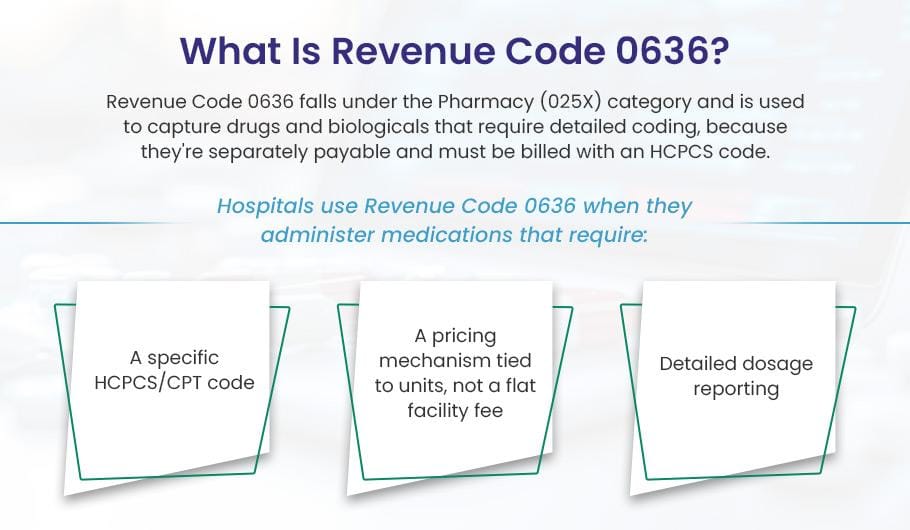
Revenue Code 0636 is a special label to inform the insurance carrier, “this medication is not included within the standard visit fees; it must be billed separately.” As opposed to including the costs of all routine supplies, such as bandages and aspirin, into the one flat rate payment, with this special billing code the hospital can enter each drug individually onto the bill.
However, simply listing the generic name of the medication will not suffice. The reason for this is because the insurance carriers require the hospital to identify the exact amount of the medication provided (hence the necessity to assign an additional identification number called the HCPCS code).
In short:
- The routine drugs are bundled into the overall bill.
- The special drugs (0636) receive their own individual line item charges for reimbursement purposes.
Examples of medications that may use 0636 revenue code are:
- Chemotherapy drugs
- Injectable medicines
- High cost biologicals
So, when a healthcare payer sees code 0636, they know to look at the specific drug code and pay for the exact dosage used, rather than just paying a flat fee for the visit to the healthcare provider. The code is alerting the payer that the medication is not included in a package payment and should be reimbursed separately.
When to Use Revenue Code 0636
Revenue Code 0636 should be used whenever an outpatient drug needs to be separately reimbursed from the hospital service it was provided with. Every outpatient drug that will be separately reimbursed will also require a unique identifier called an HCPCS (Healthcare Common Procedure Coding System) code.
So, use this code for things like:
- Injectable drugs or infusions, including chemotherapy.
- High cost biologic medications which are charged out for the exact amount of medication administered.
- Medications listed on the OPPS addendum B as being able to be separately billed (in other words, not included in a standard hospital “bundle”).
When Not to Use Revenue Code 0636
However, you must be cautious. Do not use the 0636 Revenue Code for those drugs that are considered basic and therefore already contained within the reimbursement for a related hospital service.
For example, skip code 0636 if:
- A medication is contained within a surgical or procedural package and is therefore not to be separately billed.
- It is a routine supply, such as a saline flush or a bag of water.
- You are giving oral pills in the emergency department where these pills are not separately reimbursable.
- The patient is taking the medication home. That requires a totally separate code.
Reimbursement for Revenue Code 0636
You cannot assume you are going to receive an automated payment for this code. The payment depends upon multiple variables, which include the HCPCS code selected, the number of units billed, and the specific rules of the payer selected.
Below, we break down each of the various payers’ approaches to the reimbursement of 0636 RC:
Medicare (OPPS)
When determining Medicare reimbursement for 0636 revenue code, the agency uses a system called the Outpatient Prospective Payment System (OPPS). To decide if they will pay for a drug separately, they look at its “Status Indicator.”
A “status indicator” is essentially a payment flag. If a drug has a status indicator like K or G, it means it is “separately payable.” Medicare will pay for it individually under code 0636. But if it has a status indicator like N, it is “packaged.” That means the cost is already covered by the main procedure fee, and you will not get extra money for it. You need to check these indicators in the “Addendum B” file that Medicare releases.
Medicare is strict about the math when calculating units. Your hospital should calculate the units based on the HCPCS description. For example, if the HCPCS definition describes 1 unit as being equivalent to 10 mg, and your patient received 50 mg, then you would need to bill 5 units. If you simply enter “1,” you will be underpaid.
If the HCPCS code does not directly correlate to the actual drug description, or if there is no explanation within your clinical documentation as to why a particular dose was required, the claim will likely be denied. Because of this reason, some hospitals opt to outsource their medical billing and coding services to avoid denial of claims.
Medicaid
The process for submitting Medicaid claims with the revenue code 0636 can vary from state to state as rules may differ. However, most states tend to follow similar trends. Many states, for example, mandate line-item billing for all drugs, thereby requiring a separate line item on the claim form for each drug dispensed. Most states also base the price on the “average selling price” (ASP) of the drug.
In addition to the HCPCS code, many Medicaid plans now request the National Drug Code (NDC) number (a unique, 11-digit identifier found on the box) in order to process the claim. Failure to report the correct NDC or omission of the NDC number altogether will result in a denial of the claim.
Commercial Insurance
Reimbursement amounts for revenue code 0636 submitted to commercial insurers can vary significantly due to differences in their respective agreements with the healthcare providers. Some commercial insurers may contractually agree to pay more generous reimbursement for biologic agents, while others may only pay a minimal amount.
A report from PayerPrice shows just how wide that gap can be. These are national averages, so take them with a grain of salt:
| Payer | Average Payment |
| BCBS | $48.57 |
| UnitedHealth | $181.00 |
| Aetna | $140.71 |
| Cigna | $7.47 |
All commercial payers generally have additional obstacles that must be addressed. Their pricing schedules are updated quarterly, and many require prior approval of the drug prior to administration. Commercial payers also review the ICD-9-CM code associated with the prescription to ensure that it supports the use of the drug prescribed. If the ICD-9-CM code does not support the use of the drug according to the payer’s policy, they will not provide coverage for the claim.
How to Bill Revenue Code 0636 on the UB-04 Form?
If you have ever probably experienced outpatient pharmacy billing, then you should know that billing for outpatient drugs using Revenue Code 0636 is the same tricky. To help you avoid the common traps, we put together a simple guide below on how to bill it properly.
Step #1: Determine if the Drug is Eligible
First determine if the drug qualifies for billing using 0636. There are three general qualifications:
- There must be a valid HCPCS code assigned to the drug (J-code, Q-code, or similar identifier).
- The drug must be separately reimbursable. This means it must not be part of a low-cost supply or a typical drug that is already bundled into the cost of the hospital visit.
- The drug must be administered in an outpatient setting.
Use the following analogy: If the drug is expensive enough to require its own line item on the claim, you will need 0636. If it is something like Tylenol or a standard saline flush that was provided to the patient and is therefore included in the cost of the room rental, then leave 0636 off of the claim form.
Step #2: Get the Correct Calculation of HCPCS Units
HCPCS codes are like the bar codes in a grocery store. If you scan the wrong code, you are going to get the wrong reimbursement.
Every time you are billing for a line item, you must have three pieces of information match: the correct HCPCS code, the correct amount of the drug administered to the patient, and the correct unit conversion.
This is the most common error in all of billing. HCPCS units do not always equal the dose in milligrams.
Let’s say that the code for a particular drug states that “1 unit” equals 10 mg. The nurse administered 40 mg of the drug. In order to bill properly, you would need to bill 4 units, not 1.
If you bill “1 unit” simply because you administered “one dose”, you may lose 75% of your reimbursement. Thousands of claims get denied or under-reimbursed each month due to simple math errors such as this.
Step #3: Only Bill One Drug per Claim Line
There is no negotiating on this one. You cannot bundle multiple medications onto a single claim line.
Why? Because every medication has a unique price and a unique code. If you attempt to bundle medications, the insurance computer will literally not know what it is seeing, and it will automatically reject the claim.
Here’s how to do it:
- Line 1: Rev 0636 | Code J0178 | 1 unit
- Line 2: Rev 0636 | Code J2405 | 5 units
And here’s how NOT to do it:
- Line 1: Rev 0636 | J0178 + J2405 (This will result in an automatic rejection of the claim).
Step #4: Complete the UB-04 Form Properly
This is where the rubber hits the road. For the UB-04 form, you are focused on the central table on the UB-04 form. You need to place the proper information in the proper fields, or the payer may decide that it is simply a generic supply charge.
The following information goes in the following fields:
➜ Field 42 (Revenue Code): Place 0636 in this field. This informs the payer that you are charging for a specific drug separately.
➜ Field 43 (Description): Enter the name of the drug in this field (e.g., “Inj, Rituximab”).
➜ Field 44 (HCPCS/Rates): This is the most important field. You must enter the proper HCPCS code (such as J9312) adjacent to the revenue code. If Field 44 is blank, 0636 is useless.
➜ Field 46 (Service Units): Enter the number of units you determined in Step 2. Use the same method to convert to units as described in Step 2 (i.e., based upon the code definition — 10mg = 1 unit, not based upon the actual number of vials used).
➜ Field 47 (Total Charges): This is the total amount of money charged for that line item.
Step #5: If It Isn’t Written Down, Then It Didn’t Happen
The bill has to match the patient’s record perfectly, with no exceptions. Prior to submitting the claim, verify the following three records:
- The physician ordered the exact amount of the drug you billed.
- The nurse documented administering the exact amount of the drug you billed.
- The diagnosis code supports the medical necessity for the drug you billed.
If the Medication Administration Record (MAR) indicates you administered 4 mg of Zofran, but you billed for 8 mg, you will receive a denial. Or worse, you may be audited.
Step #6: Submit Your Claim and Monitor for Denials
Even with a clean claim, sometimes claims are denied. This is just the way the healthcare industry works. You should check your 0636 denials at least weekly.
Here are the top three reasons Rev Code 0636 claims get denied, along with what they really mean:
- Wrong Units: Denial occurs because the units billed did not correspond with the mathematical calculation necessary to bill according to the HCPCS code.
- Missing NDC: Commercial payers and Medicaid require the 11 digit NDC number directly from the box or vial used. When you fail to provide this number on your claim, they will not pay.
- Diagnosis Mismatch: Payers deny claims because the diagnosis code you used does not support the medical necessity for the drug you billed.
Once you identify the mistake, correct it, and resubmit the claim. Do not wait until the claim’s timely filing deadline expires.