The way that Grow Therapy compensates you is important to understand before you join it. Below is a breakdown of Grow Therapy reimbursement rates, so a provider can estimate their earnings per session and per week.
You will be able to determine how insurance contracts, CPT codes and a provider’s licensure status impact their actual compensation. You will also learn how medical billing regulations, deadlines and client no-shows can affect reimbursements from Grow Therapy (not the listed rates).
With that understanding, you will be able to decide if Grow Therapy will support your long-term clinical and financial goals.
What is Grow Therapy for Providers?
Grow Therapy connects therapists with potential clients for therapy sessions (in-person or online). As a Grow therapist, you can set your own schedule and select which clients to work with based on your preferred insurance(s), specialty(s) and/or location(s).
Grow Therapy does not charge a monthly fee; instead, clients pay for each session individually. It sends the provider’s payments directly into their bank account once their claims are processed. Grow Therapy also manages all aspects of the billing process, including verifying the client’s insurance eligibility, creating and submitting claims.
Grow Therapy will make direct deposit payments to providers at regular intervals. A provider’s Grow Therapy Provider Portal provides a summary of their anticipated payment for each scheduled session.
Grow Therapy has established insurance contracting agreements with most major insurance carriers, including Medicare and Medicaid. Providers do not need to establish their own payer relationships or independently manage claims.
Additional features of being a Grow Therapy provider include access to complimentary CEU programs, free wellness stipends, and other resources for e-prescription management.
How Much Does Grow Therapy Pay Providers?
Grow Therapy is an independent contractor model for paying therapists. It establishes a pre-determined payment scale based upon a provider’s qualifications, the type of services provided, CPT codes, provider’s licensure, the location of where services are rendered, and the insurance coverage provided to their patients.
After receiving payment from the patient’s insurance carrier, Grow Therapy reimburses providers for the services provided.
Grow Therapy’s insurance reimbursement rates vary significantly between different types of payors and regions throughout the United States. Grow Therapy does not provide a single “Master Rate Chart” that represents all of the various rates.
Instead, Grow Therapy communicates estimated reimbursement rates through a provider’s Grow Therapy Provider Portal and a provider’s rate sheet.

According to many therapists who have shared their experiences with Grow Therapy, the average reimbursement rates are typically between $60-$150 per session, however, some therapists have reported significantly higher and lower rates depending upon the local market and their patient’s insurance coverage.
For example, according to Grow Therapy’s documentation, a Psychiatric Mental Health Nurse Practitioner could potentially earn approximately $129 per hour. Similarly, a Licensed Clinical Social Worker could potentially earn approximately $85.80 per hour.
These reimbursement rates are generally consistent with the typical in-network rates for outpatient therapy services in many U.S. markets. However, some therapists may find these rates to be relatively low compared to other medical specialties or high-fee private practices.
Provider-Reported Grow Therapy Reimbursement Rates by CPT Codes
Please note that the Grow Therapy reimbursement rates listed below are estimates. The reimbursement rates are based on provider reports and general in-network trends and are not representative of Grow Therapy’s official reimbursement rate charts.
| CPT code | Common use | Typical provider-reported payout range* |
| 90791 | Diagnostic intake / initial evaluation | $100 – $160+ per session |
| 90834 | 45–50 minute individual psychotherapy | $70 – $100+ per session |
| 90837 | 60 minute individual psychotherapy | $80 – $120+ per session |
| 90832 | 30 minute individual psychotherapy | $60 – $90+ per session |
| 90839 | Psychotherapy for crisis (30–74 minutes) | $90 – $140+ per encounter |
| 90840 | Add-on crisis code (each additional 30 min) | Often paid as an add-on to 90839 |
This table is only intended to be used for initial directional planning purposes. To obtain an exact number of reimbursement amounts, refer to your Grow Therapy rate sheet and your portal for each appointment to determine the actual payout amount.
State Wise Reimbursement Benchmarks for Grow Therapy Providers
Grow does not publish a full fifty state rate table, but we do have solid public benchmarks for a subset of states. The table below uses:
- A sample of commercial insurance rates for a 60-minute psychotherapy session from a single national carrier across several states
- Grow’s own statement that it passes through in network rates to providers

Use this information as an approximate range for Grow Therapy reimbursement for a typical 60-minute individual psychotherapy session, such as CPT Code 90837, when you are contracted in-network with comparable plans and possess an Independent License.
| State | Estimated per session reimbursement range (USD) | Interpretation |
| Alaska | about 103 to 113 | Very high benchmark market. Combined with evidence that Medicaid and Medicare rates here are well above national averages, Grow Therapy reimbursement is likely near the top of the national range for therapy. |
| California | about 82 to 123 | Wide spread by metro. High cost coastal metros and Bay Area counties tend to sit toward the upper part of this range. Expect strong in network rates for individual psychotherapy, especially in urban regions. |
| Colorado | about 87 to 98 | Slightly above national commercial averages. Grow Therapy pay per session for standard therapy codes will usually fall in the higher two digit range when paneled with the same payers. |
| Georgia | about 83 to 93 | Moderately strong Southern market for commercial mental health reimbursement. Grow providers commonly see mid to upper two digit reimbursements for 90834 and 90837. |
| Maine | about 62 to 87 | Lower end of the commercial range and among the lowest Medicaid benchmarks nationally. Grow Therapy reimbursement here may trail high cost coastal states, making payer mix and cash pay particularly important. |
| Maryland | about 81 to 94 | Benchmarks sit around national averages, with Baltimore and DC suburbs enjoying somewhat higher Medicare and commercial rates. Grow Therapy reimbursements here are usually solid but not top of the chart. |
| New York | about 82 to 99 | High density of insurers and strong Medicare locality adjustments, especially in Manhattan and the outer boroughs, support competitive Grow Therapy reimbursement for fully licensed clinicians. |
| Ohio | about 77 to 93 | Near the national median for commercial reimbursement. Grow Therapy rates in Ohio tend to land in the mid range compared with coastal states. |
| Oregon | about 84 to 109 | Above average commercial reimbursement with higher rates near Portland. Grow Therapy providers here often see strong in network pay paired with robust demand for telehealth. |
| Pennsylvania | about 93 to 113 | Commercial benchmarks look healthy, but state Medicaid data show some of the lowest psychotherapy reimbursement in the country. Your Grow Therapy rates will track your commercial mix, while Medicaid visits may pay significantly less. |
| Rhode Island | about 79 to 102 | Small but relatively competitive market. Most Grow Therapy reimbursement rates for individual sessions will fall close to national commercial averages. |
| Texas | about 93 to 112 | Large spread by metro, but overall commercial therapy reimbursement is strong. With statewide Medicare rates slightly above the national average, Grow Therapy pay in Texas can be attractive for therapists who build full caseloads. |
| Virginia | about 91 to 109 | Consistently above average fee schedules, particularly in Northern Virginia and DC suburbs. Grow Therapy reimbursement rates in Virginia are often near the higher end of national ranges. |
| Washington | about 91 to 105 | Seattle area Medicare rates exceed national levels and commercial benchmarks are solid. Grow Therapy providers in Washington typically see robust in network reimbursement combined with high telehealth demand. |
(for 60 minute psychotherapy, based on sample commercial fee schedules)
Higher Benchmark States

The “Higher Benchmark” states are Alaska, California coastal metro areas, New York, New Jersey, Massachusetts, Connecticut, Colorado, Washington, Virginia, and D.C.
These states typically have robust, well-funded commercial insurance fee schedules and the highest Medicare locality adjustment factors, which means Grow Therapy providers working in these states will generally receive reimbursement closer to the upper end of the national reimbursement curve.
Median reimbursement range
- Individual therapy sessions are $100 to $140 per session
- Occasionally, Grow Therapy providers may reach the high end of this range (i.e., $145-$160) in specific high-cost, specialty markets.
Why do these states pay more?
- Higher cost-of-living
- Stronger commercial insurance contracts and negotiations
- Geographic Practice Cost Index (GPCI) values
- High-density urban client base
Grow Therapy providers often earn the most money per session in these states, particularly when billing CPT 90837.
Midpoint Range States

States such as Texas, Florida, Illinois, Minnesota, Michigan, Georgia, North Carolina, and Wisconsin all tend to be somewhat above, at, or slightly below the national average in terms of both Medicare and commercial psychotherapy reimbursement for mental health services provided by Grow Therapy providers. Grow Therapy tends to generate a relatively consistent middle-range reimbursement value that represents a moderate level of commercial insurer negotiated fees.
Median reimbursement range
- Individual therapy sessions: $80 to $110 per session
- Typical midpoint reimbursement for Grow Therapy therapists: $85 to $100 per session
Why are these states mid-range?
- Balanced mix of commercial and public payer reimbursement
- Moderate cost-of-living index
- Large pool of insured clients
- Insurer fee schedules tend to be competitive but fairly stable, avoiding spikes seen in high-cost-of-living areas.
Grow Therapy providers in these states can expect to experience a consistent reimbursement level without experiencing the sharp increases seen in coastal or high cost regions.
Lower Benchmark States
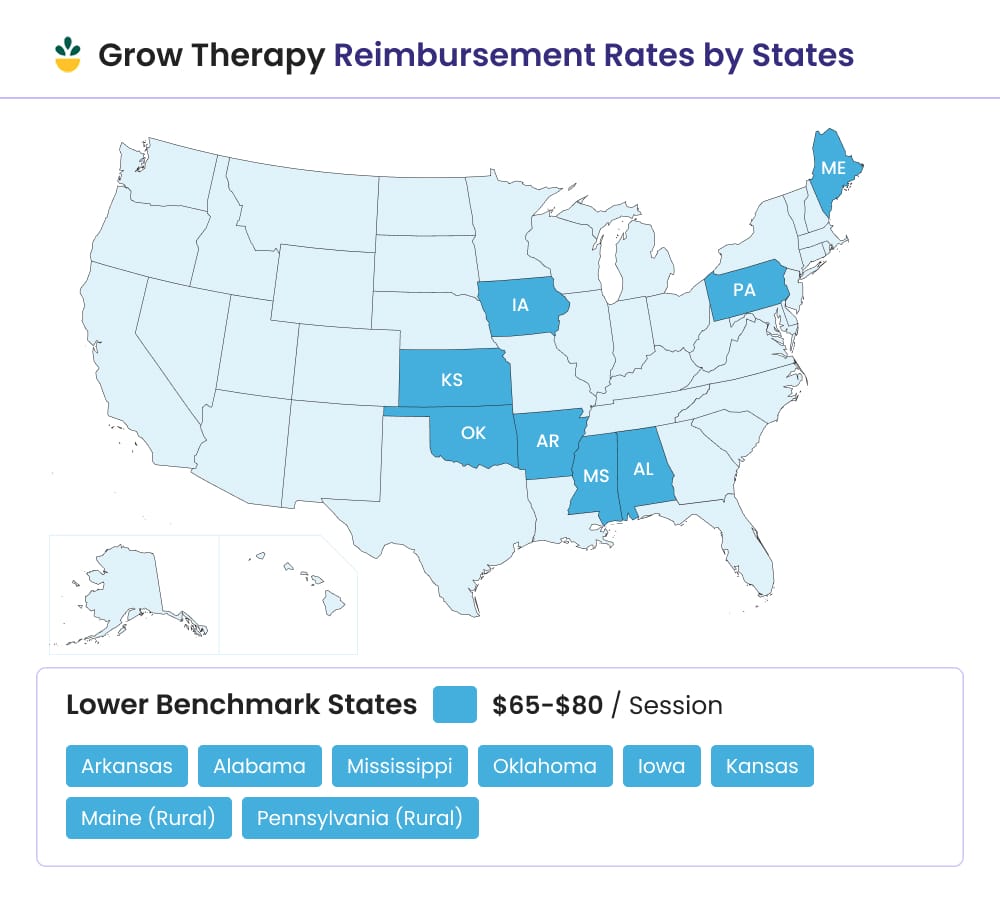
States such as Arkansas, Alabama, Mississippi, Oklahoma, Iowa, Kansas, rural Maine, and rural Pennsylvania tend to have lower-than-average reimbursement. Medicaid and Medicare reimbursement tend to be lower in these states, and many commercial insurers also follow similar payment patterns.
Median reimbursement range
- Individual therapy sessions: $60 to $85 per session
- Medicaid (in low-paying markets): $45 to $70 per session
Why do these states have lower than average reimbursement levels?
- Lower Medicaid budgets in these states
- Reduced Medicare locality adjustment
- Less commercial plan competition for mental health services
- Low-density or rural client population
Grow Therapy reimbursement in these areas can support a large caseload, but will likely be less than what commercial mental health services can earn nationally.
Summary Table of Estimated Grow Therapy Reimbursement Ranges
Below are refined dollar ranges for the three reimbursement tiers: Higher Benchmark States, Near Median States, and Lower Benchmark States.
| State Category | States Included | Estimated Reimbursement Range per Session | Typical Grow Therapy Range |
| Higher Benchmark States | AK, CA (metros), NY, NJ, MA, CT, CO, WA, VA, DC | $100-$140 | $110-$130 |
| Near Median States | TX, FL, IL, MN, MI, GA, NC, WI | $80-$110 | $85-$100 |
| Lower Benchmark States | AR, AL, MS, OK, IA, KS, rural ME, rural PA | $60-$85 | $65-$80 |
Grow Therapy Provider Reimbursement vs. Traditional Insurance Reimbursement Rates
Grow Therapy’s reimbursement rates tend to be significantly higher than those offered through traditional insurance models. The reimbursement rates established by Grow Therapy are negotiated with the insurance companies to benefit the participating providers.
While traditional insurance companies take 14-21 business days to issue payment for services provided to their insured clients, Grow Therapy is able to make payments to its providers in approximately 7 business days.
Insurance Reimbursement Rates are the maximum amount that an insurance company will reimburse for a specific code and diagnosis for a particular service. Grow Therapy negotiates these rates and receives the reimbursement rate when the claim is processed.
A provider’s reimbursement rate is the percentage of the reimbursement rate received from the insurance company. The provider will receive reimbursement after Grow Therapy deducts their fees. They will not receive the details of the fee split with Grow Therapy. However, they will receive a payout for each session via their Grow Therapy Provider Portal.
When using Grow Therapy, reimbursement rate for a specific CPT code can vary between different clients due to differences in their insurance coverage and contractual agreements with Grow Therapy. The differences in reimbursement rates are determined by the insurance coverage provided to a provider’s patients and not due to errors made during the billing process.
How Does Grow Therapy Reimbursement Work
Once Grow Therapy providers complete documentation and submit an invoice, Grow Therapy generates insurance claims, sends them to insurance companies and monitors the status of the claims and manages any patient costs (copays and deductibles).
With in-network sessions, providers will not need to contact the insurance company directly to confirm receipt of a claim.
Grow Therapy sends payments using Stripe through direct deposit, typically on Friday afternoons, and most banks have received these payments by the following Monday morning.
Insurance claims generally take 14-21 days to process after a provider has sent an invoice, while cash payments generally take 7 days to clear.
Grow Therapy protects providers’ insurance payments regardless of whether they collect from the patient or from the insurance carrier. However, Grow Therapy’s protection against insurance payments does not include collection of no-show fees or cash-only charges, which providers must handle themselves.
Grow Therapy requires that providers submit an invoice within 14 days; otherwise, the invoice will expire and it will take additional steps to resolve, which may cause a delay in or reduction to the provider’s payment.
Providers may not submit more than one standard invoice per client, per day as most insurers only allow one outpatient visit per day. Therefore, providers must plan their schedules accordingly for longer or crisis visits.
Specific Crisis Session Codes: Use code 90839 for 30-74 minutes and add code 90840 for every 30 minutes beyond 74 minutes. Grow Therapy’s system allows only one 90840 unit per 90839 and does not permit mixing of crisis codes with other psychotherapy codes on a single claim.
Factors Affecting Grow Therapy Reimbursement Rates
The structural elements of the provider’s location or region, provider licensure, and the payors that Grow Therapy has contracted in the provider’s geographic area, all influence the allowed amounts that providers receive from Grow Therapy.
For example, a psychologist in California will likely have a different allowed amount than a licensed professional counselor in Georgia, even though they may be using the same CPT code.
Grow Therapy provider reimbursement rates are influenced by the mix of payors in the provider’s caseload. Most large national plans, Medicaid, Medicare, and regional payors each have their own unique fee schedules.
Additionally, there are competitor platforms, such as Headway, that report that some payors pay more to providers on other platforms or through direct contract arrangements. However, Grow Therapy may prioritize ease of use, speed, and simplicity of its platform over offering the highest possible reimbursement rates.
The type of session selected by the provider and the CPT code(s) chosen, will affect the amount of money that the provider receives per session. Intake sessions, extended sessions, family therapy sessions, and crisis sessions often have higher allowed amounts than standard 45-minute sessions. If the provider uses low reimbursed codes or conducts mostly short sessions, the average reimbursement per session will decrease even if the provider has a strong nominal fee schedule.
How to Request Grow Therapy Reimbursement Rate Sheet
Grow Therapy provides providers with rate sheets that provide a summary of how Grow Therapy compensates providers across payors, service types (CPT codes), and states or regions. The rate sheets provide a basis for comparison among payors and a way to project potential revenue.
To obtain a Grow Therapy provider rate sheet, providers simply need to log into their provider portal, click on the Help icon located in the bottom right-hand corner of the screen, select the option to send a message, type “rate sheets” and follow the prompts. Once the provider follows the prompts, Grow Therapy will provide the relevant rate sheet for the provider’s state or region and license type.
Each rate sheet includes information about payors, service types/CPT codes, and the corresponding reimbursement amounts. Because payor agreements change over time, it is recommended that providers request an updated rate sheet whenever they identify changes in their reimbursement amounts or when Grow Therapy makes significant changes to its network.
How Grow Therapy Compares With Other Options
Grow Therapy is in competition with other billing platforms, including Alma and Headway. Reviews often comment that Grow Therapy is free to join, provides excellent assistance in obtaining credentials, and ensures that providers will receive payment for their services from the insurance company. However, some reviews indicate that Grow Therapy’s Electronic Health Record (EHR) functions are less sophisticated than those offered by Alma.
Reviews also indicate that Alma requires a monthly fee, but provides more advanced EHR capabilities than Grow Therapy. Additionally, some providers report receiving higher reimbursement rates for their services in certain markets compared to Grow Therapy.
Overall, Grow Therapy provides more rapid and convenient entry into the in-network market than direct contracting. Providers who choose Grow Therapy’s platform are trading the ability to fully control their contracts, client relationships, and payor strategies for faster entry into the in-network market, administrative simplification, and a directory of providers to which referrals are directed.
While many reviewers indicate that Grow Therapy’s negotiated reimbursement rates are generally better than what solo practitioners can negotiate independently, some reviewers also suggest that specialty practices and solo practitioners can earn more with their own contracts than they would receive from Grow Therapy’s platform.
Finally, providers consider other factors when choosing between Grow Therapy and other billing platforms, including ownership of the client, stability of referrals, and quality of customer support. While some reviewers appreciate the flexibility that Grow Therapy offers in terms of scheduling and weekly payments, others criticize the lack of consistency in referrals, the relatively low reimbursement rates compared to other platforms, and the difficulty in transitioning from Grow Therapy’s platform to manage ongoing clients.
How to Increase the Grow Therapy Reimbursement Rates?
➜ The first step to increasing Grow Therapy reimbursement rates is to become familiar with the provider’s Grow Therapy rate sheet and the payout views provided in their Grow Therapy portal.
➜ Providers need to familiarize themselves with which payors, CPT codes, and service types generate the highest effective hourly reimbursement rate.
➜ As much as possible, tailor your provider’s schedule and caseload to include the service types and CPT codes that generate the highest reimbursement rates consistent with clinical judgment and the requirements of the provider’s licensure.
➜ Next, improve your medical billing workflow. Submit invoices within the required 14 days. Attempt to meet the Thursday evening EST deadline for faster reimbursement. Do not enter unlisted or backdated appointments unless support instructs you to do so.
➜ The accuracy of a provider’s documentation and the appropriateness of the CPT codes used will reduce denial and recoupment issues and ultimately increase true earnings.
➜ Lastly, monitor no-show policies, cash-payment policies, and self-pay workflows. Grow Therapy does not provide protection for these items, so providers must develop clear policies and reminders to protect their time.
➜ Review monthly snapshot, payout reports, and bank statements to detect problems quickly and to seek support from Grow Therapy when discrepancies occur between your expected reimbursement and your actual reimbursement.
When Grow Therapy May Not Fit Your Practice Goals
Grow Therapy may not be suitable for a practice’s goals if it currently has existing contracts with payors at high reimbursement rates. They may experience a loss of income if they transition to Grow Therapy’s platform and their reimbursement rate decreases as a result of the platform split, without sufficient increases in volume or administrative efficiency.
Providers may also experience difficulties using Grow Therapy’s platform if they rely on specialty services or intensive treatment programs that are not well represented by standard outpatient codes. Some specialists may be able to achieve higher levels of reimbursement through out-of-network or cash-pay arrangements than through in-network contracts processed through a billing platform.
Finally, providers may consider Grow Therapy as a transitional or temporary solution, if they desire total control over their EHR system, client relationships, and payor strategies.
Even if they choose to use Grow Therapy for credentialing and to gain rapid entry into a network, they may wish to use Grow Therapy temporarily until they can find an alternative structure for their long-term needs.
FAQs About Grow Therapy Reimbursement Rates
Here are a few questions about Grow Therapy payment rates.
1. Are Grow Therapy reimbursement rates competitive?
Many practitioners have said they found Grow Therapy’s insurance reimbursement rates for in-network services are competitive with other in-network rates for the early stage practices in their regions.
A few reviewers stated that Grow’s reimbursement rates were less competitive than some of the competitor platforms, but many appreciated Grow’s reimbursement guarantee and streamlined administrative process.
Whether or not your reimbursement rates are competitive will be dependent upon your payor mix and other options available to you locally.
2. Does Grow Therapy guarantee insurance payouts?
Yes, Grow Therapy provides a reimbursement guarantee for all paid-in-network services to Grow providers. Additionally, Grow takes care of the administrative tasks associated with resolving denied claims on behalf of its providers.
Grow’s reimbursement guarantee does NOT include cash payments, no-show fees or any service that is not reimbursed under the terms of an applicable insurance contract.
3. How often does Grow Therapy pay providers?
Grow makes its first weekly payout each Friday. As long as the claim was processed through the insurance company in a timely manner (usually 14-21 days), most providers report receiving the payment via direct deposit into their bank account on the following Monday. If the claim was paid via cash payment, this typically occurs in a week or less.
4. Can you negotiate Grow Therapy provider reimbursement rates?
Grow sets its reimbursement rates for its providers based on the rates negotiated with the respective payors, your type of medical licensure and the geographic location where you practice. Therefore, Grow does not offer the ability to individually negotiate a different reimbursement rate for any particular practitioner.
However, you can request your reimbursement rate sheet from Grow at any time. Once you receive your rate sheet you can review your earnings history, compare your actual earnings to what you anticipated when deciding to join the platform, and determine if the benefits of Grow’s credentialing assistance, referral program and reimbursement structure align with your overall goals.
5. How can you estimate annual income from Grow Therapy clients?
To estimate your annual income, you should multiply your average reimbursement per session by the number of sessions you expect to perform during a given week. Then you would multiply this total by the number of weeks you plan to work in a given year.
Be sure to factor in your expected level of no shows and cancellations, as well as any amount of your cash-based fees that may go unreimbursed. Using your online Grow portal, you can access your monthly snapshot and payout information to develop your estimates over time using real-time data.