
If you are a nurse practitioner, where you live changes what you are allowed to do. In some states you can run your own care, make your own calls and even open your own clinic. In other states, a doctor has to sign off on your work for your whole career. This guide explains the difference in plain words, shows you which states fall into which group and points out what is changing right now in 2026.
The short answer: as of 2026, 27 states plus Washington, D.C. and two U.S. territories give nurse practitioners full practice authority, according to the American Association of Nurse Practitioners (AANP). This count comes from AANP’s official map, last updated in May 2026. Some news articles say 28, 29 or even 30 states because they count places that just passed new laws that AANP has not officially added to its list yet. When the numbers disagree, we go with AANP.
This guide is written for three kinds of readers. It is for nurse practitioners thinking about moving to a new state. It is for NP students choosing where to start their career. And it is for nurses who want to open their own practice one day and need to know where that is possible.
What “Full Practice Authority” Really Means
Full practice authority, often shortened to FPA, simply means a nurse practitioner can do their full job without a doctor watching over them.
To be specific, an NP with full practice authority can look at a patient, figure out what is wrong (that is what “diagnose” means), order tests and read the results and prescribe medicine. This includes controlled substances, which are the stronger, more tightly watched drugs like certain painkillers. All of this happens without a required agreement that ties the NP to a supervising doctor.
In a full practice state, your work is overseen by the state’s board of nursing, not the board of medicine. In plain terms, nurses answer to nurses, not to doctors. No doctor’s signature stands between you and the care you were trained to give.
Full practice authority is only one of three levels a state can choose. People mix these three up all the time.
The Three Levels of NP Practice Authority
Think of these three levels as three different amounts of “doctor required.”
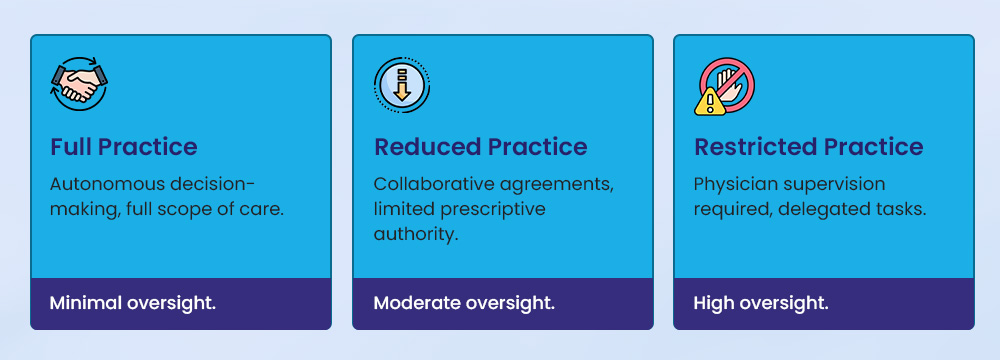
- Full Practice: The NP works on their own, overseen by the board of nursing. No doctor agreement is needed. This is the setup recommended by the National Academy of Medicine and the National Council of State Boards of Nursing, two respected groups that study how healthcare should work.
- Reduced Practice: The NP must have a lifelong written agreement with a doctor for at least one part of the job. So an NP here has real skills but the law still ties one hand to a doctor.
- Restricted Practice: This is the tightest level. A doctor must supervise, direct or manage the NP’s work for the NP’s entire career.
One thing gets misunderstood a lot. Full practice authority does not mean the NP works alone on an island. NPs in full practice states still ask other experts for help, still send patients to specialists and still work in teams. The only difference is that they get to choose when to ask for help, instead of the law forcing them to have a doctor attached at all times. Freedom to choose is the whole point.
Full Practice Authority States for Nurse Practitioners in 2026
Accurate as of July 2026. These laws change often, sometimes every year, so always double-check the current status on the AANP State Practice Environment map before you make any big decision.
Here are the 27 states that give nurse practitioners full practice authority. Each column is in alphabetical order, top to bottom.
| Alaska to Kansas | Maine to New Mexico | New York to Wyoming |
| Alaska | Maine | New York (see note) |
| Arizona | Maryland | North Dakota |
| Colorado (see TTP note) | Massachusetts | Oregon |
| Connecticut (see TTP note) | Minnesota | Rhode Island |
| Delaware | Montana | South Dakota |
| Hawaii | Nebraska | Utah |
| Idaho | Nevada | Vermont |
| Iowa | New Hampshire | Washington |
| Kansas | New Mexico | Wyoming |
On top of these 27 states, three more places also allow full practice: Washington, D.C., Guam and the Northern Mariana Islands. That is how you get the full “27 states plus D.C. plus 2 territories” count.
Two entries on the list need extra explanation before you rely on it: New York, and the states marked with a TTP note.⬇️⬇️⬇️
Note #1: Related to New York (very important as of July 2026)
New York is on the list because AANP still counts it as full practice but its situation is shaky right now and that could change. New York’s independent practice law came with a built-in expiration date, called a “sunset,” of July 1, 2026. Two bills, S2360 and A1220, would have removed that expiration and made the freedom permanent. But the New York legislature went home for the year on June 5, 2026 without passing them. So as of today, July 8, 2026, that deadline has passed with no permanent fix in place. This means experienced NPs in New York may be pushed back into needing a doctor agreement. If you practice in New York, do not guess. Check the current rule directly with the New York State Education Department and the AANP map before you rely on working independently.
Note #2: Related to TTP (transition to practice)
A few full practice states, like Colorado and Connecticut, make you work a set number of supervised hours first, before you get your full freedom. This is called a “transition to practice” period. Think of it like a learner’s permit before a full driver’s license. The state still counts as full practice because the supervision ends for good once you finish those hours. Check your state’s board of nursing for the exact hour count.
Reduced and Restricted Practice States for Nurse Practitioners
These are the states where nurse practitioners cannot practice fully on their own because the law requires a doctor to stay involved for the NP’s whole career. The difference between the two groups is how much doctor involvement the law requires.
➜ Reduced Practice States (12 states plus 3 territories, per AANP)
Alabama, Arkansas, Illinois, Indiana, Kentucky, Louisiana, Mississippi, New Jersey, Ohio, Pennsylvania, West Virginia and Wisconsin, plus American Samoa, Puerto Rico and the U.S. Virgin Islands. In these places, you need a lifelong written agreement with a doctor covering at least one part of your job.
➜ Restricted Practice States (11 states, per AANP)
California, Florida, Georgia, Michigan, Missouri, North Carolina, Oklahoma, South Carolina, Tennessee, Texas and Virginia. In these places, a doctor must supervise, direct or manage your work for as long as you practice.
One fair point. Being on the reduced or restricted list is about the state’s rules, not about the skill of its nurse practitioners or how badly they are needed. In fact, some of the biggest and busiest NP job markets in the country, like California, Florida and Texas, are restricted states. A state can have tight rules and high demand at the same time.
What’s Changing in 2026
(This section was updated July 8, 2026. Because these things move fast, check current status before acting on any of them.)
- New York: This is the big one. The July 1, 2026 deadline has now arrived and lawmakers left for the year without making NP independence permanent. New York did extend this same deadline once before, back in 2024, so another rescue is still possible when the legislature returns. For now, though, treat New York’s status as uncertain and confirm it directly.
- California: California opened a new path to independence through a law called Assembly Bill 890, using two levels named “103” and “104.” The catch is that reaching the “104” level, the one that lets you work solo, takes about 4,600 supervised hours, which is roughly three years, all done inside California. So the door is open but you walk through it slowly. This is why AANP still lists California as restricted for now.
- Oklahoma: In mid-2025, Oklahoma passed a law letting qualified NPs prescribe on their own after 6,240 hours of supervised prescribing. It took effect in November 2025. Oklahoma is still listed as restricted but it is loosening up.
- New Jersey: Special pandemic-era rules that let NPs prescribe without a doctor agreement ended on February 16, 2026. A new bill, Senate Bill 2996, was introduced to give permanent full practice to experienced NPs there.
- Recent movers: Utah became the 27th full practice state in 2023. Kansas and New York both passed full practice laws in 2022. Other states, like Pennsylvania, are still working on bills right now.
The Case For and Against Full Practice Authority
Practice authority is not just a paperwork issue. It is a long-running fight between two groups: nursing organizations, which want NPs to practice on their own, and doctor groups, which want to keep physician oversight in place. Both sides say they are protecting patients.
The Case for Full Practice Authority
The strongest argument is the doctor shortage. The country is expected to be short on doctors for years to come and that gap grows heading into the 2030s. (The most-quoted estimate comes from the Association of American Medical Colleges but note that this is a projection and the exact number gets revised every year, so treat it as a rough guide and not a fixed fact.) The simple logic is this: if there are not enough doctors, someone has to deliver care and nurse practitioners are the fastest-growing group ready to do it.
On top of that, studies have linked full practice authority to better access to care, shorter wait times and quality that holds up well against doctor-led care. These gains show up most in rural and underserved areas, the places that struggle the most to attract doctors. Full practice also tends to cost less to deliver, since it removes the extra fees and paperwork that come with a required doctor agreement.
The Concerns from the Other Side
The main pushback comes from organized medicine, especially the American Medical Association, which is the largest doctors’ group. They call the trend “scope creep,” meaning they feel nurses are stretching into work that should stay with doctors. Their core worry is patient safety, mostly in complicated or serious cases, where they argue that a doctor’s longer and deeper training makes a real difference.
Both of these positions are still being argued out in statehouses across the country. Neither side has “won.” The honest takeaway is to look at the evidence yourself before you form a firm opinion.
What This Means for You in Practice
1). Opening your own clinic becomes much easier in full practice authority states.
If your dream is to own your own practice, full practice states are by far the easiest path because you can open and run it under your own license. In restricted states, you must keep a supervising or collaborating doctor for the life of the business. That adds cost and a risk you cannot fully control. If that doctor retires or raises their fee, your clinic has a problem right away, because you cannot legally run it without them.
2). Practicing through telehealth means following each patient’s state laws.
With telehealth, the rule that matters is where your patient is sitting, not where you are. So you need the right to practice in every state your patients live in. Living in a full practice state makes the rules easier on your side, but you still have to follow the rules of every state where your patients live.
3). The APRN Compact could simplify multi-state practice in the future.
This is a newer idea worth knowing. The APRN Compact is a shared license that would let an advanced practice nurse work across several member states with just one license, instead of applying separately in each one. It works like the existing multi-state license that regular RNs already use. Several states have signed on and more are considering it. If working in many states is part of your plan, keep an eye on this through the NCSBN.
4). Full practice authority does not eliminate every business requirement.
One thing surprises many NPs: your personal freedom and your clinic’s business rules are two different things. Some clinic types, like med spas that do injectables, IV hydration bars and GLP-1 weight-loss programs (the popular new weight-loss drugs), may still be required to have a medical director, even if you personally have full practice authority. So always check the rules for that specific business type, not just for your license.

National Rules That Affect NPs
Two things are happening at the U.S. federal level, meaning the national government rather than any single state. First, there is the ICAN Act (short for Improving Care and Access to Nurses Act). This bill in Congress would remove some barriers so NPs can work more independently under Medicare and Medicaid, the big government health programs. It is still sitting in committee and has support from both political parties. Second, the Department of Veterans Affairs already lets NPs practice with full authority inside its own hospitals, no matter what the state law says. Many people point to the VA as proof that the full practice model can work on a large scale.
Frequently Asked Questions
How many states have full practice authority in 2026?
Twenty-seven states, plus Washington, D.C., Guam and the Northern Mariana Islands, based on the AANP map updated in May 2026. Some sources say 28 to 30 because they count states with brand-new or transition-based laws that AANP has not officially reclassified yet.
Does New York still have full practice authority right now?
As of July 8, 2026, this is unsettled. New York’s independent practice law hit its July 1, 2026 expiration date and lawmakers adjourned in June without passing the bills (S2360 and A1220) that would make it permanent. AANP still lists New York as full practice but that could change soon. Confirm the latest rule with the New York State Education Department before making any decision.
Can a nurse practitioner open a practice without a doctor?
Yes, in full practice states, as long as you meet the normal business and license rules. In reduced and restricted states you can often still own a practice but you must keep a doctor agreement in place to legally operate it.
What is the difference between full, reduced and restricted practice?
It comes down to how much doctor involvement the law forces on you. Full practice needs none. Reduced practice needs a doctor agreement for at least one part of your job. Restricted practice needs doctor supervision for your entire career.
Does full practice authority mean a doctor is never involved?
No. It removes the required oversight, not teamwork. NPs in full practice states still consult, refer and work with others. They just decide when and with whom.
Is my state about to add full practice authority?
Maybe. Laws move every year and states like Pennsylvania and New Jersey have active bills. Check the AANP map for the current status and your state board of nursing or NP association for any bills in progress.
What is the APRN Compact?
It is a shared, multi-state license for advanced practice nurses, built like the one regular RNs already use. Once it is fully running, it will let nurses in member states practice across state lines with a single license.