
Two skin clinics in the same town could treat the same patients and do the same kind of work, and yet one of them could make a good profit this year while the other loses money. Often, the reason for this difference is MIPS, because the dermatology clinic that reports its MIPS data correctly keeps more of the money that Medicare pays it.
MIPS is short for Merit-Based Incentive Payment System. It’s a program run by CMS, the government agency in charge of Medicare, and CMS uses it to decide whether a doctor’s Medicare payments go up or down.
For a dermatologist in 2026, a low MIPS score is the easiest way to lose Medicare money without even realizing it.
“MIPS determines whether Medicare pays a dermatology clinic a little more or a little less. For example, if Medicare deducts even a few dollars from each claim, a busy dermatology clinic could lose thousands of dollars a year.”
Two things happen when a dermatology office scores low on MIPS:
- First, the office misses out on the bonus payment that Medicare gives to clinics that score higher.
- Second, Medicare starts paying the office a little less on each claim, and a claim is simply the bill the clinic sends to Medicare after treating a patient. One small payment doesn’t hurt much, but a few hundred small payments over the course of twelve months add up to a lot of lost money.
Many clinics try to solve this with a ready-made MIPS reporting plan. Such a plan usually fails for dermatologists, because their daily work is different from that of other doctors. Dermatologists send out biopsies, they follow patients for years for skin cancer, and they treat skin problems that last a long time, like psoriasis and eczema. A plan that was written for a family doctor doesn’t include any of the work.
So every dermatology practice needs a MIPS plan that’s tailored to its patients. This guide shows how to create that plan, and it covers four topics.
- How CMS 2026 Uses MIPS Scores.
- Best Quality Measures for Dermatologists
- What’s Changed in the Dermatology Care MIPS Value Pathway (MVP)
- Simple Steps That Lead to a Higher MIPS Score
MIPS Eligibility Timeline for New Dermatology Practices (2026–2030)
The following table assumes that a dermatology practice begins Medicare billing during the last three months of the year.
| Practice Opening Year | Opening-Year MIPS Status | First Possible MIPS Performance Year | First Possible Payment Adjustment Year |
| 2026 | Generally exempt | 2027 | 2029 |
| 2027 | Generally exempt* | 2028 | 2030 |
| 2028 | Generally exempt* | 2029 | 2031 |
| 2029 | Generally exempt* | 2030 | 2032 |
| 2030 | Generally exempt* | 2031 | 2033 |
*Future year projections assume that CMS maintains its current eligibility rules.
Important: Opening a practice does not automatically make it eligible for MIPS the following year. Eligibility depends on Medicare enrollment date, billing volume, individual or group reporting status, and applicable CMS rules.
MIPS payment adjustments generally take effect two years after the year of performance.
How MIPS works for dermatologists in 2026.
MIPS occurs in three phases.
- In the first phase, dermatology clinics collect data about their patient care through 2026.
- In the second phase, clinics send that data to CMS between January 2 and March 31, 2027.
- In the third phase, CMS converts the data into a MIPS score, and that score determines how much Medicare pays the clinic through 2028.
Which Dermatologists Can Participate?
MIPS does not apply to every dermatologist. CMS looks at how much Medicare work a dermatologist did between October 1, 2024, and September 30, 2026, and MIPS is only required if the work falls below these three thresholds.
- Medicare Part B is billed more than $90,000.
- More than 200 Medicare patients were seen.
- More than 200 services were provided to those patients.
A dermatologist must also enroll in Medicare before January 1, 2026. Physician assistants and nurse practitioners who work in a dermatology office are screened against the same limits.
Any dermatologist can find out where they stand by typing their NPI number into the QPP Participation Status tool on the CMS website.
MIPS Timeline, Step by Step
MIPS runs over three years, and each year has its own work.
➜ January 1 to December 31, 2026 (The clinic is operational): CMS designates 2026 as a performance year. During those twelve months, the dermatology clinic treats its patients and records MIPS data in its EHR.
➜ January 2 to March 31, 2027 (Clinics submit their data): CMS calls this the submission period. The clinic, its EHR company, or its registry submits 2026 data to CMS by the March 31 deadline.
➜ Around mid-2027 (CMS issues scores): CMS reviews the data and then shows each dermatologist a final MIPS score out of 100 points, along with the payment change.
➜ Shortly after the score (Clinics can ask for a review): Dermatology practices that believe their scores are incorrect can ask CMS to review them. The time to ask is short, as it closes about 30 days after CMS releases payment information.
➜ January 1 to December 31, 2028 (Medicare changes payments): CMS calls 2028 the payment year. Medicare increases or decreases what it pays dermatologists on every Part B claim for that entire year.
So dermatologist care in 2026 doesn’t change any payments in 2026. It changes Medicare payments two years later, in 2028.
Understanding MIPS Scores for Dermatology Practices
The score runs from 0 to 100 points, and the number that matters most is 75.
- Below 75 points, the dermatologist gets a penalty. Medicare pays less on every claim in 2028, and the deduction can be as high as 9%.
- At exactly 75 points, nothing changes.
- Above 75 points, Medicare adds a small bonus to its 2028 payments.
“The goal for each dermatologist is 75 out of 100 points. MIPS operates on a two-year roll, so the score earned for 2026 determines what Medicare pays in 2028.”
Are dermatology practices that opened in late 2026 required to participate in MIPS?
Dermatology practices that begin billing to Medicare between October 1 and December 31, 2026, are generally exempt from individual MIPS reporting for that year. CMS determines 2026 eligibility using Medicare billing data from two periods, the second ending September 30, 2026.
Dermatologists who enroll in Medicare for the first time in 2026 are also excluded from MIPS for that performance year. These exclusions generally mean no MIPS penalties or bonuses in 2028. However, clinicians who join an existing practice that reports as a group may receive a payment adjustment for that group.
One important exception: Dermatologists who previously billed Medicare at another practice may still have MIPS reporting obligations associated with their former practice. Moving to a new practice in December does not automatically eliminate those obligations.
For newly established practices, 2027 is the starting year for MIPS performance, provided they meet CMS eligibility requirements.
2026 MIPS Category Weights for Dermatology
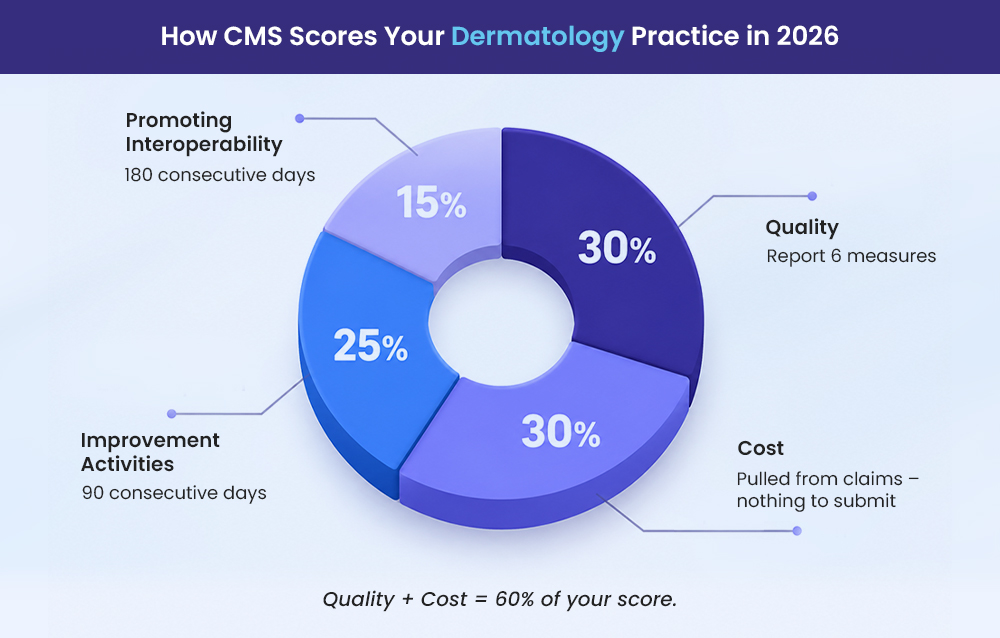
CMS creates a 100-point score from four categories, and some of them count for more points than others. The four categories are:
- Quality
- Cost
- Promoting interoperability
- Improvement activities
“A dermatologist’s MIPS score is made up of four parts. Quality and cost are the most important, as each makes up 30% of the total. Therefore, a poor quality outcome costs a dermatology clinic twice as much as a poor improvement activity outcome, which is only 15%.”
1). Quality (30%)
Quality is worth 30 out of 100 points, and this is the category where dermatologists have the most choice. Here, the clinic chooses six quality measures and reports on them for the entire year. The quality measure is simply a question about patient care that can be answered with a number.
Suppose a skin clinic measures skin cancer biopsies, and over the course of a year it sends 100 skin cancer biopsies to the lab. If the lab results for 95 of those biopsies are returned to the dermatologist within seven days, the clinic’s result for that measure is 95%. CMS compares that to the 95% of results other doctors have obtained on the same measure, and then CMS gives the clinic a score of 1 to 10 for it.
CMS scores all six measures in this way, so a clinic can earn a maximum of 60 points from them. CMS then converts those measurement points into a clinic quality score. A clinic that earns 48 out of 60 measurement points, for example, has achieved 80% of the quality category. Because quality is worth 30 points, that clinic gets 80% of the 30, which comes to 24 points toward its MIPS score.
Quality takes more time and paperwork than the other three categories because the numbers for each measurement come from chart notes. Chart notes are notes that the dermatology team writes after each patient visit in the electronic health record, or EHR, which is the software that the clinic uses to keep its patient records. A good chart note contains all the details needed for the measurement, such as the diagnosis, the dermatologist’s recorded score, and the date of the visit. It is also written on the day of the visit, before staff forgets these details. Clinics that write their chart notes this way receive better quality scores.
2). Cost (30%)
Cost is also worth 30 points, and it’s the easiest category because dermatologists don’t fill out any forms or send anything to CMS. Medicare already has claims that clinics have sent in for their Medicare patients, and Medicare uses those claims to figure out how much it costs to care for those patients.
For example, when a dermatologist removes melanoma from a Medicare patient, Medicare adds up all the claims related to that surgery, such as the surgery bill, the lab work bill, and the follow-up visit bill. Medicare then compares that total to what other doctors typically charge for the same care when they treat similar patients. If the dermatologist’s total is the same as or less than the typical cost, the dermatologist gets a good cost score.
“A dermatology clinic doesn’t collect anything for the cost category. Medicare calculates it from the claims the clinic has already submitted.”
3). Promoting Interoperability (25%)
The Promoting Interoperability category is worth 25 points, and a skin clinic earns them by using its EHR to share health information safely. That includes sending prescriptions to the pharmacy by computer, letting patients see their own records online, and sending patient records to other doctors by computer.
The main rule in this category is about time. A dermatology office has to report its Promoting Interoperability data for at least 180 days in a row, which is about six months. The office picks its own dates, so it could report from January 1 to June 29, or from July 5 to December 31, and both of those periods are exactly 180 days long.
Small dermatology offices get a break here. CMS calls any office with 15 or fewer clinicians a small practice, and a clinician means a doctor, a physician assistant, or a nurse practitioner. A small practice does not have to report Promoting Interoperability at all. When it skips this category, CMS takes the 25 points and adds them to Quality and Improvement Activities.
4). Improvement Activities (15%)
The final category, improvement activities, is worth 15 points. Dermatology practices earn these points by doing activities that improve the care of their patients. CMS has a list of about 100 approved activities, and each practice chooses from this list. Most have to do two activities to earn all 15 points, while a small practice only has to do one.
Two common activities are extended clinic hours and improved care coordination.
Extended clinic hours count because when a dermatology office is open some evenings or on weekends, patients with skin problems who can’t wait can see a dermatologist sooner.
Improved care coordination means that doctors communicate patient information to each other in a thoughtful manner. For example, after a dermatologist removes a melanoma, the office sends a report of the surgery to the patient’s family doctor and makes sure the patient has follow-up appointments booked.
So longer hours are about when patients can be seen, while care coordination is about how well the dermatologist works with the patient’s other doctors.
This category also has a time rule, although it is shorter than the 180-day rule for Promoting Interoperability. Each selected activity has to continue for 90 days or more without a break, which works out to about three months. At the end of the year, the practice certifies to CMS that each activity lasted that long.
“Two time rules are worth remembering. EHR reporting requires 180 straight days, and each improvement activity requires 90 straight days. So dermatology clinics should start early in the year, because someone who waits until the fall (autumn) doesn’t have enough days left.”
MIPS High-Quality Measures for Dermatologists in 2026
Quality is the only category where the dermatologist decides what is reported, as the dermatologist selects six measures.
CMS does not give dermatologists a fixed set of six. CMS has a list of about 200 quality measures, and dermatologists can choose any six from it that are appropriate for the clinic’s patients. Most of those 200 have nothing to do with skin, so the six need to be chosen carefully.
CMS has two rules about selecting quality measures.
- Dermatologists are required to report six or more quality measures, and data for each measure must cover all twelve months of the year.
- At least one of the six must be an outcome measure or a high-priority measure.
An outcome measure looks at how the patient’s treatment went, so it asks whether the patient has actually improved. Measure #485 is an outcome measure, because it measures whether a psoriasis patient’s itching has decreased after treatment.
A high-priority measure is one that CMS has marked as extra important, usually because it relates to patient safety or how well doctors and labs share information. Measure #440 falls into this second category, because it measures how quickly biopsy results get from the lab to the dermatologist. Measure #440 doesn’t say anything about whether the patient is getting better, but CMS still marks it as high priority because getting cancer results quickly is so important.
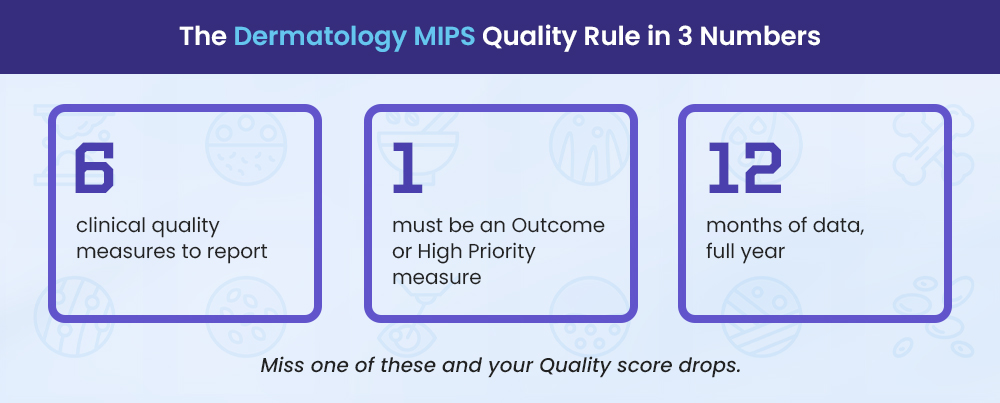
“A dermatologist takes six quality measures from the CMS list and reports them for the entire year. One or more of these six must be either an outcome measure or a high-priority measure.”
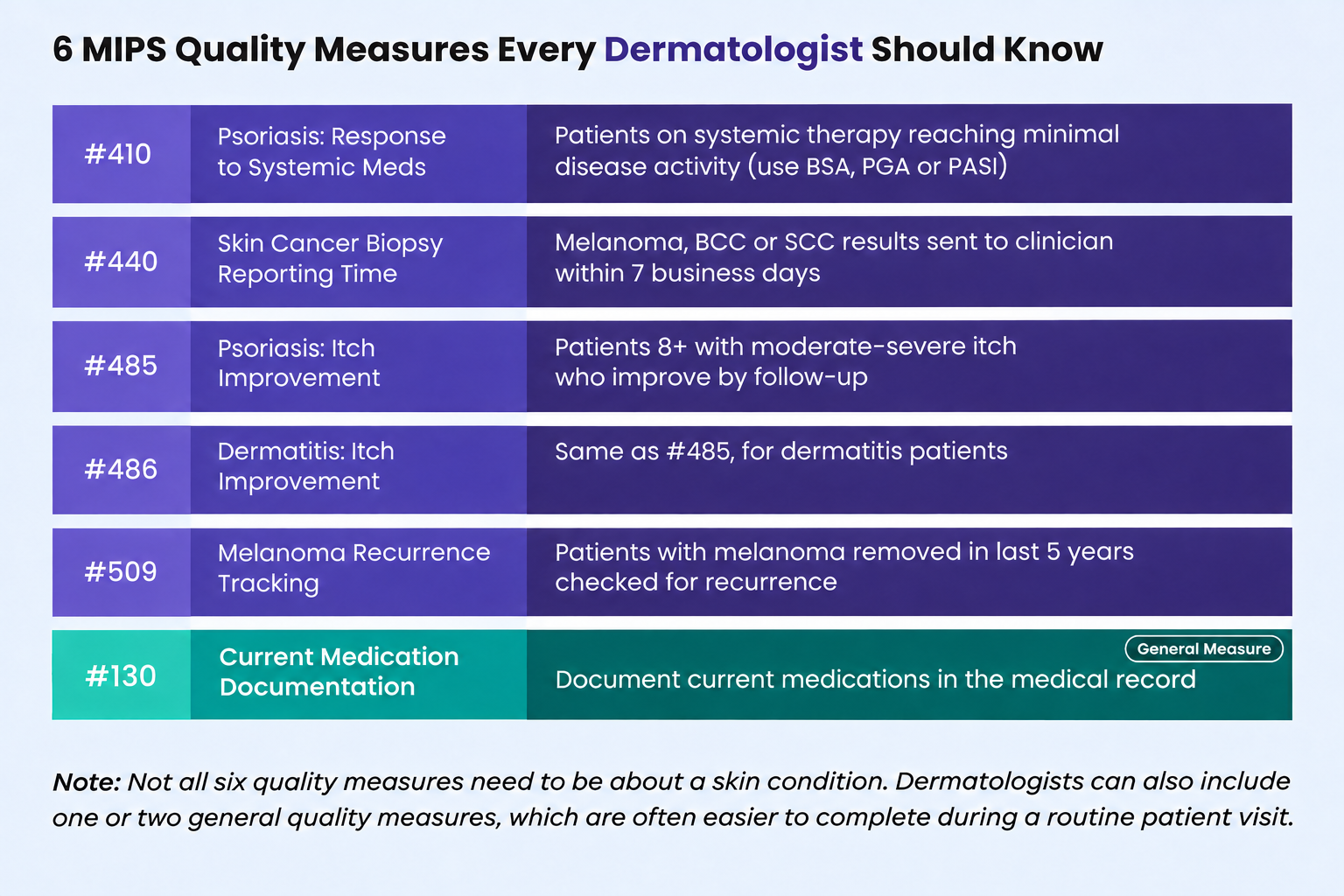
Seven quality measures are popular with dermatologists. Five of the seven are about skin conditions, and the remaining two are general measures that any doctor can use. A dermatologist can create a complete set of six of the seven, and a sample set is shown below, followed by the seven descriptions below:
1). Measure #410, Psoriasis Clinical Response to Systemic Medications
Measure #410 is one of the best outcome measures for dermatologists. It’s about psoriasis patients who take systemic medications, which means medication that works throughout the body, like pills or tablets. The measure asks what percentage of those patients have their psoriasis under control.
To show good control, dermatologists give a patient’s psoriasis a score and record that score on a chart. Three scoring methods are common.
- Body Surface Area (BSA). Dermatologists measure what percentage of a patient’s skin is covered by psoriasis.
- Physician Global Assessment (PGA). Dermatologists give psoriasis an overall rating, ranging from mild to severe.
- Psoriasis Area and Severity Index (PASI). The dermatologist calculates a score based on the redness, thickness, and scaling of the psoriasis and how much of the skin it covers.
For example, when psoriasis covers less than 3% of a patient’s body, Measure #410 counts that patient as well controlled.
2). Measure #440, Skin Cancer Biopsy Reporting Time from Pathologist to Clinician
When skin cancer biopsy results come in late, the patient’s treatment also starts late, and to prevent this delay, CMS created Measure #440. This high-priority measure looks at biopsies that the lab diagnoses as one of the three skin cancers.
- Melanoma
- Basal cell carcinoma
- Squamous cell carcinoma
For each of these biopsies, Measure #440 looks at whether the pathologist sent the results to the dermatologist within seven days of receiving the skin sample. The pathologist is the lab doctor who examines the sample.
Measure #440 is helpful for two reasons. The patient learns the diagnosis early and can start treatment early, which is very important with melanoma. The skin clinic also earns MIPS points that a good lab would already be doing.
There is a limit to Measure #440. Most quality measures can earn up to 10 points, but this one can only earn up to 7. CMS set the low limit because almost every doctor already scores close to 100% on Measure #440, and when almost all doctors get the same high result, the measure can no longer show which clinics are doing better than others.
3). Measure #485, Psoriasis Improvement in Patient Reported Itch Severity
Measure #485 is an outcome measure for itching in psoriasis patients who are 8 years of age or older. It shows whether itching has improved after treatment.
The measure works in two steps:
- At the first visit, a member of the dermatology team asks the patient to rate their itching on a scale of 0 to 10 and records that number in the EHR.
- At subsequent visits, the same question is asked again and a new number is also recorded.
If itching started at a 4 or higher and then went down 3 points or more, Measure #485 counts that patient as a success.
This means that staff must ask about itching at both visits and record the number both times. If either number is missing from the chart, CMS cannot count that patient as a success, even if the patient feels much better.
4). Measure #486, Dermatitis Improvement in Patient Reported Itch Severity
Measure #486 works exactly like Measure #485, in that it also uses a 0 to 10 itch score across two visits. The only difference is the patient group, as Measure #486 is for people with skin inflammation, such as eczema, while Measure #485 is for people with psoriasis. CMS views #485 and #486 as two separate measures, so a clinic that reports both has filled two of its six slots.
5). Measure #509, Melanoma Tracking and Recurrence Assessment
Measure #509 is a high-priority measure about monitoring patients after melanoma surgery. It covers patients who have had early-stage melanoma surgically removed within the past 5 years. For each of these, the measure looks in the clinic records to see if the dermatologist or surgeon who performed the surgery reexamined the patient to see if the melanoma had returned.
Not all six quality measures need to be about a skin condition. Dermatologists can also include one or two general quality measures, which are often easier to complete during a routine patient visit. Two general measures that are easy to report are:
▼▼▼
6). Measure #130, Current Medication Documentation – (a general measure)
Measure #130 is about the patient’s medication list. It asks whether the clinic has written down all the medications the patient takes at each visit and has kept the list up to date. In most dermatology offices, a medical assistant asks each patient about their medications before they enter the doctor’s room, so the medical assistant can complete Measure #130 during the same conversation.
7). Measure #226, Tobacco Use Screening and Prevention Intervention – (a general measure)
Measure #226 is about tobacco use. It tracks two things: whether the clinic asked patients 12 years of age and older if they used tobacco, and whether patients who said yes were given advice or help to quit.
“Not all six measures are about skin. Simple measures, like updating a medication list or asking about tobacco use, can fill in the gaps.”
Six Quality Measures That Suit Most Dermatology Clinics
A dermatologist can combine the seven measures above in various ways, and the combination below will work well for a typical dermatology clinic.
- Measure #410, Psoriasis response to systemic medication (outcome)
- Measure #485, Psoriasis itching improvement (outcome)
- Measure #486, Dermatitis itching improvement (outcome)
- Measure #509, Melanoma follow-up (high priority)
- Measure #440, Skin cancer biopsy reporting time (high priority, 7-point range)
- Measure #226, Tobacco screening (general)
This sample follows both CMS principles, as it has six measures and several of them are outcomes or high priority measures. This is just an example, though. A clinic that sees very few psoriasis patients might replace Measure #410 with Measure #130, and a clinic that treats mostly skin cancer might choose a completely different six.
“The best measures for dermatologists are those that match the patients they already see every day. For example, a skin clinic that sends a lot of skin cancer biopsies should look closely at the biopsy timing measure (#440).”
2026 Updates for Dermatology Care MVP
Six measures from the full CMS list are called traditional MIPS, which is the standard way to participate in the MIPS program. Some dermatologists find that choosing from nearly 200 measures is too much work, and for them, CMS offers a second option called the MIPS Value Pathway, or MVP. MVP is a shortened version of MIPS that CMS has created for one type of physician. The MVP for dermatologists is called the Dermatology Care MVP.
The Dermatology MVP is simpler than traditional MIPS because its list of choices is shorter. The list includes only quality measures, improvement activities, and cost measures that are relevant to skin care. It also requires fewer quality measures, as a dermatologist in the MVP reports four of them while a dermatologist in the traditional MIPS reports six. Each dermatologist chooses one option or the other for the year and not both.
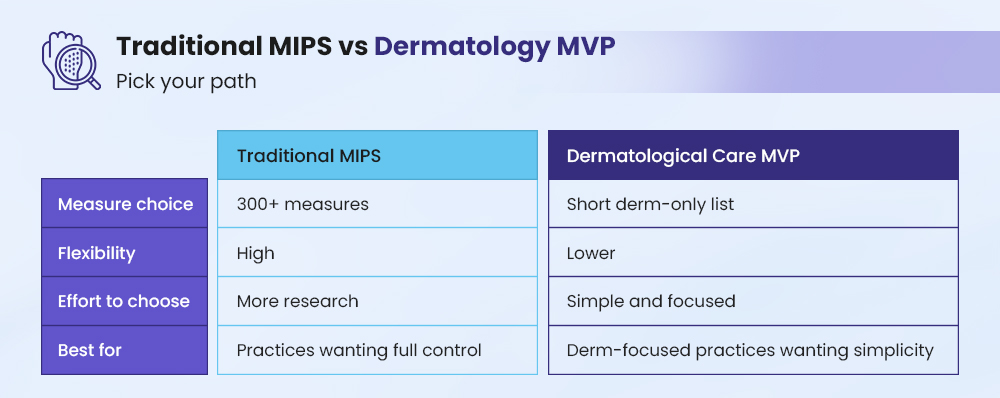
“The MVP is a short list of measures designed just for dermatology. It’s easy to follow, but it gives skin clinics fewer choices.”
For 2026, CMS changed which quality measures are on the dermatology MVP list.
CMS added two quality measures this year.
➕ Measure #47, Advance Care Plan
An advance care plan is a document where a patient writes down the type of medical care they want later in life. Measure #47 asks whether the dermatologist has placed such a plan in the chart for every patient age 65 and older, or at least talked to the patient about creating one. Like the biopsy measure, the most Measure #47 can score is 7 points, because doctors already score it highly.
➕ Measure #238, High-Risk Medication Use in Older Adults
Measure #238 also looks at patients who are 65 years of age or older, and it counts how many of them were given medications that could be dangerous for older people. Some medications that dermatologists prescribe for skin conditions are on the high-risk medication list. To perform well on Measure #238, dermatologists have to be careful about prescribing for older patients and keep accurate notes about their medications in the EHR. Measure #238 has a single 7-point threshold.
CMS also removed some quality measures from the MVP list for 2026, and many dermatology clinics were using two of them.
➖ Measure #130 (Current Medication Document)
➖ Measure #487 (Screening for Social Drivers of Health)
This removal does not affect dermatologists who report traditional MIPS, as they can still select Measure #130 from the CMS central list. It only affects dermatology groups that report through MVP. Such groups may now need one or both of the newly added measures to replace the removed CMS.
“A dermatologist who reported Measure #130 or #487 through MVP last year must elect the replacement in early 2026, not at the end of the year. For example, the Advanced Care Plan measure (#47) may replace it for patients 65 years of age and older.”
Subgroup Reporting Reminder
CMS made another change to the MVP rules in 2026, and it affects dermatologists who work in a larger clinic that also has other types of doctors.
Starting in 2026, a clinic with more than one specialty and 16 or more clinicians can no longer report MVP as a single group. Such clinics must be divided into smaller groups, with one group for each specialty, and CMS calls these smaller groups subgroups. Each subgroup signs up for its own MVP and reports its own data.
Being divided into subgroups may seem like extra work, but it actually helps dermatologists in a larger clinic. The dermatology subgroup MIPS score now only reflects the work of the dermatology department, so a poor result from another department in the same building can’t make it any worse.
“Larger clinics with multiple specialties are now required to report to the MVP by department. For example, a clinic with 20 clinicians in dermatology and cardiology would report to its dermatology team separately, so that team is scored only on its own work.”
Free 2026 MIPS Score Calculator for Dermatologists
The calculator below gives an estimate in about two minutes. It asks for the points earned on each quality measure, an estimated Cost score, the Promoting Interoperability points from the EHR, and the number of improvement activities completed. For any score under 75, it also shows the estimated cut to 2028 Medicare payments. The result is an estimate only, because CMS calculates the official score.
Key Reporting Strategies for Maximizing Dermatology MIPS Scores
A dermatology clinic only earns a high MIPS score when it follows these principles year-round. Dermatology clinics that earn MIPS bonuses and avoid MIPS penalties typically start planning in the first few months of the year, and these five steps help with that planning.
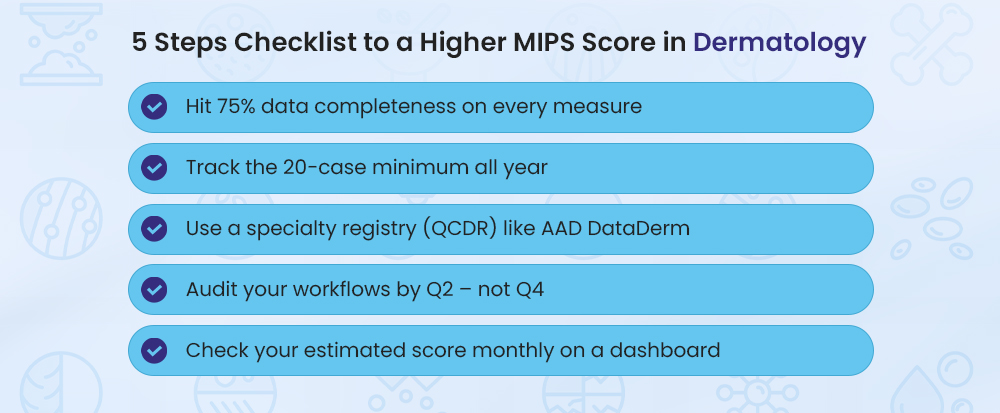
1). Reach a 75% data completeness threshold.
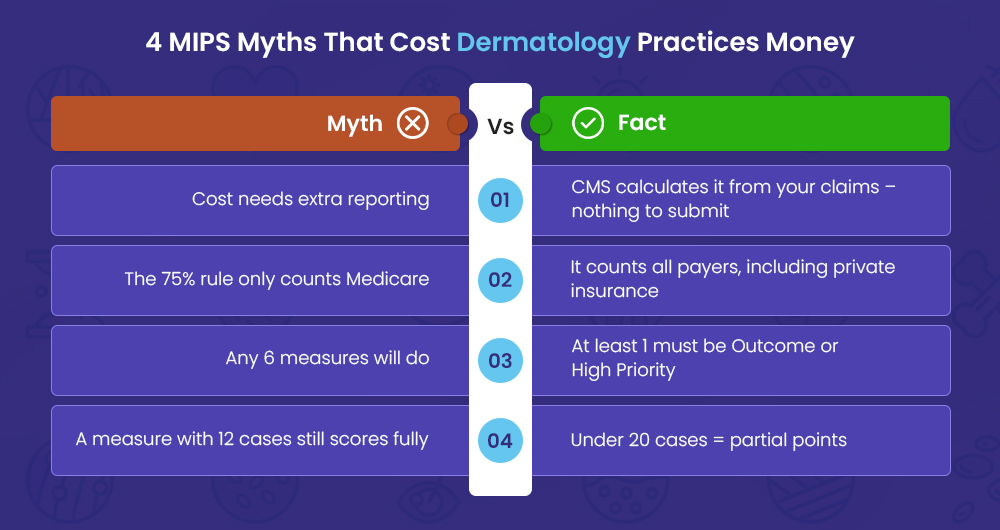
For each quality measure it chooses, a dermatology practice must report at least 75% of the patient visits that qualify for that measure. This 75% rule covers patients with any type of insurance and not just Medicare patients, which many dermatologists don’t realize. It’s also something separate from the 75-point MIPS score goal, although the two numbers look similar.
2). Monitor at least 20 cases.
Each standard also requires a sufficient number of patients to measure, and at least 20 qualifying patients during the year. When a measure is less than 20, CMS cannot compare the clinic’s results with those of other doctors in the usual way. In this case, a small practice with 15 or fewer physicians gets only 3 points for the measure, and a large practice with 16 or more physicians gets 0 points for it.
“Two numbers determine whether a measure counts at all. A dermatology clinic needs 20 or more qualifying cases a year, and it has to report three out of every four qualifying visits. So if 200 psoriasis visits qualify for a measure, 150 of them must be reported.”
3). Leverage specialty registries.
A clinic’s EHR can report standard MIPS measures to CMS, but the registry can do more for dermatologists. A registry is a service that collects a clinic’s MIPS data and sends it to CMS for the clinic. Some registries are called Qualified Clinical Data Registries, or QCDRs, and they offer additional quality measures that were written specifically for dermatology. A good example is DataDerm, which is run by the American Academy of Dermatology.
4). Audit your workflow early.
Many dermatology clinics don’t look at their MIPS data until the last three months of the year, and by then it’s too late to fix most of the problems they find. It’s safest to do this check before the end of June. During the check, the clinic makes sure its dermatologists and medical assistants are writing down the details that each selected measure requires at each patient visit.
5). Use real-time dashboards.
Most EHR and billing systems have a MIPS dashboard, which is a screen that displays the clinic’s estimated MIPS score so far in the year. It’s a good idea to look at this dashboard once a month, because if a measurement is down by mid-year, the dermatology team has time to increase it.
“A dermatology clinic should check its MIPS numbers every month and review its progress by mid-year. For example, if the itch score numbers look low in June, there are still six months to go before they are brought up.”
Outsource Your MIPS Reporting to BellMedEx and Protect Up to 9% of Your 2028 Medicare Income
If you bill Medicare $400,000 a year, a low MIPS score can take up to $36,000 out of your 2028 payments. The loss arrives a few dollars at a time on every claim, so most dermatologists notice it only after the year is over. Let BellMedEx check where your score stands today, while there is still time to raise it.