The timely filing limit for Anthem (now part of Elevance Health) is usually 90 days from the date of service. This applies to commercial and Medicare Advantage claims. However, the filing window can change from state to state. It also depends on your plan type and the terms of your provider agreement.
Anthem’s Medicaid plans are more generous. In fact, they often give you 365 days to file. Still, the exact limit depends on the rules in each state.
First, a quick note on names:
In 2022, Anthem, Inc. renamed its parent company to Elevance Health. Even so, the health plans kept their familiar names. For example, in the 14 states where Anthem holds a Blue Cross Blue Shield license, you will still see Anthem Blue Cross or Anthem Blue Cross and Blue Shield.
In some other states, many of Elevance’s plans now use the Wellpoint brand.
In short, your paperwork might say Anthem, Elevance Health, Empire, or Wellpoint.
Either way, the rules in this guide are a good starting point. Just be sure to confirm them against the specific plan.
Timely Filing Limits for Anthem (Now Elevance Health)
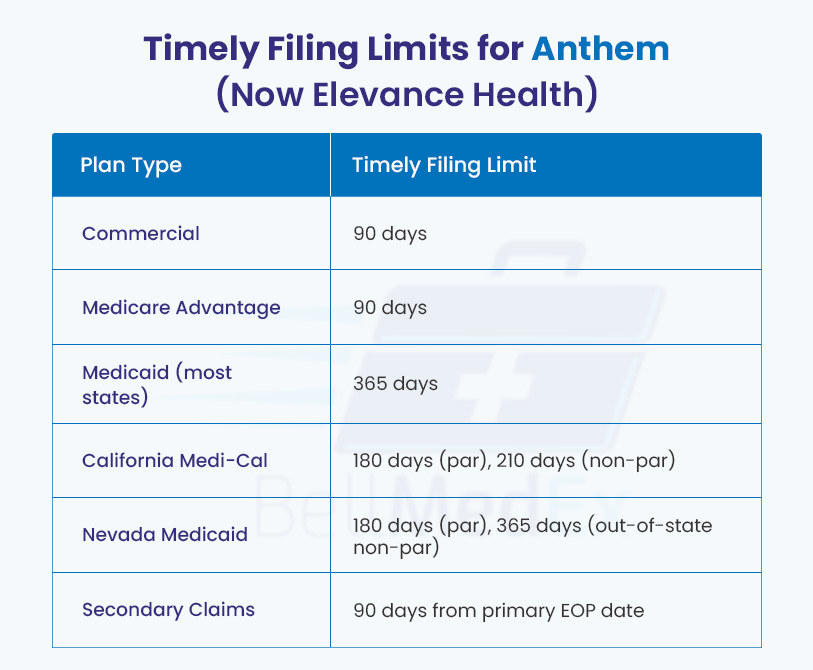
| Plan Type | Timely Filing Limit |
| Commercial | 90 days from date of service |
| Medicare Advantage | 90 days from date of service |
| Medicaid (most states) | 365 days from date of service |
| California Medi-Cal | 180 days (participating); 210 days (non-participating) |
| Nevada Medicaid | 180 days (participating); 365 days (out-of-state non-participating) |
| Secondary Claims | 90 days from the primary payer’s EOP date |
Anthem (Elevance) Timely Filing Limit for Corrected Claims
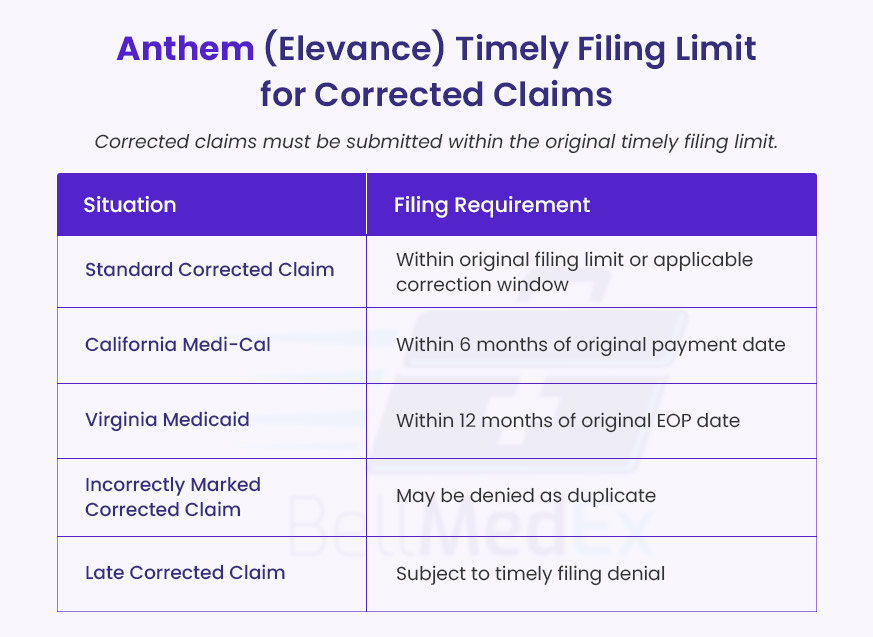
| Situation | Filing Requirement |
| Standard corrected claim | Within the original filing limit, or the applicable correction window |
| California Medi-Cal | Within 6 months of the original payment date |
| Virginia Medicaid | Within 12 months of the original EOP date |
| Incorrectly marked corrected claim | May be denied as a duplicate |
| Late corrected claim | Subject to a timely filing denial |
A corrected claim is a claim you resubmit after you fix an error. For example, you might correct a diagnosis code, a procedure code, or a billing mistake. Keep in mind that a corrected claim is not the same as a duplicate claim.
In most cases, you must submit a corrected claim within the original timely filing limit. If not, you may have 6 months from the date of payment on the original claim. The right rule depends on your state, your plan type, and your provider agreement.
Here are the key rules Anthem applies to corrected claims:
- Mark the claim clearly as a corrected claim, and use the correct resubmission code.
- If you do not flag it properly, Anthem may deny it as a duplicate.
- If you send a corrected claim after the timely filing limit, it will be denied.
- For Anthem Medicare Advantage, corrected claims follow federal and CMS rules.
In California (Medi-Cal), for instance, you must file corrected claims within 6 months from the date of payment on the original claim. In Virginia Medicaid, the window is longer. There, you have 12 months from the original EOP date.
Anthem Timely Filing Limit for Secondary Claims

You file a secondary claim when a patient has two insurance plans. First, the primary plan pays its share. After that, the provider bills the secondary plan for the rest.
Here is Anthem’s rule for secondary claims. When Anthem is the secondary payer, the clock starts from the date of the primary payer’s Explanation of Payment (EOP). In other words, it does not start on the date of service.
This is an important protection for providers. Suppose the primary payer takes several months to process the claim. Even then, your 90-day window with Anthem does not begin until you receive the primary payer’s EOP.
For this reason, always keep the primary payer’s EOP or EOB (Explanation of Benefits) on file. Later, if Anthem denies a secondary claim for timely filing, you can use the primary EOP as proof. It shows that the window had not yet closed.
Anthem Timely Filing Limit for Appeals
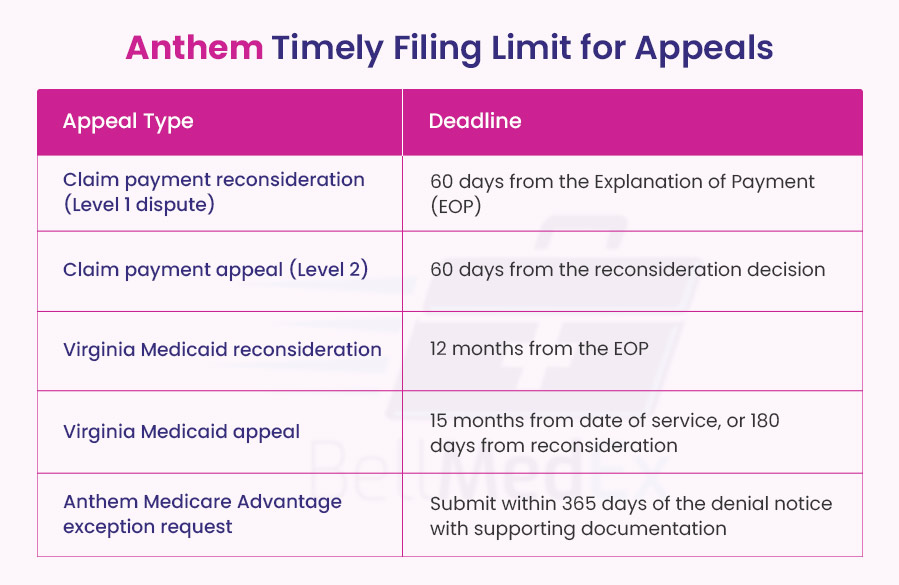
You can appeal claims that were denied for reasons other than timely filing. The windows below cover standard payment disputes and appeals. They do not cover timely filing exceptions, which we explain a bit later.
| Appeal Type | Deadline |
| Claim payment reconsideration (Level 1 dispute) | 60 days from the Explanation of Payment (EOP) for most commercial plans |
| Claim payment appeal (Level 2) | 60 days from the reconsideration decision |
| Virginia Medicaid reconsideration | 12 months from the EOP |
| Virginia Medicaid appeal | 15 months from date of service, or 180 days from the reconsideration |
| Anthem Medicare Advantage exception request | Within 365 days of the denial notice, with supporting documentation |
Important: appeal deadlines vary by state and plan. The 60-day reconsideration window above applies to most commercial plans. However, it is not the same everywhere. In California, for example, the appeal window can stretch to 365 days from the notice date. Likewise, some Medicaid programs give you 365 days from the date of service, or 60 days from the EOP, whichever is later. So always confirm the exact window in your state’s Anthem provider manual.
Do not wait. Where a 60-day window applies, it is tight. As soon as Anthem denies a claim, set a reminder. Then file your reconsideration well before the deadline.
How to Submit an Appeal or Dispute
Anthem accepts payment disputes and appeals in several ways:
- Availity Essentials. This is the online provider portal, and it is Anthem’s preferred method.
- The Payment Appeal Tool inside Availity.
- A written submission to the Payment Appeals Unit. (The mailing address varies by state.)
- By phone through Provider Services, for reconsiderations.
In most cases, you cannot appeal a denial that was caused by late filing. A CO-29 denial cannot be reversed through the standard dispute process. (CO-29 is simply the code that payers use when a claim is denied for missing the timely filing limit.) There are, however, a few exceptions. For instance, you might prove that the claim was actually sent on time but Anthem failed to process it. In that case, you can file a timely filing exception request.
Anthem will consider a timely filing exception if you can document one of the following:
- A system outage, either at your clearinghouse or on Anthem’s own portal, at the time you submitted.
- A payer error, such as Anthem giving you incorrect information.
- A natural disaster that prevented submission.
- Retroactive eligibility, which means the member’s coverage was added after the date of service.
- Incorrect insurance information that the member gave you.
The ERISA Exception: A Protection Many Providers Miss
Many of Anthem’s commercial plans are employer-sponsored. These plans fall under a federal law called ERISA (the Employee Retirement Income Security Act). ERISA covers most private employer group plans. However, it does not cover church plans or government plans. For the plans it does cover, federal rules often give you broader appeal rights than a 90-day contract.
So what does this mean in practice?
Suppose a clean claim for an ERISA member is denied for timely filing. You may be able to appeal under ERISA and ask for the longer federal window. People often cite this window as up to 12 months. This will not override every contract on its own. Even so, it is worth trying before you write off the money. To prepare, keep proof of the patient’s employer-group coverage. After that, consider citing ERISA in your written appeal.
Note: This is general information, not legal advice. For high-dollar denials, check your appeal plan with your billing compliance team or a lawyer.
Timely Filing Limit for Anthem Medicare (Medicare Advantage)
Anthem (Elevance Health) offers Medicare Advantage plans in many of its states. Keep in mind that the rules can differ from one state to the next.
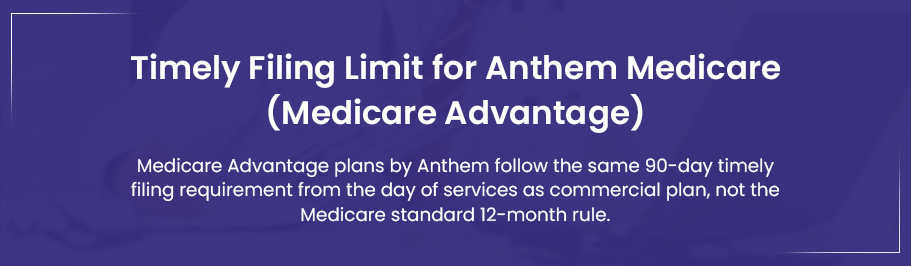
Anthem Medicare Advantage plans use the same 90-day timely filing limit as commercial plans. They do not follow the 12-month rule that applies to Original Medicare.
This point matters a lot. Many providers assume Anthem Medicare Advantage works like Original Medicare, which gives you 365 days to file. In reality, it does not.
Anthem set this 90-day limit back in October 2019. At that time, it updated its Medicare Advantage provider agreements.
Here is the practical difference:
Say you treat a patient on traditional Medicare (Part A or Part B). In that case, you have 365 days to submit the claim. But if the same patient is on an Anthem Medicare Advantage plan, you only have 90 days. For this reason, always check the patient’s coverage before treatment. Also, look at the front of the insurance card, because Medicare Advantage cards look different from Original Medicare cards.
Timely Filing Limit for Anthem Medicaid
Anthem (Elevance Health) runs Medicaid managed care plans in several states. Here is the main difference from commercial plans:
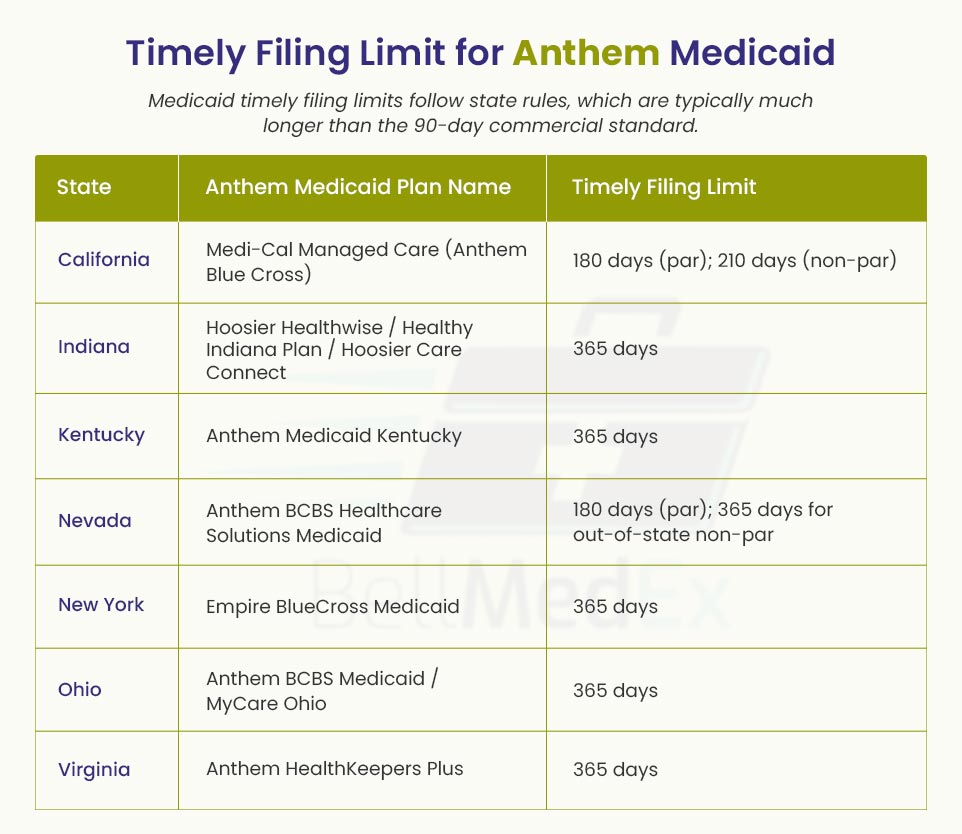
Medicaid timely filing limits follow state rules. As a result, they are usually much longer than the 90-day commercial standard.
The most common Anthem Medicaid limit is 365 days from the date of service. This has been confirmed in Ohio, Virginia (HealthKeepers Plus), Indiana, Kentucky, and Georgia, based on Anthem’s published policies.
| State | Anthem Medicaid Plan Name | Timely Filing Limit |
| California | Medi-Cal Managed Care (Anthem Blue Cross) | 180 days (par); 210 days (non-par) |
| Indiana | Hoosier Healthwise / Healthy Indiana Plan / Hoosier Care Connect | 365 days |
| Kentucky | Anthem Medicaid Kentucky | 365 days |
| Nevada | Anthem BCBS Healthcare Solutions Medicaid | 180 days (par); 365 days for out-of-state non-par |
| New York | Anthem BCBS of NY Medicaid (formerly Empire BlueCross) | 365 days |
| Ohio | Anthem BCBS Medicaid / MyCare Ohio | 365 days |
| Virginia | Anthem HealthKeepers Plus | 365 days |
A special note for behavioral health providers: For most Anthem members, Carelon Behavioral Health manages mental and behavioral health benefits. (Carelon used to be called Beacon Health Options, and it is part of Elevance Health.) As a result, these claims and prior authorizations often go through Carelon, not Anthem. On top of that, the payer ID and the filing deadline can differ. So before you bill, confirm the correct routing and timely filing limit for Carelon services.
Anthem BCBS Timely Filing Limits by State (2026)
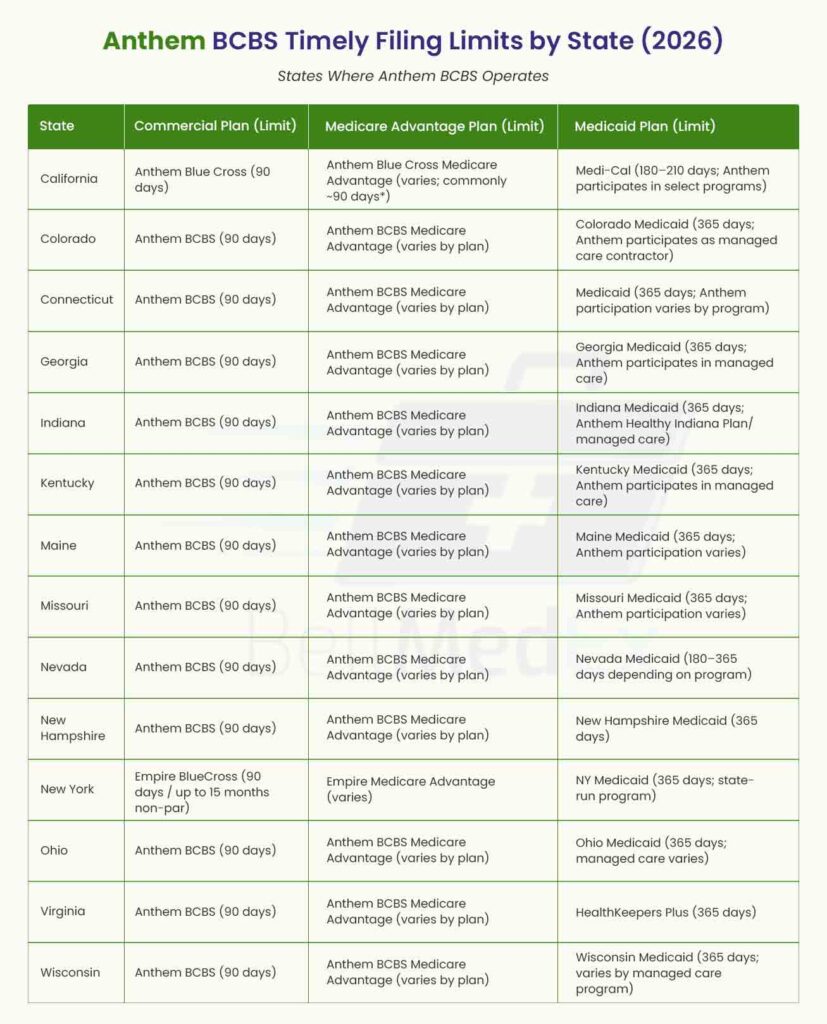
Anthem Blue Cross and Blue Shield operates in 14 states. The exact company name on the insurance card varies by state. Even so, all of these plans fall under the Elevance Health and Anthem umbrella.
| State | Commercial (Limit) | Medicare Advantage (Limit) | Medicaid (Limit) |
| California | Anthem Blue Cross (90 days) | Medicare Advantage (commonly about 90 days*) | Medi-Cal (180 to 210 days; select programs) |
| Colorado | Anthem BCBS (90 days) | Medicare Advantage (varies by plan) | Colorado Medicaid (365 days; managed care) |
| Connecticut | Anthem BCBS (90 days) | Medicare Advantage (varies by plan) | Medicaid (365 days; participation varies) |
| Georgia | Anthem BCBS (90 days) | Medicare Advantage (varies by plan) | Georgia Medicaid (365 days; managed care) |
| Indiana | Anthem BCBS (90 days) | Medicare Advantage (varies by plan) | Indiana Medicaid (365 days; HIP/managed care) |
| Kentucky | Anthem BCBS (90 days) | Medicare Advantage (varies by plan) | Kentucky Medicaid (365 days; managed care) |
| Maine | Anthem BCBS (90 days) | Medicare Advantage (varies by plan) | Maine Medicaid (365 days; varies) |
| Missouri | Anthem BCBS (90 days) | Medicare Advantage (varies by plan) | Missouri Medicaid (365 days; varies) |
| Nevada | Anthem BCBS (90 days) | Medicare Advantage (varies by plan) | Nevada Medicaid (180 to 365 days by program) |
| New Hampshire | Anthem BCBS (90 days) | Medicare Advantage (varies by plan) | New Hampshire Medicaid (365 days) |
| New York | Anthem BCBS of NY / Empire (90 days; up to 15 months non-par) | Medicare Advantage (varies) | NY Medicaid (365 days; state-run) |
| Ohio | Anthem BCBS (90 days) | Medicare Advantage (varies by plan) | Ohio Medicaid (365 days; managed care varies) |
| Virginia | Anthem BCBS (90 days) | Medicare Advantage (varies by plan) | HealthKeepers Plus (365 days) |
| Wisconsin | Anthem BCBS (90 days) | Medicare Advantage (varies by plan) | Wisconsin Medicaid (365 days; varies) |
Note: These figures reflect Anthem’s published reimbursement policies and provider manuals. Your own provider contract may differ. Also, Medicare Advantage windows vary by plan, so verify each one. As always, confirm with your provider agreement or the Anthem provider portal for your state.
Timely Filing Limit for Anthem in California
- Commercial plans (contracted providers): 90 days from the date of service.
- Medi-Cal (Medicaid), participating providers: 180 days from the date of service.
- Medi-Cal (Medicaid), non-participating providers: 210 days from the date of service.
- Secondary claims (Medi-Cal): counted from the date of the primary carrier’s EOP.
In California, the Department of Managed Health Care (DMHC) regulates Anthem Blue Cross. State law and DMHC rules can sometimes give providers extra protections. So if you are not contracted with Anthem in California, check state law. You may find rules that allow a longer filing window.
Timely Filing Limit for Anthem in Virginia
In Virginia, Anthem runs both commercial and Medicaid plans. However, it does so through different legal entities.
- Commercial and Medicare Advantage (Anthem Blue Cross and Blue Shield): 90 days from the date of service.
- Medicaid (Anthem HealthKeepers Plus, run by HealthKeepers, Inc.): 365 days from the date of service.
Virginia state law also gives out-of-network providers at least 12 months to file claims. So if you are not contracted with Anthem in Virginia, you may have a longer window under state law.
Common Mistakes That Lead to Timely Filing Denials
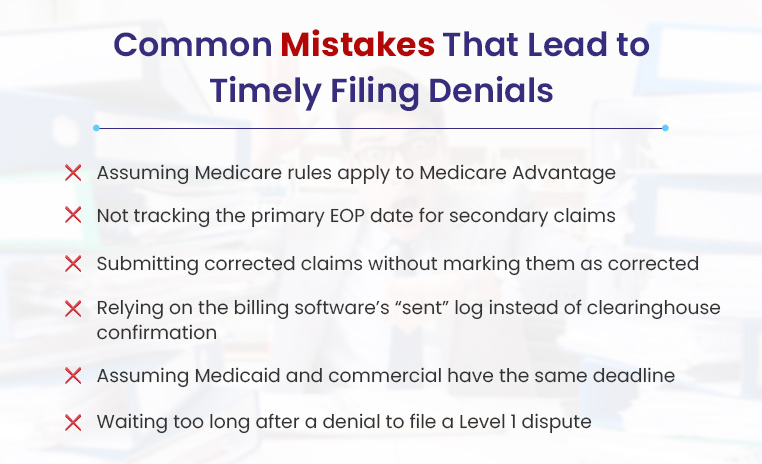
These are the errors that most often cost providers money:
- Assuming Medicare rules apply to Medicare Advantage. Anthem Medicare Advantage is 90 days, not 365.
- Not tracking the primary EOP date for secondary claims. The clock starts when you get the primary EOB, not on the service date.
- Submitting corrected claims without marking them as corrected. They get denied as duplicates, and the correction window may then close.
- Trusting your billing software’s “sent” log instead of the clearinghouse acceptance report. What counts is the date Anthem actually receives and accepts the claim, not the moment you hit “send.”
- Assuming Medicaid and commercial share the same deadline. Medicaid is usually 365 days, while commercial is only 90.
- Waiting too long after a denial to file a Level 1 dispute. Where the 60-day window applies, the clock starts at the EOP.
How Anthem Calculates Timely Filing?
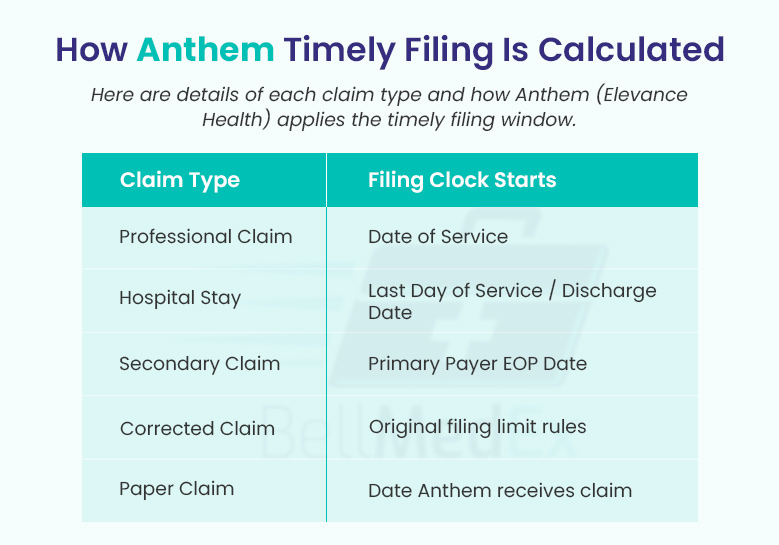
Anthem works out timely filing in a simple way. It subtracts the date of service from the date it receives the claim. Note that this is the date the claim arrives at Anthem, not the date you sent it.
Here is how the filing clock starts for each claim type:
| Claim Type | Filing Clock Starts |
| Professional claim | Date of service |
| Hospital stay | Last day of service, or the discharge date |
| Secondary claim | Primary payer EOP date |
| Corrected claim | Based on the original filing-limit rules |
| Paper claim | Date Anthem receives the claim |
Frequently Asked Questions
What is the Anthem timely filing limit in 2026?
For commercial and Medicare Advantage claims, it is 90 days from the date of service. Most Medicaid plans allow 365 days. A few states, such as California, also have their own windows.
Is Anthem Medicare Advantage 90 days or 12 months?
It is 90 days. The 12-month rule for Original Medicare does not apply to Anthem Medicare Advantage plans.
What is a CO-29 denial?
CO-29 is the code that payers use when a claim is denied for being filed too late. In most cases, you cannot reverse it through a standard appeal. Instead, you must file a documented timely filing exception.
Can I appeal a timely filing denial?
Not through the normal dispute process. However, you can request a timely filing exception if you can prove the claim was sent on time. You can also request one if a qualifying event applies, such as a system outage or a payer error. In addition, for ERISA employer plans, you may have broader federal appeal rights.
Did the Elevance Health rebrand change the deadlines?
No. The 2022 rebrand changed the parent company’s name, not the filing rules. The plans still operate as Anthem, or in some states as Wellpoint. As a result, the deadlines in this guide still apply.
Conclusion
Anthem is now the health benefits arm of Elevance Health. It is also one of the strictest major payers on timely filing. Its 90-day commercial window is shorter than most other large insurers, so it leaves little room for error. The good news is that Anthem’s Medicaid plans are far more forgiving. In most states, they give you a full 365 days. On top of that, employer-sponsored ERISA plans may give you more room to appeal than a 90-day contract suggests.
Note: This article is based on Anthem’s published provider reimbursement policies, official provider news, and verified state provider manuals as of 2026. Timely filing limits, appeal windows, and state programs can change over time. So to confirm the right deadline for your situation, always check directly with Anthem (Elevance Health) or your provider contract.