
Aetna uses different claim-filing limits depending on plan type, provider contract, state law, and claim category.
As a healthcare provider, you should always check the member ID card and the provider portal before billing Aetna. Exceeding the filing limit may result in a claim denial with code CO-29.
In the blog, we will discuss in detail the different filing limits for claims submitted to Aetna in 2026. However, Aetna did not announce major nationwide changes in claim-filing limits for 2026. Most timelines remain the same as in 2025.
Aetna Timely Filing Limit for Initial Claims
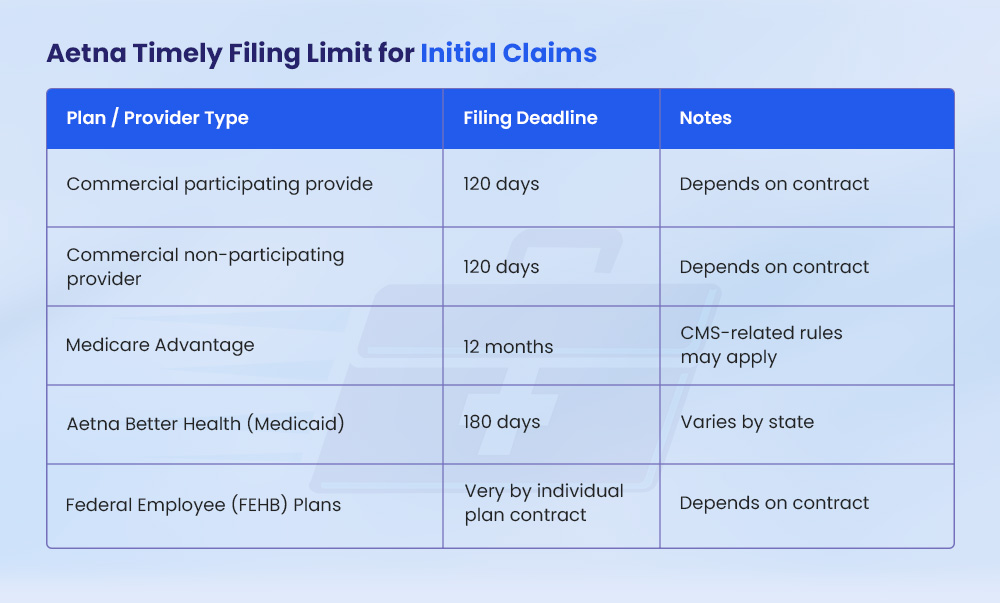
Aetna’s time limit for filing initial claims is 120 days. This is the standard claim submission window. It works the same for all types of providers, i.e., participating and non-participating providers, and for all types of benefit plans. The initial claim submission deadline is determined by the payer contract or varies by state.
The deadline starts on the day of service (DOS), not the date you submitted the claim. Remember, it does not matter that you just mailed it; what is necessary is that Aetna receives your claim before the deadline expires.
| Plan / Provider Type | Filing Deadline | Notes |
| Commercial participating provider | 120 days | Depends on contract |
| Commercial non-participating provider | 120 days | Depends on contract |
| Medicare Advantage | 12 months | CMS-related rules may apply |
| Aetna Better Health (Medicaid) | 180 days | Varies by state |
| Federal Employee (FEHB) Plans | Very by individual plan contract | Depends on contract |
Aetna Timely Filing Limit by Claim Type
Aetna applies the same timely filing limit for all initial claims regardless of claim type. However, there are different forms used for submission of a claim.
Whether you submit a professional claim or hospital claim, paper claim or electronic claim, there is a same window of 120 days for claim submission unless you have a contract with the payer.
| Claim Type | Form Type | Timely Filing Limit |
| Professional claim (physician) | CMS-1500 | 120 days |
| Institutional claim (hospital) | UB-04 | 120 days |
| Inpatient Hospital | UB-04 | 120 days |
| Outpatient/Ancillary | CMS-1500 or UB-04 | 120 days |
| Electronic Claims (EDI) | 837P / 837I | 120 days |
| Paper Claims | CMS-1500 / UB-04 | 120 days |
Aetna Timely Filing Limit for Corrected Claims
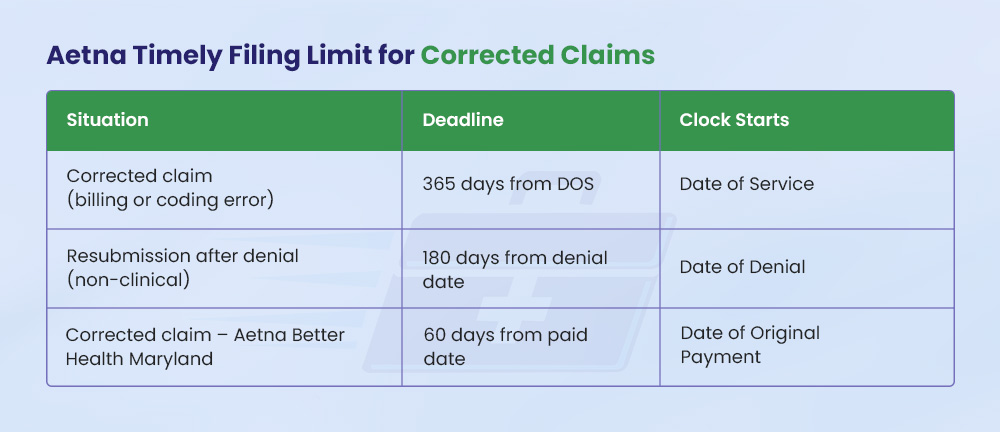
If Aetna denies a claim solely because it is untimely, the participating (in-network) provider may request reconsideration. The provider must submit the corrected claim due to a billing or coding error within 365 days after the DOS (date of services). However, the payer will only consider the claim if it was late due to an unusual error, and the provider generally submits claims on time. Aetna may reduce reimbursement by up to 25% in these cases. The reduced reimbursement rate (25%) may vary depending on the payer’s agreement with Aetna.
Moreover, providers can resubmit claims after a non-clinical denial; the resubmission period is generally 180 days from the date of the denial.
Aetna Better Health Maryland’s timeline for payment dispute claims is 60 days from the date of the original payment. It’s important to check the specific state regulations for the most accurate information.
| Situation | Deadline | Clock Starts |
| Corrected claim (billing or coding error) | 365 days from DOS | Date of Service |
| Resubmission after denial (non-clinical) | 180 days from denial date | Date of Denial |
| Corrected claim – Aetna Better Health Maryland | 60 days from paid date | Date of Original Payment |
Aetna Timely Filing Limit for Claim-Payment Dispute by State
The time limit for corrected claims, also referred to as a claim payment dispute, can vary by state and situation.
| State | To Whom Does the Exception Apply? | Time Allowed to File an Initial Claim-Payment Dispute |
| Arizona (AZ) | All providers (participating and nonparticipating) | 1 year |
| California (CA) HMO | All providers participating and nonparticipating for HMO members | 365 days |
| California (CA) Traditional | All providers | 180 days |
| Colorado (CO) | All providers (participating and nonparticipating) | 12 months |
| Florida (FL) | Participating or nonparticipating licensed physicians, PAs, OP, chiropractors, podiatrists, or dentists | 12 months (does not apply to facilities) |
| Georgia (GA) | All providers | 24 months from DOS or discharge |
| Indiana (IN) | All providers | 2 years from claim payment date |
| Kentucky (KY) | Participating providers only | 2 years |
| Maryland (MD) | All providers | 365 days |
| New Jersey (NJ) | Providers treating fully insured NJ contracted members using PICPA appeal form | 90 calendar days from disputed claim notice |
| New Jersey (NJ) | Providers seeking reimbursement for underpayment claims | 18 months from first claim payment date |
| North Carolina (NC) | All providers | 2 years from original claim payment |
| Ohio (OH) | All providers | 2 years |
| Oklahoma (OK) | All providers | 2 years |
| Oregon (OR) | All providers | 18 months from denial/payment date; 30 months for COB issues |
| Rhode Island (RI) | All providers | 18 months |
| Tennessee (TN) | All providers | 15 months |
| Utah (UT) COB Error | All providers | 24 months |
| Utah (UT) Government Recovery | All providers | 36 months |
| Utah (UT) Other Reasons | All providers | 12 months |
| Washington (WA) | Listed providers on the official website | 24 months from denial/payment date; 30 months for COB issues |
Aetna Timely Filing Limit for Secondary Claims (COB)
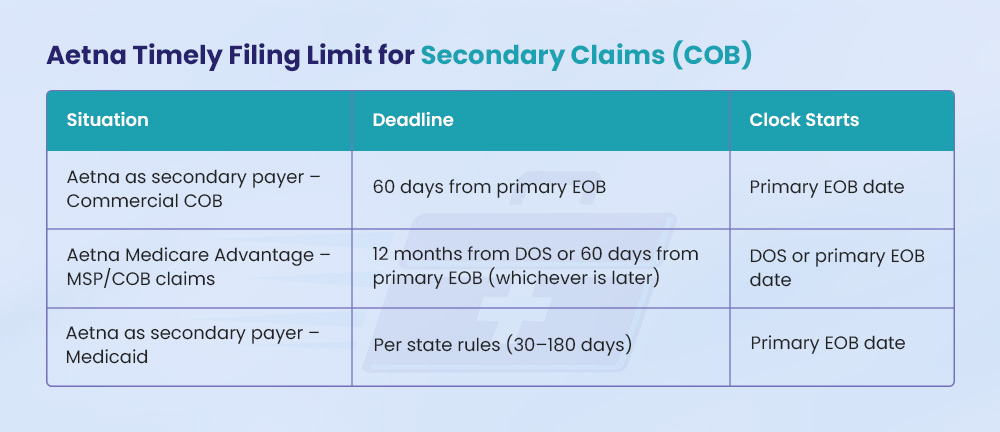
The deadline for filing secondary claims in which Aetna serves as the secondary payer may vary. For commercial Coordination of Benefits (COB), it is 60 days from the primary payer’s Explanation of Benefits (EOB) date. For Aetna Medicare Advantage, it’s 12 months from the date of service or 60 days from the primary EOB, whichever is later. For Medicaid, it follows state rules.
| Situation | Deadline | Clock Starts |
| Aetna as secondary payer – Commercial COB | 60 days from primary EOB | Primary EOB date |
| Aetna Medicare Advantage – MSP/COB claims | 12 months from DOS or 60 days from primary EOB (whichever is later) | DOS or primary EOB date |
| Aetna as secondary payer – Medicaid | Per state rules (30–180 days) | Primary EOB date |
Required Documents for Secondary Filing
- Primary payer’s EOB or RA
- Patient’s primary insurance ID
- Claim showing primary payment amount
- Coordination of Benefits (COB) form
Aetna Timely Filing Limit for Appeals
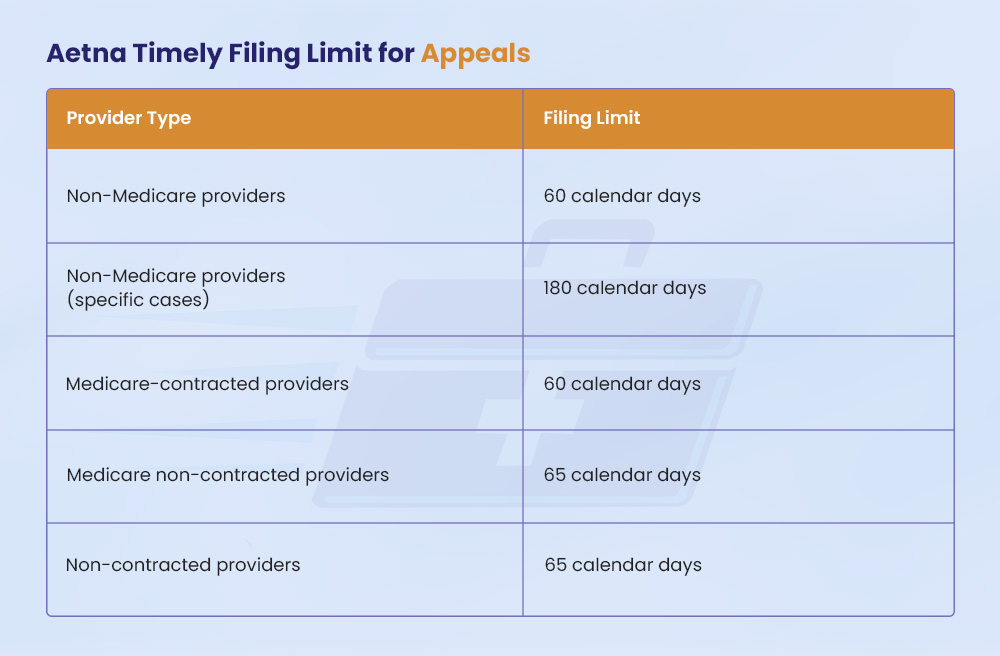
Aetna’s appeal filing limit can vary based on both the type of appeal and the type of provider.
| Provider Type | Filing Limit |
| Non-Medicare providers | 60 calendar days |
| Non-Medicare providers (specific cases) | 180 calendar days |
| Medicare-contracted providers | 60 calendar days |
| Medicare non-contracted providers | 65 calendar days |
| Non-contracted providers | 65 calendar days |
Aetna Timely Filing Limit by Appeal and Provider Type
| Appeal Type | Provider Type | Filing Limit |
| Reconsideration | All providers | 180 calendar days |
| Standard appeal | Non-Medicare providers | 60 calendar days |
| Medical necessity / experimental / investigational appeal | Non-Medicare providers | 180 calendar days |
| Appeal | Medicare-contracted providers | 60 calendar days |
| Appeal | Medicare non-contracted providers | 65 calendar days |
The 180 calendar days limit for non-Medicare providers applies to utilization review or claims appeals issues based on medical need or experimental/investigational coverage criteria.
Aetna Medicare Timely Filing Limit
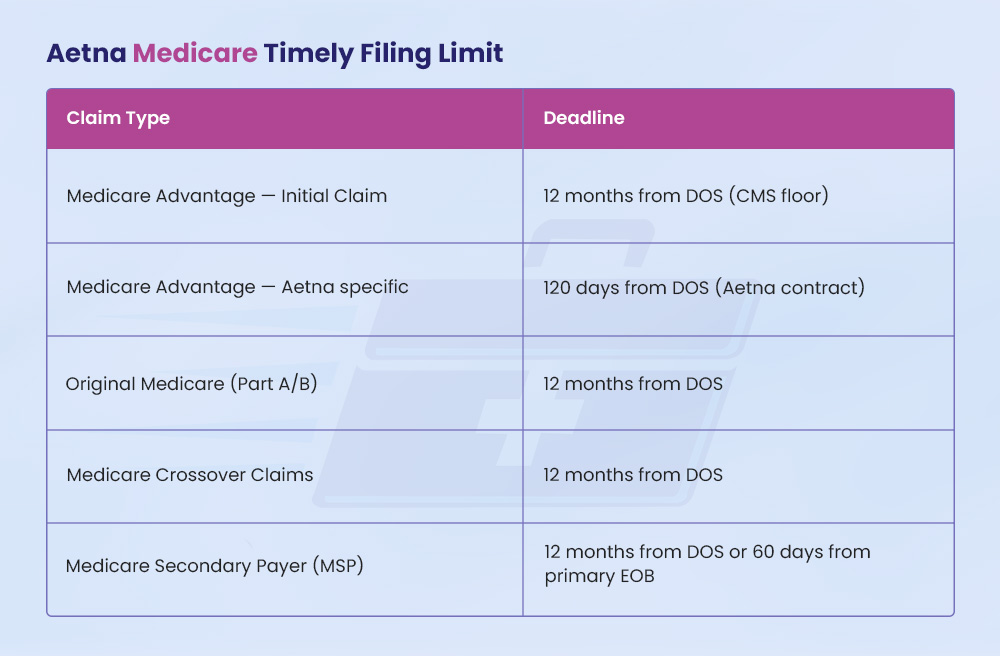
For Aetna Medicare, the standard timely filing limit for new claims is 120 days after the date of service. However, it is governed by a combination of CMS federal rules and Aetna’s own plan policies.
| Claim Type | Deadline |
| Medicare Advantage — Initial Claim | 12 months from DOS (CMS floor) |
| Medicare Advantage — Aetna specific | 120 days from DOS (Aetna contract) |
| Original Medicare (Part A/B) | 12 months from DOS |
| Medicare Crossover Claims | 12 months from DOS |
| Medicare Secondary Payer (MSP) | 12 months from DOS or 60 days from primary EOB |
Always check your specific state’s guidelines, as they can vary.
Aetna Timely Filing Limit Exceptions
Aetna does not offer grace periods for routine errors. However, exceptions are allowed in limited circumstances.
| Exception Type | Qualifies? |
| FEMA-declared natural disaster | Yes |
| Retroactive patient eligibility | Yes |
| COB delay (primary payer slow to process) | Yes |
| Aetna system or portal outage (verified) | Yes |
| Provider enrollment/credentialing delay | Sometimes |
| Administrative billing error (staff error, software glitch) | No |
| Patient failed to provide insurance information | No |
How to Calculate Aetna Filing Deadlines
It is not enough for providers and billing teams to just know the filing limit. The days must also be counted correctly. The countdown begins from the date on which the patient received care, and every calendar day is counted, including weekends and holidays. If the deadline is missed by even one day, the claim can be denied and there is very little that can be done after that. Below are two common filing windows with clear steps shown to help calculate each one accurately.
90-Day Window
Under a 90 day window, the countdown starts on the date of the visit. For example, the patient was seen on January 10, 2026 and we need to work out where exactly 90 days lands on the calendar. Below is a quick example showing how to find the exact cutoff date.
- Start with DOS: January 10, 2026
- Add 90 calendar days
- January has 31 days → 21 days remaining in January
- 90 − 21 = 69 days into February + beyond
- February 2026 has 28 days → 69 − 28 = 41 days remaining
- March has 31 days → 41 − 31 = 10 days into April
- Deadline = April 10, 2026
12-Month Window
Unlike the 90 day window, a 12 month filing limit does not require counting individual days. If the patient was treated on March 15, 2026, the deadline is simply March 15, 2027. So it’s simply moving the year forward by one year on the same calendar date.