Florida’s behavioral health providers are facing new challenges in 2026 as the state has updated the Specialized Therapeutic Services (STS) Fee Schedule for 2026. The state has changed how it oversees high-level care services, such as Qualified Residential Treatment Programs (QRTPs) and Specialized Therapeutic Foster Care (STFCs), by adding codes and modifiers.
To continue growing your practice, you need to learn these codes and modifiers.
In Florida, these services operate on a State Fiscal Year (SFY) basis. That means all services are provided between July 1st and June 30th of each year.
If you bill these services incorrectly, it can limit your ability to help those who rely on them. Accuracy is crucial, whether you’re receiving $196.21 per day for H0019 or tracking the 20-hour limit for H0031 HA.
This blog explains the reimbursement rates for Specialized Therapy Services (STS) and the rules that FL Medicaid closely monitors in 2026.
2026 Florida Medicaid Fee Schedule Overview for Specialized Therapeutic Services
To accurately receive reimbursement for these services, it is important to understand CPT codes, HCPCS modifiers, and their application to Medicaid billing.
| Service Description | Procedure Code | Max Fee | Essential Limitations & Billing Tips |
| Comprehensive Behavioral Health Assessment | H0031 HA | $12.22 / 15 min | Reimbursed once per fiscal year (July 1–June 30), capped at 20 hours per recipient annually. Payment is issued only after the final report is completed, not at the start of service. |
| Specialized Therapeutic Foster Care (Level I) | S5145 | $88.03 / day | Cannot be billed with psychosocial rehabilitation or clubhouse services. Requires daily eligibility verification to avoid denied claims. |
| Specialized Therapeutic Foster Care (Level II) | S5145 HE | $136.94 / day | Must use the HE modifier to receive the enhanced rate. Missing or incorrect modifiers may reduce payment to the base level or trigger denial. |
| Specialized Therapeutic Foster Care (Crisis Intervention / Alternate Modifiers) | S5145 (e.g., HK depending on state rules) | Up to $136.94 / day | Crisis-related foster care may require modifiers like HK in addition to standard coding. Documentation must clearly show crisis severity and intervention provided. |
| Therapeutic Group Care Services | H0019 | $196.21 / day | Not reimbursable during Juvenile Justice (DJJ) detention stays. Duplicate billing with other payers for the same service is strictly prohibited. |
| Qualified Residential Treatment Program (QRTP) | H0019 HM | $196.21 / day | Must meet QRTP certification requirements. Strictly no duplicate billing applies if another entity has already reimbursed the service. |
- To stay compliant with Florida Medicaid STS reimbursement, make sure your coding is accurate, you use the right modifiers, track eligibility, and keep thorough documentation. This helps protect your healthcare practice from revenue leakage.
- Correct coding and modifiers impact reimbursement in the STS fee schedule 2026, with services that include $136.94 / day for S5145 HE and $196.21/day for H0019 services.
- Since S5145 and H0019 services are billed by the day, each patient’s eligibility must be confirmed daily to ensure timely payment and prevent potential claim denials.
- Providers will need to document high-cost services such as QRTP (H0019 HM) and H0019 to receive the maximum reimbursement rate of $196.21/day.
- The STS fee schedule follows a fiscal year calendar (July 1–June 30), and billing at an incorrect time may result in delayed reimbursement.
- If services overlap, you cannot bill for them. Providers are not allowed to submit more than one behavioral health service for the same Date of Service (DOS).
- Proper documentation and modifier use are essential to ensure full reimbursement and avoid audits under the STS fee schedule 2026.
The following breakdown highlights different therapeutic service categories and their corresponding Florida Medicaid fee schedules.
1). Comprehensive Behavioral Health Assessment (H0031HA)
This service will evaluate a patient’s overall mental health and is paid by FL Medicaid at a rate of $12.22 per 15-minute session. This means an hourly payment limit of $48.88.
Since this is a timed billing code, auditors need exact start and stop times documented within the patient’s chart for each billed 15-minute increment of service.
Medicaid has established a cap on this type of assessment, which can occur only once per fiscal year. Additionally, there is a hard ceiling of 20 total hours of service that can be billed to an individual recipient.
Payment will only be made when the final report is completed. Partially completed reports or unfinished assessments cannot produce a clean claims submission.
If a patient becomes ineligible for services while undergoing the assessment or enters inpatient care before it is completed, the original referral date will serve as the official date of service, ensuring that all work completed up to that point remains protected.
2). Specialized Therapeutic Foster Care (STFC) – Level I (S5145)
This level of care is designed for individuals who require structured therapeutic support due to emotional, behavioral, or mental health needs but do not meet the criteria for the more intensive Level II program.
The reimbursement rate for Level I care is $88.03 per day under procedure code S5145.
Level I services provide a therapeutic foster-home environment, along with supervision, behavioral support, skill-building, and treatment coordination, to help recipients maintain stability in their homes and communities.
Documentation must support the medical necessity for therapeutic foster care services and clearly reflect the recipient’s ongoing treatment needs and progress.
3). Specialized Therapeutic Foster Care(STFC) – Level II (S5145 HE)
This is designed for those with high behavioral needs. The reimbursement rate for this level of care is increased to $136.94 per day via the HE modifier. Level II can only be accessed when the recipient has documentation showing that the complexity of their case requires a significant increase in clinical intensity beyond the typical therapeutic foster care model.
Documentation must show that the patient has a high level of need. If the documentation does not clearly identify why they are eligible for level II care and appears stagnant, the state will likely downgrade the rate to level I.
As with Level I, you cannot bill for concurrent behavioral health services. It would be considered double-billed. Therefore, you could not receive Medicaid funding twice.
You must track daily activity logs and document all support given to each recipient to justify the amount of money/effort spent on them as a result of your treatment program.
4). STFC Crisis Intervention (S5145 HK)
When combined with the HK modifier, this Florida Medicaid code is reimbursed at $136.94/day for acute emergency stabilization. Although the reimbursement rate matches level II, this code is intended for short-term use during a crisis episode rather than for ongoing maintenance.
The provider will need to document the specific events that caused the crisis, the stabilization techniques used, and the crisis’s clinical outcome to receive payment.
Providers cannot bill this service when the child is residing in juvenile detention or when other simultaneous residential behavioral health services are being billed.
Due to the high value of these crisis codes and their time-sensitive nature, the most frequent reason claims are denied and providers initiate administrative appeals is incomplete narrative documentation.
5). Therapeutic Group Care Services (H0019)
H0019 is a behavioral health residential billing code designed to provide healthcare providers with a complete reimbursement of $196.21 per day from FL Medicaid. Therefore, it represents some of the highest-value services provided under the behavioral health fee schedule. It is imperative, for revenue protection purposes, that the most important data elements for reimbursement include verified admission and discharge dates for all residents.
Any partial or whole days spent by a recipient in a Department of Juvenile Justice detention center will result in automatic forfeiture of reimbursement.
Since Medicaid is considered the “payer of last resort”, providers will need to verify that there were no prior private insurance payments or other third-party coverage for the same period of care.
Providers need well-supported daily records showing how the monthly claim total was calculated and why it is payable.
6). Qualified Residential Treatment Programs (QRTP)- (H0019/HM)
Qualified residential treatment programs (QRTPs) are an exception, as they can receive reimbursement under the HM modifier at a higher rate ($196.21) than standard residential rates. The reason the QRTP has this option is that the facilities have met specific requirements to become certified as “trauma-informed” and are providing clinical services and treatment to their patients’ families.
As long as the facility remains certified as a QRTP, it will be eligible for reimbursement of the daily rate provided by the HM modifier. However, if the certification lapses at any time, the facility would no longer be eligible for reimbursement under the HM modifier. It could lose funding for residential services until the recertification process is completed.
Medicaid allows billing for various residential behavioral health services. However, when services are billed simultaneously, they cannot include more than one residential behavioral health code. In other words, a provider may bill for either residential treatment or residential detox services, but not both on the same date.
What Are the Main Compliance Rules in the Florida Medicaid STS Fee Schedule 2026?
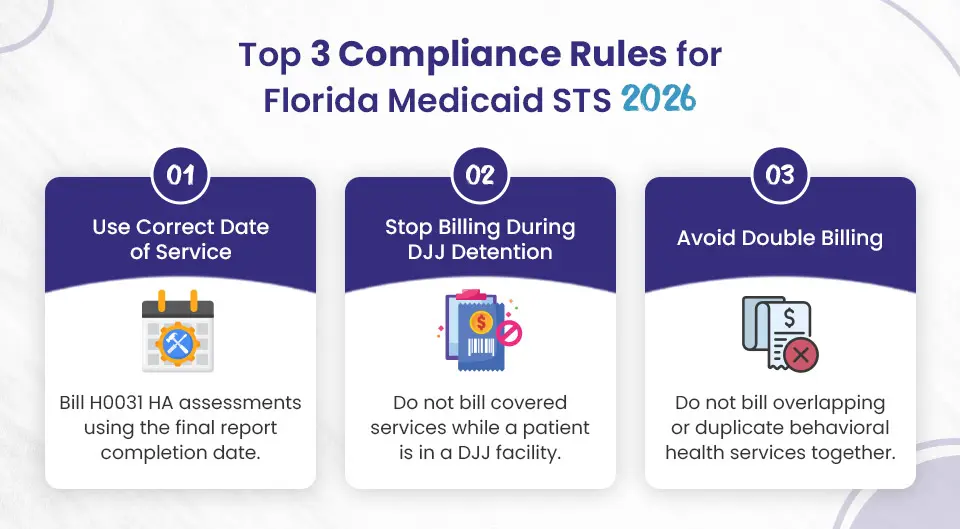
Behavioral health providers need to follow the Medicaid compliance rules, which significantly contribute toward improved revenue cycle performance and reduced audit risk. The rules outlined below directly relate to reimbursement accuracy and the approved rate of claims submitted for reimbursement.
✅ “Date of Completion” Assessment Rule (H0031 HA)
The Medicaid reimbursement for Comprehensive Behavioral Health Assessments (H0031 HA) is based on the date that the final assessment report was completed, rather than the date when the patient consultation began. Therefore, it is essential that your billing staff correctly associate each submitted claim with the report completion date to ensure proper reimbursement.
However, there are several exceptions. For example, if a patient is admitted into a Statewide Inpatient Psychiatric Program (SIPP) before completing an assessment, or has lost Medicaid coverage prior to completing an assessment. Then you may consider using the referral date as the date of service. This exception protects against revenue loss resulting from external interruptions to the assessment process.
✅ Billing Restriction related to Juvenile Justice (DJJ)
Medicaid does not reimburse for specific services provided to patients placed in a Department of Juvenile Justice (DJJ) detention facility.
This restriction applies to the following services:
- Specialized Therapeutic Foster Care (S5145 series)
- Therapeutic Group Care Services (H0019/H0019HM)
Once a patient is placed in a juvenile detention center, these services must be ceased immediately and no longer billed until the patient’s release. Continued billing for these services while in a juvenile detention center would be considered non-compliance and is often cited as one of the leading causes of audits and repayment of previously paid claims.
✅ Overlapping Service Restrictions (No Double Billing Rule)
Medicaid does not allow billing for multiple services at the same time when the services are identical or duplicate each other in nature.
For example, a recipient of Specialized Therapeutic Foster Care (S5145 series) cannot receive separate billing for community-based behavioral health psychosocial rehabilitative services or clubhouse-type support services.
Similarly, other services, such as adult day care and case management, cannot be billed at the same time as certain covered services.
These services are mutually exclusive; only one service type can be billed at a time. To avoid claims being denied due to this issue, your billing system must be set up to automatically identify potential issues and flag them before claims are submitted.
Simply, we can say the compliance with billing regulations in the behavioral health industry is dependent upon adherence to three main concepts:
- Correct alignment of claims submitted with the applicable date of service guidelines
- Delay in submitting claims once the individual has been detained through a Department of Juvenile Justice program
- Prevention of overlapping services being billed in conjunction with one another