Florida Medicaid’s 2026 private duty nursing fee schedule outlines the maximum hourly rates for nursing services:
- The registered nurse rate under code S9123 is $32.23 per hour.
- The licensed practical nurse rate under code S9124 is $28.14/hour.
- The TT modifier is used when one nurse provides care to multiple recipients in the same setting.
- With the TT modifier, the first recipient is paid at the full rate, the second at 50% of that rate and each additional recipient at 25% of that rate.
- The UF modifier is used when a provider coordinates with another service provider in the same setting.
For the Florida Home Health Agency (HHA) owners, 2026 is a year of unparalleled financial opportunities and regulatory risks. For around a decade, Florida agencies operated on thin margins. Recruiting nurses was hard as the wages soared. However, the real turning point was 2024’s Live Healthy legislative package.
The Senate Bill 7016 injected a whopping $717 million into the healthcare system to overcome the workforce shortage issues. Simply put, this large amount of money has stabilized the industry, which was on the brink of collapse.
With maximum fees reaching $32.23/hour for registered nurses (RNs) and $28.14/hour for licensed practical nurses (LPNs), agencies finally have the capital to compete for nursing talent.
However, the State of Florida or Medicaid is not giving out this money for free. There are certain conditions you have to meet.
Agency for Health Care Administration (AHCA) and Managed Care Organizations (MCOs) like Sunshine Health, Simply Healthcare, and Humana have deployed sophisticated, AI-driven auditing systems.
- These systems are designed to find cloned documentation, i.e., the same or nearly identical notes reused across multiple patient visits.
- Moreover, they detect overlapping Electronic Visit Verification (EVV) timestamps. EVV is a digital check-in/check-out system recording when a caregiver starts and ends a visit.
- These AI-driven audit systems are also very careful about modifier errors.
2026 Florida Medicaid Private Duty Nursing Fee Schedule: Rates, Codes, and Billing Basics
To ensure your billing team is operating with 100% precision, here’s the table of the current AHCA reimbursement rates and procedural codes exactly as they appear in the official state schedule below.
| Code | Mod 1 | Mod 2 | Service | Maximum fee |
| S9123 | — | — | RN private-duty nursing, up to 24 hours per day | $32.23/hr |
| S9123 | TT | — | RN private-duty nursing for multiple recipients in the same location | $32.23/hr for 1st recipient; $16.12/hr for 2nd; $8.06/hr for each extra recipient |
| S9123 | UF | — | RN private-duty nursing when more than one nurse provides care in the same setting | $32.23/hr |
| S9123 | TT | UF | RN private-duty nursing for multiple recipients, with multiple nurses in the same setting | $32.23/hr for 1st recipient; $16.12/hr for 2nd; $8.06/hr for each extra recipient |
| S9124 | — | — | LPN private-duty nursing, up to 24 hours per day | $28.14/hr |
| S9124 | TT | — | LPN private-duty nursing for multiple recipients in the same location | $28.14/hr for 1st recipient; $14.07/hr for 2nd; $7.03/hr for each extra recipient |
| S9124 | UF | — | LPN private-duty nursing when more than one nurse provides care in the same setting | $28.14/hr |
| S9124 | TT | UF | LPN private-duty nursing for multiple recipients, with multiple nurses in the same setting | $28.14/hr for 1st recipient; $14.07/hr for 2nd; $7.03/hr for each extra recipient |
Notes:
- Billing for time longer than 30 minutes can be billed at the next one-hour block of time (i.e. 30-59 min = 1 hour) as long as your total number of hours billed does NOT EXCEED your approved amount of daily hours.
- Each provider will need to use modifier TT when submitting their claim(s), in addition to listing ALL of the cases they provided service on that day. Billing a case across multiple claims by different providers is strictly prohibited.
- Modifier UF identifies services coordinated with another home health provider.
- The listed rates are per provider.
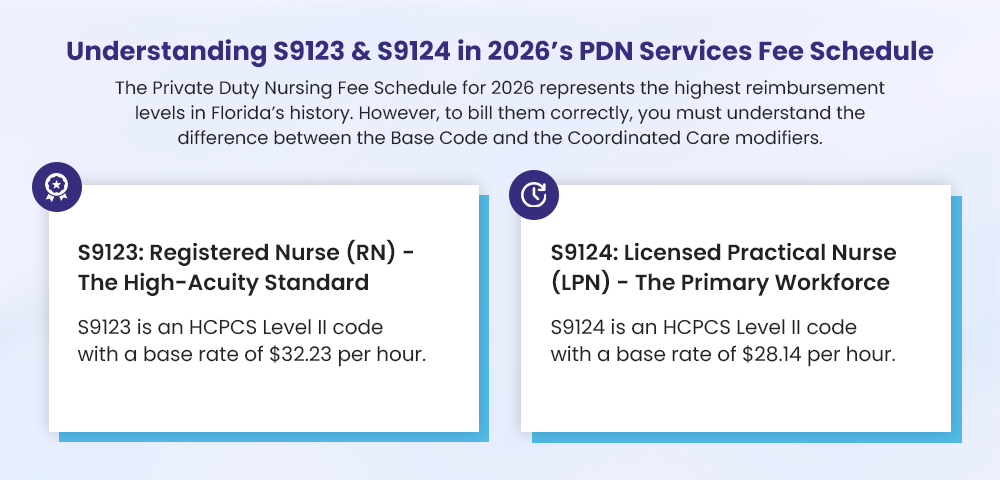
Understanding S9123 & S9124 in 2026’s PDN Services Fee Schedule
The Private Duty Nursing Fee Schedule for 2026 represents the highest reimbursement levels in Florida’s history. However, to bill them correctly, you must understand the difference between the Base Code and the Coordinated Care modifiers.
S9123: Registered Nurse (RN) – The High-Acuity Standard
S9123 is an HCPCS Level II code with a base rate of $32.23 per hour.
This code is for the most medically fragile patients. In 2026, MCOs are looking for specific Skilled Interventions that an LPN cannot perform under Florida law. These include complex central line maintenance or certain advanced respiratory assessments.
It is worth remembering that the rate gap between RN and LPN is only $4.09. Based on this, many home health agencies in Florida are finding that staffing with an RN is more cost-effective. The reason is that it eliminates the administrative overhead and costs of the mandatory RN supervisory visits required for LPN-staffed cases.
S9124: Licensed Practical Nurse (LPN) – The Primary Workforce
S9124 is an HCPCS Level II code with a base rate of $28.14 per hour.
S9124 code handles the majority of the 24/7 care shifts in Florida. Considered as the backbone of the program, this HCPCS code covers stable tracheostomy care, G-tube feedings, and standard medication administration.
Modifier Codes Explained One-by-One
In the state of Florida, an HCPCS modifier is a technical instruction. If a provider or the medical biller misses a single modifier, the entire claim will be rejected with a note, “Duplicate Service.” The reason why you receive this rejection is that the state’s system thinks you are trying to bill twice for the same hour.
1). The TT Modifier (More than one recipient in the same setting)
Under the coding system used by AHCA, the TT modifier stands for Multiple patients seen during one trip. Simply put, when a nurse provides specialized care to more than one patient in the same home.
It could be a sibling with complex needs. In such a situation, you must append a TT modifier. The state of Florida uses a tiered payment model to clearly document the shared time.
The 2026 Tiered Calculation for Registered Nurses is as follows.
- S9123 TT (1st Recipient): $32.23/hr (100% of Max Fee)
- S9123 TT (2nd Recipient): $16.12/hr (50% of Max Fee)
- S9123 TT (3rd+ Recipient): $8.06/hr (25% of Max Fee)
Important Note: If your agency cares for three children in one home, the average pay rate is about $18.80/hour. In 2026, using an RN for these cases isn’t profitable. You need to manage staffing costs very carefully.
2). The UF Modifier (Multiple providers or the Shift-Handoff rule)
The UF modifier is required when more than one provider is in the home.
For instance, Agency A handles the 7 AM – 7 PM shift and Agency B handles the 7 PM – 7 AM shift.
The Overlap:
During the 30-minute clinical handoff, both agencies are in the home. Both must use the UF modifier. Without it, the state will freeze payments for the overlapping hours. It could result in a stalled cash flow for 60-90 days.
3). The TT UF Combination (For the most complex households)
The S9123 TT UF combination is used for Florida households where multiple siblings receive care during a shift handoff. The TT modifier indicates care for multiple patients, while UF justifies the temporary overlap of a second nurse for the clinical report.
Combining these ensures the state recognizes the specific multi-patient rate and the handoff simultaneously, preventing automated payment denials.
For example, this unique combination tells the payer: “I am caring for the second child in this home (TT), and I am coordinating with another nursing team in the same residence (UF).”
What is the 30-Minute Rounding Revenue Rule?
One of the most valuable pieces of information for a Florida biller is hidden in the footnotes of the Official AHCA PDN Fee Schedule.
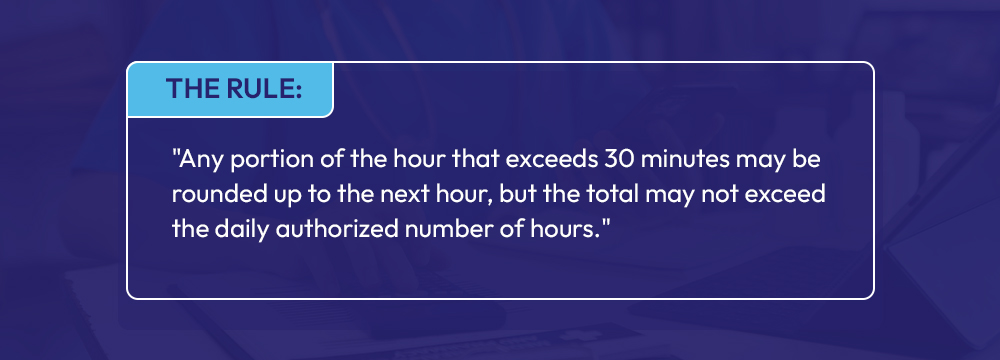
The Rule: “Any portion of the hour that exceeds 30 minutes may be rounded up to the next hour, but the total may not exceed the daily authorized number of hours.”
Why is this rule considered crucial for reimbursement?
In a 24/7 setting, if a nurse completes an 8-hour and 35-minute shift, standard 15-minute unit billing would record only 8.5 hours. However, under Florida’s rounding revenue rule, since the time passes the 30-minute threshold, you can bill it as a full 9 hours.
❌ The worrying stat: On a 24/7 case, failing to round correctly is equivalent to losing $11,700 in legitimate revenue per patient, per year.
✅ Best strategy for 2026: Ensure your EVV software is configured to flag these rounding opportunities. If you aren’t capturing these minutes, you aren’t maximizing the value of your nursing hours.
Sunshine Health’s Stance for PDN Vs. FHHA in 2026
The rise of the Family Home Health Aide (FHHA) program is like a double-edged sword. It allows parents of medically vulnerable children to be paid for their care. Moreover, it also results in a “Duplication of Service”.
The “No-Overlap” Mandate
Florida Medicaid policy states that professional PDN services (S9123/S9124) and unskilled FHHA services cannot be provided at the same time.
The Audit Trap
MCOs are now using automated logic to cross-reference the staff nurse’s EVV logs against the parent caregiver’s EVV logs. If there is a 15-minute overlap, the agency is hit with a recoupment for the entire nurse’s shift.
Operational Tip
To avoid losing your reimbursement, your scheduling system must prevent a parent and a nurse from being ‘on the clock’ at the same time. If their timestamps overlap in the EVV system, the state may deny the entire claim. When the parent starts, the nurse must stop.
Nighttime Medical Necessity and the “Supervision Only” Denial
As we move through 2026, Managed Care plans are quite strict regarding denying nighttime PDN hours. They are of the view that if a child is in bed, sleeping, they don’t need an RN.
Expert Insight for 2026 to Avoid Denials
To prevent nighttime denials, your nurses must document Active Skilled Interventions. For example, “Patient slept well” is a clinical and financial failure. Instead, documentation must focus on the following things:
1). Nocturnal O2 Titration
Documenting adjustments to oxygen based on continuous pulse-ox monitoring.
2). Tracheal Suctioning
Recording the frequency and consistency of secretions removed during the night.
3). Skin Integrity Management
Documenting specific repositioning times for non-ambulatory patients to prevent decubitus ulcers.
If your notes don’t prove to Medicaid Florida that the patient is clinically unstable during the night, MCOs like Sunshine Health will move those hours to an unskilled “sitter” or FHHA. It will result in a 50% cut in your revenue.
Difference between Pediatric and Adult PDN
While the HCPCS modifiers are identical, the clinical hurdles to obtaining authorization vary widely across populations.
Pediatric PDN (The Under-21 Population)
This section focuses on House Bill 1261. This Senate bill aims to make sure children under 21 living in group homes receive the same hourly PDN rate as those receiving care at home.
➜ PPEC Interaction
Never bill PDN while a child is at a PPEC (Prescribed Pediatric Extended Care) center.
This is a strict audit trigger that requires immediate attention. If a child attends PPEC for 8 hours, your home authorization must be reduced by those exact 8 hours.
Adult PDN (LTC or Long-Term Care)
For adults under the Long-Term Care (LTC) waiver, the goal of the MCO is to move the patient from skilled nursing (S9124) to unskilled aide hours (HHA).
➜ The Stability Trap
Once an adult patient is considered stable, their nursing hours are at risk of getting reduced. Your documentation must focus on Preventing Hospitalization. Document the complex tasks, such as catheter care, wound staging, or bowel programs, that an aide is not legally permitted to perform.
Documentation in the Smart Audit Era, Moving Beyond Cloned Notes
In 2026, Documentation takes center stage for Florida Medicaid PDN & FHHA. AHCA auditors don’t just read your notes manually. In fact, they use modern software tools to detect cloned notes.
Copying and pasting the same note every day for three consecutive days is a huge red flag. If the documentation doesn’t change, Florida Medicaid will treat the care as unskilled and may stop your payments.
Ensure Compliance And Audit Protection With The D-I-E Method
All the documentation must be based on the D-I-E (Data, Intervention, Evaluation) method.
- Data: Current ventilator settings, lung sounds, and vital signs are assessed and documented to establish the patient’s baseline respiratory status and overall condition.
- Intervention: Intervention Tracheostomy care was performed, including replacement of the inner cannula and suctioning of approximately 5 mL of thin, clear secretions, with the patient monitored throughout for tolerance and stability.
- Evaluation: “Patient breathing easier; O2 saturation remained at 98% throughout the procedure.”
The APRN Advantage: Don’t forget that Florida’s expanded scope of practice allows Autonomous APRNs (Advanced Practice Registered Nurse) to sign Plans of Care (POCs) and PDN orders. This is a major change for 2026, as it helps agencies avoid delays caused by waiting on physician signatures for authorization.