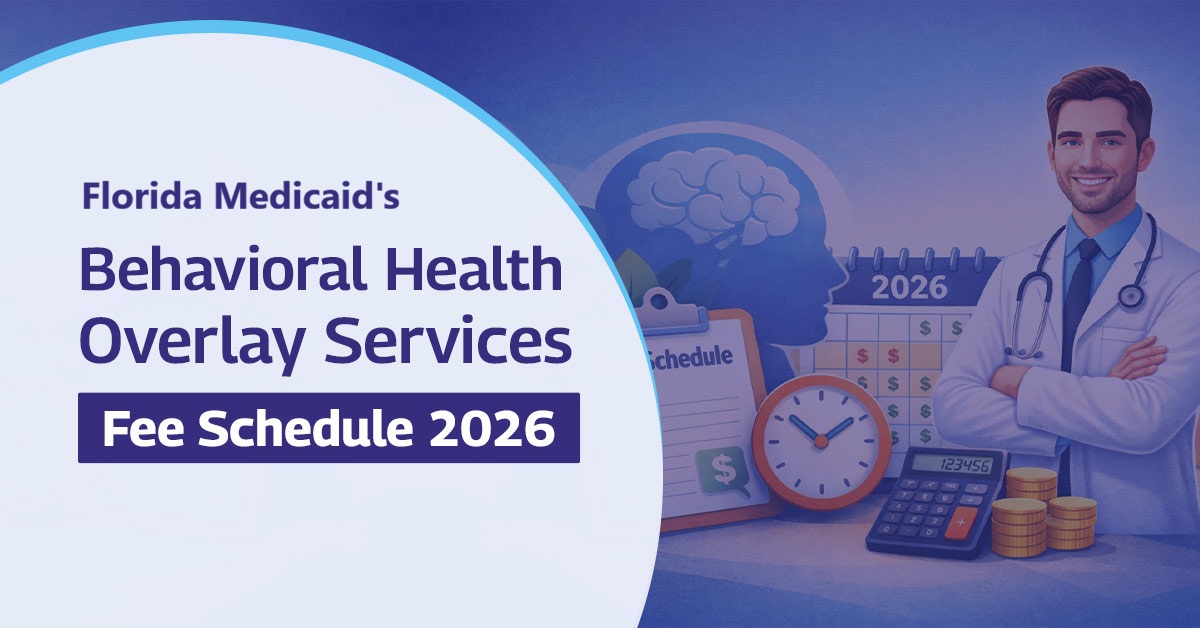
As of January 1, 2026, the Florida Medicaid reimbursement rate for Behavioral Health Overlay Services (BHOS) is capped at $33.02 per day. The procedure code for BHOS is H2020-HA.
Although the rate is fixed, revenue integrity depends on strict adherence to state-mandated limitations. Many providers are currently facing denials. These often stem from billing during ineligible placement periods rather than rate discrepancies.
Today, in our technical overview, we’ll break down the H2020-HA structure and the documentation required to avoid recoupment. We will specifically focus on reimbursement conditions, recipient absence and concurrent billing exclusions.
Protecting BHOS Reimbursements and H2020-HA Revenue Integrity
In the 2026 Florida Medicaid environment, the $33.02 daily rate is not a stipend. A stipend is money you get just for having a person in a bed. Medicaid doesn’t work that way. Instead, this is a payment for active behavioral modification.
Currently, the Agency for Health Care Administration (AHCA) is focusing on a Functional Restoration model. For a provider, this means that just watching a patient isn’t enough.
To keep your money and avoid an audit, your records must prove you actually provided a service that helped the patient improve.
| Service | Procedure Code | Modifier | Max Daily Rate | Coverage Rules & Limits |
| Behavioral health support (overlay services) | H2020 | HA | $33.02 per day | Medicaid will not cover services if the individual is absent from the program for being placed in a Department of Juvenile Justice (DJJ) detention facility. Additionally, Medicaid will not reimburse for services that have been previously funded by another entity. |
How To Bridge The Gap Between Clinical Work And Getting Paid?
Before going into the details, like how to earn the capped revenue, remember that if your documentation lacks technical precision, the AHCA auditor will consider it never happened.
Here are some technical standards that ensure your clinical notes support your daily H2020-HA revenue.
➜ The Active Intervention Rule
To ensure reimbursement-ready medical documentation, you must show that you did more than just supervision.
If an auditor sees phrases like “patient had a quiet day” or “supervised the resident during lunch,” they will label it as passive supervision. Since Florida Medicaid doesn’t reimburse for just “watching” someone, they will ask for that $33.02 back.
➜ The “Supplement, Not Replace” Rule
As you know, BHOS is an “overlay” service. So, it must add to the treatment the patient is already getting. If you bill H2020-HA but don’t show you are working with the rest of the medical team, the payer may deny your claim due to lack of medical necessity.
➜ Preventing Concurrent Billing Denials
Good documentation is a proof that you’re keeping the patient stable. If a crisis leads to a hospital visit, you cannot bill for that day. By documenting how successfully you de-escalated a situation, you prove the value of your service and protect your daily revenue from being blocked by a hospital claim.
Do you need help with medical billing for your overlay codes?
If your Florida Medicaid overlay claims are denied or underpaid, and/or claims are stuck in “Pending,” the problem is rarely an obvious error. More often than not, it is due to minor friction in the billing process: eligibility, authorization, units, documentation wording, provider type, fee schedule mismatch. We handle Medical Billing in Florida with those exact behavioral health details in mind, so your team is not guessing why a perfectly real service did not turn into real revenue.
The H2020-HA Reimbursement Framework
As a provider if you don’t fully understand the mechanics of the procedure code H2020-HA, you may have to deal with countless denials and rising Account Receivables. Also, Florida Medicaid in 2026 operates under a strict per-diem cap governed by AHCA Rule 59G-4.002.
Based on this payment model, Florida Medicaid reimburses one fixed price for the day, irrespective of how many individual interventions occur.
Simply put, it is a daily flat fee and no more billing by the hour. Revenue is tied to the date of service, and you have to move from the time-based billing.
The Daily Cap
No matter how many units of H2020 you submit in a single day, your total reimbursement will not exceed the daily maximum of $33.02.
The Volume Trap
In the 2026 Florida BHOS Fee Schedule, more hours do not equal more revenue. It doesn’t matter if you provide eight hours of service or only two. The reimbursement rate stays the same, i.e., $33.02.
Therefore clinical efficiency, i.e., delivering high-quality, targeted interventions that are documented perfectly matter, instead of just increasing the time.
SMMC Rate Variance and Net Revenue Protection
While $33.02 is the state-mandated “ceiling,” it is important to remember that not all checks will look the same.
The SMMC Factor
Individual Statewide Medicaid Managed Care (SMMC) plans, such as Sunshine Health or Community Care Plans have the latitude to contract at slightly different rates.
However, they almost never pay above the state enforced cap. Rather, they pay the exact amount or slightly below it.
The RCM Strategy
Do not rely on “estimated” income. Always verify your specific “Allowed Amount” against your provider agreement. Even a small discrepancy in your billing software can lead to massive underpayments in your aging reports.
Add Clinical Context And Unlock Revenue Through HA Modifier
Even with a perfect contract and an accurate per-diem rate, your claims will be denied if you ignore the coding specifics like modifiers. In the Florida Medicaid Program, the H2020 code doesn’t stand alone. It requires a specific HA modifier to establish medical necessity.
The use of HA modifier signals to the payer that the service was delivered to a child or adolescent within a specialized behavioral health framework. Without it, your claim for $33.02 is vague and the payer will automatically reject it.
To secure payment for HA modifier in 2026, your documentation must satisfy this 3-step checklist.
Recipient Eligibility (SED Status)
The HA modifier signals that the child has a Serious Emotional Disturbance (SED) designation. Your medical records must reflect that the level of care provided matches the intensity required for this specific population.
Diagnostic Precision (ICD-10)
You cannot attach an HA modifier to a claim without a supporting diagnosis. In 2026, auditors are looking for a direct link between the ICD-10-CM codes on the claim and the behavioral interventions documented in the daily note.
If the diagnosis doesn’t justify BHOS, the modifier and the revenue will be invalidated. For instance, if the diagnosis is the why, the HA modifier is the how. In simple words, it justifies every dollar reimbursed for the medical need.
Treatment Plan Mapping
This is where most providers fail an audit. Every billed day under the HA modifier must be mapped back to a specific, measurable goal in the Master Treatment Plan.
If a clinician delivers a great intervention but it isn’t explicitly tied to a treatment goal, the payer will view the service as non-reimbursable supervision and recoup the payment.
| The “Denial” Note (Vague) | The “Audit-Proof” Note (Clinical) |
| “Worked on behavior during group.” | “Addressed aggressive outbursts using deep breathing de-escalation.” |
| “Client had a good day and was calm.” | “Client successfully utilized coping skills to return to task within 5 mins.” |
| “Provided routine support.” | “Implemented skill-building activity focused on impulse control goals.” |
The No-Pay Zones for H2020
No Reimbursement During Juvenile Detention
Florida Medicaid reimburses BHOS services when the child is with you. The state pays to take care of them. But the second the child enters a detention center, the state “hands off” that money to the jail instead.
Here is what that means for you in practical terms. Stop billing the moment detention begins. Do not submit claims for those dates. Monitor placement changes closely so you do not have to pay money back later.
No Overlap: SIPP and Hospital Stay Conflicts
This “No-Pay” rule also applies to SIPP and Hospital Conflicts. Because H2020-HA is an overlay service, it cannot overlap with an inpatient hospital stay or a Statewide Inpatient Psychiatric Program (SIPP).
These facilities receive an all-inclusive rate that “swallows” your daily fee, i.e., $33.02. Your billing must pause the moment a child is admitted. You can only resume on the day they are officially discharged back to your care.
The “Empty Bed” Rule
Finally, remember that Florida BHOS is a presence-based payment. No child means no money. If the child isn’t physically in your building, you don’t get paid. If a child runs away (AWOL), you lose the $33.02 fee for every night they are missing.
This also applies to Home Visits. While clinically helpful, most 2026 insurance plans will not pay to “hold the bed” while a child is home for the weekend. If the child is sleeping at home, you cannot bill Medicaid for that night.
Do you need help identifying the issues within your overlay code fee schedules?
Florida Medicaid’s fee schedules can be of little value unless your billing process has been trained to operate within it. The payer’s allowable amounts for each service, as well as service rules and payer behavior, all must align to prevent revenue leakages in areas that appear non-dramatic at first. Our Miami Medical Billing Services will assist you to detect these leakages prior to them becoming commonplace.
Beyond the Claim
If it isn’t documented clearly and accurately, it didn’t happen at all. This is where you need to be proactive.
A Bad Note vs. A Good Note
A vague note like “worked on behavior” doesn’t suffice. It tells the reviewer nothing and usually leads to a denial.
A compliant note should describe:
- What behavior did you see?
- What strategy did you use to help?
- How did the child respond?
For example, instead of saying a child “had a good day,” note it like, “Addressed aggressive outbursts during group activity using deep breathing exercises. The client calmed within five minutes and returned to the activity.
Good documentation tells a clear clinical story. Make sure yours does. It creates a link between the intervention and the result.
Medical Necessity
Every BHOS service must meet the medical necessity standard. Otherwise you won’t get paid. Meeting the standard means three things. These are:
- The client has a real diagnosis
- Your service directly treats that diagnosis
- The intensity of your care matches what the child actually needs
If you provide a service for convenience, routine supervision, or general support with no clinical basis behind it, you will not meet this standard. Don’t expect to get paid because Medicaid pays for the treatment and not just watching the Juvenile.
Your Responsibilities as a Provider
Billing rules are just one piece of the puzzle. You also need to meet broader Medicaid requirements.
- You need proper staff qualifications and supervision in place.
- Your team needs training in behavioral health interventions. You cannot cut corners here.
- You must stay on top of ongoing compliance with Florida Medicaid policy guidelines. Rules change. Do not assume what worked last year still works this year.
- Regularly review the BHOS Coverage and Limitations Handbook. Check for policy updates often. Make this a habit.
Final Thoughts
Florida Medicaid’s BHOS fee structure is not just one code, a modifier and capped daily payment. It’s more complex than it seems.
The true challenge lies in how you document your work, justify medical necessity, and coordinate with other funding sources.
Providers who understand these details avoid denials, maintain compliance and deliver more effective care.
On the other hand, those who overlook these technicalities face a cycle of payment delays and recoupments. By focusing on documentation today, you are protecting your ability to serve your clients tomorrow.
Lastly, in BHOS, getting paid is not just about billing correctly. It is about showing that every service you provide has a clear purpose, a clinical foundation, and a measurable impact on the child you served.