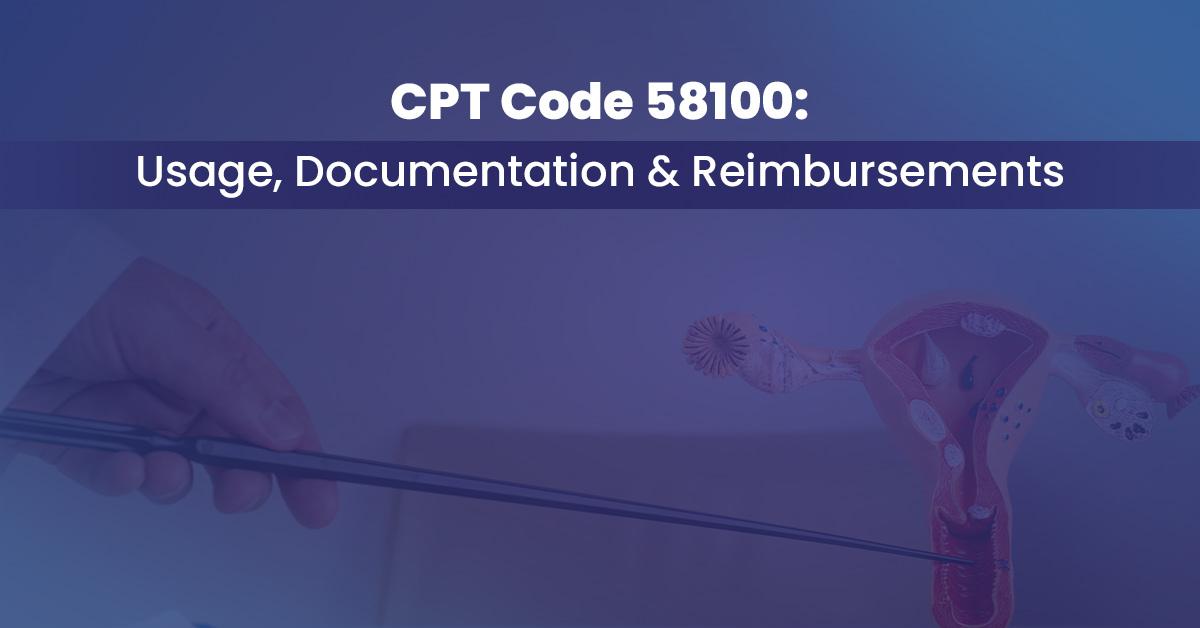
When a gynecologist performs an office endometrial biopsy, choosing the right CPT code is important for correct billing and payment.
Use CPT 58100 when the physician takes a sample from the uterine lining and does not dilate the cervix. However, if the gynecologist dilates the cervix and performs a dilation and curettage (D&C), the correct code is usually CPT 58120.
What is CPT Code 58100?

CPT 58100 means:
“Endometrial sampling (biopsy), with or without endocervical sampling (biopsy), without cervical dilation.”
This code describes a minor procedure that a gynecologist often performs in the office. During the procedure, the clinician removes a small tissue sample from the endometrium, which is the lining of the uterus. That sample helps the healthcare provider check for possible problems.
The words “with or without endocervical sampling” mean CPT 58100 already includes both. So, if the physician also takes a sample from the endocervix during the same visit, do not bill it separately.
A gynecologist may perform this procedure to check for:
- abnormal uterine bleeding
- bleeding after menopause
- suspected endometrial hyperplasia
- possible endometrial cancer
- abnormal imaging or other uterine findings
- follow-up in some patients on hormone-related therapy
During the procedure, the clinician places a thin tool, such as a Pipelle, through the cervix and into the uterine cavity. Next, the physician uses gentle suction to collect endometrial tissue from the uterine lining. Then the sample goes to pathology for testing. In most cases, the sampling step takes only a short time, and the full office visit is brief.
When to Use CPT Code 58100
CPT 58100 is used in OBGYN medical billing and coding when:
- a gynecologist performs a diagnostic endometrial biopsy
- the biopsy is done without cervical dilation
- the biopsy is a stand-alone procedure
- the service takes place in an office or outpatient setting
When Not to Use CPT Code 58100
Do not use CPT 58100 when:
- the gynecologist must dilate the cervix and the service fits CPT 58120 better
- the biopsy is part of a hysteroscopy and the hysteroscopy code better matches the service
- coding rules bundle the biopsy into another procedure under NCCI edits or CPT separate procedure rules
Also, clinicians should not describe an endometrial biopsy as a routine test for infertility or luteal phase evaluation. Current reproductive medicine guidance does not support routine endometrial biopsy with histologic dating as a standard tool for infertility evaluation.
ICD-10 Codes Commonly Used with CPT 58100
Always choose the ICD-10 code that best matches the patient’s condition and supports medical necessity. Common examples include:
- N93.0 – Postcoital and contact bleeding
- N93.8 – Other specified abnormal uterine and vaginal bleeding
- N93.9 – Unspecified abnormal uterine and vaginal bleeding
- N95.0 – Postmenopausal bleeding
Code selection should match the documented reason for the biopsy and the patient’s clinical findings.
Documentation Requirements for CPT Code 58100
Clear documentation is important. It helps show medical necessity and may help prevent denials.
The medical record should include:
- the reason for the biopsy
- confirmation that the procedure was done without cervical dilation
- the method used
- the tool used, such as a Pipelle
- confirmation that tissue was collected and sent to pathology
- how the patient handled the procedure
- any follow-up instructions
You can also include helpful details such as clinical findings, imaging results, or past treatment history that support the need for the biopsy.
Modifiers for CPT Code 58100
A modifier does not change the procedure itself. Instead, it gives extra details about how the service was performed.
Modifier 25 – Significant, Separately Identifiable E/M Service
Use Modifier 25 on the E/M code, not on CPT 58100.
This modifier may apply when the physician performs a medically necessary E/M service that is separate from the usual work done before the biopsy.
For example, a patient may come in with abnormal uterine bleeding. The physician may perform a full history, exam, and medical decision-making before deciding to do the biopsy on the same day. In that case, the physician may report Modifier 25 with the E/M service if the documentation shows that the E/M work was significant and separate.
Modifier 59 – Distinct Procedural Service
Use Modifier 59 only when another procedure is performed on the same day and the documentation shows that the biopsy was separate.
The biopsy must be distinct and not part of the other service. It must also be allowed under NCCI rules.
Do not use Modifier 59 just because two procedures happened on the same day.
Modifier XU – Unusual Non-Overlapping Service
In some cases, Modifier XU may be used instead of Modifier 59. This applies only when the biopsy is truly separate and does not overlap with another service.
However, do not use Modifier XU to avoid normal bundling rules. If the biopsy is part of the main procedure, it is usually not reported separately.
For example, endometrial sampling done during hysteroscopic evaluation is usually not separately reportable as CPT 58100.
Modifier 52 – Reduced Services
Use Modifier 52 when the planned biopsy service is reduced or not fully completed.
Do not use it automatically just because only a small amount of tissue was obtained. Instead, base the decision on what the physician actually performed and documented.
Reimbursement Rates for CPT Code 58100
Reimbursement rates for CPT Code 58100 depend on your area of the country, your payer mix, and whether the procedure was performed in your private office or a facility.
CMS Rates
For Medicare, national average payments (before geographic adjustments) are generally lower about $61 facility and $97 non-facility in 2025.
For Medicaid, rates are even lower.
For facility settings the rate is $76 facility and non-facilities up-to $48.
According to the Centers for Medicare & Medicaid Services, CPT 58100 has a 0-day global period. This means, follow-up visits after 58100 are not included in the procedure payment.
Commercial Insurance Reimbursement
Commercial payers reimburse CPT code 58100 (endometrial biopsy/sampling) as a minor surgical procedure often performed in an office setting.
Many commercial insurance companies will reimburse providers for CPT 58100 anywhere from approximately $122 to $172 per procedure.
Additional Coding Note:
CPT 58100 includes the biopsy procedure itself. It also includes endocervical sampling when it is done during the same encounter.
However, CPT 58100 does not include the pathology interpretation of the specimen. That part is billed separately by the appropriate pathology provider.
Common Billing Mistakes to Avoid
Billing CPT 58100 correctly takes careful code selection, clear documentation, and attention to bundling rules. Common mistakes include:
- using CPT 58100 when cervical dilation was required and the service is better described by CPT 58120 because dilation and curettage (D&C) was performed
- billing CPT 58100 separately when the biopsy was done as part of a hysteroscopic procedure, even though the hysteroscopy code usually better describes the service
- adding Modifier 59 or Modifier XU without clear documentation that the biopsy was distinct, non-overlapping, and separately reportable under NCCI rules
- assuming CPT 58100 has a 10-day global period, even though it actually has a 0-day global period
- failing to document that the biopsy was performed without cervical dilation, which is a key part of the code definition
- forgetting that pathology interpretation is not included in CPT 58100 and must be billed separately by the pathology provider
CPT 58100 vs. 58120 vs. Hysteroscopy Biopsy Codes
CPT 58100 is the correct code when the physician performs a routine endometrial biopsy without cervical dilation. It covers endometrial sampling and can also include endocervical sampling during the same encounter.
However, the coding changes when the procedure becomes more extensive. If the physician needs to dilate the cervix and perform a D&C (dilation and curettage), CPT 58120 is usually the more appropriate choice.
The code changes again when the sampling is done as part of a hysteroscopic procedure. In that situation, the hysteroscopy code usually gives a more complete description of the service than billing CPT 58100 on its own. For instance, CPT 58558 applies to surgical hysteroscopy with endometrial sampling and/or polypectomy, with or without D&C.
As a result, it is important to review bundling and separate procedure rules before reporting both services together. In most cases, diagnostic hysteroscopy and a separate endometrial biopsy should not be billed together unless the documentation clearly supports that they were distinct and separately reportable.
CPT 58100 Global Period and Follow-Up Billing
CPT 58100 has a 0-day global period. This means the payment covers only the usual work done on the day of the biopsy. It includes the normal care before and after the procedure on that same day. However, it does not include a 10-day post-op package like CPT 58120.
This difference affects follow-up billing. For example, a later follow-up visit does not fall into a 10-day global package for CPT 58100.
The same rule matters on the day of the biopsy too. If the physician also performs a separate E/M service, and the note supports work beyond the usual pre-procedure care, the practice may report an E/M code with Modifier 25.
A repeat biopsy on a later date also needs its own review. In that case, choose the code based on what the physician did and documented at that later visit.
Pathology Billing Note:
CPT 58100 covers the work of taking the endometrial tissue sample. However, it does not cover the pathology interpretation.
The pathology provider reports the review and diagnosis separately with the correct pathology code.
For that reason, the procedure note should clearly show three things. First, it should state that the physician obtained tissue. Next, it should confirm that the office sent the specimen to pathology. Finally, it should note whether the physician also performed endocervical sampling.
Medical Necessity / Payer Documentation Checklist
Before you submit a claim for CPT 58100, make sure the record supports the service and includes the key billing details.
Use this checklist:
- the note states why the biopsy was done, such as abnormal uterine bleeding, postmenopausal bleeding, or suspected endometrial pathology
- the note clearly says the physician performed the biopsy without cervical dilation
- the record lists the instrument or technique used, such as a Pipelle or similar sampling device
- the physician documents that endometrial tissue was obtained and sent to pathology
- if the claim includes Modifier 25, the E/M note must support a significant, separately identifiable service beyond the usual work of the biopsy visit
- if the claim includes Modifier 59 or Modifier XU, the documentation must clearly show that the biopsy was separate and allowed under the applicable coding rules
- the selected diagnosis code must support medical necessity and match the documented reason for the biopsy