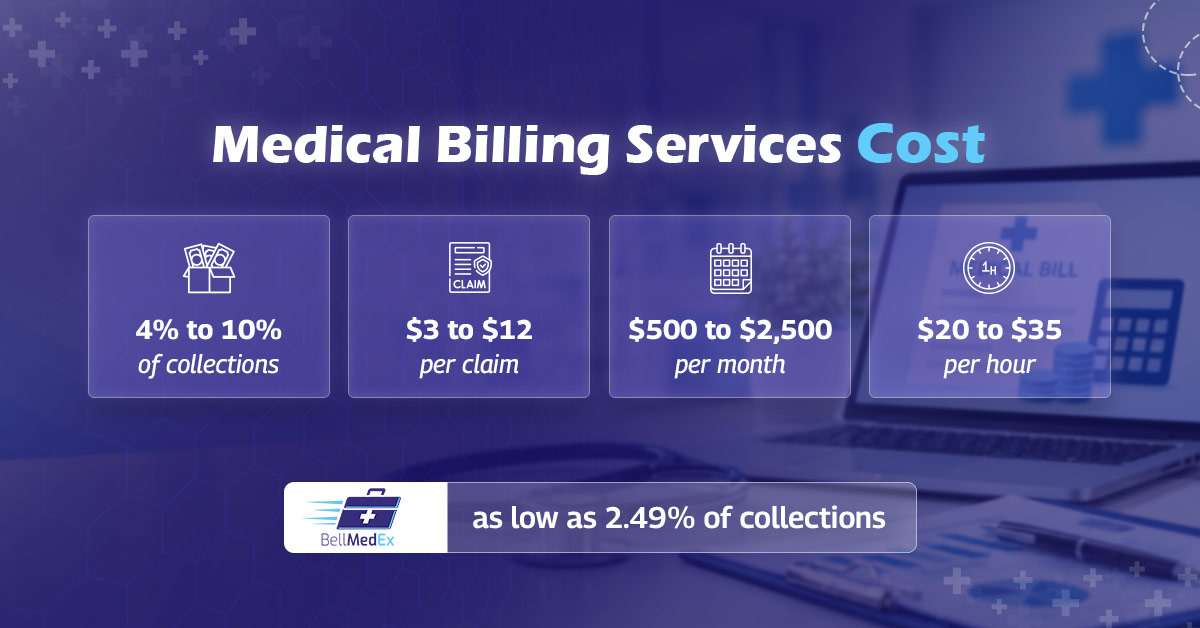
Here’s the short answer. In 2026, medical billing services cost about 4% to 10% of collected revenue, and most clinics land somewhere between 5% and 7%. Some vendors skip percentages altogether. Instead, they charge $3 to $12 a claim, a flat $500 to $2,500 or more each month, or $20 to $35 an hour for US-based help.
So what is a billing service, once you strip away the vendor pitch? It’s an outside team that sends bills, called claims, to insurers on behalf of doctors. After that, it trails every unpaid claim until it turns into a cleared deposit. Many offices hand this job over because it gives the front desk its patient hours back.
Of course, the final number depends on several things. Size, specialty, location, and the extra services needed all play a part. The sections below walk through each one with real numbers and easy examples, including a full table for every US state.
Here Is a Quick Look at 2026 Prices
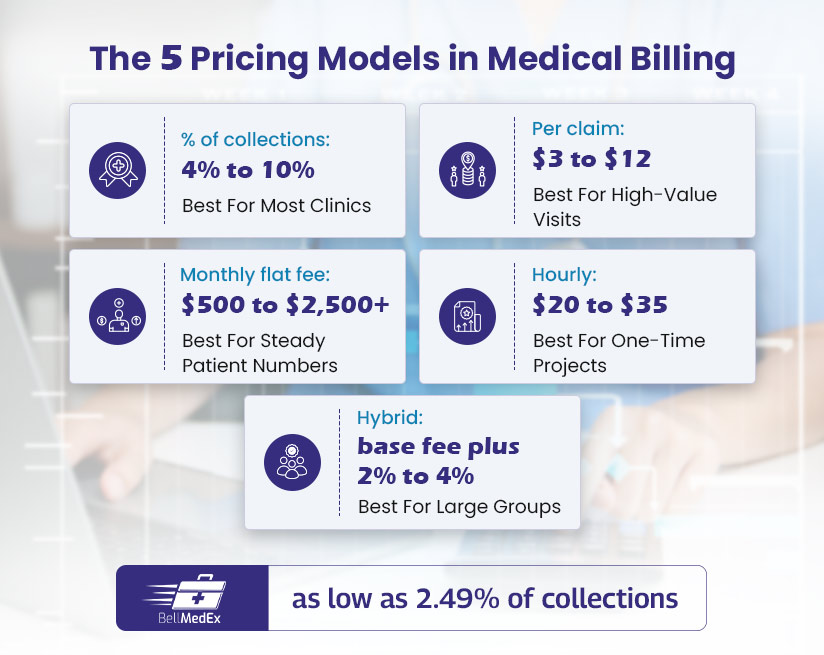
Here’s a quick summary of the five most common pricing methods, their typical 2026 ranges, and the type of clinic each one suits best.
| Pricing method | Typical 2026 range | Works best for |
|---|---|---|
| Percentage of collections | 4% to 10% (most pay 5% to 7%) | Nearly any clinic, small or large |
| Fee for each claim | $3 to $12 (most pay $4 to $7) | Offices whose claims bring in a high amount |
| Monthly flat fee | $500 to $2,500+ for the whole office, or $200 to $1,000 per clinician | Groups that like one steady bill |
| Hourly rate | $20 to $35 in the US, $8 to $15 offshore | Short projects, like clearing old unpaid claims |
| Hybrid | A base fee plus 2% to 4% | Large or multi-specialty groups |
These figures come from vendor price pages published in 2026. Every firm sets its own rates, so a real quote may come in a bit higher or lower.
A Few Billing Words Explained Simply
Before going further, it helps to know a handful of terms that show up again and again.
- A claim is a bill sent to an insurer for a patient visit.
- Collections means the money that actually arrives from insurers and patients.
- A denial is a claim the insurer refuses to pay.
- A/R, short for accounts receivable, is money still owed to the office.
- RCM, or revenue cycle management, covers the whole journey of getting paid, from booking the visit to receiving the last dollar.
- A payer is anyone who pays for care, such as Medicare, Medicaid, or a private insurer.
How Do Billing Vendors Charge for Their Work?
Not every vendor prices its work the same way. In fact, there are five common setups, and each one is tailored for a different clinic profile. The following table gives a side-by-side look before taking each model apart bolt by bolt.
| Model | How it works | Who it fits |
|---|---|---|
| Percentage of collections | The vendor keeps a small share of what it collects | Most clinics, especially new or growing ones |
| Claim-based fee | A set fee for every claim sent | Groups with high-paying visits |
| Flat monthly price | The same bill every month | Offices with steady patient numbers |
| Hourly rate | Payment for each hour worked | One-time projects |
| Hybrid | Two models mixed together | Large or complex groups |
What Does Each Pricing Model Mean in Simple Words?
The table gives a quick view, but each model deserves a proper introduction. Here’s what every option really means, along with a tiny example.
Percentage of Collections
This is the most familiar option. The billing team keeps a small share of the money it actually brings in from insurers and patients, usually 4% to 10%. So when a clinic collects $40,000 in a month at a 6% rate, the fee is $2,400. A dry collection month brings an invoice with a zero fee line, which keeps both sides focused on getting paid.
Claim-Based Fee
Here, the vendor charges one fixed amount every time it drops a bill into an insurer’s intake queue. Most firms ask somewhere between $3 and $12, no matter how large or small the claim is. For instance, 500 claims at $6 apiece add up to $3,000. This option feels simple, and it works especially well when visits bring in large payments.
Flat Monthly Fee
With this setup, the invoice is exactly the same every month. Some vendors set one price for the whole office, while others charge by the number of doctors, often $200 to $1,000 apiece. A three-physician clinic paying $600 per doctor, then, always pays $1,800. Owners who love a predictable budget usually lean toward this choice.
Hourly Rate
This one works like hiring a helper by the hour. The office pays only for the time billers actually spend on its account, typically $20 to $35 an hour for US-based staff. Forty hours of cleanup at $30 an hour, for example, costs $1,200. It’s ideal for short projects, though harder to budget for everyday work.
Hybrid Pricing
Hybrid plans combine two of the models above. The most common blend is a modest base fee plus a smaller percentage, often 2% to 4%. So a group paying $500 plus 3% on $60,000 in collections ends up with a $2,300 invoice. Larger and more complex organizations tend to like a fee with a fixed floor and a results based top layer.
Why Is Percentage of Collections the Most Popular Pricing Model?
Simply put, the vendor’s paycheck rises and falls in step with the clinic’s deposits. The billing team earns a small commission on every recovered dollar. A month of zero recoveries leaves the commission line at zero too.
Take a family clinic that collects $40,000 in March. With a 6% rate, its fee for that month is $2,400. Then, if income dips to $30,000 in April, the fee drops to $1,800 on its own.
What Does Each Level of Service Usually Cost?
Rates shift depending on how much of the work the vendor takes on. This quick table shows the usual share for each level of service.
| Level of service | Typical share of collected revenue |
|---|---|
| Insurance claims only | 4% to 9% |
| Patient balances only | 2% to 6% |
| Full service, start to finish | 5% to 10% |
Full service covers every step. That means coverage confirmed before the patient walks in, claims sent out clean, denials repaired and refiled, and patient balances brought safely home.
Why Do Net Collections and Gross Charges Make Such a Big Difference?
Here’s a detail many owners miss. The word “collections” can mean different things in different contracts. Net collections are the dollars that actually land in the bank after insurer cuts and refunds. Gross charges, by contrast, are the full prices billed before any cuts.
That small wording change can cost a lot. Picture an office that bills $100,000 but receives $60,000. At 6% of net collections, it pays $3,600. At 6% of gross charges, though, it would pay $6,000, which is $2,400 more for the same work.
Who Gets the Most Value From This Model?
This setup works for almost everyone. It’s especially friendly for new and growing offices, because the bill rises and falls with income. So in a slow month, the fee shrinks too.
What Should Owners Confirm Before Signing a Percentage Deal?
It’s smart to get three things in writing. First, the rate should apply to net collections, not gross charges. Second, the contract should say whether copays and other patient payments count. Third, any minimum charge should be clear, since a minimum can quietly push up the true rate in slower months.
How Much Does Medical Billing Cost Per Claim?
With claim-based pricing, the vendor charges one fixed amount for each bill that rolls across its conveyor. It doesn’t matter whether that bill is worth $80 or $800. Across the market in 2026, full-service firms ask anywhere from $3 to $12 for each claim, and smaller offices usually pay between $4 and $7.
Here’s how that plays out. Suppose a pediatric office sends 500 claims in May at $6 apiece. Its bill for the month comes to $3,000.
How Do Claim Fees Change With the Type of Service?
Claim fees also depend on how much of the job the vendor handles, as the breakdown below shows.
| Service | Typical fee for each claim |
|---|---|
| Full service | $3 to $12 |
| Insurance billing only | $4 to $7 |
| Patient statements only | $1 to $3 |
| Clearinghouse only (checking and sending) | $0.11 to $0.35 |
Some firms go a step further and charge only when a claim gets paid. One New York vendor, for instance, lists $4.90 for each paid workers’ compensation claim. That kind of offer is great news for the office, since denied claims cost nothing.
What Do Different Specialties Pay for Each Claim?
Some fields need more work for every claim than others. Here’s a look at typical claim fees across common specialties.
| Specialty | Typical fee for each claim |
|---|---|
| Labs and pathology | $2 to $6 |
| ABA and behavioral therapy | $2 to $8 |
| Primary care | $3 to $6 |
| Internal medicine and pediatrics | $4 to $7 |
| Mental health | $4 to $8 |
| Radiology | $4 to $8 |
| Oncology | $5 to $9 |
| Orthopedics and surgery | $5 to $10 |
| Cardiology | $5 to $10 |
Anesthesia is the odd one out. Since its claims depend on time spent in the operating room, most vendors stick with a percentage for this specialty.
When Does a Flat Claim Fee Save Money, and When Doesn’t It?
The trick is to compare the fee with the average payment. A flat fee looks tiny next to a big payment but feels heavy next to a small one. The table below turns a $6 fee into a percentage at different payment sizes.
| Average payment received | What a $6 fee equals as a share |
|---|---|
| $80 | 7.5% |
| $90 | 6.7% |
| $150 | 4.0% |
| $300 | 2.0% |
| $600 | 1.0% |
In other words, a therapist with $80 sessions would pay more this way than with a 6% plan. A surgeon with $600 cases, on the other hand, would get a bargain.
Which Offices Benefit Most From Claim-Based Pricing?
This approach shines for groups with high-value visits, such as surgery centers, cardiology clinics, and imaging centers. It also appeals to owners who simply want one locked in price stamped on every bill.
What Questions Help Avoid Surprises With Claim Fees?
Two questions hold most of the pricing weight here. Does the fee apply to every claim sent, or only to the ones that get paid? And does a corrected claim that goes out again count as a brand-new one? Those two answers can tilt the monthly invoice more than the rate itself.
What Is the Average Medical Billing Price Per Month?
Many owners just want one number. What will the invoice look like each month? The answer depends on the pricing setup, so this part covers both flat plans and what percentage plans add up to over a month.
How Do Flat Monthly Plans Work?
With a flat plan, the invoice stays the same whether the waiting room is full or quiet. Most flat plans in 2026 run between $500 and $2,500 or more for a whole office. Some vendors price by headcount instead, usually charging $200 to $1,000 for each clinician.
Consider a three-doctor clinic paying $600 per physician. Its invoice comes to $1,800, every single month.
What Do Percentage Plans Add Up to Over a Month?
Because most clinics pick a percentage, their invoice moves with income. In the table below, owners can find the row closest to their monthly collections and then read across to see the fee at each rate.
| Monthly collections | Fee at 4% | Fee at 6% | Fee at 8% |
|---|---|---|---|
| $20,000 | $800 | $1,200 | $1,600 |
| $50,000 | $2,000 | $3,000 | $4,000 |
| $100,000 | $4,000 | $6,000 | $8,000 |
| $250,000 | $10,000 | $15,000 | $20,000 |
How Does Group Size Change the Monthly Invoice?
Bigger groups usually win lower rates, since they send far more claims. As a result, their fees grow more slowly than their revenue, which the next table makes easy to see.
| Group size | Usual rate | Sample monthly income | Usual monthly fee |
|---|---|---|---|
| Solo clinician | 7% to 12% | $25,000 | $1,750 to $3,000 |
| 2 to 5 clinicians | 6% to 9% | $83,000 | $5,000 to $7,500 |
| 6 to 15 clinicians | 4% to 7% | $290,000 | $11,700 to $20,400 |
| 16 or more clinicians | 3% to 6% | $667,000 | $20,000 to $40,000 |
How Can a Minimum Fee Raise the True Rate?
Plenty of contracts include a floor, meaning the lowest amount owed even in a quiet month. Common floors range from $300 to $600 for each physician, while some vendors set a single $1,000 floor for the whole office.
That floor can sting. Imagine an office that brings in only $10,000 during a slow August, with a 3% rate and a $1,000 floor. Instead of paying $300, it pays $1,000, which works out to a true rate of 10%.
Who Is a Flat Monthly Plan Best For?
Flat plans suit owners who like a predictable budget. They also make sense for offices that see roughly the same number of patients from one month to the next.
What Fine Print Comes With Flat Plans?
Most flat plans cap the number of claims included. So it’s worth asking where that cap sits, what each extra claim costs, and whether the price changes when a new doctor joins.
How Much Do Medical Billers Charge Per Hour?
Hourly pricing is just what it sounds like. The office pays for every hour a biller spends on its account, and each invoice lists the work done. Rates swing widely, mostly because of where the staff are located and how skilled they are.
What Hourly Rates Are Common in 2026?
This table compares typical hourly rates by type of help and where the team is based.
| Type of help | Hourly rate |
|---|---|
| US billing firm, insurance follow-up | $20 to $35 |
| US billing firm, patient accounts | $15 to $25 |
| US virtual medical assistant | $25 to $45 |
| US outsourced coder | $28 to $60 or more |
| Latin America virtual assistant | $12 to $22 |
| Philippines billing assistant | $9 to $15 |
| India billing and A/R team | $8 to $14 |
| Freelancers on job websites | $8 to $18 |
| Offshore coder | $12 to $25 |
For context, the U.S. Bureau of Labor Statistics puts the median wage for medical records specialists at $24.59 an hour as of May 2025. That figure covers wages alone, so an employee’s full expense climbs once benefits are added.
Some offshore agencies also offer a dedicated full-time assistant for a set monthly price, usually somewhere around $1,500 to $3,000.
What Does an Hourly Project Look Like in Real Life?
Say a dermatology office needs 40 hours of work to dig out a backlog of claims gathering months of dust. At $30 an hour, the whole project costs $1,200.
When Does Paying by the Hour Make the Most Sense?
Hourly billing fits short, one-time jobs best. Good examples include cleaning up old A/R, auditing coding mistakes, or covering for a biller on leave. For everyday work, though, it’s less handy, since the monthly total is hard to predict.
How Can Owners Keep Hourly Costs Under Control?
A written estimate of hours before work starts helps a lot. It’s also worth packing two extra questions into the call, about minimum hours and whether the team knows the specialty well.
How Does Hybrid Billing Pricing Work?
Hybrid plans blend two approaches into one. The most common version pairs a base fee with a small slice of collections, often 2% to 4%.
Picture an orthopedic group paying a $500 base fee plus 3% of its $60,000 in monthly income. That adds up to $500 plus $1,800, or $2,300 in total.
This mix tends to fit larger groups, multi-location clinics, and offices that offer several specialties under one roof. Since the math runs on several moving gears, it helps to request a sample invoice for both a busy month and a slow one.
How Can Clinics Compare Billing Quotes Fairly?
Comparing quotes can feel confusing at first. One vendor talks in percentages, another in claim fees, and a third in flat amounts. Luckily, there’s an easy fix, because every quote can be turned into one number called the effective rate.
The formula is simple. The total monthly invoice gets divided by that month’s collections, and the result is multiplied by 100.
Imagine a primary care office that collects $50,000 and sends 600 claims each month. It receives three offers, and the comparison below shows how they stack up.
| Offer | Pricing | Monthly invoice | Effective rate |
|---|---|---|---|
| Vendor A | 2.95% with a $1,000 floor | $1,475 | 2.95% |
| Vendor B | $5 for each claim | $3,000 | 6.0% |
| Vendor C | $500 base plus 3% | $2,000 | 4.0% |
At first glance, Vendor A looks like the clear winner. Yet things change in a slow month. If income drops to $10,000, that $1,000 floor applies, and the effective rate jumps to 10%. That’s why it’s wise to run the numbers for both normal and quiet months.
Why Do Some Billing Services Now Charge Less Than 3%?
During 2026, a number of firms began advertising starting rates under 3% of collections. Sharper claim software, hands free workflows, and deeper staff benches have pushed their own costs down, and they’re passing some of those savings on. That’s genuinely good news for clinics shopping around.
Still, a low starting rate doesn’t always cover everything. Some budget plans leave out patient billing, credentialing, appeals, or old A/R. Others add a minimum fee. So before getting excited about a low number, it’s worth requesting a full list of what’s included.
Why Isn’t the Lowest Rate Always the Cheapest Choice?
A skilled billing team recovers a bigger share of every dollar the office has earned. Because of that, a firm with a higher rate can still win once the deposits are tallied side by side.
Here’s a quick example. A clinic expects $100,000 every month from insurance payouts and patient payments combined, and it’s weighing two vendors. The numbers below reveal what each option really delivers.
| Item | Vendor A | Vendor B |
|---|---|---|
| Fee rate | 5% | 7% |
| Share of owed revenue collected | 90% | 97% |
| Revenue collected | $90,000 | $97,000 |
| Fee paid | $4,500 | $6,790 |
| Revenue the clinic keeps | $85,500 | $90,210 |
Surprisingly, the pricier vendor wins. The clinic keeps $4,710 more each month with Vendor B, which adds up to $56,520 over a year. So the smartest comparison looks at take-home revenue, not the sticker rate alone.
How Much Could a Clinic Save by Outsourcing to BellMedEx?
This quick calculator compares a clinic’s current billing cost with BellMedEx outsourced billing at a flat 2.49% of collections. It takes only a few numbers, and the results update instantly.
Estimated results
Current estimated cost
- Per month
- Per year
- Effective rate
With BellMedEx at 2.49%
- Per month
- Per year
- Effective rate
- 2.49%
Enter the clinic’s numbers to see the difference.
Estimates only. In-house costs use May 2025 BLS median pay for each state plus about 30.4% for benefits and payroll taxes, and they leave out software and hiring costs. A custom quote may differ.
What Are Typical Medical Billing Rates by Specialty?
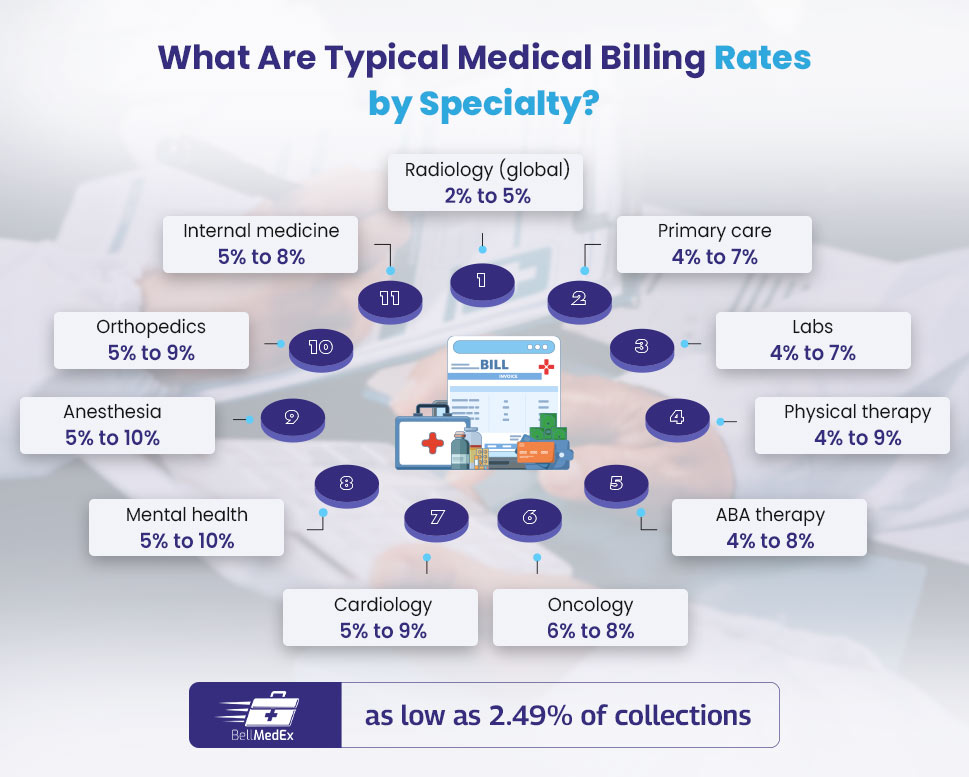
Specialty makes a real difference. Fields with simple, well-paid claims often earn gentler price tags. Meanwhile, fields that need extra steps, such as an insurer’s sign off before treatment, usually pay more. Rates for common specialties are listed next, along with why each one lands where it does.
| Specialty | Usual share of collections | Why the price lands there |
|---|---|---|
| Radiology (global billing) | 2% to 5% | Huge volume, and each claim pays well |
| Primary care and family medicine | 4% to 7% | Lots of visits with simple, common codes |
| Labs and pathology | 4% to 7% | High volume with mostly routine claims |
| Physical therapy | 4% to 9% | Visit limits and therapy-specific codes |
| ABA therapy | 4% to 8%, up to 12% for complex cases | Treatment needs approval again and again |
| Internal medicine and pediatrics | 5% to 8% | More visit types and more follow-up |
| Orthopedics and surgery | 5% to 9% | Big payments, but strict rules for care after surgery |
| Cardiology | 5% to 9% | Many tests need insurer approval first |
| Mental and behavioral health | 5% to 10%, most pay 6% to 8% | Small payment per session, plus frequent approvals |
| Anesthesia | 5% to 10% | Time-based claims need careful math |
| Radiology (reading only) | 5.5% to 10% | Lower payment for each reading |
| Oncology | 6% to 8% | Costly drugs and tight approval rules |
| Chiropractic, urgent care, dermatology, OB/GYN, telehealth | About 5% to 9% (estimate) | Each has its own coverage limits and coding rules |
| Ambulance, EMS, and medical equipment (DME) | About 6% to 10% (estimate) | Every claim needs solid proof of medical need |
A higher percentage doesn’t automatically mean a bigger bill, though. A therapist bringing in $15,000 a month at 7% pays $1,050. Meanwhile, a surgeon earning $150,000 at 5% pays $7,500. So the therapist has the steeper rate, yet the surgeon writes the far larger check.
What Do New and Solo Practices Usually Pay?
Brand-new clinics face a unique challenge. With no income history yet, vendors can’t predict their monthly volume. For that reason, many ask newcomers for a flat fee or a small floor during the first few months. Once a few months of claim history settle into a pattern, switching to a percentage usually becomes an option.
Solo doctors and therapists, on the other hand, often wonder whether outsourcing is even worth it at their size. In most cases, it is. For less than the cost of one hire, a solo clinician gets a full billing department on loan, and claims keep rolling through vacations and sick days. Typical rates for one-person offices run from about 7% to 12% of collections.
How Much Do Credentialing, Coding, and Other Add-Ons Cost?
Sending claims is only part of the job. Most clinics also need help with insurer enrollment, coding, approvals, and more. Vendors usually sell these extras one by one or as a bundle, and bundles almost always come out cheaper.
What Do These Extra Services Actually Do?
- Credentialing gets a clinician approved by an insurer, so that insurer will pay for their visits.
- Medical coding turns a doctor’s notes into the standard codes insurers use.
- Prior authorization means getting insurer approval before a test or treatment.
- An eligibility check confirms a patient’s coverage is active before the visit.
- A/R recovery chases old claims that have stayed unpaid for months.
What Do Add-On Services Cost in 2026?
Here are typical 2026 prices for the most requested extras, plus a quick note on each.
| Service | Common price | Good to know |
|---|---|---|
| Credentialing | $100 to $300 for each insurer, for each clinician | Complete packages often run $1,500 to $3,500 per doctor |
| Credentialing upkeep | $600 to $2,400 yearly per clinician | Covers renewals with every insurer |
| Coding for office visits | $1 to $4 a chart | Surgical and specialty charts cost $4 to $8 or more |
| Prior authorization | $4 to $15 a request | Stops many denials before they start |
| Eligibility check | $0.15 to $0.35 online, $6 to $15 by phone | Often bundled into full service |
| Old A/R recovery | 15% to 30% of whatever is recovered | Nothing is owed unless money comes in |
| Patient statements | $0.50 to $2.50 a paper statement | Postage may be extra |
| Clearinghouse | $0.11 to $0.35 a claim, or $60 to $120 monthly | Frequently included in the main fee |
| Setup | $300 to $1,500 per clinician | Many firms now waive it |
| Practice software, when sold separately | Roughly $170 to $800 per doctor monthly | Usually included with percentage plans |
| Offshore virtual assistant | $7.50 to $14 an hour | About $1,300 to $2,400 for full-time monthly help |
What Happens to the Price When Credentialing Is Added?
Take a new two-doctor clinic that wants to join five insurers. At roughly $200 per insurer for each doctor, the one-time cost is 2 x 5 x $200, or $2,000. After approval comes through, the clinic simply pays its regular billing rate, such as 6% of collections.
How Much Does Coding Add on Top of Billing?
Now consider a busy family clinic with 800 visits a month. At $3 a chart, coding adds $2,400 to the monthly invoice. Some vendors fold coding into their percentage instead, so it’s smart to request both prices and compare.
Is Prior Authorization Help Worth Paying For?
A cardiology group that needs 150 approvals a month at $8 each would spend $1,200 on this service. In return, far fewer claims bounce back for missing approval, which usually saves more than it costs.
What Does a Full Revenue Cycle Package Include?
A full RCM package handles everything, from checking coverage before the visit to collecting the very last payment. It typically costs 5% to 10% of collections, and software, the clearinghouse, and denial work often come included.
What Does Medical Billing With MIPS Reporting Cost?
When MIPS gets bundled in, clinics usually pay their normal billing rate, about 4% to 8% of collections, plus a separate MIPS fee. Basic MIPS reporting adds roughly $300 to $600 a year for each clinician. Full MIPS management, on the other hand, runs about $1,500 to $5,000 annually per doctor. Better still, some billing firms include MIPS at no extra charge for their clients.
What Is MIPS, in Plain English?
MIPS stands for Merit-based Incentive Payment System. It’s a Medicare program that gives each clinician a yearly score, mostly based on the quality of care. Medicare then nudges that clinician’s future payments up or down depending on the score.
Scores from 2026 affect Medicare payments in 2028. A very low score can trigger a cut of up to 9%. A high score can earn a bonus, although that bonus is usually much smaller than 9%, because Medicare spreads a limited pool of bonus money across everyone.
Who Has to Report MIPS in 2026?
A clinician must take part when all three of these are true:
- They bill more than $90,000 to Medicare Part B.
- They see more than 200 Medicare Part B patients.
- They provide more than 200 covered services to Medicare Part B patients.
Each doctor’s status can be checked on the CMS eligibility page. In most cases, 2026 data is due by March 31, 2027.
Which Billing and MIPS Bundles Are Available?
Billing firms package MIPS in a few different ways. Each option in the following table adds a different amount to the bill.
| Bundle option | What’s included | Extra MIPS cost on top of billing |
|---|---|---|
| MIPS included | The billing firm handles MIPS as part of its service | $0 extra |
| Billing plus registry reporting | Data goes to CMS through an approved registry | $250 to $600 yearly per clinician |
| Billing plus MIPS software | Software tracks the score all year | About $1,200 to $1,800 a year |
| Billing plus full MIPS management | Experts pick measures, watch the score, fix gaps, and submit | $1,500 to $5,000 yearly per clinician |
For reference, standalone registries publish prices like $389 to $499 per clinician for individual reporting. Specialty groups run registries too. The American College of Radiology, for example, charges members $299 per physician each year and non-members $1,399.
What Does the Full Bundle Add Up To?
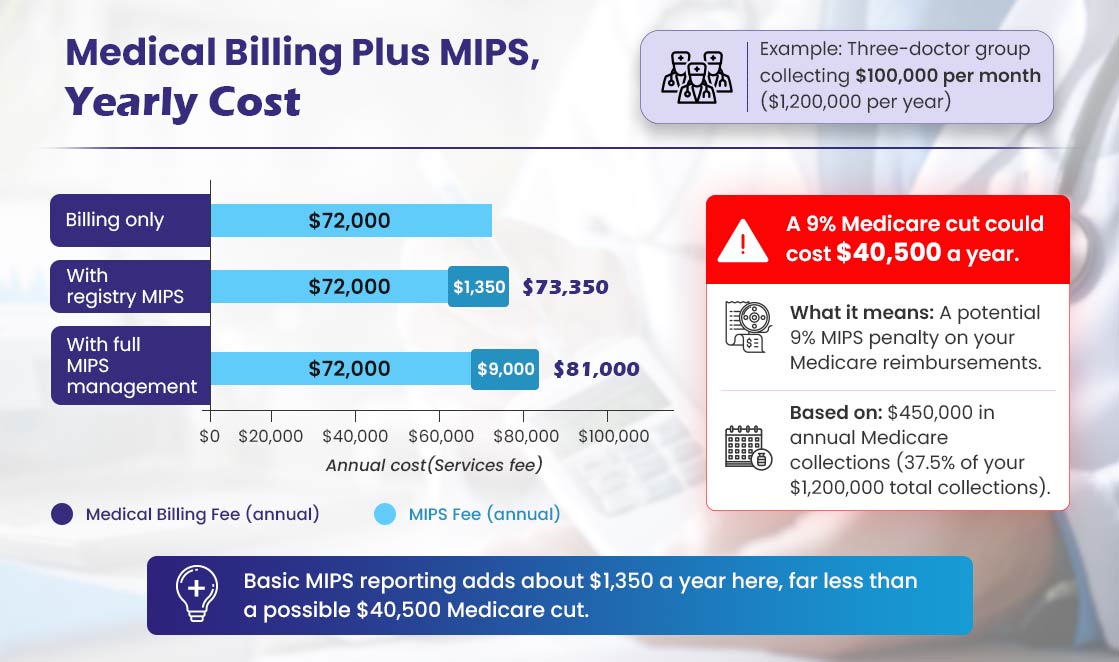
Here’s a realistic scenario. A three-doctor group collects $100,000 a month and pays a 6% billing rate, so billing alone costs $72,000 a year. The breakdown that follows shows how the total grows once MIPS joins the package.
| Package | Yearly billing fee | Yearly MIPS fee | Yearly total | Monthly total |
|---|---|---|---|---|
| Billing only | $72,000 | $0 | $72,000 | $6,000 |
| Billing plus registry MIPS ($450 per doctor) | $72,000 | $1,350 | $73,350 | About $6,113 |
| Billing plus full MIPS management ($3,000 per doctor) | $72,000 | $9,000 | $81,000 | $6,750 |
Is Adding MIPS Worth the Extra Money?
For groups with lots of Medicare patients, it almost always is. Suppose the three doctors above receive $450,000 a year from Medicare Part B. A 9% cut would then wipe out $40,500 in a single year. Compared with that, $1,350 for basic reporting looks like a bargain.
Which MIPS Questions Belong in Every Billing Contract?
A few questions clear things up quickly. Is MIPS included in the rate, or priced on its own? Which MIPS categories will the vendor report? Will the team help raise the score during the year? And who covers the loss if a reporting mistake lowers the score?
Is Hiring an In-House Biller Cheaper Than Outsourcing?
It’s tempting to see a salaried biller as the bargain seat. After all, a salary feels simpler than a percentage. However, once benefits, software, and turnover enter the picture, an employee often comes out pricier on a per claim scale.
What Does One Staff Biller Really Cost Each Year?
Here’s what one full-time biller typically adds up to over a year, line by line.
| Expense | Yearly amount |
|---|---|
| Salary (US median, May 2025) | $51,140 |
| Benefits and payroll taxes (about 30% of total pay in healthcare) | About $22,340 |
| Software and clearinghouse | $2,500 to $12,000 |
| Replacing someone who quits | $9,000 to $12,000 each time |
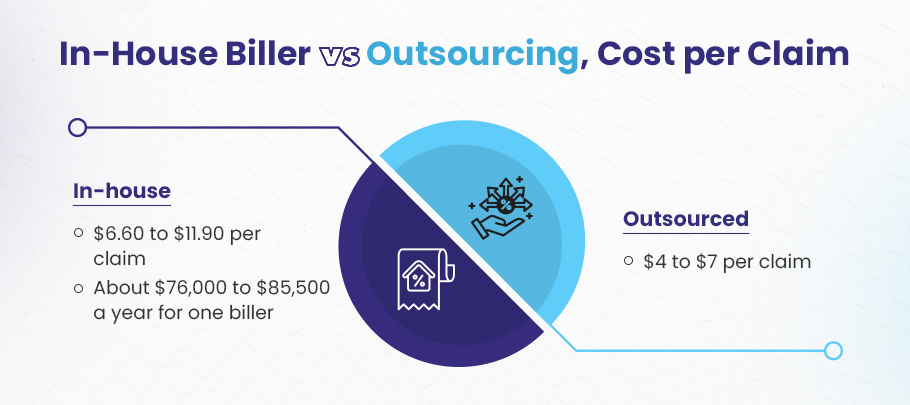
| Total for one employee, before turnover | About $76,000 to $85,500 |
The salary figure comes from the U.S. Bureau of Labor Statistics. The benefits line follows the BLS finding that benefits make up roughly 30.4% of total pay in healthcare, while the remaining rows reflect common market estimates.
How Many Claims Can One Person Handle?
There’s no official national standard. Still, industry studies suggest that one biller works through about 6,700 claims a year on average. When most claims go out clean, a skilled employee can manage closer to 10,000.
So What Does Each Claim Cost When Billing Stays In-House?
This next table divides the yearly expense of one employee, roughly $79,500, by the number of claims handled.
| Claims handled yearly | Staff cost for each claim |
|---|---|
| 6,700 | About $11.90 |
| 10,000 | About $7.95 |
| 12,000 | About $6.60 |
Outsourced help, by comparison, usually lands between $4 and $7 a claim. For most small and mid-size clinics, then, outsourcing wins on price.
When Does Keeping Billing In-House Make Sense?
An internal team starts to pay off only at a large scale. For instance, a 2.99% outsourced fee matches the cost of one employee only when a group collects about $2.46 million a year, or roughly $205,000 monthly. Below that point, an outside partner nearly always costs less. For a quick overview, the grid below compares both options point by point.
| Point to compare | Staff biller | Outsourced team |
|---|---|---|
| Holidays and sick days | Work pauses | Work keeps going |
| Know-how | One person’s experience | A full group of specialists |
| Software | Bought and updated by the clinic | Usually included |
| Growth | More hiring needed | Extra staff added as needed |
| Monthly expense | Fixed salary | Moves with income |
| Oversight | Daily hands-on control | Regular reports and dashboards |
How Much Does Medical Billing Cost in Each State?
Here’s the part that turns a popular assumption upside down. Outsourced rates barely change from state to state, because most vendors work online and serve the whole country. Across the US, they usually sit between 4% and 10% of collections.
What does change, and quite a lot, is the cost of hiring a local employee. That’s why location matters most when weighing outside help against an internal hire.
What Does a Staff Biller Earn and Cost in Every State?
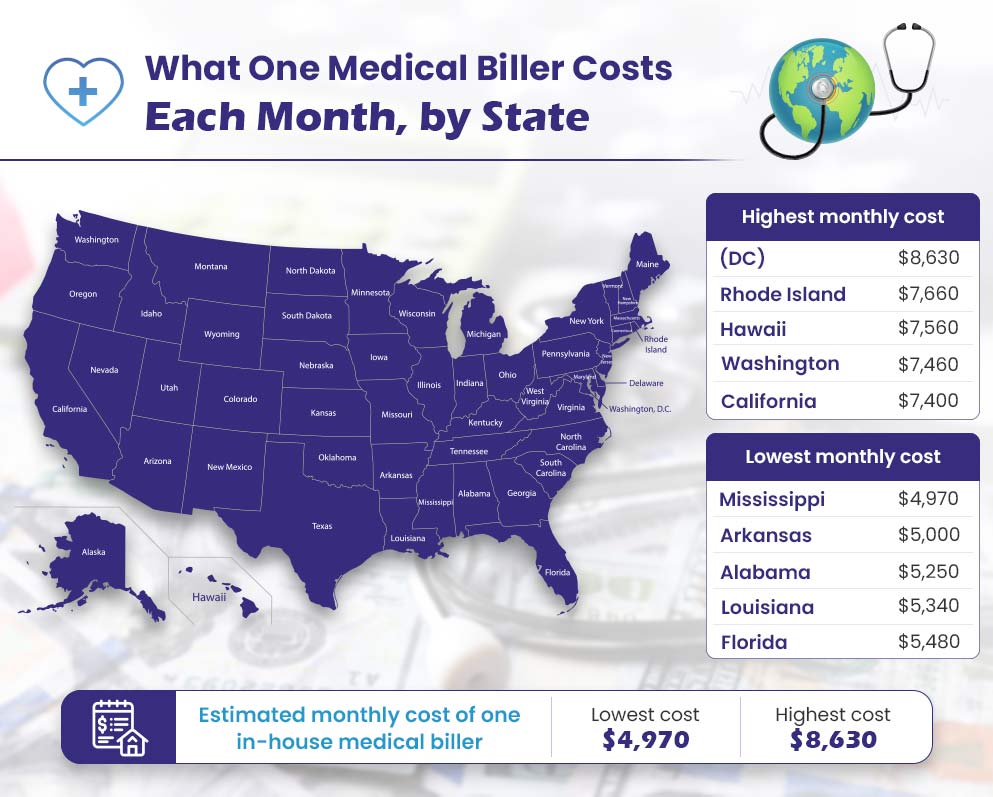
The table below lists May 2025 median pay for medical records specialists, a job group that includes billers and coders. It also estimates the full expense of one employee once benefits and payroll taxes are added, since those make up about 30.4% of total pay in healthcare.
| State | Median hourly pay | Median yearly pay | Estimated yearly cost with benefits | Estimated monthly cost |
|---|---|---|---|---|
| Alabama | $21.06 | $43,810 | $62,950 | $5,250 |
| Alaska | $29.37 | $61,090 | $87,770 | $7,310 |
| Arizona | $22.90 | $47,630 | $68,430 | $5,700 |
| Arkansas | $20.07 | $41,740 | $59,970 | $5,000 |
| California | $29.71 | $61,810 | $88,810 | $7,400 |
| Colorado | $28.37 | $59,020 | $84,800 | $7,070 |
| Connecticut | $29.30 | $60,940 | $87,560 | $7,300 |
| Delaware | $26.95 | $56,060 | $80,550 | $6,710 |
| District of Columbia | $34.63 | $72,040 | $103,510 | $8,630 |
| Florida | $22.00 | $45,760 | $65,750 | $5,480 |
| Georgia | $24.78 | $51,550 | $74,070 | $6,170 |
| Hawaii | $30.37 | $63,180 | $90,780 | $7,560 |
| Idaho | $25.70 | $53,460 | $76,810 | $6,400 |
| Illinois | $27.14 | $56,440 | $81,090 | $6,760 |
| Indiana | $22.92 | $47,670 | $68,490 | $5,710 |
| Iowa | $24.35 | $50,640 | $72,760 | $6,060 |
| Kansas | $23.15 | $48,160 | $69,200 | $5,770 |
| Kentucky | $23.28 | $48,410 | $69,550 | $5,800 |
| Louisiana | $21.45 | $44,610 | $64,090 | $5,340 |
| Maine | $25.04 | $52,090 | $74,840 | $6,240 |
| Maryland | $26.07 | $54,220 | $77,900 | $6,490 |
| Massachusetts | $29.02 | $60,350 | $86,710 | $7,230 |
| Michigan | $23.13 | $48,120 | $69,140 | $5,760 |
| Minnesota | $29.58 | $61,530 | $88,410 | $7,370 |
| Mississippi | $19.95 | $41,500 | $59,630 | $4,970 |
| Missouri | $24.40 | $50,750 | $72,920 | $6,080 |
| Montana | $24.13 | $50,190 | $72,110 | $6,010 |
| Nebraska | $24.84 | $51,670 | $74,240 | $6,190 |
| Nevada | $24.19 | $50,300 | $72,270 | $6,020 |
| New Hampshire | $23.66 | $49,210 | $70,700 | $5,890 |
| New Jersey | $24.16 | $50,240 | $72,180 | $6,020 |
| New Mexico | $27.63 | $57,470 | $82,570 | $6,880 |
| New York | $29.67 | $61,720 | $88,680 | $7,390 |
| North Carolina | $23.86 | $49,620 | $71,290 | $5,940 |
| North Dakota | $22.25 | $46,280 | $66,490 | $5,540 |
| Ohio | $24.52 | $50,990 | $73,260 | $6,100 |
| Oklahoma | $25.70 | $53,460 | $76,810 | $6,400 |
| Oregon | $28.37 | $59,000 | $84,770 | $7,060 |
| Pennsylvania | $22.52 | $46,840 | $67,300 | $5,610 |
| Rhode Island | $30.75 | $63,960 | $91,900 | $7,660 |
| South Carolina | $26.10 | $54,280 | $77,990 | $6,500 |
| South Dakota | $24.81 | $51,610 | $74,150 | $6,180 |
| Tennessee | $23.45 | $48,780 | $70,090 | $5,840 |
| Texas | $23.49 | $48,860 | $70,200 | $5,850 |
| Utah | $25.42 | $52,870 | $75,960 | $6,330 |
| Vermont | $27.67 | $57,560 | $82,700 | $6,890 |
| Virginia | $25.62 | $53,290 | $76,570 | $6,380 |
| Washington | $29.94 | $62,270 | $89,470 | $7,460 |
| West Virginia | $22.77 | $47,360 | $68,050 | $5,670 |
| Wisconsin | $28.98 | $60,280 | $86,610 | $7,220 |
| Wyoming | $26.06 | $54,210 | $77,890 | $6,490 |
Pay figures come from the BLS Occupational Employment and Wage Statistics for May 2025. The yearly and monthly expense columns are estimates that add benefits and payroll taxes, and they leave out software and hiring costs.
How Can This State Table Help With the Decision?
The table shows the point where outsourcing starts saving money. Take California, where one biller costs about $7,400 a month. That’s the same as a 6% fee on roughly $123,000 in monthly collections. So a California clinic bringing in less than that will usually come out ahead by outsourcing.
Mississippi tells a different story. There, one employee costs about $4,970 monthly, which equals a 6% fee on around $83,000. In short, the savings show up sooner in high-wage states and a little later in lower-wage ones.
Which State Rules Can Make Billing Harder?
Vendors rarely redraw their price list at the state line. Even so, certain state level rules lengthen the filing journey, and that extra effort can raise the price of specific claims. The most common ones are listed here.
| State rule | Where it applies | Why it matters |
|---|---|---|
| No-fault or PIP car accident coverage | Commonly listed as Florida, Hawaii, Kansas, Kentucky, Massachusetts, Michigan, Minnesota, New Jersey, New York, North Dakota, Pennsylvania, and Utah | Accident claims need special forms and deadlines |
| Workers’ compensation fee schedules | Every state, with major programs in New York, California, and Texas | Each state sets its own work injury prices |
| Medicaid managed care | Most states, including Medi-Cal in California, MassHealth in Massachusetts, and Texas Medicaid | Each plan follows its own approval and claim rules |
| Surprise billing laws | Nationwide under the federal No Surprises Act, plus extra state laws | Out-of-network offices must follow strict billing limits |
In states like these, local experience turns into real dollars. A team that already carries the state rules in its head slips up far less often and brings payments through the door sooner.
Are Offshore Billing Teams Cheaper Than US-Based Ones?
Usually, yes, at least on the hourly rate. Some vendors staff their teams in the US, while others rely on staff in India, the Philippines, or Latin America. Many now blend the two, with US managers guiding offshore specialists. Both options come with their own winning cards, so the right call hinges on what the clinic needs most. Here’s how the two compare.
| Point to compare | US-based team | Offshore team |
|---|---|---|
| Hourly price | $20 to $45 | $8 to $22 |
| Percentage rates | Usually 4% to 10% | Often lower, sometimes under 4% |
| Working hours | Same time zone | Often night shifts to match US hours |
| Phone calls with insurers and patients | Native US English and local know-how | Strongest on back-office tasks |
| Privacy rules | Must follow HIPAA | Must also follow HIPAA through a signed agreement |
| Ideal tasks | Complex claims, patient calls, appeals | High-volume data entry, payment posting, follow-up |
Wherever the team sits, one document is a must. A business associate agreement, or BAA, makes the vendor legally responsible for guarding every patient record to HIPAA’s standards.
How Much Do Denied Claims Really Cost?
Denials hurt twice. First, someone has to spend time fixing and resending each one. Second, some denied claims never get paid at all. That’s exactly why a strong billing partner can save more than its fee.
A few industry numbers paint the picture:
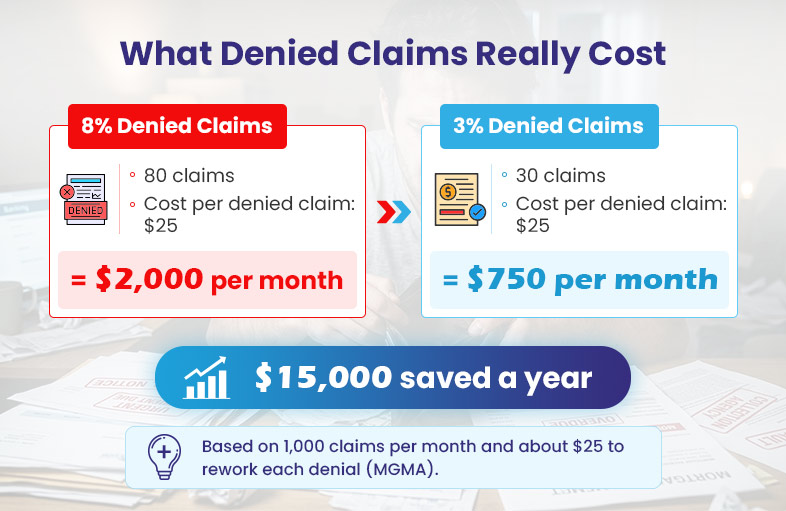
- Reworking one denied claim costs about $25 on average, based on data reported by MGMA.
- Roughly 8% of claims get denied on the first try, according to MGMA.
- In a 2025 Experian Health survey, 41% of providers reported denial rates of 10% or more.
- Most denials are preventable with better checks before a claim goes out.
What Could Lower Denials Save in a Year?
Picture an internal medicine office that sends 1,000 claims every month with an 8% denial rate. That’s 80 denials, and at $25 apiece, fixing them costs $2,000 monthly. Now suppose a sharper team brings the rate down to 3%. Only 30 claims need rework, costing $750. The office saves $1,250 a month, or $15,000 a year, before even counting the stranded revenue that finally makes it to the bank.
What Does a Full Billing Quote Look Like Line by Line?
A headline rate rarely tells the whole story. Real quotes contain several lines, and each one adds a little to the invoice. Below is a sample for a three-doctor family clinic that collects $90,000 and sends 1,000 claims every month.
| Quote line | How it’s priced | Monthly amount |
|---|---|---|
| Core billing fee | 5.5% of net collections | $4,950 |
| Practice software | Included | $0 |
| Clearinghouse | Included | $0 |
| Eligibility checks | Included | $0 |
| Patient statements | 200 statements at $1 each | $200 |
| Prior authorizations | 40 requests at $8 each | $320 |
| Credentialing upkeep | $1,200 yearly for each doctor | $300 |
| MIPS registry reporting | $450 yearly for each doctor | About $113 |
| Setup | Waived | $0 |
| Total each month | About $5,883 |
Notice what happened there. The core fee is only 5.5%, yet the full invoice equals about 6.5% of collections once every line gets added. That’s why the complete quote matters far more than the headline number.
Which Hidden Fees Should Clinic Owners Watch For?
Some contracts tuck extra charges into the contract’s back pages. A vendor worth trusting puts every fee in plain view, so a slow, line by line read before signing always pays for itself. The fees listed next show up most often, so they’re worth spotting early.
| Fee | What it covers | Usual amount |
|---|---|---|
| Setup | Connecting systems and training staff | $300 to $1,500 per clinician, often waived |
| Minimum charge | The lowest invoice, even in slow months | $300 to $600 per doctor |
| Early exit | Leaving before the contract ends | One to three months of fees |
| Clearinghouse | Checking and sending each claim | $0.11 to $0.35 a claim |
| Patient statements | Each paper bill mailed to a patient | $0.50 to $2.50 apiece |
| Resubmission | Sending a corrected claim again | Varies by vendor |
| Data return | Handing back records after leaving | Varies by vendor |
Which Contract Terms Are Red Flags?
Certain terms can quietly siphon money month after month. It’s worth pausing for a second read whenever a contract includes any of these:
- The fee is based on total charges billed rather than money actually collected.
- The minimum charge is high compared with the clinic’s income.
- A corrected claim counts as a brand-new one.
- Copays collected by the front desk still count toward the fee.
- A large fee applies to finishing old claims after the contract ends.
- Data ownership isn’t clearly given to the clinic.
- Insurer enrollments are set up in a way the clinic can’t keep after leaving.
- The agreement renews automatically without a clear reminder.
- Every worked denial carries an extra charge.
- The vendor takes a cut of money that was owed before the contract began.
What Questions Should Be Asked Before Signing?
Asking every vendor the same set of questions makes side-by-side comparison much easier. Here are ten that cover the essentials:
- Does the rate apply to net collections or gross charges?
- Do copays and other patient payments count toward the fee?
- Which services come with the base price?
- Is there a charge for resending corrected claims?
- Is there a setup fee or a monthly floor?
- How long does the contract last, and what does leaving early cost?
- Who owns the data, and how quickly can it be returned?
- How many clients in the same specialty does the team already serve?
- What are the average clean claim, denial, and collection rates?
- Is MIPS reporting included, and if not, what does it cost?
A reliable partner answers all ten clearly and puts the answers in writing. That kind of openness is one of the best signs of a healthy long-term relationship.
Can a Billing Firm Take a Percentage of Medicare Payments?
Yes, as long as the money flows the right way. A Medicare rule known as 42 CFR 424.73 controls how billing vendors get paid on Medicare claims.
In everyday terms, Medicare has to deposit its payments straight into the clinic’s own bank account. The vendor can’t receive that money in its own name and then skim a share. As long as the funds reach the clinic first, a percentage fee is perfectly fine. So it’s worth confirming that every Medicare payment travels straight into the clinic’s own account.
What Does It Cost to Switch Billing Companies?
Changing vendors is more common than many people think, and most moves wrap up within a few weeks to two months. Even so, a handful of costs come with the switch, and planning for them early keeps the money stream from stuttering. Each one is broken down in the table that follows.
| Switching cost | What it means | Usual amount |
|---|---|---|
| Notice period | Time the old contract requires before leaving | 60 to 90 days |
| Early exit fee | A charge for ending the contract ahead of schedule | One to three months of fees |
| Runout work | The old vendor finishes claims sent before the switch | Varies, so it’s worth asking upfront |
| Old A/R cleanup | The new team chases old unpaid claims | 15% to 30% of what gets recovered |
| Data transfer | Moving patient and claim records to the new system | Often free, occasionally a fee |
A capable new partner manages the whole handover. That way, current claims keep marching forward and deposits keep arriving on their usual schedule throughout the change.
What Do Special Types of Medical Practices Pay for Billing?
Some organizations have unusual billing needs, and those needs shape the price. The table below shows estimated rates for several common situations.
| Type of organization | Estimated share of collections | What drives the price |
|---|---|---|
| Hospitals and large health systems | About 2.5% to 5% | Huge volume spreads the vendor’s costs thin |
| Telehealth-only clinics | About 4% to 7% | Simple claims, though online-visit rules change often |
| FQHCs and rural health clinics | About 5% to 8% | Special Medicare and Medicaid payment rules plus yearly cost reports |
| Medicaid-heavy offices | About 6% to 9% | Low payments for each claim, so percentages beat claim fees |
| Out-of-network clinics | About 6% to 10% | Heavy patient billing and strict surprise billing rules |
| Car accident and work injury clinics | About $5 for each paid claim, or 6% to 10% | Special forms, PIP and no-fault rules, and state fee schedules |
A couple of patterns stand out here. Federally qualified health centers and rural clinics do best with a vendor that already understands their payment system, even if the rate is slightly higher. Medicaid-focused offices, meanwhile, usually save money with a percentage, because flat claim fees eat up a large share of small payments.
Out-of-network clinics face a different challenge, since patients often owe a bigger part of the bill. For them, a plan that includes strong patient billing support tends to work best. Accident and injury clinics, finally, should look for a team with PIP and workers’ compensation experience, because those claims follow their own state-by-state rules.
Frequently Asked Questions About Medical Billing Costs
How much do medical billing companies charge?
Most charge between 4% and 10% of collections, and the typical clinic pays somewhere from 5% to 7%. Other common setups include $3 to $12 for each claim or a flat $500 to $2,500 or more monthly.
What is a reasonable percentage for medical billing?
For small and mid-size offices, 5% to 7% is generally fair for full service. Large groups can often negotiate 3% to 5%. Anything above 10% usually applies only to very small or unusually complex clinics.
How much does it cost to bill a single claim?
Full-service vendors usually ask $3 to $12, and smaller offices tend to pay $4 to $7. Patient statements alone cost far less, about $1 to $3.
Is outsourcing cheaper than hiring a biller?
For most clinics, yes. One employee costs roughly $76,000 or more a year once benefits and software are included. That works out to about $7 to $12 for every claim, while outside help usually costs $4 to $7.
How much does a medical biller earn per hour?
According to the U.S. Bureau of Labor Statistics, the median wage for medical records specialists was $24.59 an hour in May 2025. Pay ranges from around $20 in Mississippi to nearly $35 in Washington, DC.
Do vendors charge on billed amounts or on collections?
Most charge on net collections, meaning the money that actually arrives. A few contracts, however, use gross charges, which costs far more. Checking this detail in writing avoids an expensive surprise.
Is a percentage plan better than a flat fee?
For most offices, a percentage works better, since the fee moves up and down with income. A flat fee makes more sense for groups with steady patient numbers and high-paying claims.
Why do some services charge less than 4%?
Better software, automation, and bigger teams have lowered costs across the industry. Even so, some bargain plans leave out key services or add a minimum, so a quick look at what’s included always helps.
How much does credentialing a new doctor cost?
It usually runs $100 to $300 for each insurer. A complete package for one clinician often falls between $1,500 and $3,500.
How many claims can one biller handle?
On average, about 6,700 a year. With mostly clean claims, an experienced biller can reach around 10,000.
How much does billing with MIPS reporting cost?
It’s usually the regular billing rate plus about $300 to $600 a year per clinician for basic reporting. Full MIPS management costs roughly $1,500 to $5,000 for each doctor annually, and some vendors include it for free.
How long does switching billing vendors take?
Most transitions finish within a few weeks to two months. A well-organized partner keeps existing claims moving the entire time.
Are billing fees tax deductible?
Clinics usually treat these fees as an ordinary business expense. That said, an accountant should confirm how it applies to each situation.
Final Thoughts on Choosing the Right Billing Partner
There’s no single price tag for outsourced billing. Instead, every clinic pays based on its size, specialty, location, and the services it needs. Across 2026, most offices are paying 4% to 10% of collections, $3 to $12 a claim, or a steady flat fee each month.
The smartest approach comes down to three simple steps. First, every quote gets turned into one effective rate. Next, the comparison focuses on how much revenue each option leaves in the bank, not just the rate on paper. Finally, the winning partner is the one that shares clear, honest results every single month.
With those steps in hand, any clinic can pick a billing partner with confidence and give patient care the lion’s share of every workday.