

If you’re reading this, chances are that you’re having a hard day with multiple speech therapy patients’ notes due. You’re slowing down to get the wording right, but that is only making you fall behind on the next four notes.
Writing several speech therapy SOAP notes back to back is challenging, especially when each one has to hold up whenever an insurance reviewer, a supervisor, or another therapist opens the file.
A weak note can put a session of reimbursement at risk, but a strong SOAP note protects the client, your clinical judgment, and the time you already spent in that speech-language rehabilitation session.
This read comes down to writing a SOAP note that is fast and accurate at the same time, so the client’s communication progress stays visible over time, to you and to anyone else who reads the chart.
What is a SOAP Note for Speech Therapy?
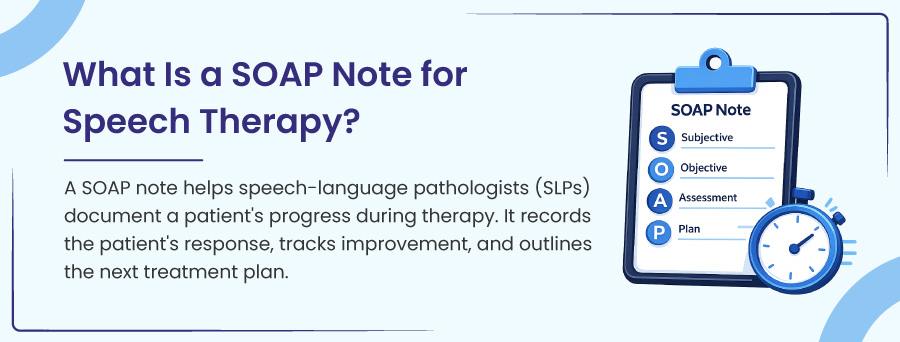
SOAP is a style of notetaking that works much like the checklist a nurse fills out at every dressing change to see whether a wound is closing, staying the same, or getting worse.
A speech-language pathologist (referred to as “SLP”) uses the same structure to track a patient’s communication and swallowing progress over time.
It involves recording the important details of how the patient participated in the session, whether the target was articulation, expressive language, fluency, voice, cognitive communication, or swallowing.
A SOAP note for speech therapy typically records things like:
- The speech, language, voice, fluency, or swallowing goals targeted during the session.
- How the patient responded to each therapy activity.
- The patient’s level of accuracy or improvement (for example, correctly producing target sounds or following directions).
- The therapist’s professional judgment about the patient’s progress.
- The plan for the next session, including new exercises, goals, or adjustments to the treatment approach.
What Do the Four Parts of a Speech Therapy SOAP Note Explain?
A session can go perfectly and still get lost the moment it hits the paper. That is not because the therapy was weak, but because the note wasn’t built to hold it.
Writing a SOAP note for speech therapy isn’t as complicated as it seems, but it does take the right structure and a little practice to get it done right.
These four parts explained below are what separate a note that holds up from one that doesn’t:
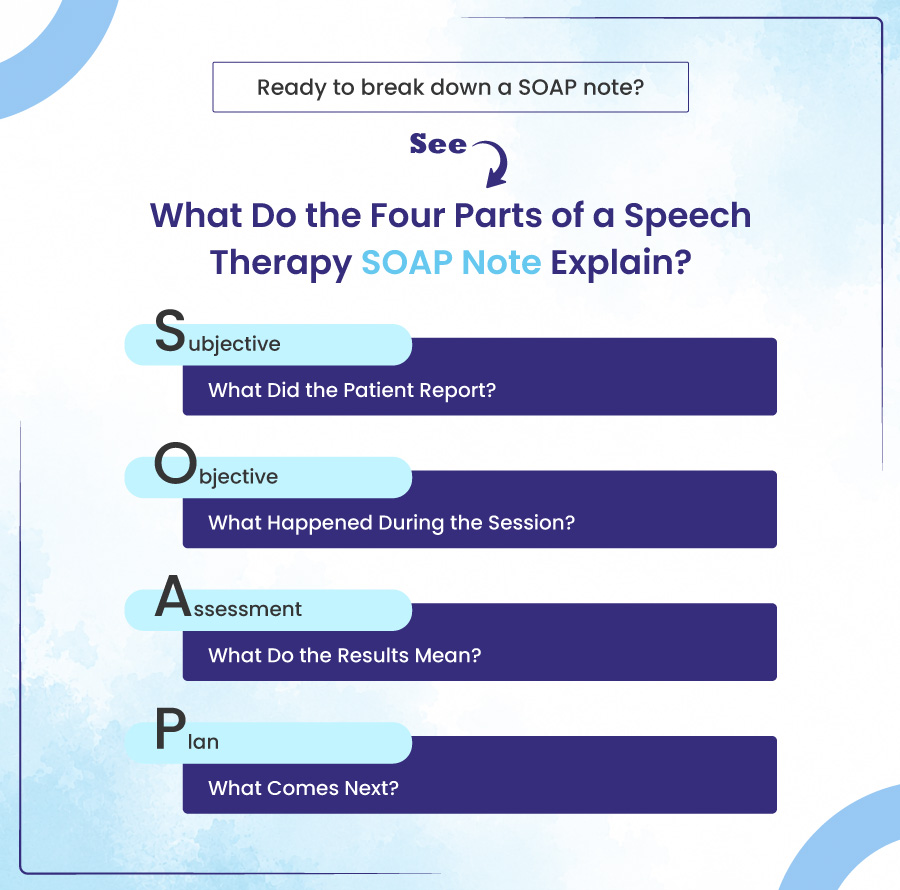
S – Subjective (What Did the Patient Report?)
The Subjective captures the information shared by the patient, parent, or caregiver that helps explain the patient’s condition before or during the session.
This part documents reports such as the patient practicing speech sounds at home, mentioning that swallowing felt easier this week, or a caregiver noting that the patient had difficulty communicating at school.
In the Subjective part, it’s important to record only the information that was reported or directly observed and is relevant to the therapy session.
Try to avoid including personal opinions or assumptions at any stage of the note.
O – Objective (What Happened During the Session?)
The Objective records what happened during the therapy session using measurable facts. You document the goals targeted, the activities completed, the level of cueing or support provided, and the patient’s performance in numbers or clear descriptions.
Instead of writing “The patient did well with articulation,” write “The patient produced /r/ in the initial position of words with 80% accuracy (16 of 20 trials) given minimal verbal cues.”
This is also where you record whether the patient followed two-step directions with 70% accuracy, answered WH questions correctly in 8 out of 10 opportunities, or completed swallowing exercises with moderate verbal prompting.
It’s also important that you keep this section factual. It should describe what you measured, not what you think the results mean.
What those numbers actually mean belongs in the next section.
A – Assessment (What Do the Results Mean?)
The Assessment explains what the Objective data tells you about the patient’s progress.
If the patient improved accuracy from the last session, you might explain that they are making steady progress and are becoming less dependent on verbal cues.
If performance declined, you could note that fatigue, reduced attention, or increased task difficulty may have affected the results.
This section should answer questions such as:
- Is the patient progressing toward their therapy goals?
- Which skills are improving?
- Which areas still need more work?
- Were there any factors that influenced today’s performance?
P – Plan (What Comes Next?)
Now comes the Plan, which explains what you will do in the next sessions based on today’s results. It should clearly describe the immediate next steps instead of repeating the patient’s long-term goals.
- If the patient has mastered the /s/ sound at the word level, you might plan to begin practicing it in sentences during the next session.
- If the patient struggled with three-step directions, you may continue targeting two-step directions while gradually increasing the level of difficulty.
You can also note plans such as introducing new speech exercises, fading cues, assigning home practice activities, coaching the caregiver, or updating the treatment approach if needed.
The goal of the Plan is to show how today’s performance will shape the next stage of the intervention, so the patient keeps progressing toward their communication goals.
How to Write a SOAP Note for Speech Therapy?
After knowing the four parts of the SOAP note for speech therapy, now comes the hard part of writing all four of them correctly and quickly. This is the stage where documentation usually breaks down. Here is how to put it into practice:
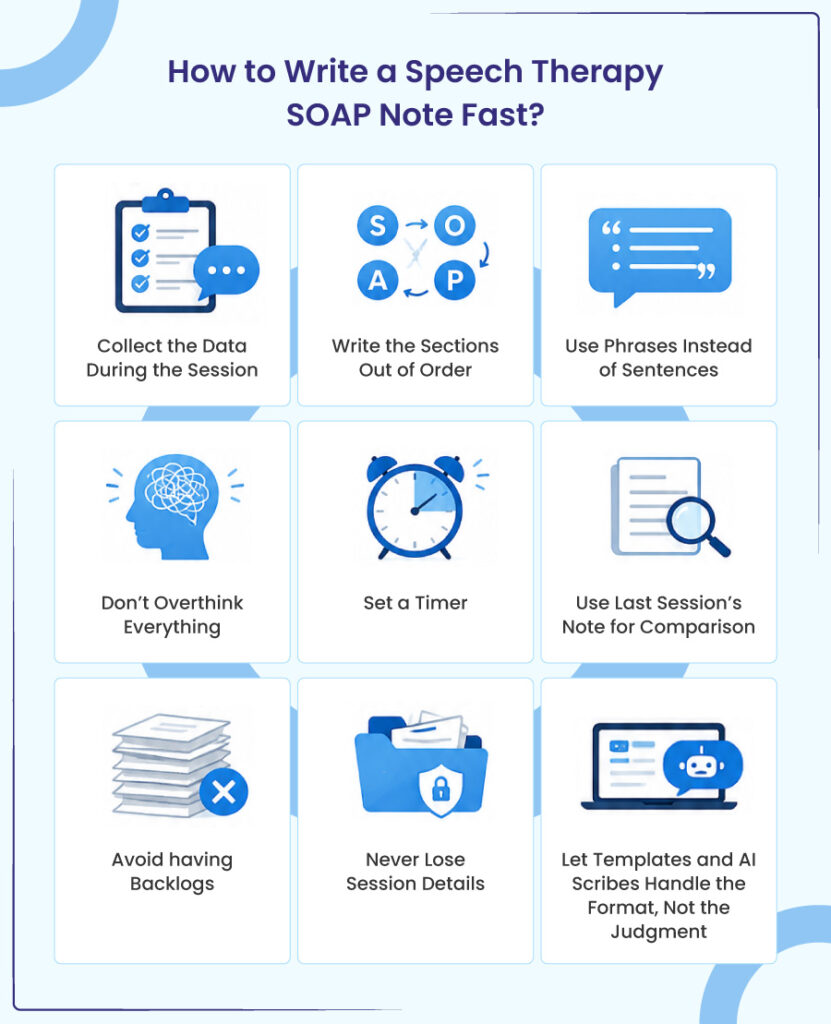
1). Collect the Data During the Session
The single biggest time-saver has nothing to do with writing. It happens before you write a word.
If you’re trying to remember accuracy scores and client comments after the session ends, you’re doing the hardest part of documentation from memory.
Keep a simple tally sheet or scoring column open during the session. Mark each correct and incorrect response as it happens.
By the time the session ends, your Objective data is already sitting on the page. Instead of writing the note from scratch, you’re formatting numbers you already collected.
2). Write the Sections Out of Order
Most clinicians default to writing the Subjective part first, because it comes first in the acronym.
Unfortunately, this habit slows everything down. It’s better to write the Objective section first, because it’s the fastest part to complete when the data has already been collected.
Getting Objective down first turns a blank page into a page with content on it, which makes Subjective and Assessment easier to write around.
3). Use Phrases Instead of Sentences
A lot of documentation time doesn’t go into deciding what happened. It goes into deciding how to phrase it.
It’s best to build a small set of phrases you reuse across similar sessions and adjust only the numbers and the specific details.
A short bank of reusable wording covers most of what a session note needs:
- Cue level: independent, minimal verbal cue, moderate verbal cue, phonemic cue, semantic cue, visual or tactile cue.
- Accuracy: 16 of 20 trials, 80% accuracy across two activities, improved from 60% in the previous session.
- Response: self-corrected after a model, required repetition of directions, fatigued after 15 minutes.
- Support: caregiver trained in home practice, AAC device used with partner-assisted scanning, chin tuck cued during liquid trials.
This will keep you from spending mental energy on sentence construction for a document that only needs to be clear.
4). Don’t Overthink Everything
A well-organized note should take five to ten minutes to write.
If a note regularly takes you twenty minutes or more, then most probably you’re spending that time making the note perfect rather than simply writing it.
Remember that a note that’s clear and finished in eight minutes is more useful than a polished note that’s still open when your next client appears.
Perfection on one note isn’t worth falling behind on the next four.
5). Set a Timer
Documentation speed only improves once you can see it.
Time three notes this week and write the numbers down. Most SLPs are surprised by how much of the delay sits in editing rather than in writing.
Once that habit holds, lower the target gradually. Beating the clock then becomes routine, whether the session was articulation, fluency, or dysphagia focused.
6). Use Last Session’s Note for Comparison
Assessment depends on comparison. It’s best to pull up your previous note and keep it open side by side with today’s observations.
Copy forward only the specific data line you need for the comparison, instead of the full note. That way you’re referencing accurate numbers without accidentally reusing old, unrelated text.
7). Avoid Having Backlogs
A half-finished note left for “later” is how backlogs start. Once you move on to the next client, the details you didn’t write down are gone, and you now owe two notes instead of one.
Never open two notes at once. If you catch yourself starting a new note while an old one is unfinished, stop and finish the old one first, even if it means keeping it shorter and more direct than you’d like.
A short, complete note is always more useful than a longer one that never gets closed out.
8). Never Lose Session Details
Sometimes a client runs late, or something urgent interrupts your schedule. On those days, don’t skip documentation, and don’t plan to rely on memory later.
Spend sixty seconds capturing the raw data: the accuracy counts, the cue level, and one short line on mood or behavior. That is usually enough to reconstruct the full note accurately later on.
Handle it this way, and writing a fast note and an accurate note will no longer be a trade-off.
9). Let Templates and AI Scribes Handle the Format, Not the Judgment
Most EHR platforms now ship with SOAP templates, and AI documentation assistants can draft a session note from your data in seconds. Both are useful for structure, phrasing, and formatting.
What neither can do is make the clinical judgment for you. You remain responsible for every word you sign, so read the draft before it enters the chart, correct anything the tool inferred rather than observed, and make sure the note reflects that specific session rather than a generic one.
How to Structure a Speech Therapy SOAP Note: Printable Template + Examples
The refined template format below is used by speech-language pathologists to keep every therapy session documented in a consistent structure. Use it as your reference by copying the structure, keeping the order, and filling in your own client’s details. You can also edit this template here and print it for your use.
Printable Template
Speech Pathology Clinic Note
| Client Full Name: | Rebecca Howard | Date of Service: | 07/07/2026 |
|---|---|---|---|
| Client Date of Birth: | 09/02/1992 | Session Start/End Time: | 4:33 PM – 6:02 PM |
| Session Location: | 342 Wisconsin Lane, Minnesota | Diagnosis Code: | ICD-10-CM __________ |
| Treating Clinician: | Laura Bennett, MS, CCC-SLP | CPT Code: | 92507 |
| Goals Addressed: |
Goal 1 – Word Retrieval Goal 2 – Sustained Attention During Conversation |
||
| Task | Trial 1 | Trial 2 | Summary Data | Notes |
|---|---|---|---|---|
| Confrontation naming, 20 mid-freq nouns | 13/20 | 17/20 (85%) w/ semantic cues | 70% indep last visit | |
| Structured convo task, 10 min | on-topic x7 min, required redirect x3 |
G2: progressing, not met.
| ✅ | Current Treatment | Cont. confrontation naming w/ semantic cueing, reassess indep acc next visit for return to baseline. Cont. structured convo task. |
| 🔶 | Intervention Level | Advance to 12 min if attn >70%. Recommend f/u w/ neuro re: recent sz activity and cognitive-communication impact. |
| Clinician Signature: | Laura Bennett, MS, CCC-SLP |
|---|---|
| Date Signed: | 07/07/2026 |
| Lic/Cert No: | 12345-SLP-789 |
Copyright © 2026 [Integrated Speech Pathology Services] or similar
'); doc.close(); frame.onload = function(){ try{ frame.contentWindow.focus(); frame.contentWindow.print(); }finally{ /* Remove the iframe after the print dialog is dealt with */ setTimeout(function(){ if(frame.parentNode){ frame.parentNode.removeChild(frame); } }, 2000); } }; }