Mental Health Billing Services in New York, NY

Managing medical billing for mental health clinics in New York, sending claims to insurance, and getting payments can be tough. Even a tiny mistake in accounting can slow down a claim sent to Medicaid, a managed care plan, or another insurance firm. The mental health center often gets paid late for the care it gives.

New York Counties Mental Health Billing (by BellMedEx) works with mental health providers and psychiatric hospitals all over the State of New York. Our company knows what impacts the reimbursement for behavioral health services. These cover the rules in Article 31, how to figure payments for the APG, who can join HARP, special rules for CFTSS in various counties of New York, and other rules for different insurance firms.

Not all private insurance companies and government plans have the same rules. That is why our Medical Billing team gets your behavioral health center’s claim ready for payment. They follow the rules and send it to the right insurance company or payer.

This way cuts down mistakes in math and documentation, cuts down the chance of claims being turned away that could have been stopped early. It also cuts down on the need to file objections and redo claim submission forms.

The aim is to make sure your mental health facility gets the reimbursement it needs for the mental health care it gives — much faster, regularly, and with fewer denials.

Revenue cycle support built around Article 31, APG, HARP, and New York payer rules.

APG rate code accuracy

APG rate codes determine how eligible services are priced and reimbursed under New York Medicaid.

Article 31 billing

Article 31 sets billing requirements for OMH-licensed mental health programs and the services they provide.

HARP & BH HCBS eligibility

HARP and BH HCBS status determines whether certain behavioral health services qualify for coverage.

CFTSS county billing

CFTSS billing depends on where the service is delivered so the claim follows the correct county rules.

Oxford behavioral health routing

Oxford behavioral health claims may require a dedicated submission path for proper payer processing.

Eligibility & authorization

Eligibility confirms active coverage while authorization confirms that the service is approved for billing.

Coding & aocumentation

Accurate codes and supporting records connect the service provided to the reimbursement being requested.

Community behavioral health billing

We operate the billing process for community-based behavioral health services provided locally in accordance with relevant New York insurance regulations.

Here's What Your Peers Are Saying

Excellent

Based on 351 reviews

Billing behavioral health claims in New York requires specialized knowledge and expertise

⚠️ State programs, payer networks, eligibility rules, and claim pathways all push in a direction that generic billing workflows do not account for.

Imagine it’s Saturday night. A mental health therapist in New York City completes her last session and turns off her computer. The center then sends a claim to the patient’s health insurance plan to collect the amount due for the visit. But if the claim is not properly prepared, the insurance company may refuse to pay for the mental health service provided. For example, the claim may be denied if the insurance information does not match the service provided, or if a key New York medical regulation is ignored.

The rules for reimbursement for mental health services in New York vary depending on the type of center and the service provided. The state has set specific requirements for centers operating under Article 31. APG rules can affect how services provided under Medicaid are paid for. HARP status determines whether a patient can receive certain behavioral health services. Similarly, separate rules apply to reimbursement for services provided under CFTSS.

BellMedEx’s NYC Mental Health Experts operate in accordance with these requirements. Our team considers the rules set by OMH, OASAS, and eMedNY, as well as the specific practices of each payer in New York.

We work as a Complete Revenue Cycle Management Partner for mental health practices in New York

The New York Mental Health Reimbursement process isn’t limited to sending claims to insurance companies. From verifying a patient’s insurance coverage to submitting a payment request and following up on unpaid balances, each step can affect when your therapy center will receive the amount due.

BellMedEx handles these financial and sensitive matters in compliance with the rules set by New York’s insurance agencies and government programs.

When you Outsource Psychiatric Billing Services to BellMedEx, the entire process from patient care to recovery of due compensation becomes more systematic and predictable.

Claim Submission and Scrubbing

We prepare physician and other professional Provider Payment Requests (837P) and Institutional Payment Requests for your facility and submit them daily to the correct insurer.

Before submitting a request, we review each request against the applicable insurer’s New York medical reimbursement rules. This helps catch errors that could later delay your facility’s payment.

Handling Rejected Requests and Objections

Did the insurer reject a payment request? No worries! Our NY-based Mental Health Billing Specialists determine the reason before taking the next step. They correct the calculation and resubmit the request with the insurance company’s required documentation.

Even if Optum requests medical records or other documentation before releasing funds, we also handle these prepayment documentation requirements.

Collection of Old Receivables

Some payment requests remain receivable after 120 days. We review your facility’s past insurance balances and determine which claims can still be processed.

Our team then maintains ongoing contact with the relevant insurance company to collect the amount owed, where possible.

Verification of Insurance Eligibility and Availability

We verify a patient’s insurance coverage before submitting a claim for payment for a specific service. For Behavioral Health Patients in New York who meet the relevant criteria, we also verify HARP status and BH HCBS eligibility.

This helps ensure services provided under CORE are documented according to the patient’s accurate and effective insurance coverage and submitted for payment accordingly.

Provider Credentialing and Insurance Enrollment in New York

Insurance companies typically require a physician or facility to complete professional credentialing and formal enrollment before they will pay under their approved network.

We handle the entire process for your facility, from application submission to follow-up. This includes CAQH, NPI, Medicaid enrollment through eMedNY, and OPRA enrollment. We also submit applications to New York Health Insurance Plans and track each insurer’s processing time.

Patient Collection, Without Affecting the Relationship

We handle sending the patient a detailed bill, collecting the patient’s share, and arranging installment payments. We clearly tell the patient how much they owe and why. This way, your staff spends less time on accounting questions and difficult payment issues.

Monthly Billing Collection Reports

Each month, we clearly tell your facility how much has been collected and how quickly the insurer is paying. We also highlight which insurers are rejecting more claims and where unpaid balances are rising.

These reports are written in simple, plain language so clinicians can understand the true financial picture without complex calculations or difficult data.


Almost 99%
Clean
claim ratio
About 97.35%
1st submission
pass rate
Up to 30%
Revenue
Increase

Our Medical Billing Service is purely built for Mental Health Clinics in New York

Not every mental health facility receives payment from insurance companies in the same way. That’s why we customize medical codes, insurance company requirements, patient eligibility, payment rates, and follow-up of denied claims to your facility’s practice.

Article 31 / MHOTRS Clinic Billing

APG payment is not determined solely based on the service provided. The facility’s Base Rate and Grouper values ​​both affect the amount of payment. If the wrong fee schedule rate is used, the claim may be denied, or the facility may receive less than the amount due. It is also important to compare the actual payment received from the insurance company to the expected reimbursement. If this comparison is not made, the underpayment may go unnoticed for months.

What we do

First, we verify the correct Base Rate based on the facility’s area and the associated insurance group. We then review the medical procedures and additional modifiers used. After payment is received, we re-review each enrollment detail to determine if the mental health therapist has received the full amount due.

The base APG rates increased by 10% effective March 1, 2025. Similarly, the base MHOTRS rates for providers in the Quality Improvement Collaborative increased by 8.5% effective October 1, 2024. If this increase is not reflected in your payments received, you may still owe some money.

HARP, CORE, and Adult BH HCBS Billing

A claim for payment may be denied even if the CPST session is completed and all required documentation is correct. For example, the patient’s HARP or HCBS eligibility may not be recorded in the relevant system, the rate may not match the provider’s registered occupational classification, or the insurance plan requires a Revenue Code 0900 or 0911 that was not included in the claim.

What we do

We verify HARP and BH HCBS eligibility before providing service. This allows issues to be identified early, rather than having to be reported as a denied claim weeks later. Rate Codes, Medical Procedures, and Supplementary Codes are entered correctly from the start. If a patient changes insurance during treatment, we resubmit the claim correctly under the new plan, rather than dropping the claim on the old plan.

Billing Support for CFTSS Services

CFTSS requirements are specific to New York, so providers who are accustomed to other states’ practices are more likely to make mistakes here. Each CFTSS service has a separate Rate Frame, which must be entered at the beginning of the claim with Value Code 24. Effective December 1, 2023, claims must also include the county where the service was actually provided, not just the county where the behavioral health provider’s main office is located. Incorrectly entered location of service may also result in a claim being denied.

What we do

We verify both the correct county identification and the associated rate on each claim. If a provider is entitled to an additional rate based on an approved Evidence-Based Treatment, we also ensure that the claim is submitted at the exact rate.

Group and Solo Practices on Commercial Panels

Working with Oxford may seem easy, but some Behavioral Health claims require a different approach. Some cases are sent through Optum’s Provider Express instead of the usual UnitedHealthcare (UHC) method, and a separate Payer ID is used for them. If a claim is sent incorrectly, it may appear that the problem is with the claim, when the real problem is the claim being processed through the wrong channel or method.

What we do

We handle the entire process of Pre-Authorization, Medical Records Requests, Payment Claims, and Appeals or Objections in Oxford Behavioral Health cases accurately, ensuring that every step moves in the right direction.

We also work with major Behavioral Health medical codes, including:

  • Psychiatry: 90791 and 90792
  • Psychotherapy: 90832, 90834 and 90837
  • Complementary Therapy Codes: 90833, 90836 and 90838
  • Family Therapy: 90846 and 90847
This support is also available for major New York insurance companies, such as EmblemHealth, Aetna, Cigna / Evernorth and MVP.

Out-of-Pocket Psychiatric Care in Manhattan, Brooklyn and Westchester

Centers operating through insurance networks typically face financial losses in two areas. On the one hand, the amount due is not fully collected despite complete and detailed medical billing or receipts. On the other hand, staff spend a lot of time verifying patient eligibility, insurance benefits and coverage. If underpayments are consistently ignored, they can gradually become routine.

What we do

We prepare accurate superbills, pre-verify benefits and coverage, and support New York's Independent Dispute Resolution process through DFS when a claim qualifies. New York IDR and federal No Surprises Act IDR run on different rules, so picking the right process matters. For eligible surprise bills, Financial Services Law §606 may also cap the patient's responsibility at the in-network cost share.

Community Behavioral Health Billing

Community Oriented Recovery and Empowerment (CORE) Services have specific eligibility and service-combination requirements. Certified Community Behavioral Health Clinic (CCBHC) services operate under their own Medicaid billing framework. New York also limits when certain services can be billed together. If the billing team treats these programs the same, a valid service can end up under the wrong billing structure.

What we do

Before preparing a claim, BellMedEx's NY Community Behavioral Health Billing Specialists determine whether the billing of the service will be under CORE or under CCBHC, as the billing procedure of both is different.

For example, if someone is a HARP member and has an H1 eligibility code, they may be eligible for CORE services, provided the service provided meets New York's prescribed medical conditions. Psycho-social rehabilitation can be billed under 7784 + H2017 + U1 if provided within the institution, while 7785 + H2017 + U2 are used for service provided outside the institution.

In contrast, the billing method of CCBHC is different. New York-approved CCBHC services are not billed through Medicaid Managed Care, but are sent directly to Medicaid through eMedNY. For this, a 837I claim is submitted, in which rate code 1147 and HCPCS T1040 are entered.

If at least one CCBHC service is provided on a given day that meets the payment terms, Medicaid pays the clinic according to the daily prospective payment system (PPS) rate approved for that day, rather than paying for each service separately.

Common New York Behavioral Health Billing problems by practice type and how we solve them

These are the billing problems we see most often across New York, matched to what we do about them.

Practice type Common problem How we help
Article 31 / MHOTRS clinic Wrong rate codes, or claims paid below the correct amount We verify the correct rate and compare what was owed against what was actually received.
HARP / CORE / BH HCBS Eligibility gaps, missing designations, or mid-treatment plan changes We confirm eligibility before services are delivered and rebill when coverage changes.
CFTSS / children's services Claims billed with the wrong county or rate code We verify service location, county, and rate code before the claim is submitted.
Group or solo commercial practice Wrong payer routing, Optum issues, or record requests that stall payment We route claims to the correct payer channel and work the record requests holding up payment.
Out-of-network practice in NYC or Westchester Plans pay less than expected, or disputes are filed through the wrong process We monitor payments and use the correct dispute resolution path for underpayments.
Any practice billing NY Medicaid Missed filing deadlines, eligibility problems, or NPI and affiliation errors We track deadlines, resolve enrollment and affiliation issues, and correct rejected claims.

Whether it is a rate code, an eligibility record, an underpayment, or a missed filing deadline, we can find the problem and fix what is draining your revenue.

Our billing process is built around local NY rules

Three things decide whether a New York behavioral health practice gets paid correctly and on time, or spends months untangling avoidable billing problems.


We prepare each claim around New York requirements from the start.

Reimbursement rules are not the same for Article 31, Article 28, and private medical centers. The nature of the provider and facility, the method of preparing the claim, the acceptable rate, the insurer’s terms, and the path to dispute or appeal a denied claim—all affect how much and when the center will receive payment.

Many general medical billing companies understand this difference after the claim has already been denied. We review the claim against the relevant New York rules before sending it, so that providers of psychotherapy, counseling, guidance, and other behavioral health services meet the necessary requirements for reimbursement from the start.

For centers across the state, this means that payment decisions are not made based on guesswork, but on clear rules and accurate information.

We help your practice claim the reimbursement protections New York allows.

Section AA of the 2024 legislation took effect January 1, 2025. It requires commercial health insurance plans to pay OMH and OASAS-approved providers at least the Medicaid APG rates.

Remote medical services that qualify under the law must also be subject to the same payment terms as those set for in-person care.

New York has previously implemented behavioral health payment rules. These include actions against Aetna, Oscar, and Wellfleet in 2021, and actions against certain Medicaid managed care plans in 2023.

These rules can help ensure more equitable reimbursement for properly prepared claims, but they require the correct application of rates, location of service, nature of service, and payment terms.

Our team reviews paid, underpaid, and denied claims against these same New York-specific requirements, then determines where the discrepancy occurred and how it can be corrected.

We maintain billing records with New York audit requirements in mind.

The revised OMIG regulations under 18 NYCRR Part 521 went into effect on December 28, 2022. These regulations set a specific threshold for significant Medicaid income, and also added additional requirements for providers whose accounts have revealed unusual or suspicious behavior.

It is not enough for behavioral health organizations to simply use accurate medical codes. Consistency in accounting records, accurate tracking of payments received, and complete financial documentation are equally important.

All of these things improve an organization’s preparedness for government audits and help reduce financial risks throughout the accounts receivable process.

That’s why we streamline the process of preparing a payment request, recording the amount received, following up on rejected requests, and identifying overpayments in a single, streamlined and transparent manner.

Available Across New York

BellMedEx supports psychiatrists, therapists, counselors, Article 31 clinics, and other Behavioral Health Providers throughout New York State. Our New York-focused Behavioral Health Revenue Cycle Management team understands that insurance structures, payment policies, and program requirements can vary significantly from Manhattan to Western New York.

Whether a practice works with commercial plans, New York Medicaid, APG Payments, HARP, CFTSS, or Out-of-Network patients, our billing process is tailored to the practice’s specific location and its payer contracts.

Hire Medical Billers at Affordable Pricing

With our reasonable rates (beginning as low as 2.49% of your monthly collections), pay-for-paid approach, free EMR software, integrated scalability, and free denied-claim appeals support, you may save money compared to in-house billing. Contract with us to optimize your billing with benefits like:

In-House Billing Costs

In-House Billing Costs
*calculations based on a medium-scale practice with $100,000 collections
Annual Salary$54,480
Overheads$15,000
Total$69,480

BellMedEx Full Service Medical Billing Costs

BellMedEx Full Service Medical Billing Costs
*calculations based on a medium-scale practice with $100,000 collections
Billing Service Rates as low as 2.99% of the collections
Total$35,998

Annual Savings with BellMedEx

Annual Savings with BellMedEx
$33,482

Schedule a free medical billing demo with BellMedEx

Send us your recent denials and aged A/R

A copy of what you already have. Nothing needs to be prepared or cleaned up first.

We review the claims line by line

We check for the New York-specific issues that cause most of the damage: rate codes, payer IDs, county locators, eligibility files, and filing deadlines.

You get written findings and a clear quote

There is no obligation to move forward. You can use the report internally to fix what we found. At minimum you will understand where revenue is leaking. At best, you correct it before it affects another month of payments.

Our Medical Billing Software is built for Psychotherapy Practices in New York

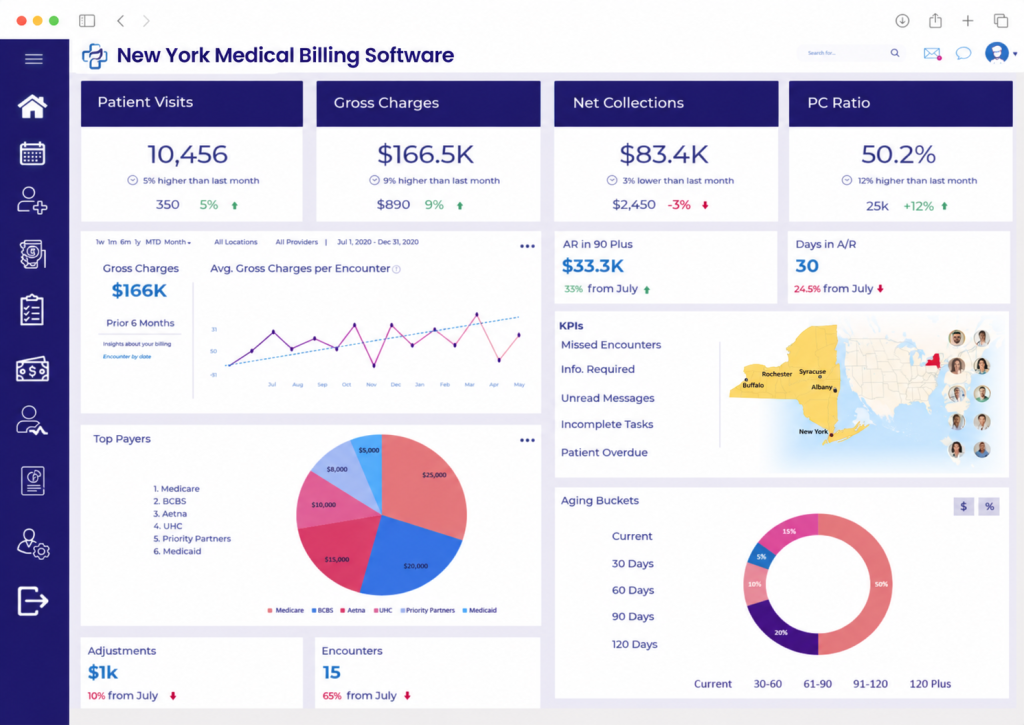
BellMedEx’s Billing Software Built For Mental Health Practices manages claims according to the different insurer rules that apply in New York. Medicaid claims can be checked under the terms of eMedNY and Managed Care, and you can also view the status of claims for psychiatric treatment and TMS services payable under Medicare.

Similarly, claims from private insurers can be handled according to each insurer’s specific procedures, including plans such as Oxford, Optum, EmblemHealth, Healthfirst, Fidelis, Aetna, and Cigna.

The system not only collects claims but also records prior approvals, patient insurability, current claim status, rejected claims, and payments received. This way, clinicians can see how a case for any provided service moves from the treatment phase to final payment.

FAQs

Answers to what most psychotherapy practices ask us most.

How much does BellMedEx charge for mental health billing?

We keep a percentage of what is actually collected. There is no setup fee, no monthly minimum, and no annual contract. The rate depends on volume and service type. An Article 31 APG clinic is priced differently from a two-provider private practice. After we review your New York billing profile, you receive a clear written proposal.

Yes. For Article 31 and MHOTRS billing in New York, we make sure the correct payer group or provider region base rate code is used, along with the right procedure and rate combination. We also run APG payment audits comparing expected New York reimbursement against what the plan actually paid. Standard professional billing for psychiatrists, psychotherapists, counselors, and group clinics is supported as well.

Yes. SPA NY-22-0045 was approved on September 23, 2022 with an effective date of July 1, 2022, expanding the scope of LMHC and LMFT services under New York Medicaid. NY-22-0081 expanded coverage for independent clinics and diagnostic and treatment centers. Programs under Articles 16, 29-I, 31, and 32 require OPRA registration in certain cases, and provider enrollment has to be completed and approved through eMedNY.

Some psychiatric, counseling, and therapy services are administered by Optum, so providers work through Provider Express rather than standard UHC workflows for authorizations and denials. Those claims also have to be submitted under the correct payer ID. If authorization dates, referral information, or provider records do not line up, the claim can be delayed or denied even when the patient’s coverage is perfectly valid.

It depends on the claim type and circumstances. For New York Medicaid, the standard filing limit is generally 90 days from the date of service, though this can differ when a documented delay reason or program exception applies. Managed care plans can set their own filing deadlines, so we confirm the deadline that applies to each payer rather than applying one rule to every psychotherapy or mental health claim.

Most New York mental health practices move their billing to us in about two weeks. In that window we set up portal access, configure the clearinghouse, review workflows, take on outstanding claims, and begin new submissions, so existing A/R and new claims keep moving without a gap.

Yes. New York credentialing and enrollment covers CAQH, NPI, and Medicaid enrollment through eMedNY, plus panel applications with plans such as Healthfirst, MetroPlus, EmblemHealth, Fidelis, Oxford, Aetna, Cigna, MVP, and Excellus. Applications are built around the requirements and timelines that apply to psychiatrists, therapists, counselors, and other behavioral health professionals.

Service Type

Medical Billing Services

Provider
BellMedEx
SubsidiaryNew York Counties Mental Health Billing
Specialties ServedPsychiatry practices, psychology and counseling groups, community behavioral health centers, CCBHCs, substance use and addiction treatment programs, Article 31 outpatient mental health clinics, applied behavior analysis (ABA) providers, partial hospitalization and intensive outpatient programs, and telebehavioral health providers
Service Price
as low as 2.49% of your monthly collections
LocationNew York Counties Mental Health Billing office, New York, NY 10118
Contact Number888-987-6250
Business Hours
Mon–Fri: 8 AM – 6 PM (CST)

Built for mental health practices, BellMedEx's New York Counties Mental Health Billing Group covers every step of your revenue cycle. We submit clean claims, appeal denials, reconcile payments, and track every dollar across NYC boroughs and surrounding counties.

Subscribe to Our NewsLetter

GDPR